


Tocumen International Airport in Panama City is the main hub of Copa Airlines and one of Latin America’s busiest transit airports. With two different terminals, a growing domestic section, and connections that can involve both terminals on a single trip, many travelers worry about turning up at the wrong place. This guide explains, in practical terms, how Terminal 1 and Terminal 2 work, which one you are likely to use, and how to move between them without missing a flight.
Get the latest updates straight to your inbox!
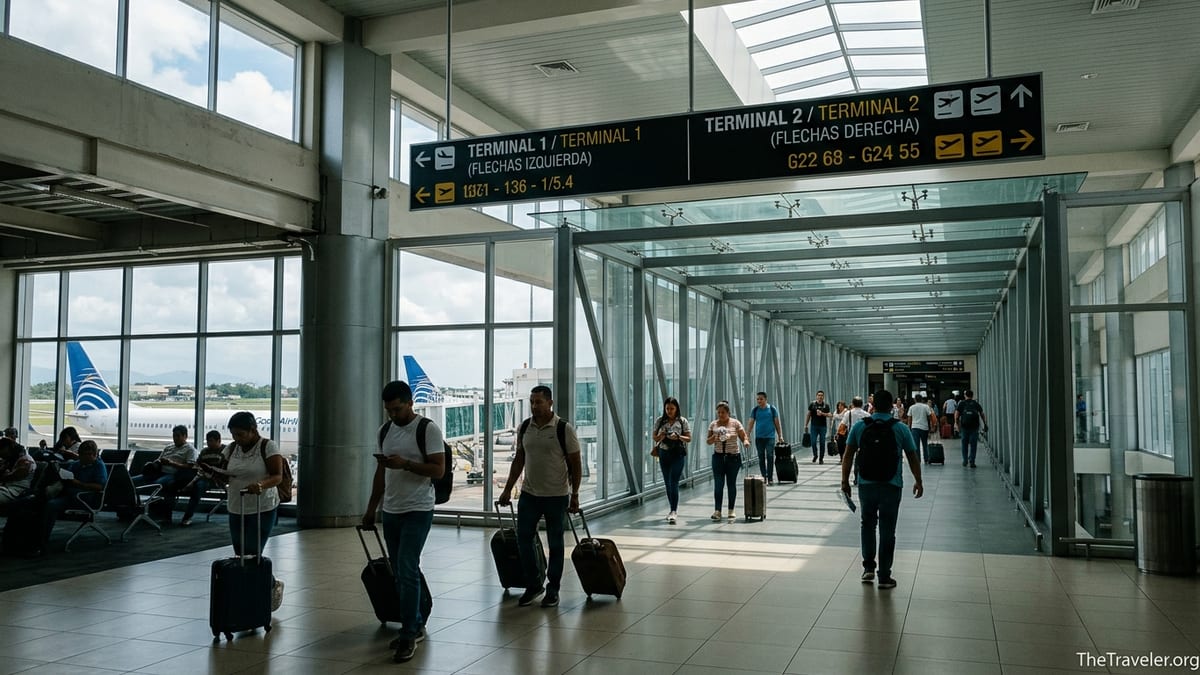
Terminal 1 vs Terminal 2 in a Nutshell
Tocumen International Airport (PTY) has two passenger terminals that work together as a single “Hub of the Americas,” but they feel quite different when you are on the ground. Terminal 1 is the older building, used by many non-Copa international airlines and some Copa gates. Terminal 2 is the newer, glass-fronted building that Copa Airlines uses as its main home base, with most Copa check in, boarding gates, lounges, and baggage services handled there.
In practice, this means a typical American Airlines or KLM passenger flying into Panama for a vacation will arrive and depart from Terminal 1, while a traveler doing a same-day connection from Los Angeles to Bogotá on Copa is much more likely to experience Terminal 2 for both flights. However, because Copa also uses some gates that are physically part of Terminal 1, you can easily land at a gate marked as Terminal 1 and still complete most of your connection via the corridors and facilities linked to Terminal 2.
From a traveler’s point of view, the key difference is not so much which airlines “belong” to each building, but where your flight actually checks in and where you must go to collect or recheck bags. Copa’s operations, including its Copa Club and many self-service kiosks, are concentrated in Terminal 2. Many foreign carriers such as American Airlines, Iberia, Air France, KLM, Avianca, and others generally use Terminal 1. Always confirm the terminal on your booking or in your airline’s app the day before travel, as gate and terminal assignments can change.
Because the two terminals are physically connected airside and also linked by a landside shuttle, many international-to-international transfers happen entirely within secure corridors without needing immigration. On the other hand, if Panama is your final destination or you are switching airlines on separate tickets, you may have to clear immigration, collect bags, and potentially move between terminals the long way around.
How Copa Airlines Uses Terminal 1 and Terminal 2
Copa Airlines is the dominant carrier at Tocumen and the main reason Terminal 2 was built. Copa began moving its international operations into Terminal 2 in mid-2022 and now uses Terminal 2 as its primary check in and departure area. Inside Terminal 2 you will find large rows of Copa check in counters, dozens of self-service kiosks, and the newer Copa Club lounge near outbound immigration. Travelers flying business class or holding Star Alliance Gold status will normally be processed here.
That said, Copa is spread over both terminals when it comes to gates. Some Copa flights still depart from gates physically located in Terminal 1, especially at busy times when the banked hub schedule creates multiple waves of arrivals and departures. For example, a morning flight from New York or Toronto might arrive at a gate in the Terminal 1 concourse, while an onward connection to Guayaquil could depart from a gate in the Terminal 2 wing. The transfer happens airside, through a long corridor that links the two buildings.
For point to point travelers whose journey ends in Panama, the main thing to remember is this: Copa’s international baggage claim and arrivals processing are centered in Terminal 2. It is very common to land at a gate signed as Terminal 1 and then follow the “Connections / Arrivals” signage that leads you through secure passages to immigration and the baggage belts in Terminal 2. Some travelers have been surprised by this, thinking they are in the “wrong” terminal, when in fact this is exactly how the airport is designed to route Copa passengers.
Copa also operates a separate domestic terminal space connected to Terminal 2 for routes such as Panama City to David. Since 2024, passengers arriving internationally with a same-day Copa connection to a domestic flight usually collect their bags at Terminal 2, then follow signage down to the domestic area on the lower level. If you are flying, for example, Orlando to Panama City to David all on Copa, you can expect to use Terminal 2 for check in, immigration, baggage, and the domestic departure lounge, with no need to visit Terminal 1 at all.
Airlines by Terminal and Typical Itineraries
For most travelers, the easiest way to figure out which terminal they need is to look at the airline they are flying. Copa Airlines is primarily based in Terminal 2, although you may occasionally board or disembark at a Terminal 1 gate as part of a connected concourse. Many other international carriers, by contrast, currently operate from Terminal 1. These include large North American, European, and Latin American airlines that use Tocumen as a destination but not as their main hub.
For example, if you are flying Miami to Panama City on American Airlines, your flight is scheduled to arrive and depart from Terminal 1. A traveler flying Madrid to Panama City on Iberia or Amsterdam to Panama City on KLM will likewise use Terminal 1 as both arrival and departure point. If those passengers connect onward within Panama or to another Latin American city, the connection may involve changing to a Copa flight in Terminal 2, in which case they will have to consider transit time between the two terminals.
On the other hand, someone traveling Houston to Lima via Panama on a single Copa ticket will usually experience Terminal 2 only. They will check in at Copa counters in Terminal 2, fly into a gate that is part of the integrated Copa concourse system, and simply follow “Connections” signs without going landside or visiting Terminal 1’s public arrivals hall. In many cases, this type of connection is scheduled with just 50 to 70 minutes between flights, which is normally adequate if both segments are on Copa and you stay airside.
Complications tend to arise when passengers are traveling on separate tickets or are switching from an airline based in Terminal 1 to a Copa or domestic flight in Terminal 2. For instance, a traveler flying Orlando to Panama City on Spirit or another carrier and then separately booked on a Copa flight to Quito will have to arrive in Terminal 1, clear immigration, collect bags, exit into the public arrivals hall, and then transfer landside to Terminal 2 for recheck. In that real-world scenario, a two to three hour connection is advisable.
Arrivals, Departures, and Where You Actually Need to Go
Arrivals at Tocumen are not always straightforward to interpret based on your gate number alone. For Copa passengers, it is common to arrive at a gate signed as part of Terminal 1 but then be routed through the central immigration hall and baggage claim in Terminal 2. This can feel disorienting if you are expecting a classic “arrive in Terminal 1, leave by Terminal 1” pattern, so it is important to simply follow the overhead signs for Immigration, Baggage Claim, and Connections rather than fixating on terminal labels.
If Panama is your final destination, once you clear immigration you will collect your luggage on the carousels indicated on the screens. For most Copa passengers this is in Terminal 2. After customs, you will emerge into the public arrivals area on the lower levels of Terminal 2, where you find official taxis, rideshare pick up zones, and the short walk or shuttle to the metro station. Travelers arriving on non-Copa airlines in Terminal 1 will emerge into that building’s arrivals level instead, where separate taxi ranks and transport services are located.
For departures, you should always go to the terminal specified in your airline’s confirmation email or mobile app. Copa check in is almost always handled in Terminal 2, even if your operating gate is technically associated with Terminal 1. If your ticket says check in at Terminal 2 but the boarding pass later shows a gate in the 1XX range, do not worry; you will reach that gate using the connected airside corridors after security. Non-Copa passengers should plan to go directly to Terminal 1 unless their airline specifically instructs otherwise.
Business class travelers and frequent flyers may also want to consider where lounges are located. Copa operates a Copa Club in Terminal 2 near outbound immigration, and there are other independent lounges in both terminals. If you have lounge access and a choice of terminals because of a flexible check in option, Terminal 2 generally offers the newer and more comfortable facilities, including expanded seating and charging points that are designed for the high volume of connecting passengers.
Walking and Shuttle Connections Between Terminal 1 and Terminal 2
The distance between Terminal 1 and Terminal 2 at Tocumen is walkable, but it is longer than many travelers expect. Depending on your exact starting gate and the crowd levels, walking between the far ends of each terminal can take around 15 to 30 minutes at a normal pace. This is manageable for fit travelers with light bags and ample layover time, but can be stressful if you are on a tight connection or have mobility issues.
To reduce this risk, Tocumen operates an internal shuttle bus known as the Interterminal Shuttle. The airport has explained that this service is specifically intended to move passengers more quickly between the two terminals, both on the secure side and, when needed, in the public landside areas. One well publicized description notes that the walk can easily reach 15 to 30 minutes to the most distant gates in either terminal, which is why the shuttle was launched as a time-saving option.
Official airport information describes shuttle stops at Terminal 1 between gates in the low 100s range and at Terminal 2 around the 200-series gates, especially near gate 209. In practice this means that if you land at a remote Copa gate at the end of the Terminal 1 concourse with a short connection at the opposite end of Terminal 2, it is usually wiser to follow signs for the shuttle rather than attempting to walk the full distance. Local travelers on online forums frequently recommend budgeting at least 20 additional minutes if you plan to walk the whole way with carry ons.
Outside the secure area, there is also a landside shuttle option that links the public departures and arrivals levels of both terminals. This can be useful if you arrive on a non-Copa airline in Terminal 1, exit customs, and then need to reach Copa check in counters in Terminal 2 for a separate ticket. Travelers with heavy luggage or children often choose the landside shuttle over walking along the curbside roadway, especially in the midday heat.
Wrong Terminal Risks and How to Avoid Them
Ending up at the wrong terminal at Tocumen is more than just an inconvenience. Because many Copa connections are scheduled with relatively short layovers, wasting 20 or 30 minutes walking back and forth between terminals can be the difference between a smooth transit and a missed flight. The risk is highest for travelers combining different airlines on separate bookings or for those unfamiliar with how Tocumen routes Copa arrivals through Terminal 2.
Consider a real example: A traveler from Chicago books an American Airlines ticket to Panama City and, separately, a Copa ticket from Panama to Cartagena. American uses Terminal 1, while Copa check in is in Terminal 2. The passenger lands in Terminal 1, clears immigration, collects bags, and exits into the public hall. If they mistakenly look for Copa counters inside Terminal 1 instead of walking or shuttling to Terminal 2, they might lose 20 to 30 minutes before realizing their error. On a two hour self-transfer, that lost time could lead to a stressful rush or even a missed bag drop cut off.
Another frequent misunderstanding occurs when Copa passengers see their arriving gate labeled as Terminal 1 and assume they must leave via Terminal 1 arrivals to get their luggage. In reality, many of those flights funnel passengers through internal corridors to immigration and baggage claim in Terminal 2. A traveler who ignores the official “Arrivals / Baggage” signage and instead follows side passages toward Terminal 1 exits could end up in the wrong public hall with no checked bags in sight, then have to backtrack through long corridors.
To avoid these scenarios, always verify three specific pieces of information on the day of travel: your check in terminal, your departure gate, and your baggage claim location. Use your airline’s app rather than relying on old confirmation emails, because terminal assignments can change if parts of the airport are undergoing works or if traffic levels shift. If you are ever unsure, ask an airport or airline staff member which terminal you should use for check in and baggage, stating clearly which airline and flight number you are traveling on.
For self-connect itineraries, build in a margin of safety. If you are switching from a carrier based in Terminal 1 to a Copa or domestic flight in Terminal 2 on separate tickets, plan for at least two and preferably three hours between scheduled arrival and departure. This allows time for immigration lines, baggage delivery, customs, walking or shuttling between terminals, and a fresh security check at the new terminal. Travelers who allow this kind of buffer typically find that Tocumen is a manageable airport, even with the two-terminal layout.
Domestic Flights, Immigration, and Special Situations
Tocumen’s domestic operations are relatively small compared with its international hub, but they add another layer of complexity to the terminal layout. Since mid-2024, Copa has been using a domestic terminal space connected to Terminal 2 for flights to cities within Panama, such as David. For passengers arriving internationally and continuing domestically, this usually means entering Panama through immigration in Terminal 2, collecting bags, passing customs, and then heading to the domestic area on a lower level within the same building.
A typical example is a traveler going from New York to David via Panama on Copa. They arrive at Tocumen, follow “Connections / Arrivals” signs to immigration in Terminal 2, collect checked luggage there, and then proceed according to the instructions for domestic transfers, which often involve dropping bags at a dedicated domestic counter and going through a separate security checkpoint. At the end of their trip, when flying back from David to Panama and then onward to the United States, they will arrive on a domestic flight into the dedicated domestic baggage area and then go up one level to check in or connect to their international flight.
Where things can get confusing is when domestic flights are on separate tickets or with a different carrier than your international segment. If, for example, you arrive in Panama on a non-Copa international flight into Terminal 1 and then have a separate domestic ticket departing from the domestic area attached to Terminal 2, you will have to complete all formalities in Terminal 1, collect baggage, and then transfer landside to Terminal 2. Immigration rules mean you cannot remain airside to move between terminals in that case, because you must legally enter Panama before taking a domestic flight.
Special situations such as tight minimum connection times, traveling with pets, or needing wheelchair assistance are all safer when booked on a single ticket with one airline, preferably Copa, which is most integrated into Tocumen’s operations. If you book separate tickets that involve both terminals, inform your airline of any special assistance needs well before travel and allow extra time for interterminal transfers, as wheelchair dispatch and pet handling facilities may be located in specific zones of Terminal 2.
The Takeaway
Choosing between Terminal 1 and Terminal 2 at Tocumen International Airport is less about personal preference and more about understanding how your airline and ticket use the airport. Terminal 2 is Copa’s modern home base, where most of its check in, lounges, and baggage services are located. Terminal 1 is the main base for many non-Copa international airlines and still hosts some Copa gates, especially at busy times.
For most travelers flying on a single Copa ticket, the airport is designed so that you do not have to think much about terminals at all: you simply follow the signs for connections and arrivals, often within the integrated concourse system that links both buildings. The risk of confusion rises when you mix airlines, book separate tickets, or assume that a Terminal 1 gate always means Terminal 1 baggage claim.
If you remember a few key practices, Tocumen becomes easier to navigate. Always double-check your check in terminal in your airline’s app on the day of travel. Follow official signage for immigration, baggage, and connections rather than relying on your assumptions about where your flight “should” arrive. If you need to move between Terminal 1 and Terminal 2 with luggage, use the interterminal shuttle or allow plenty of walking time.
With realistic buffers between flights, a clear idea of which airline you are flying, and an awareness that Copa’s hub is centered on Terminal 2 even when some gates are labeled as Terminal 1, you can use Tocumen confidently as your gateway between North and South America or as the starting point for exploring Panama itself.
FAQ
Q1. How do I know whether I need Terminal 1 or Terminal 2 at Tocumen?
Check the terminal shown in your airline confirmation or app on the day of travel. Copa Airlines primarily uses Terminal 2, while many other international airlines use Terminal 1.
Q2. I am flying Copa Airlines and my gate shows Terminal 1. Did I book the wrong terminal?
Not necessarily. Copa uses gates in both terminals. You will usually check in and collect bags in Terminal 2 and then walk or shuttle airside to a Terminal 1 gate if needed.
Q3. Can I walk between Terminal 1 and Terminal 2, and how long does it take?
Yes, the terminals are connected, but the walk can take roughly 15 to 30 minutes depending on your starting gate and pace. Allow extra time if you choose to walk.
Q4. Is there a shuttle between Terminal 1 and Terminal 2 at Tocumen?
Yes. Tocumen operates an interterminal shuttle that moves passengers between the terminals, both airside in the gate areas and landside in the public zones, which is helpful on tight connections.
Q5. What happens if I arrive at the wrong terminal for check in?
You will need to walk or take the shuttle to the correct terminal, which can easily cost 20 to 30 minutes. This can be serious if you have a short check in window, so always verify your terminal beforehand.
Q6. Where will I collect my bags if I fly Copa into Panama?
Most Copa international arrivals are processed through immigration and baggage claim in Terminal 2, even if the arriving gate is physically part of Terminal 1. Follow the signs to Immigration and Baggage.
Q7. I have separate tickets: one airline into Panama and Copa onward. How much time should I allow?
If you must clear immigration, collect bags, change terminals, and recheck, plan for at least two to three hours between flights to protect against lines and transfer time.
Q8. Are domestic flights at Tocumen in Terminal 1 or Terminal 2?
Current domestic services, such as Copa flights to David, use a dedicated domestic area connected to Terminal 2. International passengers usually enter Panama in Terminal 2 before moving to the domestic section.
Q9. Do I need to go landside to change terminals if I have a through ticket on Copa?
Generally no. With a single Copa ticket and international to international connections, you stay airside and use the connected concourse or shuttle. You only go landside if you need immigration or separate check in.
Q10. Which terminal is better for lounges and amenities?
Terminal 2 is newer and is home to Copa’s main Copa Club and many self-service facilities. Terminal 1 also has lounges and services, but most hub-focused amenities are concentrated in Terminal 2.