


More news on this day
Ronald Reagan Washington National Airport is bracing for significant disruption as rehearsals and planned flyovers tied to a Trump-backed airshow over the National Mall trigger rolling ground stops, mounting delays, and confusion for summer travelers.
Get the latest news straight to your inbox!
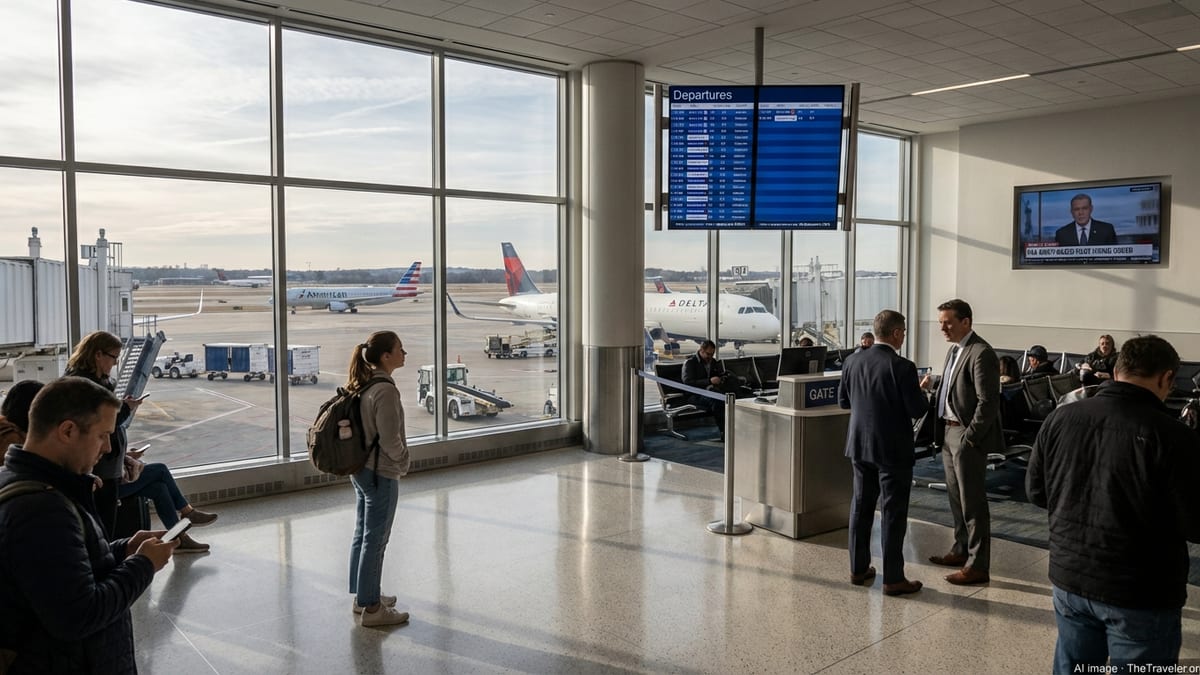
Airshow Plans Collide With Peak Summer Travel
The Federal Aviation Administration has issued alerts warning that military air traffic associated with an airshow over central Washington could cause delays of more than an hour at Reagan National, one of the country’s most tightly constrained airports. The notices describe periods in which airspace near the National Mall will be reserved for aerial demonstrations, forcing commercial departures and arrivals to be slowed or temporarily halted.
Publicly available information shows that the disruption is tied to a Trump-aligned patriotic spectacle organized around the America250 commemorations, featuring military aircraft flyovers and other aerial performances above downtown Washington. The events are scheduled to unfold over several days leading into the July 4 holiday, intersecting directly with one of the busiest stretches of the summer travel season.
Airport advisories indicate that traffic-management initiatives, including ground holds and airborne rerouting, are already being used to sequence flights around practice windows for the airshow. Early projections point to average delays in the range of several dozen minutes, with the potential for much longer holdups during peak demonstration periods.
For passengers, the operational balancing act between spectacle and schedule is translating into uncertainty. Travelers arriving at Reagan National are reporting last-minute gate changes, rolling departure times, and difficulty rebooking when tight connections are missed because of temporary pauses in operations.
Freedom250 Flyover Draws Scrutiny
According to published coverage, the airshow is being staged in connection with the so-called Freedom250 and Great American State Fair initiative, a Trump-backed celebration marking 250 years since American independence. The aerial component is designed as a centerpiece, with military jets and heritage aircraft flying low over the National Mall in closely choreographed displays.
The involvement of active-duty military assets in a politically charged environment has stirred debate. Commentators note that the event blends civic commemoration with partisan-style pageantry, while still relying on federal aviation infrastructure and security resources that directly affect commercial travelers. Critics argue that the calculus around noise, safety, and delays has not fully accounted for the strain on an already stretched airport.
Supporters, by contrast, frame the flyovers as a powerful patriotic symbol meant to showcase American airpower and history above the nation’s capital. They emphasize that similar aerial demonstrations have long been part of national celebrations and argue that temporary inconvenience for travelers is a reasonable trade-off for a high-profile public event.
Regardless of perspective, the practical impact at Reagan National is unmistakable. As rehearsal schedules expand and additional demonstration windows are locked in, airlines are being forced to adjust departure banks, reposition crews, and make contingency plans for aircraft that could be left out of place when the airspace temporarily closes.
Reagan National’s Tight Airspace Magnifies Impact
Reagan National is uniquely vulnerable to disruption from special-use airspace. The airport sits within the complex security footprint of central Washington, with tightly prescribed approach and departure paths that thread between restricted zones and noise-sensitive communities along the Potomac River. Even small adjustments to that choreography can ripple across the entire operation.
Observers note that when special events overlay this already constrained environment, the margin for maintaining normal traffic flow narrows quickly. Any additional restrictions, such as those needed to protect low-flying demonstration teams, leave controllers with fewer options to absorb weather delays, runway construction, or routine operational hiccups.
The result is a cascading effect that can reach far beyond Washington. Because Reagan National is deeply integrated into the domestic hub networks of major carriers, delays there can strand aircraft and crews that are needed for later flights in other cities. A midmorning ground stop for an airshow rehearsal can, by afternoon, translate into missed connections and cancellations hundreds of miles away.
Aviation analysts point to previous episodes in which security-related or special-event restrictions around Washington created widespread schedule problems, arguing that the latest Trump-linked air demonstrations highlight the need for more transparent planning and better communication with passengers about expected impacts.
Passengers Face Confusion and Limited Options
Travelers attempting to navigate the airport during the airshow window are encountering a patchwork of information. Airline apps and departure boards are updating frequently as traffic managers respond to changing airspace conditions, but many passengers report difficulty distinguishing routine congestion from delays rooted in the aerial events over downtown.
Some carriers have issued travel waivers for Washington-area airports around the busiest days of the celebrations, allowing customers to move flights without standard change fees. However, with load factors already high for the holiday period, rebooking options remain limited, and alternative flights can quickly sell out, leaving many would-be passengers stuck in long lines or stranded overnight.
Industry observers say the situation underscores ongoing fragility in the U.S. aviation system, where staffing constraints, tight schedules, and high demand leave little slack to absorb unplanned disruptions. When special events like large-scale airshows are overlaid on that environment, the system can tip rapidly from orderly to chaotic.
Social media posts from the terminals show crowded concourses, extended waits at customer-service desks, and passengers camping out near power outlets as they monitor for reassignments. Reports also describe frustrated travelers missing family events and business meetings after airshow-related flow restrictions pushed their flights outside comfortable connection windows.
Debate Over Balancing Spectacle and Reliability
The turbulence at Reagan National is feeding a broader conversation about how U.S. aviation regulators and political leaders should weigh public spectacle against the imperative of reliable air travel. As the America250 calendar continues, observers expect more high-visibility events in and around major airports, raising questions about how frequently regular operations can be disrupted for ceremonial flyovers and related displays.
Advocates for stricter limits contend that, in a system already grappling with periodic gridlock, planners must treat large-scale air demonstrations with the same caution that governs runway construction or major security drills. That would mean publishing detailed impact forecasts well in advance, offering broader fee waivers for affected routes, and exploring options to stage parts of such events away from the most capacity-constrained airports.
Others argue that national celebrations often carry unavoidable logistical trade-offs, and that the aviation system should be robust enough to accommodate occasional, planned interruptions. They maintain that with clearer messaging and better coordination between event organizers, federal agencies, and airlines, disruptions can be kept to manageable levels without curtailing high-profile displays.
For now, travelers transiting Reagan National are bearing the immediate costs. As the Trump-backed airshow and associated festivities continue, the airport’s experience is emerging as a stress test of how much strain the nation’s aviation network can absorb when politics, patriotism, and peak travel collide in the same slice of airspace.