


More news on this day
Turkey is pressing ahead with an ambitious rail investment drive, with recent budget decisions and international financing packages indicating that Ankara intends to keep funds flowing into high-speed lines, tourism-focused services and new cross-border routes that are reshaping how residents and visitors move around the country.
Get the latest news straight to your inbox!
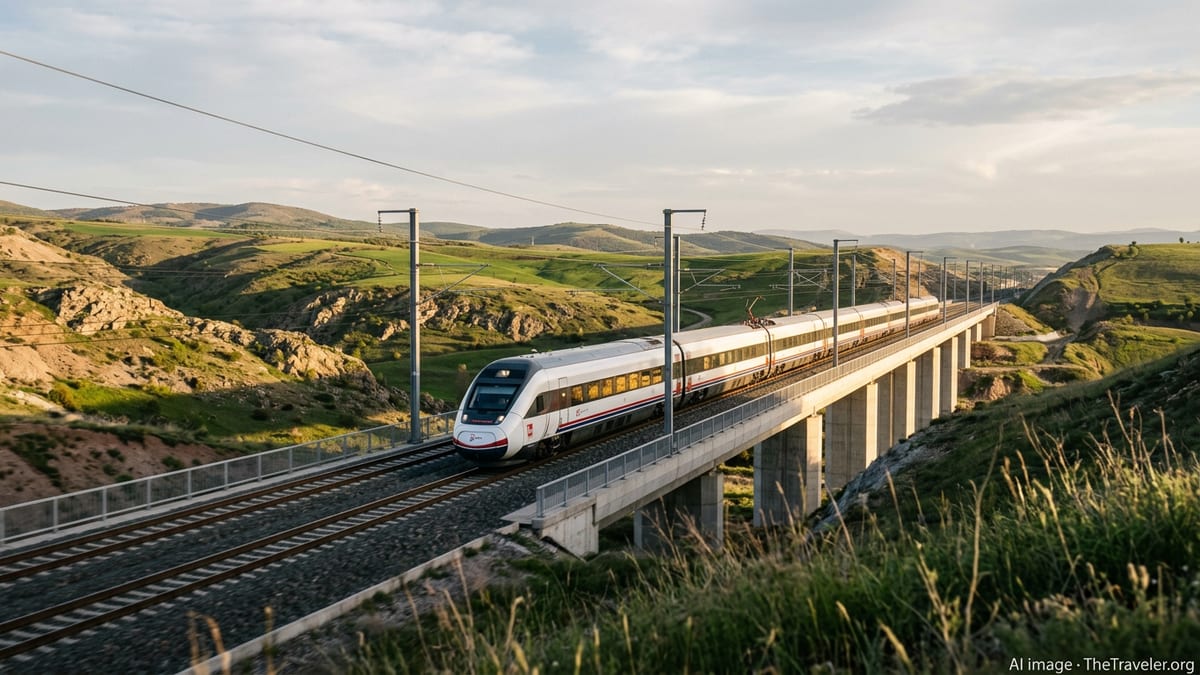
Ankara’s budget signals long-term rail commitment
Publicly available budget data for 2025 and 2026 show that rail continues to rank among Turkey’s top infrastructure priorities, with Ankara directing a significant share of transport spending to both new and upgraded lines. Analysis of the 2025 national budget highlighted plans to extend the rail network by thousands of kilometres over the next three decades, underscoring a strategic shift toward steel-on-rail rather than asphalt on highways.
For 2026, domestic coverage of the Public Investment Program indicates that transport and communications again receive the largest single share of capital spending, with high-standard rail projects allocated tens of billions of lira. Funding is being channelled into new main lines, key junctions and connection routes that link industrial areas to export gateways, as policymakers seek to turn Turkey’s geography into a logistics advantage rather than a bottleneck.
In parallel, Ankara’s provincial development strategy through 2028 frames the capital as the central node of the national high-speed network. With multiple high-speed corridors radiating from the city, the plan positions Ankara as the country’s primary rail hub, supporting both internal connectivity and longer-distance international routes that feed into European and Asian corridors.
International lenders back Istanbul crossing and key corridors
Turkey’s rail ambitions are not being funded by the state alone. In March 2026 the World Bank approved a multibillion-dollar financing package for the Istanbul North Rail Crossing Project, a new high-capacity, electrified line that will carry trains across the Bosphorus via the Yavuz Sultan Selim Bridge. The loan is part of a wider financing framework involving the Asian Development Bank, Asian Infrastructure Investment Bank, European Bank for Reconstruction and Development, Islamic Development Bank and the OPEC Fund.
Government investment promotion materials describe the scheme, known as INRAIL, as one of the largest rail projects ever supported by the World Bank in Turkey. The project aims to relieve a critical bottleneck where multiple strategic freight and passenger corridors converge on Istanbul, including the Middle Corridor linking China and Central Asia to Europe, emerging routes from the Gulf and Iraq, and the long-standing Turkey–EU rail axis.
Procurement notices published in July 2026 by Turkey’s General Directorate of Infrastructure Investments show that Ankara has moved quickly to translate the financing into tenders for design, construction and electrification works on the crossing. By locking in long-term multilateral support, policymakers are seeking to insulate the project from domestic fiscal swings while guaranteeing the funding pipeline needed to complete a complex piece of cross-Strait rail infrastructure.
Tourism routes and high-speed services bolster travel appeal
While freight logistics dominate the headlines around the Istanbul crossing, Turkey’s ongoing rail investment push is also reshaping the country’s tourism offer. The Touristic Eastern Express, a scenic overnight service running between Ankara and Kars, completed its 2025–2026 winter season with more than ten thousand passengers, according to figures released by the Transport and Infrastructure Ministry earlier this year. The train, which features extended station stops for excursions along one of the country’s most dramatic rail corridors, has become a flagship product for rail-based tourism.
The route shares parts of the historic Ankara–Kars alignment while also intersecting with new high-speed infrastructure between Ankara and Sivas. Rail enthusiasts note that the high-speed Ankara–Sivas line, opened to passengers in 2023, has cut journey times across central Anatolia and given many domestic travellers their first taste of modern high-speed rail within Turkey’s borders.
For everyday travellers, the growing Yüksek Hızlı Tren network is turning rail into a realistic alternative to domestic flights and intercity buses. The high-speed link between Ankara and Istanbul, together with extensions toward Sivas and construction works on the Ankara–Izmir corridor, offers faster journeys and a comparatively low-carbon way to traverse the country. Traveller reports circulating in spring 2026 describe competitive fares and on-board amenities that are helping to shift perceptions of Turkish rail beyond its historic image.
Cross-border links reshape Turkey’s regional role
Beyond domestic mobility, Ankara’s investment stance is closely tied to broader regional connectivity goals. Recent reports on talks between Turkey and Armenia over restoring the Kars–Gyumri rail link, along with growing freight movements on the Kars–Tbilisi line toward the South Caucasus, point to an emerging strategy that uses rail to support political normalisation and trade diversification in the wider neighbourhood.
European institutions have also highlighted Turkey’s role in extended versions of the trans-European transport network, particularly on east–west land bridges between the EU and the Caspian region. Technical assistance programmes funded by the European Union and implemented through Turkey’s transport ministry have focused on strengthening intermodal rail services, terminal capacity and customs processes, which are essential for making overland routes competitive with maritime alternatives.
Officials in Ankara have framed these initiatives as part of a broader effort to position Turkey as a “nexus” between Europe, Asia and the Middle East. By keeping rail investment flowing even in a tight fiscal environment, the government is signalling that cross-border lines are as much about diplomacy and economic resilience as they are about engineering and timetables.
Implications for travellers planning rail journeys in Turkey
For international visitors considering rail-based itineraries, these funding decisions are starting to translate into practical options. High-speed services now connect Ankara with Istanbul, Konya and Sivas, creating a spine of fast routes that can be combined with slower, scenic lines such as the Ankara–Kars corridor and regional branches into Central and Eastern Anatolia.
As work advances on the Istanbul North Rail Crossing, the long-term expectation is for more frequent, reliable and potentially faster services into and across Turkey’s largest city, reducing dependence on crowded road bridges and domestic flights. Even before the new crossing opens, incremental upgrades and timetable adjustments are improving connectivity between Istanbul’s airports and the national rail grid.
Meanwhile, the continued operation and promotion of trains like the Touristic Eastern Express, coupled with Ankara’s designation as the 2026 Turkic World Tourism Capital, suggest that rail will remain central to the country’s tourism narrative. Travellers planning 2026–2027 trips can expect a rail system in transition, with ongoing construction works but also a steadily expanding set of services that reflect Ankara’s determination to keep investment on track.