


Stand on the shore of a turquoise lake in Banff National Park and it can feel almost unreal. The water looks as if someone poured paint into it, glaciers glint on the horizon, and rugged peaks rise in every direction. Yet what makes Banff special is not just the postcard moments, but how easy it is for ordinary travelers to step into this dramatic landscape, whether for an hour-long lakeside stroll or a week in the backcountry.
Get the latest updates straight to your inbox!
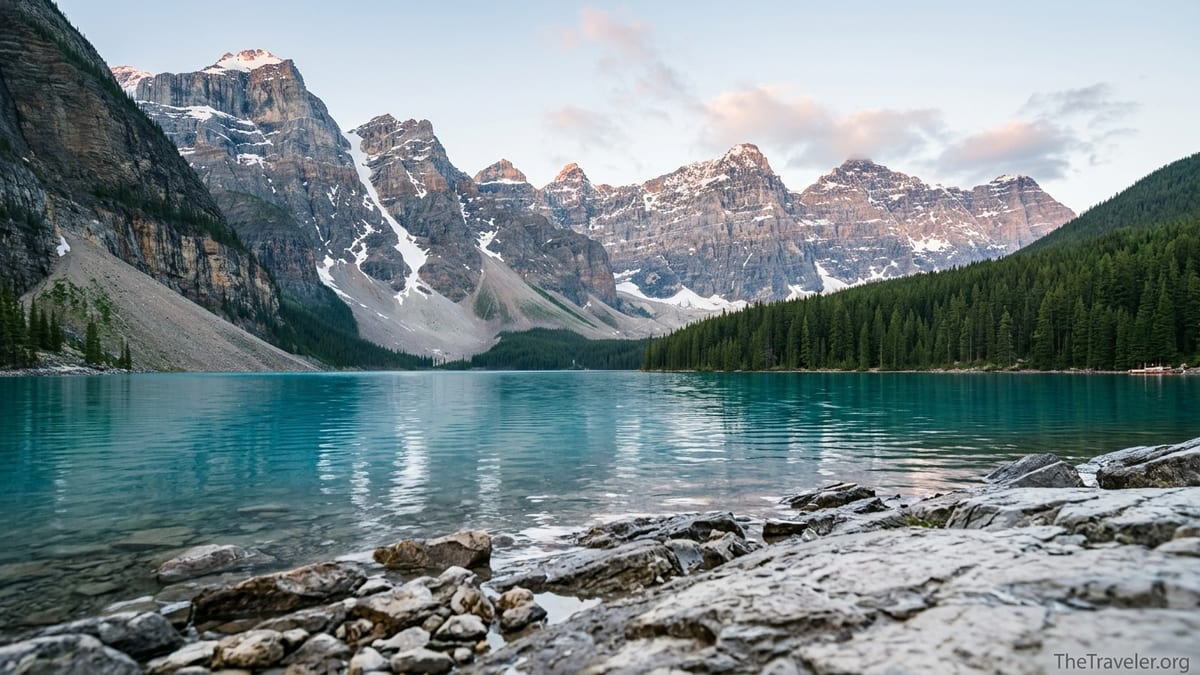
The Alchemy Behind Banff’s Turquoise Lakes
Banff’s lakes are famous for a very specific shade of blue-green that often surprises first-time visitors. The color comes from “rock flour” created when glaciers grind the surrounding bedrock into fine powder. Meltwater carries this silt into lakes like Lake Louise, Moraine Lake and Peyto Lake. When the sun hits the suspended particles, they scatter light in a way that turns the water luminous turquoise, especially from late June through September when the lakes are fully thawed and the meltwater is strongest.
You see this most vividly at Lake Louise, a 40-minute drive from the town of Banff, where the glacier-capped peaks of the Continental Divide frame one of the most photographed shorelines in the Rockies. Early in the season, in May or early June, Lake Louise can still be partly frozen and milky in color. By mid-summer, the lake becomes an almost opaque teal, so bright that many visitors initially assume it has been digitally enhanced in brochures.
For a more intimate example of this color, head to Peyto Lake on the Icefields Parkway. The main viewpoint sits above the lake, so you look down on a wolf-shaped splash of turquoise surrounded by dark spruce forest and peaks. The short walk from the parking area to the viewpoint makes it accessible to families and less-mobile travelers, yet the view feels like something out of a multi-day expedition. In the middle of a sunny day in July or August, coaches of tour groups arrive, but if you visit closer to 8 a.m. or after 6 p.m., the viewpoint often feels surprisingly peaceful.
Even smaller lakes carry the same glacial signature. At Bow Lake, you can park right beside the shoreline and walk a flat trail toward Bow Glacier Falls, watching the water shift from steely gray under morning clouds to vivid turquoise when the sun pierces through. This changeable palette is part of Banff’s appeal: return to the same lake at different times of day or in different weather and it can look like an entirely new place.
Glaciers, Icefields and the Shape of the Rockies
The scale of ice in and around Banff is hard to appreciate until you drive the Icefields Parkway between Lake Louise and Jasper. This route threads between the Waputik and Wapta Icefields and skirts the massive Columbia Icefield just outside Banff’s northern boundary. Here, rivers of ancient ice have carved the U-shaped valleys and steep headwalls that define the park’s skyline. Even travelers who are not especially drawn to geology feel the drama when they round a bend and suddenly see the Athabasca Glacier flowing almost to the roadside.
Guided icefield experiences are a popular way to connect with this frozen world. Many visitors choose a half-day tour onto the Athabasca Glacier, where specialized buses carry them up onto the ice. Stepping out, you can hear meltwater running underfoot and see crevasses banding the surface. Others prefer to view the glaciers from trail-level. The Plain of Six Glaciers trail above Lake Louise, for example, takes most moderately fit hikers four to six hours round trip and delivers views of multiple hanging glaciers, with the low roar of ice and rock shedding from the cliffs across the valley on warm afternoons.
Closer to the town of Banff, the frozen legacy is subtler but just as real. The wide Bow Valley, which now holds the Trans-Canada Highway and the Bow River, was scoured by ice that was hundreds of meters thick during the last glacial maximum. Today, gentle valley-bottom trails like Fenland, Vermilion Lakes and the Marsh Loop trace old river channels and wetlands that formed as that ice retreated. It is the contrast between these quiet, accessible areas and the high glaciated peaks that give Banff much of its depth.
Timing matters if you come for glaciers. In early June, snow still smooths over many high-elevation routes and the icefields can look like one continuous white sheet from ridge to ridge. By late August and September, seasonal snow has melted, crevasses stand out in deeper blue, and late-afternoon light rakes across the ice, emphasizing its broken texture. For most first-time visitors, late June through early September offers the best combination of open roads, turquoise lakes and clear glacier views.
Iconic Peaks and Viewpoints Made Easy
Banff’s skyline is dominated by rugged peaks like Mount Rundle, Cascade Mountain and Mount Temple, but what makes the park special is how easily visitors can enjoy these mountains without technical climbing skills. A classic example is the view from the Banff Gondola on Sulphur Mountain. In less than ten minutes, the gondola whisks you from the Bow River valley to a 360-degree panorama over six distinct mountain ranges. At the top, a boardwalk leads to Sanson Peak, where you can look down on the town of Banff, see the Bow and Spray valleys, and watch the light shifting across the peaks.
Another accessible viewpoint sits above Lake Louise at the Lake Agnes Tea House. The hike takes most visitors 1.5 to 2 hours one way, climbing steadily through dense forest before arriving at a subalpine lake backed by cliffs. Many hikers stop for tea, soup or a slice of cake on the cabin’s deck, then walk a few minutes further for an overlook back down toward Lake Louise and the Chateau hotel. Here you see a layered version of Banff’s appeal: luxury accommodation on the lakeshore, a moderate hike through forest, and alpine peaks and glaciers rising above it all.
For those willing to go a little farther, the Larch Valley and Sentinel Pass trail from Moraine Lake is one of the most celebrated day hikes in the Rockies. In summer, the trail climbs through thick spruce before opening into a basin filled with larch trees and wildflowers. In late September, those larches turn gold, and hikers find themselves walking through bands of yellow needles under the stone towers of the Valley of the Ten Peaks. The climb to Sentinel Pass, which often holds snow into early summer, gives views in two directions, revealing just how serrated the peaks around Moraine Lake really are.
Even travelers who prefer to stay close to the car can enjoy big-mountain views. The Vermilion Lakes drive, just outside the town of Banff, offers pullouts where photographers gather at sunrise to catch Mount Rundle reflected in still water. In the evening, locals often bring takeout from Banff Avenue restaurants, park beside the lake and watch the last light leave the peaks. This blend of world-class scenery and simple access is a large part of why Banff lodges in so many visitors’ memories.
Seasons of Color: When Banff Feels Most Alive
Banff is not a single-season destination. Each period in the year shapes the lakes, glaciers and peaks differently. For most first-time visitors who want turquoise lakes and open hiking trails, late June through early September is the sweet spot. Daytime highs in July typically hover in the low 20s Celsius, cool at night, and high-elevation trails like Sunshine Meadows, Larch Valley and the Plain of Six Glaciers are usually clear of snow. This is when Lake Louise and Moraine Lake display their brightest colors and when sightseeing boats start operating on nearby lakes.
June and September offer distinct moods. In early June, many trails at higher elevations still carry snow, and lakes such as Moraine Lake or Peyto Lake may be only partly thawed. The trade-off is fewer crowds and a strong sense of transition as waterfalls thunder with snowmelt. September brings crisp mornings, often near freezing in the valleys, but the days can be clear and calm. Larch trees across the park, especially in areas like Larch Valley, Sunshine Meadows and the Skoki region, turn shades of yellow and orange that contrast dramatically with the gray peaks and lingering snowfields.
Winter transforms Banff into a different kind of turquoise and white landscape. The lakes freeze solid, and instead of paddling across Lake Louise, visitors skate on cleared ice or take horse-drawn sleigh rides along the shoreline. Ice climbers tackle frozen waterfalls in Johnston Canyon and along the Icefields Parkway. Skiers and snowboarders base themselves in the town of Banff or Lake Louise and spend their days at resorts such as Sunshine Village or Lake Louise Ski Resort, where chairlifts provide quick access to alpine bowls and tree runs.
Shoulder seasons in May and October can be rewarding for travelers who value solitude and do not mind unpredictable conditions. Hotel rates are often lower, and you might share viewpoints like Bow Summit or Two Jack Lake with only a handful of other visitors. You may also encounter closed trails due to lingering snow or wildlife activity, so flexibility matters. Checking the latest Parks Canada trail reports at a visitor center before heading out is a practical habit at any time of year.
Experiencing Banff: From Lakeside Strolls to Backcountry Nights
One of Banff’s strengths is that it welcomes many different styles of travel. A couple staying in a four-star hotel on Banff Avenue can experience just as much of the lakes, glaciers and peaks as a family camping in the forest, provided they use the park’s infrastructure thoughtfully. For example, visitors who prefer gentle activities can spend a day riding the Banff Gondola in the morning, then strolling the flat shoreline path at Two Jack Lake in the afternoon, breaking up the day with a picnic from a local bakery.
Active travelers often organize their days around classic hikes and drives. A typical summer itinerary might start with sunrise at Moraine Lake, accessed by Parks Canada shuttle from the Lake Louise Park and Ride, followed by the Larch Valley trail, and then a late-afternoon stop at Lake Louise for a canoe rental. The next day could be devoted to the Icefields Parkway: short walks to the toe of the Athabasca Glacier, a visit to Sunwapta or Athabasca Falls just outside the park, and a late return to Banff as alpenglow colors peaks like Crowfoot Mountain and Mount Hector.
Camping brings Banff’s landscape even closer. Frontcountry campgrounds such as Tunnel Mountain, Two Jack Lakeside and Lake Louise are popular staging points for exploring nearby lakes and peaks. Reservations are typically essential in summer, and a separate fire permit is required if you plan to use a fire ring at your site. Falling asleep to the sound of the Bow River or waking up to alpenglow on nearby peaks is a daily reminder of why Banff was set aside as Canada’s first national park.
For those with backcountry experience, multi-day trips like the Egypt Lake region, the Sawback Range or the Skoki area offer a chance to sleep beneath star-filled skies far from road noise. These routes cross high passes where you can look down on remote tarns and hanging glaciers, and often share the landscape with mountain goats, marmots and the distant bugle of elk in autumn. Permits and careful planning are non-negotiable, not just for safety but to help keep fragile alpine environments intact for future travelers.
Getting Around: Shuttles, Transit and Crowds
Banff’s popularity means that some of its most beautiful spots are also its busiest. Rather than detracting from the experience, the park has turned this reality into a reason to improve transit. The access road to Moraine Lake, for example, is now closed to private vehicles for most visitors. Instead, people reach the lake using Parks Canada shuttles from the Lake Louise Park and Ride, Roam public transit buses, or commercial tours. Advance reservations for the main shuttles typically open in mid-April for the summer season, and seats on popular morning departures can book out quickly.
The same system increasingly shapes visits to Lake Louise. During peak summer weekends, the lakeshore parking lot can fill early in the morning. Travelers who do not secure overnight accommodation near the lake or arrive very early often find it easier to use shuttles. Savvy visitors watch for late-day opportunities: an early evening shuttle to Lake Louise or Moraine Lake can mean softer light, fewer crowds and easier photography, even if midday departures were sold out.
Within the Bow Valley, Roam Transit buses connect the town of Banff with nearby highlights such as Lake Minnewanka, Tunnel Mountain and the village of Lake Louise. This public network makes it realistic to visit Banff without renting a car, especially in summer, when service is frequent. Some hotels include transit passes with your room, and many visitors combine Roam buses with guided tours for farther-flung destinations like the Columbia Icefield or Yoho National Park.
Managing crowds in Banff is as much about timing as it is about transportation. Simple strategies can make a major difference: visiting Moraine Lake at dawn, planning popular viewpoints for weekday mornings rather than Saturdays, or exploring secondary locations like Bow Lake, Herbert Lake or the Bow Valley Parkway during midday hours. By thinking of transit reservations and timing as part of the adventure rather than a chore, many travelers find that they spend less time in traffic and more time actually standing beside turquoise water or watching light move across glaciers.
Wildlife, Safety and Respect for a Living Landscape
Banff’s turquoise lakes, glaciers and peaks are part of a living ecosystem where wildlife has priority. The park is home to grizzly and black bears, elk, bighorn sheep, mountain goats and many smaller species. It is common in summer to see elk grazing near the town of Banff at dawn or dust clouds where bighorn sheep pick their way across roadside cliffs along the Bow Valley Parkway. While these encounters can be unforgettable, they come with responsibilities.
On the trail, hikers carry bear spray, make noise on blind corners and travel in small groups. In some areas, seasonal group-size restrictions apply, especially on trails where bears are feeding on berries or where threatened species are sensitive to disturbance. In practice, this can mean planning to hike in groups of four or more or choosing an alternative route if you prefer solitude. Rangers and visitor center staff post daily updates, and checking those before setting out is as important as checking the weather.
At lakeshores and viewpoints, respecting closures and staying on established paths protects both people and the delicate environment. The braided streams that feed turquoise lakes often cross fragile wetlands where a single shortcut can damage plant communities that take decades to recover. Many popular photo spots now have railings or designated viewing platforms, such as the main overlook at Peyto Lake. While stepping beyond them might tempt photographers, doing so risks both erosion and your own safety, especially near undercut cliffs.
Weather awareness is another key to enjoying Banff safely. Mountain conditions can change quickly, especially along the Icefields Parkway and at higher passes. A warm, calm morning at Lake Louise can give way to afternoon thunderstorms with lightning, wind and sudden temperature drops near trails like Plain of Six Glaciers or Sentinel Pass. Carrying layers, a waterproof shell, gloves and a warm hat, even on bright summer days, is standard practice for locals and guides. This small amount of extra gear can turn a potentially miserable afternoon into a memorable one.
The Takeaway
What makes Banff National Park so special is not a single lake, glacier or peak, but the way all of them weave together into an experience that feels both immense and surprisingly accessible. In a normal day you can ride a gondola to a panoramic summit, watch light dance on a turquoise lake, hear the distant crack of shifting glacier ice and finally sit beside a quiet river as elk drift through the valley bottom.
It is this combination of color, scale and ease of access that has drawn travelers here for generations, from early railway tourists arriving at grand hotels on the lakeshore to modern visitors booking shuttles to Moraine Lake from their phones. Whether you come for two days or two weeks, stay in a historic hotel or under a canvas tent, Banff has a way of making the Rockies feel close. The key is to plan just enough, travel lightly on the land and leave room in your schedule to simply sit, look and let the turquoise, ice and stone work their quiet spell.
FAQ
Q1. When is the best time to see Banff’s lakes at their brightest turquoise?
The lakes usually look most vividly turquoise from late June through early September, when they are ice-free and fed by peak glacial meltwater.
Q2. Do I need a reservation to visit Moraine Lake and Lake Louise?
In peak season you typically need a shuttle reservation or public transit ticket for Moraine Lake, and parking at Lake Louise often fills very early, so advance planning is strongly recommended.
Q3. Can I visit Banff without renting a car?
Yes. Roam public transit, Parks Canada shuttles and commercial tour operators together make it realistic to stay in Banff or Lake Louise and reach major lakes, viewpoints and trailheads without a private vehicle.
Q4. Are there easy walks where I can see glaciers without a long hike?
Yes. The Icefields Parkway offers road-accessible viewpoints of glaciers, and shorter walks near the Athabasca Glacier and Bow Lake provide impressive glacier views with minimal elevation gain.
Q5. What should I pack for summer hiking in Banff?
Even in July and August, pack layers: a moisture-wicking base layer, warm mid-layer, waterproof shell, hat, gloves, sturdy hiking shoes, sun protection and enough food and water for your chosen trail.
Q6. How crowded does Banff get in summer?
July and August are very busy, especially at Lake Louise, Moraine Lake and along the Icefields Parkway. Visiting early or late in the day, or in June and September, helps avoid the heaviest crowds.
Q7. Is Banff suitable for families with young children?
Yes. Many short, stroller-friendly walks and roadside viewpoints let families enjoy lakes, waterfalls and mountain vistas without long or difficult hikes, and town facilities are well developed.
Q8. Do I need to worry about wildlife when hiking?
You should be prepared and respectful. Carry bear spray, make noise, follow posted closures and keep a safe distance from all animals. Most wildlife encounters are peaceful when these guidelines are followed.
Q9. Can I swim in the turquoise lakes?
You can, but the water is very cold, even in midsummer, because it is fed by glaciers. Many visitors prefer brief dips or simply wading at the shoreline rather than long swims.
Q10. How many days do I need to experience Banff’s highlights?
A minimum of three full days allows time for the town of Banff, Lake Louise, Moraine Lake and a section of the Icefields Parkway, but a week lets you add hikes, side trips and more relaxed exploration.