


More news on this day
Typhoon Saudel is disrupting air travel across East Asia in late August 2026, with aviation data and airport bulletins indicating hundreds of cancellations and thousands of delays from Tokyo to Okinawa and key regional hubs.
Get the latest news straight to your inbox!
Storm Tracks Across the Ryukyu Islands Into Busy Air Corridors
Public tropical cyclone advisories describe Typhoon Saudel as a powerful system tracking west-northwest through the East China Sea after passing near Japan’s Ryukyu island chain in the days leading up to August 26, 2026. Forecast discussions from meteorological agencies show sustained winds in excess of 160 kilometers per hour at peak intensity, placing Saudel among the stronger storms to affect regional air routes this season.
Satellite imagery from international Earth observation programs captured Saudel bearing down on the Ryukyus around August 25, with a well defined eye and broad cloud shield stretching over key aviation corridors between Japan, Taiwan and coastal China. Near this time, publicly available reports already noted mounting disruption at Okinawa’s Naha Airport as carriers trimmed schedules in anticipation of deteriorating conditions.
As the storm curved northwest, advisories indicated that Saudel would move away from Iwo To and toward waters south of Japan’s main islands, aligning its track with some of Asia’s busiest north south and east west flight paths. The combination of high winds, intense rainfall and large waves prompted airlines and airport operators to scale back operations not only in Okinawa but also at airports feeding into the Tokyo metropolitan area and onward to Taiwan, Hong Kong and mainland China.
Hundreds of Flights Canceled as Airlines Reshape Schedules
Domestic flight status pages for major Japanese carriers show that operations at Okinawa’s Naha Airport were heavily curtailed, with notices stating that flights to and from the island were canceled throughout August 26 and partially on surrounding days as Saudel approached and then moved west. Additional disruption extended to smaller airports across the Amami region and outlying islands, where regional services form an important bridge to the main Japanese network via Tokyo.
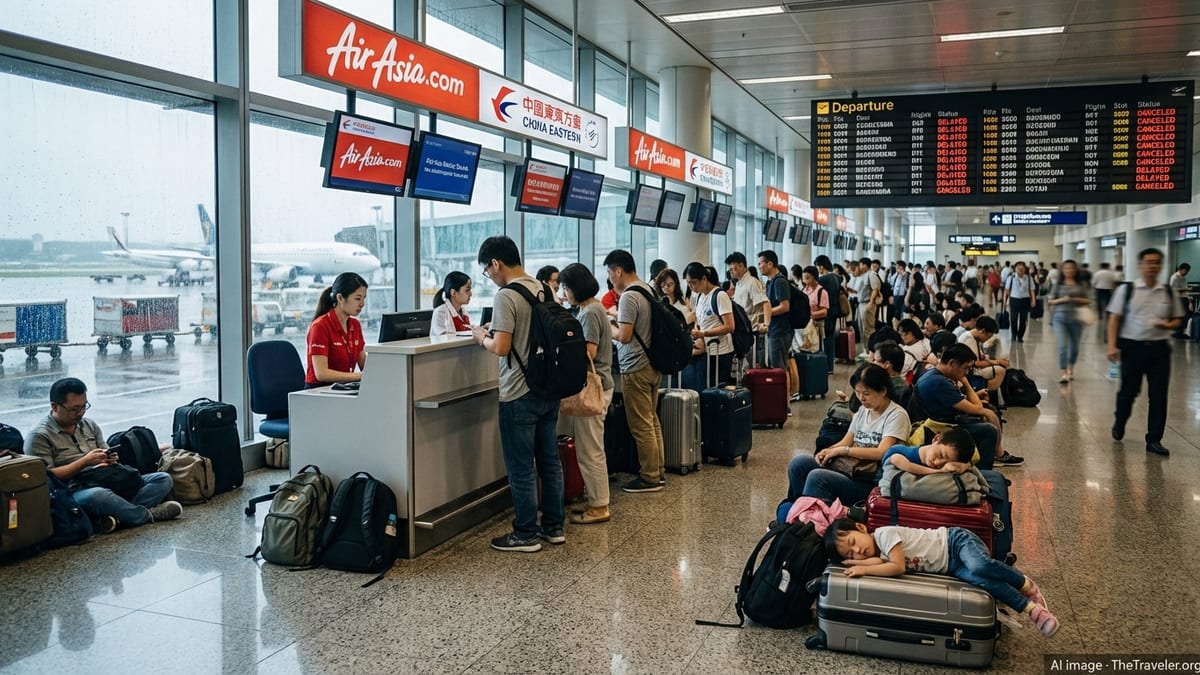
Media coverage from Japan indicates that more than 400 flights had already been canceled by the evening of August 25 as winds strengthened over Okinawa and neighboring islands. By the time airlines adjusted schedules on August 26, cumulative figures across Tokyo linked routes and Asian hubs rose further, with operational data pointing to around 743 outright cancellations and 4,668 delays across the region once secondary effects at connecting airports are included.
In Taiwan, bulletins from Taoyuan International Airport on August 25 listed at least 16 cancellations on Japan bound routes, including multiple services between Taoyuan and Naha as well as flights to Miyakojima in Okinawa Prefecture. These adjustments, combined with extensive reductions at Japanese airports and additional changes in Hong Kong and coastal China, contributed to a cascading pattern of missed connections and late arrivals across the broader Asian network.
Tokyo and Asian Hubs Manage Knock On Effects
Although Tokyo’s major airports were outside the core of the storm, ripples from Saudel’s passage through the Ryukyu region reached Haneda and Narita as airlines retimed or rerouted services. Flight status notices show that at least one Japanese carrier added extra services into Tokyo Haneda on August 25 to help recover passengers from disrupted Okinawa and Miyako operations, highlighting the capital’s role as a recovery hub when island routes are interrupted.
In Hong Kong and coastal China, flight adjustments further complicated schedules. Published coverage from regional outlets describes cancellations on Okinawa bound services and precautionary changes at airports in Zhejiang and Fujian as Saudel advanced toward the Chinese coast. These responses limited exposure to the most hazardous conditions but intensified pressure on available seats and gate capacity at alternates and onward hubs, including Tokyo, Taipei and Shanghai.
The wide geographic footprint of associated thunderstorms and rain bands also affected punctuality well beyond the immediate storm center. Even where aircraft were able to operate, air traffic control restrictions, ground handling slowdowns and the need for additional safety checks translated into longer turnarounds and increased delays, feeding into the aggregate tally of more than four thousand late departures and arrivals across Asian hubs.
Traveler Impact and Operational Challenges
Published reports from airports and airlines portray a familiar pattern for major typhoon disruptions in the Northwest Pacific. Tens of thousands of travelers faced rebookings as cancellations mounted, particularly on leisure routes linking Japan’s southern islands with Tokyo and cities across East and Southeast Asia. Many passengers headed to or from Okinawa found themselves rerouted through Tokyo or forced to delay trips as seats on recovery flights quickly filled.
Carriers activated flexible ticket policies, allowing changes and refunds on affected dates, while airport operators urged passengers to check live flight status tools before departing for terminals. With Saudel affecting a wide swath of airspace, available options for same day rerouting were limited, particularly for travelers connecting between medium sized hubs such as Taipei, Fukuoka, Naha and regional airports in southern Japan.
Operationally, the storm tested airline and airport resilience systems that have been refined over successive typhoon seasons. Publicly available information from carriers references the use of extra sections to reposition aircraft and crew once winds subside, as well as close coordination between domestic and international networks to clear backlogs. The scale of Saudel’s impact, spanning several days and multiple jurisdictions, underscores the complexity of restoring normal patterns even after skies begin to clear.
Storm Highlights Ongoing Vulnerability of Island Gateways
Typhoon Saudel’s timing at the height of the summer travel period has again focused attention on the vulnerability of island gateways in the Northwest Pacific. Airports such as Naha, Miyako and Ishigaki sit near frequently traveled storm tracks, making them particularly susceptible to seasonal disruptions that reverberate through regional and long haul markets served via Tokyo and other hubs.
Meteorological bulletins note that Saudel maintained typhoon intensity as it traversed waters south of Japan before weakening on approach to the Chinese coast, illustrating how a single system can sequentially affect multiple aviation markets. From the Northern Mariana Islands, where advisories earlier in the storm’s life cycle warned of destructive winds, to Okinawa, Taiwan and eventually coastal China, each stage of the track required tailored responses from carriers, airports and travelers.
For airlines planning future schedules, Saudel adds another data point in assessing buffer times, fleet allocation and contingency planning for late summer operations. For travelers, the episode serves as a reminder that flexibility, up to date information and awareness of seasonal typhoon patterns remain essential when flying through Tokyo and other Asian hubs during peak storm months.
Sources: ANA Flight Status and Typhoon Saudel notices; JAL domestic weather and flight information for Typhoon Saudel; NASA MODIS Typhoon Saudel imagery and summary; Focus Taiwan coverage of Taoyuan Okinawa flight disruptions; Associated Press report on Saudel’s impact on Japan’s southwestern islands