


More news on this day
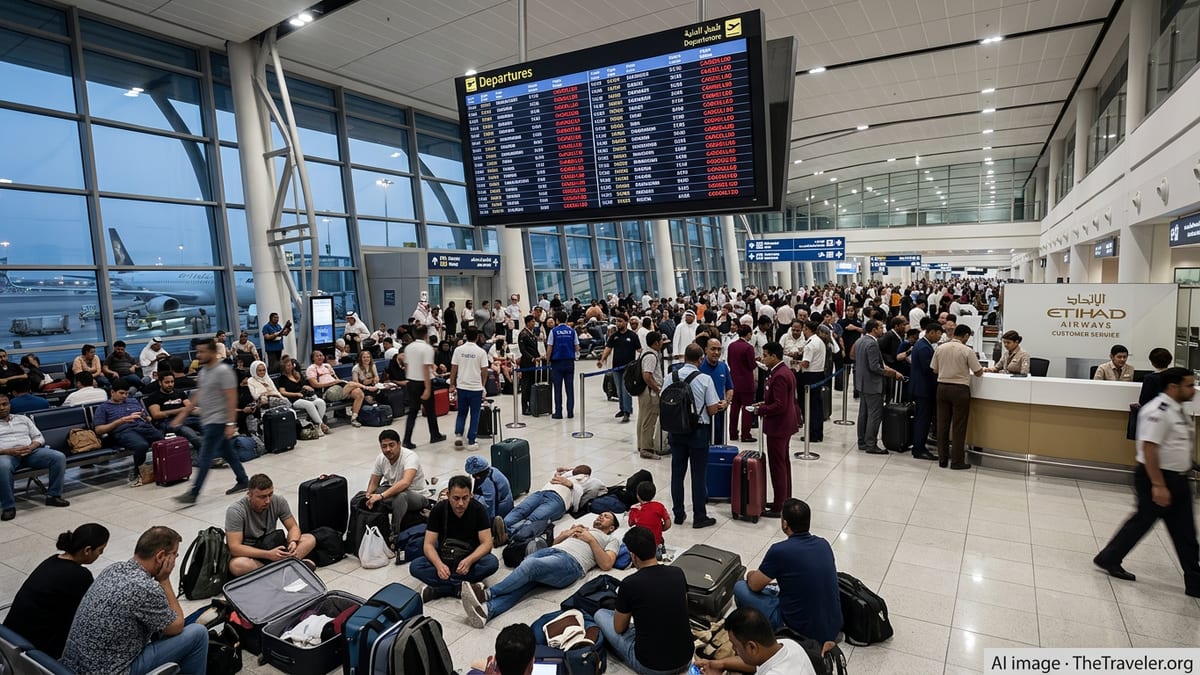
Travelers heading to or transiting through the United Arab Emirates are facing short-notice flight cancellations and delays after Emirates and Etihad adjusted services on routes involving Kuwait and Saudi Arabia amid renewed regional security concerns.
Get the latest news straight to your inbox!
Targeted cancellations hit Kuwait and Saudi routes
Publicly available airline updates and regional media reports indicate that Etihad has canceled a series of flights to and from Kuwait International Airport in recent days, describing the disruption as due to operational reasons and advising passengers to rebook or seek refunds. The cancellations are focused on Abu Dhabi to Kuwait services, with some rotations removed from schedules or listed as canceled on flight trackers.
Emirates has also been adjusting its operations on Kuwait and Saudi routes, with recent schedule changes affecting select services between Dubai, Kuwait City and secondary airports in Saudi Arabia. While many flights continue to operate, passengers are seeing isolated cancellations and significant delays, particularly on days when Kuwait’s airspace is subject to tighter restrictions.
The adjustments come on top of a broader pattern of disruption affecting flights across the northern Gulf, where airspace over parts of Kuwait and neighboring states has periodically been subject to restrictions following spikes in regional tension and security incidents.
Flight-status boards show that most long haul services to and from Dubai and Abu Dhabi are still running, but short haul links within the Gulf, including Kuwait and certain Saudi destinations, are experiencing more frequent last minute schedule changes than usual.
Security tensions and shifting airspace restrictions
Recent coverage in Gulf-focused outlets describes a renewed phase of regional tension that has led to intermittent closures or constraints in Kuwait’s airspace, with knock-on effects for airlines serving the country. Kuwait’s authorities have periodically tightened restrictions on civilian flights in response to security assessments, and airlines have been forced to adjust operations at short notice.
Further south, Saudi Arabia has kept its main airports open but has been operating with varying degrees of airspace limitation in Gulf-facing sectors. Travel and aviation bulletins summarizing the situation across the Middle East note that Saudi and Kuwaiti airspace are classified as restricted rather than fully closed, which leaves carriers room to operate but often requires tactical routing changes and extra fuel planning.
Industry snapshots compiled for logistics and humanitarian operators describe the wider Gulf corridor as constrained, with certain overflight paths over Iraq, Iran and adjacent waters unavailable or discouraged. These conditions influence how Emirates and Etihad plan their networks, particularly when linking the UAE with neighboring Gulf states where airspace can become congested as airlines compete for the same safe corridors.
Advisories from international aviation bodies have also evolved during 2026, with some agencies withdrawing broad warnings on UAE and Saudi airspace while maintaining caution around specific conflict zones. This shifting guidance contributes to a fluid environment in which carriers must continually re-evaluate the viability of particular routes.
Operational impact on UAE-bound passengers
For travelers heading to the UAE, the most immediate impact of the latest changes is on connections that rely on Kuwait or certain Saudi airports as regional entry or exit points. Passengers booked on Etihad services between Abu Dhabi and Kuwait, or on Emirates flights touching secondary Saudi cities, are among those most likely to be affected by cancellations or extended delays.
Travel reports from the region highlight instances of passengers being advised to travel by road to alternative airports in Saudi Arabia when flights to Kuwait were curtailed, underscoring the extent to which air connectivity can quickly be reshaped by security developments. Similar workarounds may not always be practical for leisure travelers bound for the UAE, especially those on tight itineraries or with fixed hotel and tour bookings.
At the same time, both Emirates and Etihad continue to prioritize maintaining core links between their hubs in Dubai and Abu Dhabi and major destinations worldwide. As a result, airlines often choose to trim or temporarily suspend shorter regional sectors, such as certain Kuwait and Saudi services, in order to preserve capacity and manage crew resources on long haul operations that feed the global network.
Airports in the UAE remain busy as the summer travel period progresses, but passengers are being advised through media and airport communications to allow extra time for check in and security, and to be prepared for last minute gate changes or departure time revisions, particularly on Gulf regional routes.
What travelers should check before flying
Published travel advisories and airline guidance emphasize that passengers planning trips involving Kuwait or Saudi Arabia should monitor their booking status closely in the days and hours before departure. Because some cancellations are being triggered by short notice airspace changes, flight-status tools and airline notifications are becoming essential for keeping up with the latest information.
Travelers connecting through Dubai or Abu Dhabi to onward destinations are being encouraged to verify whether their regional feeder segments are operating as scheduled, especially if their itineraries include stops in Kuwait, Bahrain or smaller Saudi airports. In some cases, rebooking onto nonstop services between the UAE and final destinations may reduce the risk of disruption, even if that means changing travel dates or times.
Experts quoted in regional business and aviation coverage also note that passengers should pay attention to minimum connection times and the potential for missed connections when weather or security related route changes force flights to take longer paths around sensitive airspace. Longer routings can lead to late arrivals into hub airports, which in turn increases the chance of missed onward flights.
Travel insurers and consumer advocates frequently recommend that passengers keep records of cancellation notices, schedule changes and any additional expenses incurred as a result of disruption, in case they need to pursue compensation or claims later. Given the dynamic situation in Gulf airspace, such documentation may be important for demonstrating the impact of operational decisions on individual travel plans.
Outlook for Emirates and Etihad schedules
Current public information suggests that Emirates and Etihad are treating the situation as a rolling operational challenge rather than issuing long dated suspensions across their Kuwait and Saudi networks. Schedules are being updated incrementally as airlines respond to day by day assessments of security and airspace availability.
Aviation analysts following the region indicate that, barring a significant deterioration in security conditions, UAE carriers are likely to continue with a strategy of selective cancellations and rerouting, rather than wholesale withdrawal from affected markets. This approach allows them to preserve a level of connectivity while retaining flexibility to scale services up or down.
For passengers, that means uncertainty is likely to persist in the short term, particularly on shorter Gulf routes where aircraft and crew can be moved quickly in response to new restrictions or opportunities. Travelers planning imminent trips to or through the UAE that involve Kuwait or Saudi Arabia may wish to build extra time into their itineraries and remain open to alternative routings.
As the summer peak continues, observers expect further operational updates from Emirates, Etihad and other Gulf airlines as they balance safety, regulatory guidance and commercial demand across a complex regional airspace environment.