


More news on this day
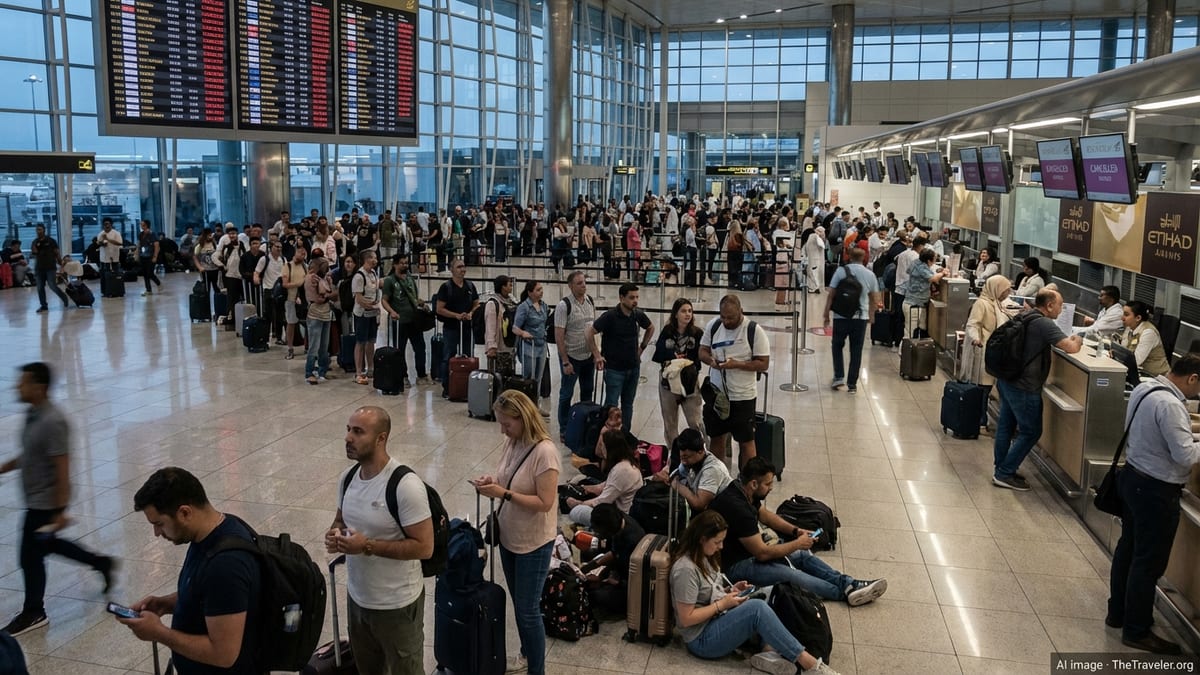
Flight schedules to and from the United Arab Emirates are facing fresh disruption as escalating hostilities between the United States and Iran trigger airspace warnings, security alerts and renewed turbulence for one of the world’s most important aviation crossroads.
Get the latest news straight to your inbox!
Heightened tensions reshape Gulf airspace
The latest round of US strikes on Iranian targets and retaliatory attacks across the Gulf has pushed regional tensions to their highest point since the Iran war began earlier this year. Publicly available reporting describes a series of tit-for-tat operations focused on the Strait of Hormuz and surrounding states, with Iran targeting shipping and sites in Gulf countries and the United States intensifying strikes on Iranian military infrastructure.
The Strait of Hormuz remains at the center of the confrontation, with Iran asserting greater control over maritime traffic and Western militaries reinforcing naval patrols to protect commercial vessels. Aviation analysts note that any instability in this narrow corridor reverberates quickly into the skies above, as airlines adjust routings to avoid perceived conflict zones and military activity.
As the security picture has deteriorated, aviation regulators have renewed caution around key flight information regions that cover Iran, Iraq and parts of the eastern Mediterranean. The European Union’s aviation safety body has recently advised airlines to avoid Iranian, Iraqi and Lebanese airspace, prompting long detours for some routes connecting Europe, Asia and the Gulf and adding further strain to network planning.
While the UAE has kept its own airspace open, the heightened risk environment in adjacent skies is reshaping how carriers plan journeys into and out of the country’s major hubs. Airlines are weighing longer flight times and higher fuel costs against passenger safety expectations and national guidance.
UAE hubs feel the strain as carriers cancel and reroute
Dubai International and Abu Dhabi International, two of the busiest connecting hubs globally, are again experiencing disruption as airlines react to the latest escalation. During earlier peaks of the Iran war, thousands of flights across the region were cancelled or heavily delayed after missile and drone attacks led to temporary airspace closures and damage at some Gulf airports. Current disruptions are more targeted but remain significant for passengers transiting the UAE.
According to recent operational updates compiled in industry and media reports, a mix of regional and international airlines have suspended or reduced services into UAE airports, citing regional security concerns and evolving airspace advisories. Some carriers have cancelled flights outright on specific days, while others are consolidating multiple frequencies into a single daily service and rerouting around sensitive air corridors.
Data collected by aviation and consultancy briefings earlier in the year showed that airspace decisions in the Gulf can rapidly translate into thousands of cancellations across the wider Middle East. With the latest US-Iran confrontation unfolding close to the heart of Gulf aviation, planners warn that even short-lived restrictions can ripple through the network and disrupt travel well beyond the region.
Travelers are also seeing longer block times on routes that previously crossed Iranian or Iraqi airspace directly. Re-routings over safer corridors add distance and congestion to already busy skies, which can lead to knock-on delays at crowded UAE hubs during peak waves of arrivals and departures.
Security alerts and consular pauses deepen traveler uncertainty
The flight cancellations and schedule changes are being compounded by a tightening of security protocols for foreign nationals in the UAE. Public notices from diplomatic missions show that the United States has suspended routine consular appointments at its embassy in Abu Dhabi and consulate in Dubai for several days, citing the regional security environment and the need to limit nonessential movements.
UAE residents and visitors are simultaneously confronting a patchwork of government travel advisories. Several Western countries have updated their guidance in recent days, asking citizens to reconsider nonessential journeys to parts of the Gulf or to exercise heightened caution when transiting major hubs such as Dubai. These notices stop short of blanket bans on travel to the UAE, but they add another layer of uncertainty for passengers weighing upcoming trips.
Security measures on the ground have also become more visible. Previous Iranian strikes on Gulf infrastructure, including reported attacks near key energy and aviation sites, prompted the UAE and neighboring states to activate air defense systems and review civil protection procedures. With the latest hostilities again involving missiles and drones, residents report increased vigilance at airports and other strategic locations.
For travelers, these developments translate into more frequent checks, longer queues and the possibility of sudden changes to itineraries if perceived threats emerge. Airline and airport advisories urge passengers to arrive early, remain flexible and monitor official channels for the latest status information.
Economic and tourism fallout for a global crossroads
The renewed wave of cancellations comes at a sensitive time for the UAE’s aviation-driven economy. Earlier in the conflict, the combination of airspace closures, damage at Gulf airports and nervous travelers left Dubai and Abu Dhabi operating at well below pre-war capacity. Industry analyses have highlighted how quickly hotel occupancy, retail spending and conference bookings can fall when international airlines scale back flights into the country.
As the conflict with Iran has dragged on, global carriers have repeatedly reassessed their exposure to Gulf routes. Some international airlines suspended services to several Middle Eastern destinations earlier in the year, while others re-entered the market cautiously, with trimmed schedules and higher fares. The latest spike in tensions risks slowing that tentative recovery, especially if airspace advisories tighten further or if additional infrastructure is affected.
Tourism operators in the UAE are closely watching booking trends for the coming weeks. Reports from regional business outlets describe price promotions and flexible rebooking policies aimed at convincing travelers to keep their plans despite the headlines. At the same time, some corporate clients are postponing nonessential trips, waiting to see whether the situation stabilizes or deteriorates.
Economists note that prolonged disruption at UAE airports could have outsized effects on global connectivity, given the country’s role as a bridge between Europe, Asia and Africa. Any sustained reduction in long-haul transfer traffic would be felt not only in the Gulf but also in secondary cities around the world that rely on Dubai and Abu Dhabi as primary intercontinental gateways.
What travelers should expect in the days ahead
Travel specialists say the outlook for UAE flights in the near term will depend largely on how the US-Iran confrontation evolves and whether further strikes affect airspace or airport operations. If tensions plateau and no new high-profile incidents occur, airlines may gradually reinstate suspended services, albeit with continued routing adjustments around Iranian airspace.
If the security picture worsens, however, more aggressive cancellations and diversions are likely. Previous phases of the conflict have shown that carriers can move quickly to pull flights or reroute aircraft when missiles or drones are used near commercial corridors. Additional advisories from regional aviation authorities or international safety agencies could also narrow the options for overflight, further complicating schedules.
For now, travelers heading to or through the UAE are being advised by airlines and travel agents to check the status of flights frequently, allow extra time for security and be prepared for last-minute changes. Flexible tickets, comprehensive travel insurance and a willingness to accept rebookings via alternative hubs are emerging as key tools for navigating the current uncertainty.
Despite the disruptions, UAE airports remain operational and continue to handle substantial passenger volumes. Aviation analysts emphasize that the country has invested heavily in layered air defense and contingency planning, which has enabled its hubs to recover relatively quickly from previous shocks. The central question for the weeks ahead is whether diplomacy can cool the latest US-Iran flashpoint before it inflicts deeper and more lasting damage on Gulf aviation.