


More news on this day
Air travel across Europe and Asia is facing a fresh wave of disruption as the United Arab Emirates joins Israel, Qatar, Saudi Arabia and Lebanon at the center of a widening aviation crisis, with major carriers cutting capacity, rerouting planes around conflict zones and warning travelers that schedules may change at short notice.
Get the latest news straight to your inbox!
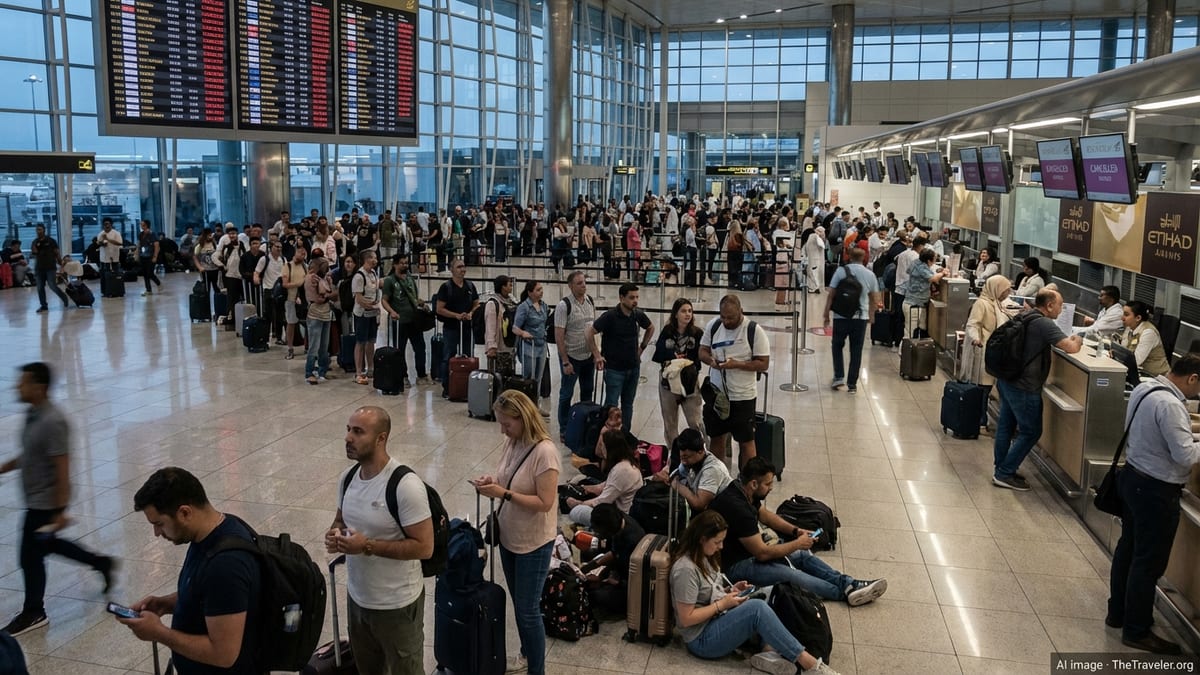
Regional Conflict Reshapes Key Europe–Asia Flight Corridors
Publicly available data on flight paths and schedule filings show that the latest phase of the Iran war and related regional tensions have forced airlines to redraw many of the busiest corridors between Europe and Asia. Carriers that traditionally funneled traffic through hubs in the UAE, Qatar, Saudi Arabia, Israel and Lebanon are now navigating airspace closures, missile warnings and tightened safety advisories that constrain how and where they can operate.
Analysts tracking route maps note that traffic which once crossed the Gulf and northern Middle East in straight lines has been pushed into two broad detours: a northern arc via Turkey, the Caucasus and Central Asia, and a southern arc that skirts through Egypt and the Red Sea before turning toward South or Southeast Asia. These longer routings add flying time, fuel burn and crew costs, and often push aircraft and crews out of position, compounding delays even on routes far from the conflict.
Industry outlook reports published in April 2026 indicate that capacity between Europe and Asia flowing through Gulf hubs has been reduced markedly in recent weeks, with some estimates pointing to a cut of around half on certain city pairs when temporary suspensions and downgauged aircraft are combined. Travelers are experiencing this not only as outright cancellations, but also as longer layovers, last‑minute aircraft swaps and crowded alternative connections through non-Gulf hubs.
Traffic bottlenecks are also emerging at airports tasked with handling diverted flights or emergency turnarounds when airspace restrictions change with little warning. Airports in Muscat, Riyadh, Kuwait City and Athens, among others, have periodically absorbed diversions from Gulf hubs and Tel Aviv during temporary shutdowns, producing knock‑on disruption across wider regional networks.
UAE Hubs Under Pressure as Emirates and Etihad Trim Networks
Dubai and Abu Dhabi, usually among the world’s most reliable super‑connectors, have been operating below normal capacity since late winter, according to operational snapshots compiled by aviation consultancies. Reports focused on the United Arab Emirates describe a pattern of rolling suspensions and reductions affecting dozens of long‑haul routes as carriers respond to evolving security assessments and airspace constraints.
Coverage of the UAE market suggests Emirates, Etihad, Flydubai and Air Arabia have all adjusted services on key links to Europe and Asia. Some routes have been temporarily dropped, while others continue at reduced frequency or with smaller aircraft. Independent trackers note that Emirates in particular has withdrawn Airbus A380s from a string of trunk routes in favor of smaller widebodies, a move that significantly cuts available seats even where the route itself remains on the map.
Case studies of the March 2026 disruption indicate that at the height of the initial closures, Dubai and Abu Dhabi saw hours‑long suspensions of departures and arrivals, with scores of flights diverted to neighboring countries and hundreds of movements disrupted. While schedules have since partially recovered, Gulf aviation risk bulletins continue to describe the UAE as operating under enhanced security controls, and regional safety notices remain in effect for certain airspace segments.
For travelers, the UAE’s inclusion among the most affected hubs means that itineraries built around Dubai or Abu Dhabi links are more vulnerable to change than in previous years. Passenger rights advocates advise that those with non‑refundable hotel and tour bookings in Europe or Asia should monitor their reservations closely and be prepared for rebooking through alternative hubs if Gulf routes are adjusted again.
Qatar Airways and Doha Grapple With Airspace Closures
Qatar has experienced some of the sharpest and most sudden disruptions in the region. Public updates on the closure of Qatari airspace in March 2026 describe a near‑total halt in operations at Doha, followed by days of severe schedule reductions as the flag carrier worked within tight constraints on departures and arrivals.
Industry newsletters and passenger‑rights organizations report that Qatar Airways was forced to cancel more than two hundred flights and delay many more within a short window, leaving thousands of travelers stranded across multiple continents. The most heavily hit routes were those linking Europe and Asia via Doha, underscoring the central role the carrier plays in long‑haul connectivity between the two regions.
In subsequent weeks, Qatar Airways has moved to rebuild its network on a reduced basis. The airline’s published schedules and travel‑trade advisories refer to a phased increase in services back toward more than one hundred destinations by mid‑May, but observers note that frequencies on some popular European and Asian routes remain below pre‑crisis levels. In parallel, consumer forums are documenting extended rebooking queues and cases where passengers have had to seek rerouting via alternative non‑Gulf hubs.
Regulatory specialists point out that for flights departing the European Union or United Kingdom, standard passenger‑rights frameworks still apply where disruption is within an airline’s control, but war‑related cancellations and airspace closures often fall into exemptions. Travelers are therefore being urged to study fare conditions closely and keep documentation of any disruption when seeking refunds, vouchers or travel insurance claims.
Israel, Saudi Arabia and Lebanon Face Intermittent Shutdowns
In Israel, the conflict has produced some of the most dramatic aviation stoppages of the current crisis. Timelines compiled from Israeli media coverage and international reporting show that the country’s airspace and Ben Gurion International Airport were fully closed for periods following major missile salvos, with regular scheduled flights by domestic carriers suspended for extended days in April.
Carriers such as El Al, Arkia and Israir have periodically shifted into emergency or limited‑service modes, operating a small number of special flights while suspending most commercial routes. The impact has rippled far beyond Israel’s borders, affecting travelers connecting between Europe and Asia who relied on Tel Aviv as a transit or destination point and forcing airlines to adjust code‑shares and interline arrangements.
Saudi Arabia’s aviation sector has also been hit as Iranian strikes and related security concerns prompted temporary closures and route suspensions. Regional travel publications describe Saudia and Gulf Air cancelling and consolidating flights serving Riyadh, Jeddah and neighboring hubs, including services to other Gulf capitals that normally act as feeders into long‑haul networks. These changes have reduced the redundancy that passengers once enjoyed when hopping between Gulf states to catch intercontinental departures.
Lebanon’s position near several active fronts and its own fragile infrastructure have left Beirut’s Rafic Hariri International Airport vulnerable to intermittent suspensions and heightened security protocols. While the country is not a major long‑haul hub on the scale of Dubai or Doha, cancellations and schedule cuts by Middle East Airlines and foreign carriers have further narrowed options for travelers seeking to cross between Europe and parts of the eastern Mediterranean or western Asia without passing through the most affected Gulf states.
What Travelers Between Europe and Asia Need To Know Now
For passengers planning trips between Europe and Asia in the coming weeks, the combined effect of disruptions in the UAE, Qatar, Saudi Arabia, Israel and Lebanon is a thinner and more fragile network of long‑haul connections. Capacity has been removed through outright route suspensions, reduced frequencies and smaller aircraft, while remaining flights are often longer and more circuitous due to reroutings around sensitive airspace.
Travel‑risk advisories and aviation outlook reports currently urge travelers to factor in additional travel time and to avoid tight connections, particularly when itineraries depend on transiting Dubai, Abu Dhabi or Doha. Itineraries that once involved one short layover in the Gulf may now require longer waits or a connection through alternative hubs in Europe or Asia, potentially pushing total journey times many hours beyond original schedules.
Consumer‑facing guidance emphasizes the importance of booking with flexible conditions, checking flight status frequently and registering for airline alerts. Passengers are also being advised to verify visa and transit requirements for any newly added connection points, as rerouting through third countries can trigger different entry rules, even for brief layovers.
While airlines and regulators continue to stress that safety takes precedence over schedule reliability, the scale of current disruptions means that travelers should approach routes touching the wider Gulf and eastern Mediterranean with an expectation of change. As the security situation remains fluid, the list of affected routes across Europe and Asia is likely to evolve, keeping the region at the forefront of global aviation disruption in the near term.