


More news on this day
Air links between the United Arab Emirates and Kuwait remain heavily disrupted as Etihad Airways extends the cancellation of key Abu Dhabi–Kuwait flights until July 24, adding fresh uncertainty for travellers already navigating several days of schedule upheaval across the Gulf.
Get the latest news straight to your inbox!
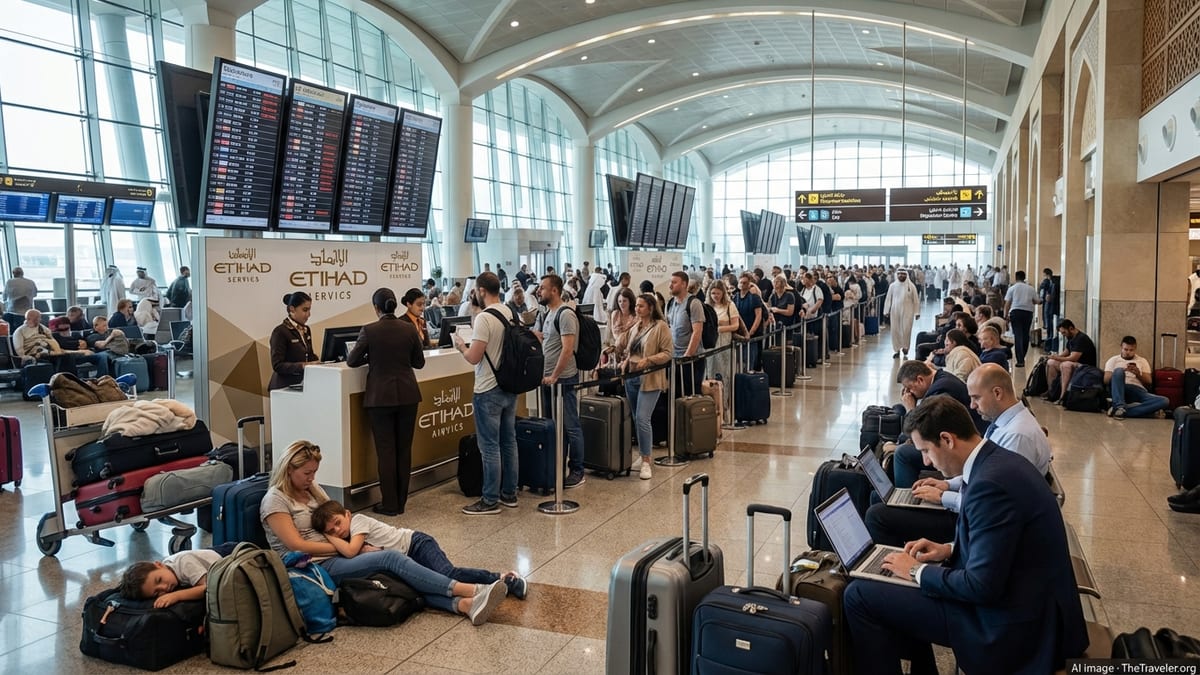
Etihad pushes Abu Dhabi–Kuwait cancellations into next week
Publicly available flight status data shows that Etihad Airways has now extended the cancellation of flights EY653 and EY654 between Abu Dhabi’s Zayed International Airport and Kuwait International Airport through July 24. Earlier updates had listed the services as cancelled on July 19 and 20, with the latest change signalling that disruption on the route will continue for at least several more days.
Reports from regional travel and aviation outlets indicate that the airline is citing operational reasons and the wider regional situation for the extended suspension. While Etihad’s broader network is operating largely as scheduled, the Abu Dhabi–Kuwait link has become one of the most affected routes, reflecting ongoing uncertainty around Kuwait International Airport’s capacity and airspace restrictions.
The extended cancellations effectively wipe out Etihad’s direct connectivity between the UAE capital and Kuwait City until at least July 24. Passengers booked on these services are being encouraged, through airline advisories, to review their itineraries, explore alternative routings, or adjust travel dates where possible.
Emirates, Air Arabia and other UAE carriers also trim Kuwait services
The Etihad decision comes amid a broader pattern of cuts on UAE–Kuwait routes. Recent operational updates compiled by regional media show Emirates cancelling multiple flights between Dubai International Airport and Kuwait International Airport across July 19 to 21, with additional schedule adjustments possible as conditions evolve.
Sharjah-based low-cost carrier Air Arabia has also cancelled selected flights linking the UAE and Kuwait, according to flight information monitored over the weekend and into Monday. The airline continues to operate most of its regional network but has joined larger Gulf carriers in selectively suspending Kuwait services.
Despite the disruptions, coverage of the situation indicates that flight operations across the UAE remain broadly stable, with the majority of services to other Gulf destinations, Europe and Asia running. The Kuwait market, together with certain routes into Saudi Arabia, stands out as a notable exception, highlighting the uneven impact of current tensions on regional air connectivity.
Regional tensions and Kuwait airport constraints drive uncertainty
The latest round of cancellations and schedule changes follows months of elevated tension in the Gulf region, including repeated disruptions to Kuwait International Airport linked to security concerns and airspace closures. Analytical briefings on Middle East air travel have noted that Kuwait’s role as both a local hub and a staging point for wider regional operations has made it particularly vulnerable when risk levels rise.
Since late February, Kuwait’s airspace and primary airport have periodically faced restrictions, prompting multiple international carriers to curtail or temporarily suspend operations. UAE airlines initially responded with short-term cancellations and aircraft rerouting but have increasingly been forced into longer extensions as the situation has proven more persistent than many travellers anticipated.
Aviation analysts cited in recent regional coverage suggest that airlines are prioritising crew and aircraft safety, predictable routings and schedule resilience over maintaining full capacity into higher-risk airports. That approach can result in relatively normal operations on most routes, even as specific destinations such as Kuwait experience extended gaps in service.
Travellers urged to monitor bookings and prepare backup plans
With Etihad’s Abu Dhabi–Kuwait cancellations now stretching at least until July 24 and other UAE carriers continuing to trim Kuwait operations on a rolling basis, industry guidance strongly emphasises proactive planning by passengers. Travellers are being advised through public travel alerts and media reports to monitor their flight status repeatedly in the days and even hours before departure.
For those holding tickets on affected services, the options generally include rebooking on alternative dates, rerouting via other Gulf hubs that remain open, or seeking refunds according to each airline’s disruption policy. Some passengers have reported shifting itineraries to connect through Saudi Arabian airports that still have capacity, though this can add time and complexity to journeys.
Travel consultants quoted in recent coverage recommend building in additional buffer time for trips involving Kuwait or nearby hotspots, allowing for last-minute gate changes, rebookings or overnight stays. Passengers are also encouraged to ensure that their contact details are up to date in airline bookings so they can receive notifications of schedule changes as soon as they are issued.
Outlook for UAE–Kuwait air links remains fluid
As of July 20, publicly available information points to a highly fluid outlook for flights between the UAE and Kuwait. Etihad’s extension of cancellations through July 24 implies that a swift return to pre-disruption schedules is unlikely, even if conditions on the ground begin to stabilise.
Industry observers note that airlines may choose to restore capacity gradually, starting with fewer daily frequencies or smaller aircraft, in order to test demand and operational reliability before bringing back full schedules. That means that travellers could continue to face limited options and higher load factors on the flights that do operate, particularly around peak business and holiday travel periods.
Until a clearer picture emerges, travellers planning journeys between the UAE and Kuwait are being encouraged by publicly available advisories and media reports to remain flexible with dates, keep alternative routings in mind and budget extra time and resources to accommodate unexpected changes. For the moment, Etihad’s extended cancellations underscore how quickly regional developments can reshape even short-haul Gulf connections that are normally among the most reliable in the world.