


More news on this day
United Airlines is accelerating a sweeping fleet modernization program while adding a wave of new international and domestic routes, signaling a strategy focused on growth, efficiency and premium travel over the next decade.
Get the latest news straight to your inbox!
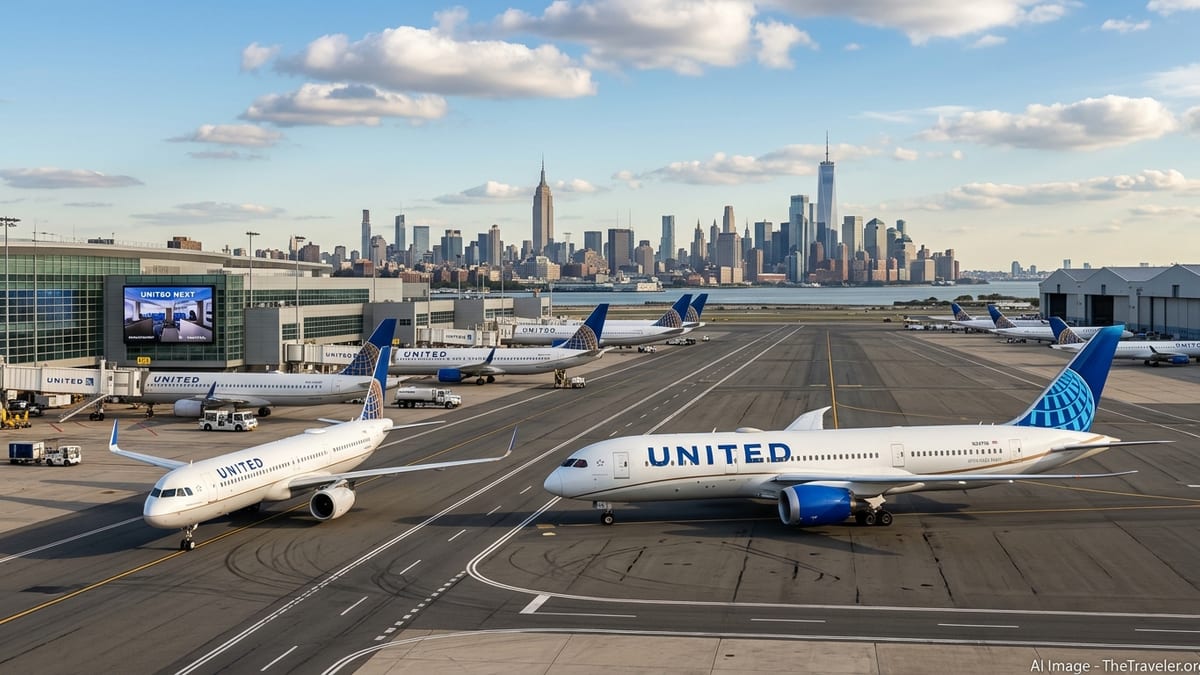
Major Aircraft Orders Anchor the United Next Strategy
Publicly available filings and company announcements show that United has committed to one of the largest aircraft renewal programs in global aviation, centered on its "United Next" strategy. Since 2021, the carrier has placed orders for more than 500 new-generation narrowbody jets and around 150 Boeing 787 Dreamliners, with deliveries stretching into the early 2030s. These orders are designed to replace aging aircraft while expanding the overall size of the fleet.
A landmark decision in late 2022 to buy up to 200 Boeing 787s marked the largest widebody order ever placed by a United States carrier. United expects roughly half of those Dreamliners to replace older Boeing 767 and 777 aircraft, targeting a double-digit reduction in carbon emissions per seat compared with the aircraft they supersede. The remainder of the 787 order book is intended to fuel long-haul growth across the Atlantic and Pacific.
Industry analyses report that United has also continued to convert options and new commitments for Airbus A321neo family aircraft and additional Boeing 737 MAX jets. This blend of widebody and narrowbody investment allows the airline to streamline operations around a smaller number of fuel-efficient types while matching aircraft size more precisely to demand across hubs and secondary markets.
Financial disclosures indicate that the updated fleet plan smooths out the pace of deliveries compared with earlier projections, reflecting supply chain constraints and regulatory limits on narrowbody production. Even with a moderated schedule, however, United still expects hundreds of new aircraft to arrive before 2032, effectively reshaping its fleet profile.
Retiring Older Jets and Upgrading the Onboard Experience
As new aircraft arrive, United is steadily retiring some of its oldest mainline jets and reducing reliance on small regional aircraft. Aviation data providers note that the airline’s Boeing 757 and 767 fleets, with average ages in the mid-20s, are being phased out in favor of 787s and A321neo aircraft that consume less fuel and offer modern passenger amenities.
The carrier has also publicly highlighted the replacement of more than 100 single-class regional jets with larger mainline aircraft in recent years. This shift is intended to improve unit economics on shorter routes, add more premium and extra-legroom seats and standardize the customer experience across hubs. For travelers, that often translates into larger overhead bins, seat-back entertainment and upgraded connectivity even on flights that were once operated by smaller regional planes.
United reports that around 70 percent of its existing mainline narrowbody fleet has now been retrofitted with the new interior standard introduced under the United Next program. That interior concept prioritizes more premium seating, high-speed Wi-Fi, larger seat-back screens and power at every seat. The airline says it is on track to complete the retrofit program across its mainline fleet within the next few years, aligning older aircraft more closely with the comfort levels of newly delivered jets.
The focus on premium cabins is especially evident on forthcoming Airbus A321neo variants, including a coastal-focused subfleet and long-range versions equipped with lie-flat business class seats. These aircraft are being positioned for high-yield transcontinental and international missions where cabin quality can be a key differentiator.
New A321XLRs and Dreamliners Open Long-Thin International Routes
United’s order book for the Airbus A321XLR gives the airline new flexibility on long-thin routes that were previously difficult to serve profitably. Public announcements describe the A321XLR as a single-aisle aircraft configured with a full international product, including an updated Polaris business class suite, enhanced premium economy-style seating options and advanced in-flight entertainment technology.
The long range of the A321XLR enables nonstop service from East Coast hubs to secondary cities in Europe and potentially beyond, without the cost of deploying a larger widebody. Industry commentary suggests that this could support a new wave of point-to-point flying from Newark and other key hubs, connecting business centers and niche leisure destinations that currently require connections.
On the widebody side, continued deliveries of Boeing 787-9 and 787-10 aircraft are underpinning expansion across the Atlantic and Pacific. Dreamliners offer lower fuel burn, long range and a cabin environment designed to reduce jetlag, features that United is leaning on as it schedules more ultra-long-haul flights to Europe, Asia and the Middle East.
By combining efficient widebodies with the forthcoming A321XLR fleet, United is building a network toolkit that can flex between dense trunk routes and emerging city pairs. This flexibility is central to the airline’s plan to increase available seat miles while maintaining tighter control of costs and emissions.
Largest-Ever International Expansions Reshape the Route Map
United’s fleet modernization is closely tied to an aggressive network strategy. In recent seasons the airline has announced the largest international expansions in its history, adding multiple new destinations in Europe, the Middle East, Africa and Asia. Public information shows that its transatlantic schedule for recent summers reached record levels, with hundreds of weekly flights and several destinations not served nonstop by other United States carriers.
Earlier announcements detailed new nonstop routes from Newark to cities such as Faro and Madeira in Portugal, along with service to additional Mediterranean and Nordic destinations. More recently, the airline has outlined plans to launch service to ten further international cities for 2027, using new aircraft to connect United’s hubs to a broader mix of leisure and business markets.
The carrier has also reinstated or added a series of domestic routes that feed its international banks, including seasonal services from Chicago and other hubs to smaller coastal destinations. These connections are intended to funnel travelers onto long-haul departures while strengthening United’s competitive position in key origin-and-destination markets.
As fleet deliveries accelerate over the next two years, United is expected to continue rebalancing capacity across hubs such as Newark, Chicago, Houston, Denver, San Francisco, Los Angeles and Washington, D.C. Industry observers note that the airline increasingly uses its global network to differentiate itself from rivals, especially on transatlantic and transpacific corridors.
Balancing Growth, Constraints and Sustainability Goals
United’s accelerated fleet plan is unfolding against a backdrop of manufacturing bottlenecks, regulatory scrutiny and infrastructure limits across the aviation system. Public disclosures from the airline indicate that it has adjusted delivery timelines to reflect production constraints at major aircraft manufacturers, particularly on the Boeing 737 MAX line. Those adjustments are intended to moderate capital spending while still supporting long-term growth.
At the same time, the modernization drive is central to United’s environmental and efficiency objectives. Newer aircraft such as the Boeing 787 and Airbus A321neo typically deliver significant reductions in fuel burn and carbon emissions per seat compared with the older jets they replace. The airline links these gains with broader initiatives around sustainable aviation fuel, operational efficiency and next-generation airport facilities.
Recent investments at key hubs, including new concourses and upgraded cargo infrastructure, complement the aircraft strategy by easing congestion and providing room for growth. Reports indicate that these projects are designed to handle more flights and larger aircraft, supporting the wave of deliveries expected in the second half of the decade.
Together, the accelerated fleet renewal and expanding route network suggest that United is positioning itself for a more competitive and environmentally conscious role in global aviation. As new aircraft enter service and older types retire, travelers are likely to see more connections, refreshed cabins and a growing number of long-haul options linking United States hubs with destinations around the world.