


More news on this day
Hundreds of travelers across Europe faced long queues, missed connections and overnight airport stays this weekend as disruption linked to a major US aviation outage triggered 1,533 delays and 36 cancellations on routes involving Athens and other key hubs.
Get the latest news straight to your inbox!
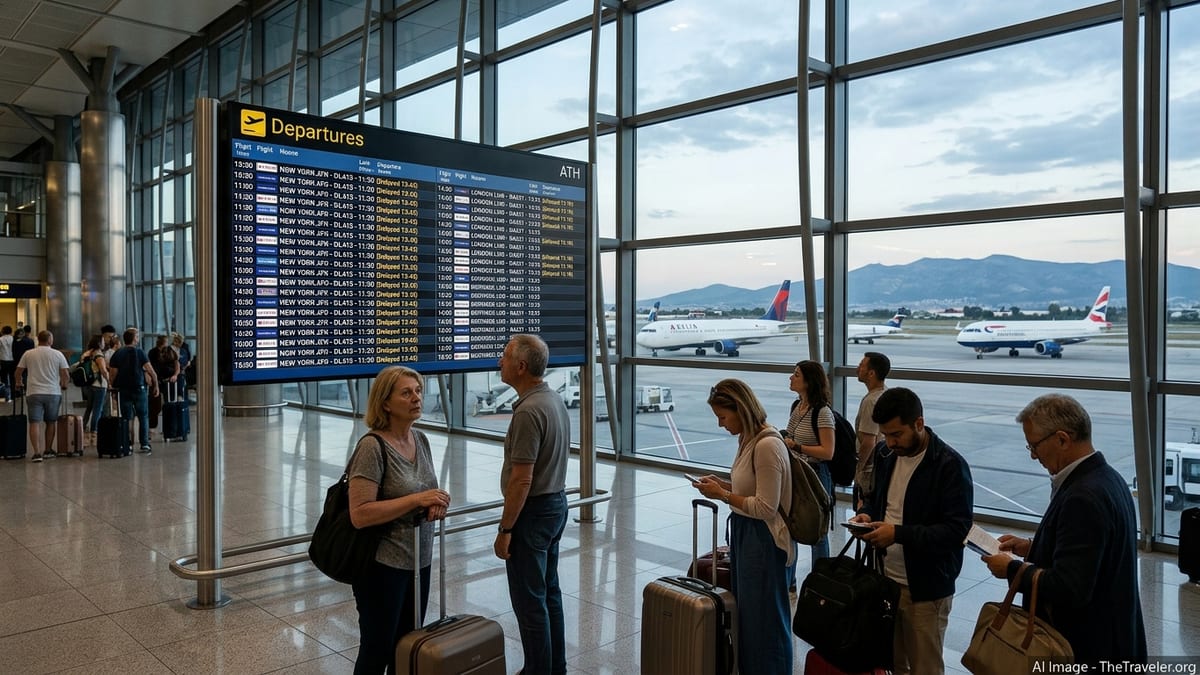
Knock-on effects from US ground stop hit transatlantic links
Publicly available flight-tracking and aviation data show that a nationwide ground stop in the United States on 13 November, introduced after a telecommunications failure in the air traffic control network, quickly spilled over into transatlantic operations. European services to and from major US gateways, including New York, were among the first to see rolling delays as aircraft and crews were left out of position for their onward legs.
Routes connecting Athens Eleftherios Venizelos International Airport with New York were particularly exposed. Regional media summaries indicate that arrivals from the United States reached the Greek capital up to two hours behind schedule on 14 November, with one inbound service due shortly after 09:00 landing well after 11:00. Subsequent departures from Athens toward other European cities departed late as ground handlers and airlines worked through the backlog.
Analytics from specialist delay-monitoring platforms for the evening of 13 November report Athens operating with an average departure delay approaching 40 minutes and cancellation rates around 1 percent of scheduled movements. While these figures remain modest in percentage terms, they translate into hundreds of affected passengers on a day when the airport typically handles more than 300 flights.
The strain coincided with a broader pattern of disruption reported at European airports handling a high volume of US-bound services, including London Heathrow, Frankfurt and Paris Charles de Gaulle. Flight statistics compiled for the wider European network on 14 November record several thousand services arriving later than planned, with a significant portion more than 30 minutes behind schedule.
Athens airspace already under pressure from structural delays
The timing of the US-driven disruption has been challenging for an airspace sector that was already operating close to capacity. A recent European air navigation overview for early November highlights the Athens Area Control Centre among the top contributors to en route air traffic flow management delays on the continent, alongside Barcelona, Madrid and Seville.
According to these data, flights under the Athens centre’s responsibility were experiencing average en route delays of around 0.6 minutes per flight even before the latest turbulence. Although that figure appears small, it reflects structural congestion in busy corridors over the Aegean and Eastern Mediterranean that leaves limited room to absorb sudden schedule shocks.
Greek business press coverage notes that, despite a series of bomb threats and infrastructure alerts reported elsewhere in Europe earlier in the autumn, overall traffic at Athens has remained resilient. However, the same reports point out that the airport and its surrounding airspace have been operating on tight margins, with any additional stress often resulting in short but widespread pushbacks to departure times.
Industry punctuality reports for European hubs in recent months also place Athens below the continental average for on-time departures and arrivals, although still within the range seen at other congested holiday-focused airports. That context helps explain why a relatively contained set of long-haul delays could ripple so quickly into regional networks serving the Greek capital.
1,533 delays and 36 cancellations ripple through European networks
Preliminary tallies compiled from multiple aviation analytics dashboards on 14 and 15 November point to at least 1,533 delayed flights and 36 outright cancellations across European routes connected in some way to the Athens sector and other affected hubs. The figure captures both long-haul services across the Atlantic and the shorter feeder flights that keep major airports supplied with transfer passengers.
While the raw numbers represent a small share of overall European traffic for the weekend, the distribution of the disruption magnified its impact. Many of the delayed flights were part of complex itineraries carrying transfer passengers onward to secondary destinations in southern and eastern Europe, meaning that a single late-arriving aircraft could derail dozens of individual travel plans.
Data snapshots from European-wide tracking projects show that the heaviest concentration of delays occurred in the late morning and early afternoon of 14 November, when transatlantic arrivals are typically at their peak. By the evening, the pattern had shifted toward intra-European routes as airlines tried to reposition aircraft and crew for the next day’s schedules.
The 36 cancellations identified so far were clustered at a handful of hubs with strong US links, including Athens, London, and major German and French airports. In several cases, airlines appear to have consolidated lightly booked services in order to free aircraft for busier or strategically important routes, a common tactic when dealing with sudden system-wide strain.
Passenger experience: missed cruises, broken connections and overnight stays
Travel forums and social media posts from the weekend tell a consistent story of disrupted plans rather than outright chaos. Many passengers reported spending additional hours on the tarmac or in departure lounges, while others described sprinting through terminals in an effort to make narrowly retimed connections.
Travel advisories issued by insurance and assistance providers in the wake of the US ground stop acknowledged that the most acute impacts would fall on connecting passengers and those linking long-haul flights with time-sensitive products such as cruises or escorted tours. With several Athens to US services arriving late, travelers heading on to island ferries or organized itineraries faced particular challenges rebooking or claiming refunds for missed segments.
In Athens itself, local coverage highlighted cruise passengers disembarking in Piraeus and attempting to reach home via tightly timed flights out of Eleftherios Venizelos. Some reported being shifted onto later departures or rerouted through alternative hubs, occasionally adding an unplanned overnight hotel stay to their journey.
Despite the frustration, publicly available commentary suggests that airport operations remained orderly. Crowding and long queues at check-in and customer service desks were common, but there were few indications of severe breakdowns in basic services. Food outlets and ground transport providers, however, faced extended demand as travelers waited out lengthy delays.
Outlook: gradual normalization but lingering knock-on effects
By the early hours of 15 November, operational dashboards for European airports indicated that most hubs, including Athens, were moving back toward normal patterns. Live delay monitors listed Athens with manageable average delays and no ongoing airport-wide restrictions, suggesting that airlines had largely worked through the immediate backlog of stranded aircraft.
Nonetheless, experience from previous large-scale outages shows that knock-on effects can persist for several days, particularly where aircraft and crews have been unable to return to their planned rotations. Some European carriers have published flexible rebooking policies for passengers due to travel in the coming days, allowing changes without penalty within a defined window.
Industry analysts note that the episode underlines the vulnerability of interconnected air travel systems to failures that originate far from the airports where the disruption becomes visible. A technical fault in one jurisdiction can quickly translate into missed holidays, business meetings and family gatherings thousands of kilometres away, especially when it affects transatlantic links at the start of a busy travel weekend.
For now, travelers planning to pass through Athens and other major European hubs are being advised by consumer groups and travel specialists to monitor flight status closely, allow extra connection time where possible and keep essential items in carry-on luggage in case checked bags are delayed. While the worst of the disruption appears to be easing, residual schedule adjustments remain likely as airlines fine-tune their operations after a turbulent few days.