


More news on this day
Air India has restored non-stop flights between Delhi, Mumbai and New York, removing temporary refuelling stops in Rome and cutting journey times on key India United States routes by up to five hours.
Get the latest news straight to your inbox!
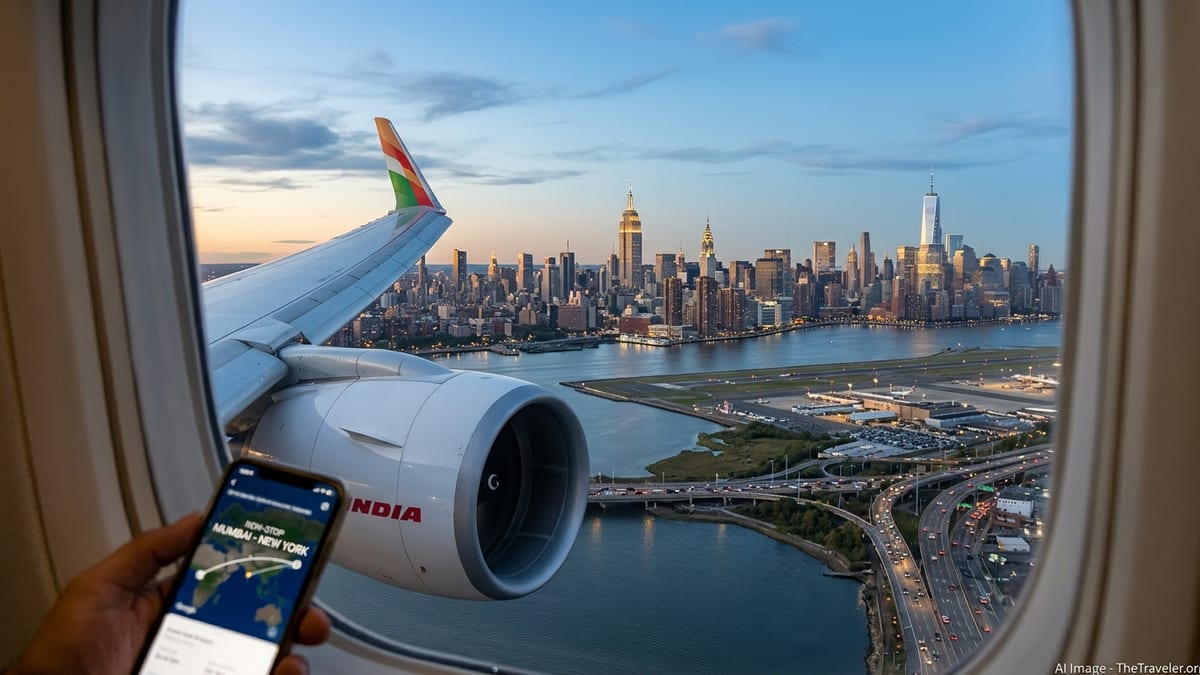
Non-Stop Links Return on All India–New York Routes
Publicly available information from Air India and multiple news outlets shows that all four India New York routes from Delhi and Mumbai are once again operating non-stop. Services now run directly to New York’s John F Kennedy International Airport and Newark Liberty International Airport without intermediate fuel stops.
The airline had introduced one-hour technical halts in Rome earlier this year, which extended typical end-to-end travel times on affected flights to around 22 hours door to door. Industry coverage indicates that with the Rome stop now withdrawn, total journey durations are approximately 17 hours, broadly in line with historic schedules for non-stop India United States operations.
Reports highlight that the revised timings apply in both directions, although flight durations can still vary slightly with season, headwinds and individual schedules. For passengers used to extended overnight and daytime segments via Europe, the restoration of through non-stop services marks a notable shift in convenience.
According to published coverage, Air India framed the change as a resumption of its intended long-haul pattern rather than a new route launch, signalling a move back toward its pre-disruption transatlantic timetable between India and the New York region.
Airspace Reopening Ends Rome Refuelling Detour
The reduction in journey time is closely linked to changing overflight conditions. News reports note that previously restricted airspace along the most efficient corridor between India and North America has recently reopened, allowing Air India to revert to more direct routings that no longer require refuelling in southern Europe.
During the period of airspace constraints, the airline had been routing certain Delhi and Mumbai departures via Rome to manage fuel and contingency requirements on longer alternative paths. While these detours allowed the flights to operate, they added both block time and operational complexity, with ground handling, additional climb and descent cycles and scheduling buffers built into timetables.
With restrictions eased, flight-planning specialists can once again plot great-circle style trajectories that shorten the distance flown and keep aircraft airborne for a single continuous sector. This shift eliminates the need to descend, land, taxi, refuel and depart again mid-journey, a sequence that industry data suggests can easily add four to five hours to the overall passenger experience once ground time and added cruise segments are included.
Aviation analysts cited in Indian business media point out that the restored routings not only cut block hours but also simplify crew scheduling, maintenance planning and day-of-operations recovery, benefits that can translate into more reliable on-time performance for travellers.
What the Time Savings Mean for Delhi and Mumbai Flyers
For travellers from India’s two largest metro hubs, the change reshapes how a New York trip fits into a calendar day. A reduction of roughly five hours effectively removes more than a quarter of the journey time that passengers had recently been enduring, turning what had become an ultra-long multi-stage itinerary back into a single ultra-long-haul sector.
From a practical standpoint, this opens more usable time at each end of the journey. Frequent-flyer commentary suggests that business travellers, in particular, are likely to value the restored ability to arrive in the New York area with enough margin to connect to domestic flights or attend same-day meetings. Leisure travellers gain from fewer overnight disruptions, simpler transit arrangements and reduced fatigue.
Published route information indicates that Air India continues to offer non-stop choices from both Delhi and Mumbai, an important consideration for travellers from beyond these metros who connect onwards from other Indian cities. With the Rome stop removed, total trip times for those connecting passengers also contract, potentially improving missed-connection resilience at the India end.
The time savings may also sharpen competition with foreign carriers that serve New York via European or Gulf hubs. While one-stop options often provide schedule flexibility, a 17-hour non-stop can now compete more strongly with itineraries that stretch close to or beyond 20 hours when transfers and layovers are included.
Capacity, Fleet and Network Strategy on the India–US Corridor
The restoration of non-stop operations comes as Air India continues a broader long-haul transformation, with new-generation aircraft being progressively introduced on key transcontinental routes. Previous announcements by the airline highlighted the deployment of Airbus A350-900 aircraft and upgraded Boeing 777s on North America services, bringing refreshed cabins, premium economy offerings and improved fuel efficiency.
Industry route maps published earlier in 2026 already depicted robust connectivity between Delhi, Mumbai and major North American gateways, underscoring the strategic weight of the United States market in Air India’s international portfolio. The New York area, served by both JFK and Newark, is one of the most heavily trafficked city pairs for travel between India and the US, catering to business, academic, medical and visiting-friends-and-relatives segments.
Traffic data and route announcements over recent seasons show that capacity on India United States routes has been tightening, with a mix of Indian and foreign carriers adding frequencies or upgauging aircraft to meet sustained demand. In that context, shaving several hours from a flagship route’s timetable strengthens Air India’s offering without necessarily adding new flights, effectively increasing the value of existing seats.
Aviation commentators note that reduced block times can also have operational and economic benefits for the carrier itself, potentially improving aircraft utilisation and lowering per-flight fuel and crew costs. Those efficiencies, while largely invisible to passengers, can support continued investment in on-board products and additional capacity over time.
Implications for the Wider Transatlantic and Polar Network
Air India’s move also reflects a broader pattern in global aviation, where long-haul airlines adjust network design in response to evolving overflight permissions and geopolitical developments. Since 2022, many carriers have reworked transpolar and trans-Eurasian routings to navigate a patchwork of restricted regions, often at the cost of longer journeys and added fuel burn.
As corridors reopen or become more predictable, airlines can gradually unwind temporary detours. In Air India’s case, the ability to operate non-stop Delhi and Mumbai New York services again slots its network back into a more conventional long-haul layout, with India functioning as a direct origin rather than a spoke relying on an intermediate European refuelling point.
The change may also influence how the carrier schedules other long-haul flights that share aircraft or crews with New York services, since a five-hour swing in block time can ripple through aircraft rotations and crew rosters. Timetables published for the current season suggest a steady effort to stabilise patterns after several years of reactive adjustments tied to regional tensions.
For passengers, the headline takeaway is simple: a journey that had stretched close to a full day of travel now looks considerably shorter. As airlines across the world weigh similar decisions on when and how to restore their most direct paths, Air India’s latest timetable shift offers a clear example of how airspace access and route planning can immediately reshape the long-haul travel experience between major global cities.