


Priority boarding on Europe’s budget airlines rarely changes your actual departure time and does not guarantee overhead locker space on every flight. Yet it can still be excellent value when it is bundled with the only practical way to bring a cabin-size suitcase on board. To understand when paying extra makes sense, you need to look at how each airline ties together three separate perks: early boarding, seat selection and a larger cabin bag.
Get the latest updates straight to your inbox!
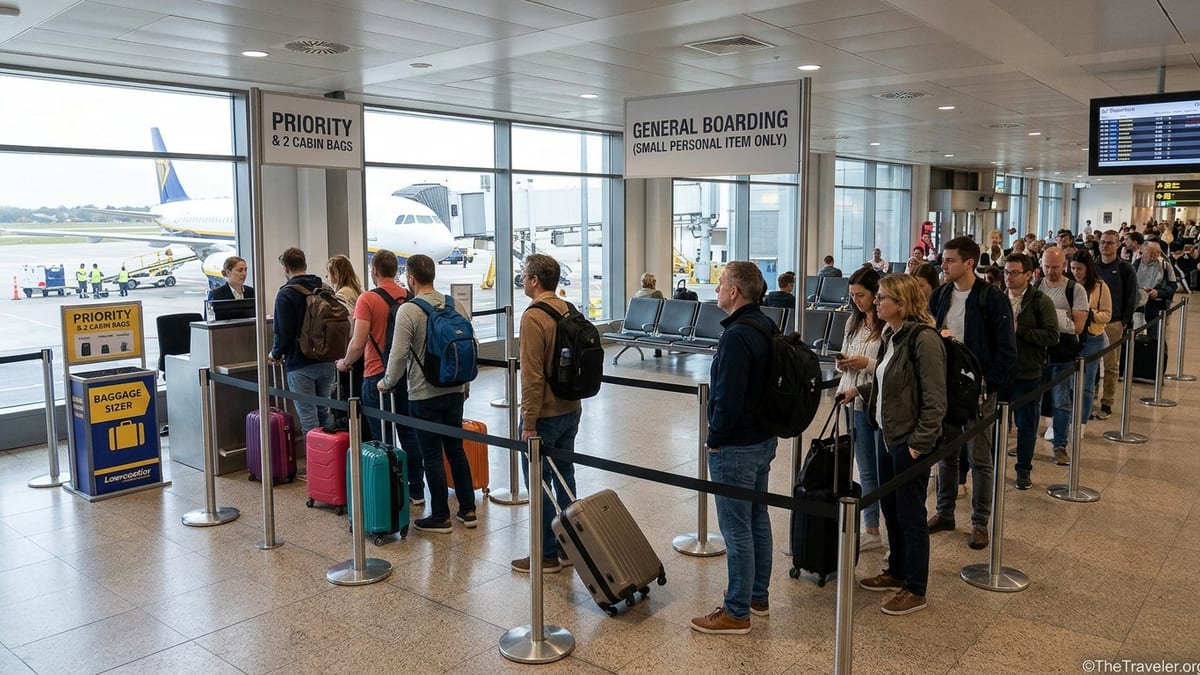
What Priority Boarding Really Buys You (and What It Does Not)
On Ryanair, easyJet, Wizz Air and most other low cost carriers, the aircraft leaves at the same time whether you board first or last. Priority boarding changes your boarding sequence, not your schedule. You may spend a little less time standing in line at the gate, but your arrival time at the destination is identical.
Overhead locker space is also not absolutely guaranteed, even if marketing language sometimes implies it. Ryanair’s own conditions state that cabin bags may be taken from passengers at the aircraft steps for stowage in the hold during busy flights, even when size rules are met. In practice that usually happens when bins are full or when operations require it, not as a routine penalty, but it underlines that no carrier can promise a specific compartment above your seat.
What priority often does guarantee is the right to bring a larger cabin bag on board when most basic fares now include only a small personal item that must go under the seat in front. On Ryanair, easyJet and Wizz Air, moving beyond that single small bag is almost always a paid decision. The key financial question is whether you buy that larger bag together with priority boarding, as on Ryanair and Wizz, or as a cabin bag product that automatically includes priority, as on easyJet.
Because these services are sold differently, a traveler who looks only at the headline “priority boarding” price can easily miss that one airline is really selling boarding plus a 10 kg suitcase allowance, while another is mostly selling a faster place in the queue.
Ryanair: Priority & 2 Cabin Bags as a Baggage Product
Ryanair’s standard fare includes one free small personal bag that must fit under the seat in front of you. Current guidance places this at up to 40 x 30 x 20 cm, with no stated weight limit on the free item. Anything larger belongs in either a paid cabin bag or the hold. A typical example would be a modest 20 to 30 liter backpack or slim laptop bag.
The airline’s main upsell is “Priority & 2 Cabin Bags.” According to Ryanair’s fee table and independent monitoring sites that track its official pages, this bundle allows you to bring the same small personal item plus one larger 10 kg cabin bag up to 55 x 40 x 20 cm that goes in the overhead locker. As of October and November 2026, the airline lists an online price range of approximately €12.49 to €36 per person, per flight, depending on route and date. Purchases at the airport or after booking tend to be higher than the entry-level online price, and passengers who appear at the gate with an oversize, unbooked bag face gate-check fees in the region of €70 or more.
The important point for value is that Priority & 2 Cabin Bags is primarily a luggage product that happens to include priority boarding. If you would otherwise pay for a 10 kg checked bag, which Ryanair currently prices in a higher band than the cheapest priority range for many routes, carrying that weight in the cabin with priority is often cheaper and faster. You avoid waiting at the carousel and reduce the risk of being separated from essentials such as medication, electronics and valuables.
For a concrete example, on a midweek flight in late November 2026 between London Stansted and Barcelona, sample searches show a base Ryanair fare in the €25–€35 range with only the small personal item included. Adding Priority & 2 Cabin Bags online for around €18 on that departure brings your total close to €50 for a seat and a 10 kg case in the cabin. A 20 kg checked bag on the same flight often prices between roughly €30 and €40 on top of the base fare. For travelers who can pack into a 10 kg wheelie case within 55 x 40 x 20 cm, priority plus cabin bag usually works out cheaper than checking a larger bag.
easyJet: Speedy Boarding Tied to the Large Cabin Bag
easyJet structures its products slightly differently. A standard fare includes a single small under-seat cabin bag up to 45 x 36 x 20 cm, which is more generous than Ryanair and Wizz Air on volume and carries a high stated weight limit, currently up to 15 kg, provided you can lift it yourself into a baggage sizer if asked. This is large enough for many travelers to use a compact soft backpack or a slim weekend bag without paying extra.
To bring a second, larger cabin bag that goes in the overhead locker, you either add a paid large cabin bag to a basic fare or choose a fare or membership that includes one. easyJet’s published rules describe the larger cabin item as up to 56 x 45 x 25 cm. The airline states that any fare or booking that includes a large cabin bag also confers Speedy Boarding. In other words, priority is bundled with the bigger bag and is not normally sold as a simple standalone line item in the way Ryanair markets “Priority & 2 Cabin Bags.”
On real autumn 2026 bookings for a London Gatwick to Milan Malpensa weekend flight, an easyJet base fare might appear at around £40 to £60 with just the free small bag. Adding a large cabin bag could cost in the region of £25 to £40 each way, again varying sharply by route and date. That supplement includes Speedy Boarding automatically. Compared with Ryanair, easyJet’s entry price for an overhead bag on that route can be slightly higher, but the allowance is physically larger, which suits travelers with a 56 x 45 x 25 cm suitcase already in the cupboard.
Because easyJet’s small bag is relatively big and heavy, a solo traveler carrying only a backpack or soft under-seat bag often finds no financial need for any priority product at all. The real value appears for passengers who specifically want to travel with a cabin-size wheelie case. For them, paying for the large cabin bag brings both storage in the overhead locker and earlier boarding in one step, rather than a separate decision about whether faster boarding is desirable.
Wizz Air: WIZZ Priority as the Gateway to Overhead Space
Wizz Air’s model sits somewhere between Ryanair’s pure add-on and easyJet’s bundled approach. On a typical basic fare, Wizz Air allows one free small personal item up to about 40 x 30 x 20 cm with a weight limit around 10 kg. Independent comparison tools that quote Wizz’s official pages also note a tolerance of around 5 cm for the wheels of a small trolley bag, but the main box still assumes 40 x 30 x 20 cm under the seat.
Larger cabin bags intended for the overhead bins are sold as part of the WIZZ Priority service. Current official descriptions emphasize that WIZZ Priority lets you bring two bags on board: your small under-seat item and an additional trolley-size piece up to 55 x 40 x 23 cm, also up to about 10 kg. In practice, the extra 3 cm of depth on the larger Wizz cabin bag compared with Ryanair (23 cm versus 20 cm) makes many standard “European cabin” suitcases fit Wizz’s template but technically overshoot Ryanair’s by a few centimeters.
Exact WIZZ Priority fees vary considerably by route and booking channel. On late 2026 tests for Budapest to London and Warsaw to Rome, online prices for WIZZ Priority, including the bigger cabin bag and priority boarding, often fell into a band broadly comparable with Ryanair’s mid-range priority fees, sometimes around €20 to €35 per direction and occasionally higher on peak summer weekends. The airline also limits the number of WIZZ Priority spots sold per flight, which means that late bookers may find the service sold out altogether and be forced either to check a bag or pack into the small personal item.
Because the larger Wizz Air cabin bag is available only with WIZZ Priority when booking most basic tickets, the decision to buy priority is effectively the decision to travel with an overhead-size suitcase at all. Travelers who are comfortable with a strictly under-seat setup may skip it; those who value a 55 x 40 x 23 cm wheelie case for city breaks almost always need WIZZ Priority or a fare bundle that includes it.
Other European Low Cost Carriers and How They Differ
Beyond the big three, several other European low cost airlines sell some form of priority or fast boarding as part of their baggage strategy. Vueling, for example, has moved toward a model where the lightest fares include only a personal item, with cabin-size bags either charged as an extra or bundled into higher fare families that include priority. Aer Lingus, on many short haul routes, distinguishes between a small personal item and a 10 kg cabin bag that is either carried on board or checked for free depending on the fare type.
On these carriers, early boarding is almost always tied to a bag product or a fare bundle. A “Vueling TimeFlex” or “Aer Lingus Plus” fare typically folds together one overhead bag, a seat assignment and priority or dedicated-check-in treatment, with each element impossible to price fully in isolation. For travelers comparing a Ryanair basic fare plus avery specific priority add-on with a more inclusive fare on another airline, the best way to compare value is to write down everything you actually receive: number of bags, sizes, seat reservation, change flexibility and boarding order.
A consistent pattern emerges in the October 2026 fare data examined for routes such as Barcelona to Paris and Dublin to Amsterdam. A very low lead-in fare from one airline often becomes more expensive than a competing “standard” or “plus” fare from another once a cabin-size bag and a specific seat are added later. This effect is strongest when the smaller airline quota of overhead bags has already partially sold out, pushing the price of that final batch of cabin bag upgrades higher for late buyers.
In practical terms, that means you should never assume that adding priority boarding and a bag to today’s cheapest headline fare will still be cheaper than choosing a slightly higher fare from a rival that quietly includes what you need.
Priority vs Checked Bags, Fare Bundles and Seat Reservations
One of the most important financial comparisons is between a priority package that lets you carry a 10 kg cabin bag and buying a 10 kg or 20 kg checked bag instead. On Ryanair, recent fee tables show the lowest online prices for 20 kg checked bags often higher than the lowest priority range. On longer or peak routes, checked-bag prices can reach roughly €50 to €60 each way, sometimes double what a 10 kg cabin bag with priority costs on quieter dates.
easyJet’s structure is similar: adding a large cabin bag with Speedy Boarding sits in roughly the same broad price zone as a 15 to 23 kg checked bag on some routes, but you save time at the carousel and keep valuables in your sight with the cabin option. Wizz Air’s WIZZ Priority, which includes the overhead bag, likewise competes with the price of a 10 or 20 kg checked suitcase. In many of the sample bookings examined, it is cheaper for a single traveler to buy WIZZ Priority and pack 10 kg into the cabin than to fly basic and check a similar weight.
Fare bundles complicate the picture further. Products like Ryanair’s “Plus,” easyJet’s “Standard Plus” or “Flexi” deals, and Wizz Air’s “Go” or “WIZZ Plus” can bring together a choice of seat, an overhead bag, sometimes a checked bag, and flexibility to change dates. On some dates, the bundle costs only slightly more than adding a single overhead bag and seat separately; on others, it is substantially more. Travelers who already plan to reserve a seat with extra legroom or for a family group should price both paths: basic fare plus individual extras versus a mid-tier bundle that includes priority-style benefits.
Seat reservation on its own rarely confers priority boarding in the way an overhead-bag product does. A Ryanair customer paying only for an assigned aisle seat without priority may board in the later groups, and those seats are not protected from having nearby lockers fill up earlier. The value in a reserved seat is mostly certainty about where you sit, not guaranteed locker space.
Three Real-World Traveler Profiles and What They Should Buy
Consider first a solo passenger flying from Manchester to Porto for a three-night break who can pack into a small backpack only. On Ryanair, that traveler can stick to the free 40 x 30 x 20 cm personal item and avoid any baggage or priority upsell. On easyJet, the free 45 x 36 x 20 cm allowance is even more generous, making it realistic to carry clothes, a compact toiletry kit and a laptop in a single under-seat bag. For this traveler, paying €15 to €30 for priority boarding would bring little practical gain. They do not need overhead space, and the flight will not leave earlier because they boarded first.
Next, look at a couple flying London to Rome on a four-day city break, each with a standard cabin-size suitcase of roughly 55 x 40 x 20 to 23 cm. On Ryanair, both passengers must either buy Priority & 2 Cabin Bags, or one buys a larger checked bag and they share. If Priority & 2 Cabin Bags prices at €20 per person per direction on their dates, the couple pays €80 return for two overhead bags with priority. A 20 kg checked bag, if priced at €40 per direction on the same route, would cost €80 return as well, but they then have only one shared suitcase in the hold and must wait at baggage claim. On easyJet, the couple might find that adding one large cabin bag, shared between them, does not work because each traveler is expected to carry their own permitted piece into the cabin. In practice, many couples decide both should have a large cabin bag product on their booking, pushing the total nearer to £100 return for London to Rome if cabin-bag supplements are in the £25 each way range on those flights.
Finally, picture a family of four flying Wizz Air from Warsaw to Malaga for a week, with parents and two children sharing one or two checked suitcases. If both adults buy WIZZ Priority at, say, €25 per person per direction while also checking a 20 kg suitcase, the total for two overhead bags plus one hold bag may exceed €200 in fees on top of base fares. Yet the children might be perfectly happy with only small under-seat backpacks, and the family may not need more than one cabin-size wheelie case in addition to the hold luggage. In that scenario, trimming WIZZ Priority to a single adult, or relying on checked bags and free personal items only, could reduce costs substantially, at the price of losing some early-boarding convenience.
These examples show how a basic fare that seems cheapest at search time can become more expensive once a necessary suitcase is added late. If that couple to Rome waits until airport check-in to add a bag, they might face higher last minute cabin-bag or checked-bag charges than if they had booked a bundle or priority package in advance, as airlines regularly publish lower online prices than airport desk or gate rates.
Operational Realities: Buses, Mixed Queues and Gate Checking
Even when you pay for priority, the real airport experience can dilute its benefits. On stands reached by bus, passengers with priority often board the first bus, but once everyone stands on the tarmac by the stairs, queues can naturally mix, particularly if there is only one set of steps. Some airlines attempt to hold priority customers back to one side, but execution depends heavily on local ground staff and passenger cooperation.
Airlines also board families with small children and passengers needing assistance ahead of, or alongside, paid priority groups. This is particularly visible on peak holiday flights. A traveler who bought priority expecting a quiet, near-empty cabin while they settle in may find instead that many rows are already filling when their group is called. In these situations, the main tangible benefit of priority can revert to the confirmed larger cabin bag allowance rather than the precise order in which you scan your boarding pass.
Another practical question is whether paying for priority prevents your cabin bag being checked at the gate. Airlines are clear that safety and aircraft weight limits override commercial promises. Ryanair and Wizz Air both state that compliant cabin bags may still be placed in the hold in exceptional cases. That typically occurs on very full flights where lockers have filled early or where there are operational constraints such as substituted aircraft with smaller lockers. When this happens, priority passengers usually do not pay extra, but they do have to part with the bag temporarily and collect it on arrival.
The upshot is that priority is best viewed as a strong probability of carrying both your personal item and your wheelie case on board, not an absolute guarantee. For items you cannot risk checking at the last minute, such as medication that must stay at a controlled temperature or fragile camera equipment, you should keep them in your under-seat bag rather than in the overhead suitcase.
Example Route Comparisons and When Priority Makes Sense
To illustrate how fees stack up in reality, consider three comparable early December 2026 departures on major leisure routes, all booked several weeks in advance. First, a Friday London Stansted to Barcelona flight on Ryanair may show a lead-in fare of about €30 with a free 40 x 30 x 20 cm bag. Adding Priority & 2 Cabin Bags for €18 and a standard seat reservation for €8 each way yields a total near €56 before taxes and payment fees. Buying instead a 20 kg checked bag for €35 without priority would put the total closer to €73 plus seat costs, while still leaving you with only a small personal item in the cabin.
On the same day, an easyJet London Gatwick to Barcelona service might price at a £55 base fare with the 45 x 36 x 20 cm free bag. A large cabin bag with Speedy Boarding may add around £30 and a reserved aisle seat £9, bringing the total to roughly £94. However, the larger free under-seat bag may let some travelers skip the overhead bag entirely, bringing their total down to the base fare plus modest seat fees.
For Wizz Air, a December Vienna to Barcelona route might advertise a €25 base fare with a 40 x 30 x 20 cm free bag. WIZZ Priority with the 55 x 40 x 23 cm trolley bag could cost about €28, and a standard seat reservation roughly €6. In that case, a traveler who wants an overhead bag and a chosen seat could be paying around €59 in extras for an all-in fare close to €84. Booking a 20 kg checked suitcase instead, in a band of around €35, would push the fare agreement up while adding airport waiting time.
While these example numbers shift constantly, they underline a consistent pattern: once you need a suitcase larger than a soft under-seat bag, you are likely to spend €20 to €40 per direction on any of these airlines for either priority plus cabin bag or a checked bag. The real decision is whether you prefer your belongings in the cabin with earlier boarding, or in the hold with more weight capacity but extra queuing at both ends.
Checklist, Comparison Summary and Clear Recommendations
Before deciding whether to pay for priority boarding on a budget airline, there are several key questions to ask yourself. Start with baggage size: can you genuinely pack into the free small personal item, which is 40 x 30 x 20 cm on Ryanair and Wizz Air and 45 x 36 x 20 cm on easyJet? If yes, priority usually has little financial merit unless you place a high personal value on boarding first. If no, you should compare the total cost of a priority or overhead-bag product with that of a 10 kg or 20 kg checked suitcase for your specific dates.
Next, examine the airline’s product structure. Ryanair and Wizz Air sell priority largely as a combined cabin bag and early boarding bundle. easyJet brings Speedy Boarding along with the large cabin bag, but the real decision there is whether you need that second bag at all. Check whether mid-tier or flex fares quietly include the overhead bag, priority and a reserved seat, and whether their total is competitive with individually adding these extras to a rock-bottom basic fare.
Then consider the airport and route. On routes that often require bus transfers to and from the aircraft, or where queue control is loose, the boarding-order benefit of priority shrinks. On very busy departures, where lockers are predictably full, the probability that your wheelie case will be gate-checked even with priority rises. For families boarding with children or passengers needing assistance, airlines often grant pre-boarding by policy, which can overshadow the benefit of paid priority for the rest of the group.
In broad terms, priority is worth paying for when it is the only realistic way to bring a full-size cabin suitcase into the cabin at a price that compares favorably with checked baggage, and when you value avoiding the baggage carousel at both ends. It is less about walking down the jet bridge first and more about securing a specific baggage allowance. When your packing fits easily into the free under-seat bag, particularly on easyJet with its relatively generous dimensions, the basic fare is usually sufficient and any extra spent purely for earlier boarding is more of a comfort choice than a financial one.