


More news on this day
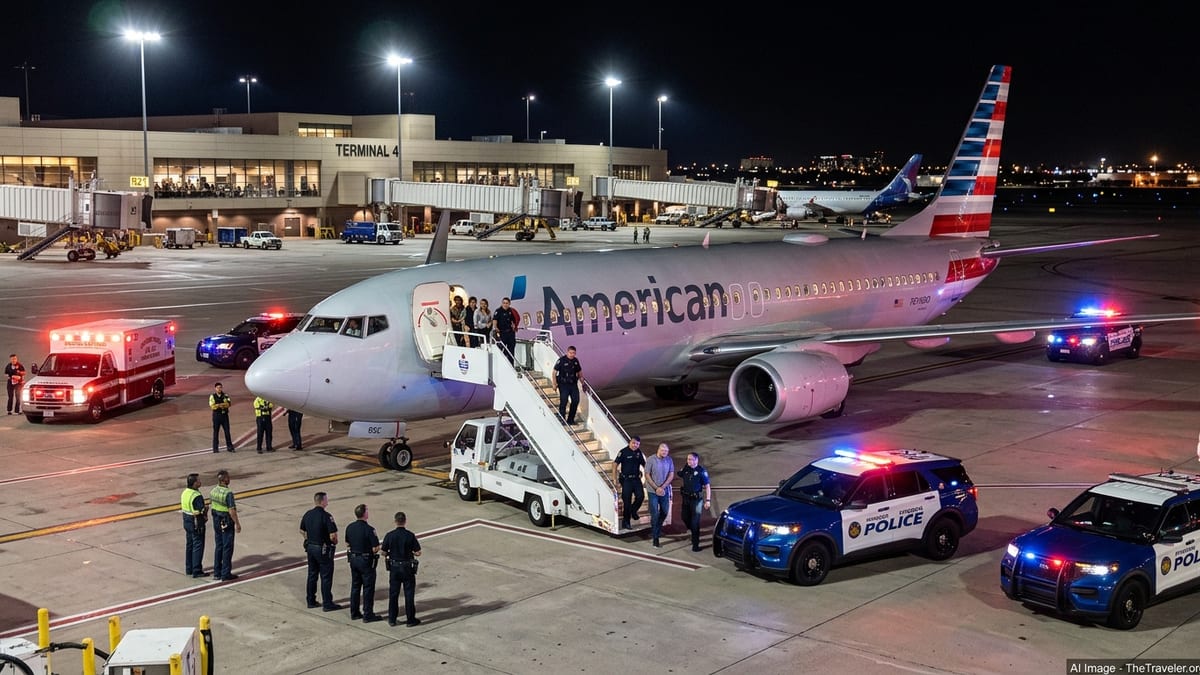
An American Airlines redeye from San Diego to Chicago was forced to divert to Phoenix Sky Harbor International Airport around 1 a.m. on November 25, 2026, after authorities say a disruptive passenger tried to manipulate an exit door in flight, prompting fellow travelers and crew to restrain him before the aircraft landed safely.
Get the latest news straight to your inbox!
What authorities say happened on American Airlines Flight 1494
American Airlines Flight 1494 departed San Diego International Airport late on Tuesday, November 24, 2026, operating an overnight service to Chicago O'Hare International Airport. According to statements from the airline and U.S. aviation authorities, the flight was en route over the Southwest when the crew reported a serious disturbance involving a male passenger and requested priority handling into Phoenix Sky Harbor International Airport.
The Federal Aviation Administration said Flight 1494 landed safely in Phoenix at about 1 a.m. local time on Wednesday, November 25, after the crew notified air traffic control of a passenger disturbance on board. Phoenix police similarly stated that a San Diego to Chicago flight diverted to Phoenix shortly after 1 a.m. because of what they described as a passenger-related incident that raised safety concerns.
Local police and multiple U.S. media outlets report that the man attempted to manipulate or tamper with an exit door during the cruise portion of the flight. Phoenix police have said they believe the passenger tried to open or interfere with the door while the aircraft was airborne, triggering an elevated threat level and a decision to divert as a precaution.
Passenger response on board and law enforcement actions on arrival
Video clips shared with local television stations in Chicago and Phoenix show at least two passengers and several flight attendants restraining a man in the aisle of the aircraft. In the footage, travelers appear to hold the passenger face down on the floor near a row of seats, while a crew member can be heard issuing instructions. According to multiple passenger accounts provided to broadcasters, several volunteers left their seats to assist the cabin crew once the disturbance escalated.
American Airlines has confirmed that the individual was restrained before landing and that law enforcement met the aircraft on arrival in Phoenix. Phoenix police said officers boarded the plane, detained the passenger and removed him from the aircraft. As of the latest official updates on November 26, authorities have not publicly released the man’s name or detailed charges, stating only that the investigation is ongoing and that federal partners, including the FAA, are reviewing the incident.
There have been no official reports of injuries to passengers or crew linked directly to the struggle on board. The airline and police have not indicated that any medical treatment was required beyond routine checks. No damage to the aircraft has been reported, and the FAA has not suggested any structural or mechanical issues arising from the attempt to manipulate the exit door.
Safety context: why exit-door incidents trigger diversions
Incidents involving aircraft doors in flight are treated as serious, even though commercial jet doors and emergency exits are engineered so they cannot be opened at cruising altitude because of cabin pressure and aircraft design. Under U.S. regulations, any attempt to interfere with cabin doors or emergency exits can still constitute tampering with aircraft systems and interfering with the duties of the crew, which are federal offenses subject to investigation and potential prosecution.
According to the FAA, U.S. carriers collectively have reported more than 1,500 incidents involving unruly passengers so far in 2026, ranging from refusal to follow crew instructions to physical confrontations and threats. Only a small subset involve attempts to open or tamper with aircraft doors, but those events typically prompt decisive action from flight crews, including diversions to the nearest suitable airport so authorities can meet the aircraft and assess the situation.
The FAA can pursue civil penalties for disruptive behavior that interferes with crew duties, while federal prosecutors may bring criminal charges in more serious cases, particularly where alleged conduct involves attempts to breach doors, assault crew or endanger the safe operation of a flight. The agency has emphasized in previous guidance that passenger noncompliance with safety instructions, especially in the confined setting of an aircraft cabin, can quickly escalate and affect the safety of everyone on board.
Impact on the San Diego–Chicago service and onward travel
American Airlines said Flight 1494 diverted to Phoenix “due to a disruptive customer” and confirmed that the aircraft landed normally and taxied to the gate under its own power. After law enforcement removed the passenger, the flight remained in Phoenix while the airline carried out what it described as operational checks and coordination before continuing. Local media reports indicate that passengers eventually traveled on to Chicago, though the precise delay from the original schedule has not been specified in official statements.
The diversion took place in the middle of one of the busiest U.S. travel weeks of the year, as airlines prepared for heavy Thanksgiving traffic. For travelers onboard Flight 1494, the unscheduled stop in Phoenix added extra time and uncertainty to an already long overnight journey between the West Coast and the Midwest. However, from an operational standpoint, Phoenix Sky Harbor is a major hub for American with significant staffing and aircraft handling capacity, which typically makes it easier to support a diverted flight, complete necessary security processes and arrange onward travel.
There has been no indication so far that the incident caused broader knock-on disruption across American’s network beyond the delay to the specific flight. As of November 26, the airline has not announced any schedule changes for subsequent San Diego–Chicago services related to the diversion, and regular operations on the route appear to be continuing. For most travelers, the event is expected to be felt primarily in the form of delay and disruption for those on Flight 1494 rather than as a systemic schedule issue.
What travelers should know when flights divert for unruly behavior
In the United States, federal rules give pilots and airlines broad authority to remove passengers or divert flights when they believe safety or security could be compromised. Guidance from the U.S. Department of Transportation explains that these decisions are based on information available to the crew at the time and are generally upheld as long as they are grounded in genuine safety concerns. For travelers, this means that serious misbehavior by a single passenger can trigger actions affecting everyone on board, including diversions, extended delays and missed connections.
When a diversion occurs, airlines typically prioritize getting the aircraft on the ground at the nearest suitable airport where safety, runway length, weather and operational support all meet minimum requirements. Once there, local law enforcement or federal agents can board the flight, and the airline will assess whether the aircraft can continue with the same crew, whether additional checks are necessary and how to re-accommodate passengers if schedules have been significantly disrupted.
For travelers flying in the coming days, particularly over peak holiday periods, industry and government agencies advise building extra time into itineraries, especially when connecting through busy hubs. While incidents involving attempts to tamper with aircraft doors remain rare, the case of Flight 1494 underlines that disruptive behavior can have serious consequences not only for the individuals involved but also for fellow passengers whose journeys may be extended or rerouted while safety protocols are followed.