


Most big-ship Alaska cruises actually follow just a few standard patterns. Understanding these patterns before you book is essential to setting realistic expectations about what you will see, which glaciers you will visit and how your days will really feel on board and ashore.
Get the latest updates straight to your inbox!
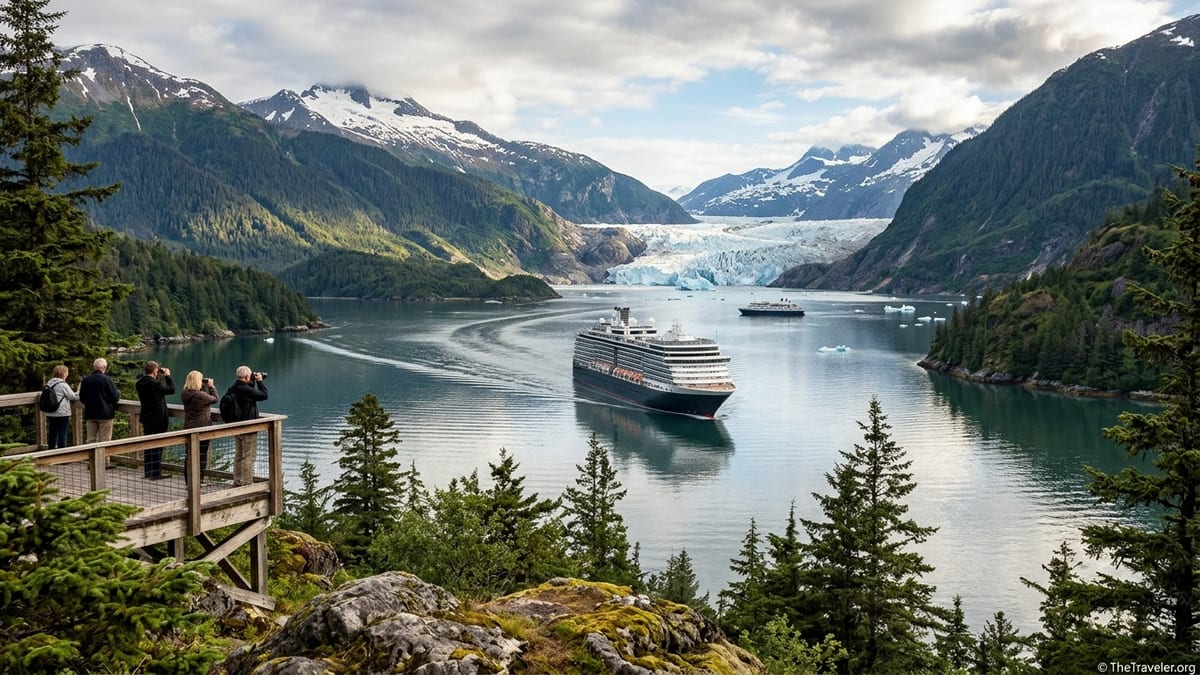
What “Inside Passage” Really Means
The Inside Passage is a natural sea route that runs for more than 1,000 miles from the Pacific Northwest to Southeast Alaska, threading through islands, narrow channels and fjords that shelter ships from the full force of the open Pacific. Official Alaska tourism and port organizations describe it as a network of protected waterways between Vancouver Island, the islands of coastal British Columbia and the Alaska mainland, with classic ports such as Ketchikan, Juneau and Skagway and at least one glacier viewing day on most cruise itineraries.
In the cruise industry, however, Inside Passage is also a marketing term. An itinerary may be labeled “Inside Passage” even if it includes stretches of exposed ocean, especially at the start and end of a Seattle round-trip where ships use the Strait of Juan de Fuca and sail outside the shelter of Vancouver Island. By contrast, many Vancouver departures follow a more continuously protected route north through British Columbia’s channels before reaching Southeast Alaska, although some still spend limited time in open water.
Official Alaska cruise itinerary guides note that the most common Alaska cruise today is a seven-night round trip from Seattle or Vancouver through the Inside Passage, usually with calls at Juneau, Ketchikan and Skagway and one major glacier day in Glacier Bay or a fjord such as Endicott Arm or Tracy Arm. Cruise brochures for 2026 and 2027 from lines like Princess and Holland America confirm that pattern, highlighting Seattle or Vancouver round trips with three main Southeast ports plus Glacier Bay or Dawes Glacier as the centerpiece.
For travelers, the key is to look beyond the label on the brochure and study the map. Identify which segments of the route hug island-dotted channels and which, if any, run along the outer coast in open ocean. This distinction affects not only scenic variety but also motion on the ship, which can matter if you are sensitive to seasickness.
Inside Passage Round-Trip Cruises: What You Actually Get
Inside Passage round-trip cruises are typically seven nights, sailing round trip from Seattle or Vancouver between late spring and early fall. The most common pattern is two full sea days and four port days plus one glacier-scenic day, although some eight-night itineraries add a fourth port or a second glacier experience. These sailings are the mainstream Alaska product offered by large lines such as Princess, Holland America, Norwegian Cruise Line, Royal Caribbean and others.
From Seattle, sample 2026 itineraries show routes like Seattle to Ketchikan, then Endicott Arm and Dawes Glacier for scenic cruising, followed by Juneau, Skagway, a brief call in Victoria in Canada and back to Seattle. Another frequent variation substitutes a full day in Glacier Bay National Park instead of Dawes Glacier. Round trips from Vancouver generally include a more continuous run through the protected Inside Passage in British Columbia, then on to the familiar trio of Juneau, Skagway and Ketchikan, sometimes adding Sitka, Icy Strait Point or Prince Rupert as a fourth port.
Glacier experiences on these cruises vary by line and by date. Some departures have a coveted permit for Glacier Bay, where ships typically spend much of a day viewing tidewater glaciers like Margerie Glacier with national park rangers narrating on board. Others go to fjords such as Endicott Arm or Tracy Arm to view Dawes Glacier or Sawyer Glacier, or to a large tidewater glacier like Hubbard on longer or specialized routes. Recent glacier guides from Alaska cruise associations emphasize that travelers need to check the exact glacier listed on their sailing, because two itineraries marketed under nearly identical names can feature different glacier days.
Logistically, Inside Passage round trips are straightforward. Seattle offers plentiful direct flights from across the United States and easy pre- and post-cruise hotel options. Vancouver is a little farther for some U.S. travelers but rewards with a more scenic sheltered route, and its downtown cruise terminal is directly connected to the city center. For many first-time visitors or families, a round-trip Inside Passage cruise from one of these ports offers the simplest combination of flights, hotel nights and cruise planning.
Gulf of Alaska One-Way “Voyage of the Glaciers” Routes
Gulf of Alaska itineraries, often branded as “Voyage of the Glaciers” or “Glacier Route,” run one way between Vancouver and either Whittier or Seward, which are the deep-water cruise ports for the Anchorage region. These sailings are also commonly seven nights, but instead of returning south, they continue across the Gulf of Alaska and into Southcentral Alaska, providing a bridge between coastal cruising and inland exploration.
Examples from Princess, Holland America and other lines show typical northbound routes of Vancouver, a sea day in the Inside Passage, Ketchikan, Juneau, Skagway, a day in Glacier Bay National Park, then College Fjord or Hubbard Glacier before arriving in Whittier or Seward. Southbound versions reverse this pattern. Industry comparison guides note that many Voyage of the Glaciers itineraries now offer two glacier days, often pairing Glacier Bay with College Fjord or Hubbard Glacier, giving more total time in icy scenery than most standard round trips.
The key difference is geography. After leaving the Inside Passage around Glacier Bay or nearby Icy Strait, the ship crosses the open Gulf of Alaska, which can feel noticeably rougher than the sheltered channels to the south. In return, you gain access to the fjords and glaciers of Prince William Sound or Yakutat Bay and finish much closer to Anchorage, with road and rail links to interior destinations like Denali National Park and Fairbanks.
Logistically, one-way Gulf of Alaska cruises require more complex air arrangements. You will typically fly into Vancouver and out of Anchorage, or vice versa, and need to account for transfer time between Anchorage and the cruise port in Whittier or Seward. Cruise lines and local operators provide rail and coach transfers, including connections on the Alaska Railroad, but you should factor these into your budget and schedule. For travelers who want to combine a cruise with several days on land in mainland Alaska, industry experts often point to these one-way itineraries as the most efficient backbone.
Small-Ship and Expedition Itineraries: Narrow Inlets and Remote Communities
While the big-ship patterns dominate Alaska cruise traffic, a growing number of travelers choose small-ship or expedition itineraries that trade marquee ports for narrower inlets, secluded coves and more intensive wildlife viewing. These ships, often carrying from a few dozen to a few hundred guests, can anchor in places that are inaccessible or impractical for large vessels.
Current small-ship itineraries commonly sail between Juneau and Sitka or between Juneau and Ketchikan over seven to twelve nights. Route descriptions from expedition operators highlight days spent in Chichagof Island’s bays, Frederick Sound, Tracy Arm or Endicott Arm, Misty Fjords and other wilderness areas, often without scheduled visits to Skagway or Ketchikan’s cruise dock. Instead of a single big glacier day from a distance, guests may explore by skiff or kayak at the base of tidewater glaciers, or hike on shore in remote areas.
Some itineraries push even farther from the mainstream, for instance ten-night voyages along the Alaska Peninsula and Aleutian Islands from Kodiak or Seward to Dutch Harbor, with landings at small communities, wildlife refuges and volcanic islands. These expeditions focus more on birdlife, marine mammals and cultural history than on the classic Southeast port trio, and they operate with strict caps on guest numbers.
Logistically, small-ship cruises usually require flights into smaller Alaskan hubs such as Juneau, Sitka or Kodiak and may not connect neatly with major international routes. Prices are often higher per night than mainstream big-ship cruises, but the inclusions can be broader, with guided excursions, wildlife experts and gear bundled into the fare. For travelers who value wilderness time and flexibility over shopping streets and large-scale entertainment, this category offers a very different way to experience Alaska’s coastline.
Reading and Comparing Real Itineraries
Because labels can be imprecise, the most important planning skill is learning how to read the fine print of an Alaska cruise itinerary. Start with the basics: embarkation and disembarkation ports, number of nights and the sequence of sea days and port days. A typical Inside Passage round trip from Seattle or Vancouver is seven nights with three main ports and one glacier day, whereas a Gulf of Alaska one-way usually includes the same three ports plus two distinct glacier days and finishes near Anchorage.
Next, look carefully at how the glacier experience is described. Glacier Bay National Park appears on schedules only when the ship has a limited park permit for that specific date; if Glacier Bay matters to you, confirm it is explicitly listed. Alternatives might be Hubbard Glacier, College Fjord, Endicott Arm and Dawes Glacier, Tracy Arm or another named bay. Industry glacier guides emphasize that two itineraries marketed with very similar names can differ significantly in glacier time, so comparing the actual port and scenic cruising lines day by day is essential.
Also distinguish between a port of call and a scenic cruising day. A line like “Endicott Arm and Dawes Glacier (Scenic Cruising)” generally means you will not disembark but will spend several hours sailing in a fjord, often with narration and viewing from the decks. A port listing such as “Juneau, 1 p.m. to 9 p.m.” signals that you can go ashore for excursions and independent wandering. Pay attention to time in port: a full day in Juneau or Skagway offers very different possibilities than a short morning call, especially when popular shore trips can last four to six hours.
Finally, check whether each port uses a dock or tenders, where passengers transfer to small boats to reach shore. Some Alaskan ports have limited dock space, and ship schedules or port authority listings sometimes show which ships are anchored versus berthed on a given date. Tendering can add transit time and occasionally be affected by weather or sea conditions, which matters if you are planning independent excursions with fixed departure times. Tide and daylight also shape certain transits, such as entering narrow fjords, so departure times for scenic cruising days may shift within the season.
Side-by-Side Itinerary Examples and Trade-Offs
Imagine two seven-night Inside Passage cruises. One round trip from Seattle lists Seattle, a sea day, Juneau, Skagway, Glacier Bay scenic cruising, Ketchikan, Victoria and back to Seattle. The other round trip from Vancouver lists Vancouver, a full day at sea in the Inside Passage, Ketchikan, Juneau, Skagway, another Inside Passage sea day and return to Vancouver. Both visit three key Southeast ports, but the Seattle route includes Glacier Bay and a quick foreign-port call in Victoria, while the Vancouver route devotes more total time to sheltered Canadian Inside Passage scenery and may feature a different glacier such as Dawes or Tracy Arm on certain dates.
Now compare two Gulf of Alaska one-way routes. A northbound Voyage of the Glaciers might read Vancouver, Inside Passage cruising, Ketchikan, Juneau, Skagway, Glacier Bay, College Fjord and Whittier. A competing sailing could substitute Hubbard Glacier for College Fjord or add Icy Strait Point instead of repeating the three classic ports. In both cases you gain two glacier experiences and end within reach of Anchorage, but the exact combination of glacier bays and ports will affect your excursions, wildlife chances and photography.
Small-ship itineraries look very different on paper. A Juneau to Sitka expedition might show almost no familiar town names at all: instead you will see “Tracy Arm Fjord,” “Chichagof Island bays,” “Frederick Sound” and “Misty Fjords,” with multiple days listed simply as exploration or wilderness cruising. These schedules are intentionally flexible so the captain can follow whales or adjust landings to weather, which is an advantage if you prize spontaneity but a drawback if you want guaranteed shopping time in Skagway.
When you place these patterns side by side, the trade-offs become clearer. Seattle round trips usually win on simple air connections for United States travelers. Vancouver round trips often offer more continuous sheltered scenery but may require a passport and sometimes a connecting flight. Gulf of Alaska one-ways maximize glacier and inland-access potential at the price of more complex flights and a stretch of open Gulf sailing. Small ships maximize wilderness immersion but reduce the number of big-name ports and large-ship amenities.
Other Variations: Repositioning, Yukon & BC Ports, and Land-Sea Packages
Beyond the standard seven-night patterns, cruise lines offer a web of variations that might appeal if you have more time or specific regional interests. At the start and end of the Alaska season, some ships operate longer repositioning cruises between Alaska and home ports in California, the Pacific Northwest or even Asia. These can include extra sea days along the West Coast, additional British Columbia stops or extended Gulf of Alaska sailing, and typically run ten to fourteen nights or more.
There are also itineraries that fold in lesser-visited ports in British Columbia and the Yukon. Some Vancouver-based cruises now add Prince Rupert as a fourth port alongside Juneau, Skagway and Ketchikan, while certain land-sea combinations connect Skagway to Yukon communities by rail and coach. These additions can offer a taste of gold-rush history or smaller coastal towns without giving up the core Inside Passage experience.
Hybrid land-sea packages are especially common on Gulf of Alaska routes. Major lines bundle one-way cruises with three to seven day land tours that begin or end in Anchorage, visiting Denali National Park, the Alaska Railroad and interior towns such as Fairbanks or Talkeetna. These packages simplify logistics by integrating hotels, transport and baggage handling, though they add cost and structure. Detailed planning for these land tours is a topic in itself, but it is important to recognize that choosing a one-way Gulf of Alaska sailing is typically the starting point for such combinations.
Travelers should keep in mind that these longer or more complex itineraries are more date-specific, often tied to the ship’s broader deployment schedule. Availability can be limited to a few departures each shoulder season, so flexibility on travel dates is helpful if you are targeting a repositioning cruise or a particular combination of ports.
Matching Itinerary Types to Your Priorities
Different Alaska cruise patterns suit different travelers. If your top priority is maximizing glacier time, one-way Gulf of Alaska routes that specifically list two glacier days, such as Glacier Bay combined with College Fjord or Hubbard Glacier, generally provide the most concentrated ice viewing. You can often extend your glacier exposure further with day-boat trips from Seward or Whittier to Kenai Fjords or Prince William Sound either before or after the cruise.
If minimizing seasickness risk matters most, many travelers find that round-trip Inside Passage cruises, especially those from Vancouver that spend more time in sheltered channels, tend to offer smoother sailing overall than routes that cross the open Gulf of Alaska. That said, no itinerary can guarantee calm seas, and exposed segments exist even on some Inside Passage cruises, so motion-sickness preparation is still wise.
Travelers focused on seeing as many ports as possible, with vibrant shore excursions and cultural experiences, may prefer round-trip itineraries that include three or four Southeast Alaska ports plus a glacier day. Lines sometimes add Sitka, Icy Strait Point or Prince Rupert to the classic trio, which can diversify your time ashore without extending the cruise length. If you want more wilderness and fewer cruise-town storefronts, a small-ship or expedition route that devotes multiple days to fjords and remote anchorages will be a better fit.
Finally, if your goal is to combine a cruise with significant time in mainland Alaska, from Denali to the Arctic Circle, a one-way Gulf of Alaska sailing that begins or ends near Anchorage is usually the best foundation. These routes integrate smoothly with rail journeys, road trips and guided land tours, letting you experience both the coastal fjords and the broad river valleys and mountains of the interior in a single trip.
How to Use Itinerary Patterns to Choose Your Cruise
The most effective way to choose an Alaska cruise is to start with the itinerary pattern that best matches your priorities, and only then compare cruise lines, ships and prices within that framework. Decide first whether you want a round-trip Inside Passage cruise, a one-way Gulf of Alaska voyage or a small-ship expedition-style route focused on wilderness and wildlife. That decision instantly narrows the universe of sailings and clarifies your likely ports, glacier options and flight needs.
Once you have chosen the pattern, compare at least two or three real itineraries side by side. Confirm the exact glacier listed, the number and duration of port calls, and whether those ports are dock or tender stops. Check embarkation and disembarkation logistics, including passport requirements and flight schedules to Seattle, Vancouver or Anchorage. Look at shoulder-season versus peak-season dates, which can affect daylight hours and wildlife sightings as well as price.
Only after this step should you focus on ship personality and onboard experience. Within a given route, one line might offer a more traditional style with enrichment lectures and quiet lounges, another might emphasize families and large-scale entertainment, and a third could lean into culinary experiences. Because most large lines follow similar port patterns on a given route, choosing your itinerary type first ensures that the brand and ship you select deliver the Alaska you actually want to see.
By approaching the decision this way, you turn Alaska cruise planning from an overwhelming list of brand names and sale fares into a clear, structured choice among a handful of proven route types. Once you understand what Inside Passage, Gulf of Alaska and expedition itineraries genuinely offer, you can book with confidence, knowing exactly what your days of glaciers, mountains and coastal towns will look and feel like.