


More news on this day
A fast‑deepening coastal storm bringing heavy rain, strong winds and coastal flooding to the Mid‑Atlantic and Northeast on Thursday 26 November 2026 has prompted major U.S. airlines to introduce limited‑time travel waivers, letting many Thanksgiving passengers scheduled through East Coast hubs move flights without standard change fees or, in some cases, added fare costs.
Get the latest news straight to your inbox!
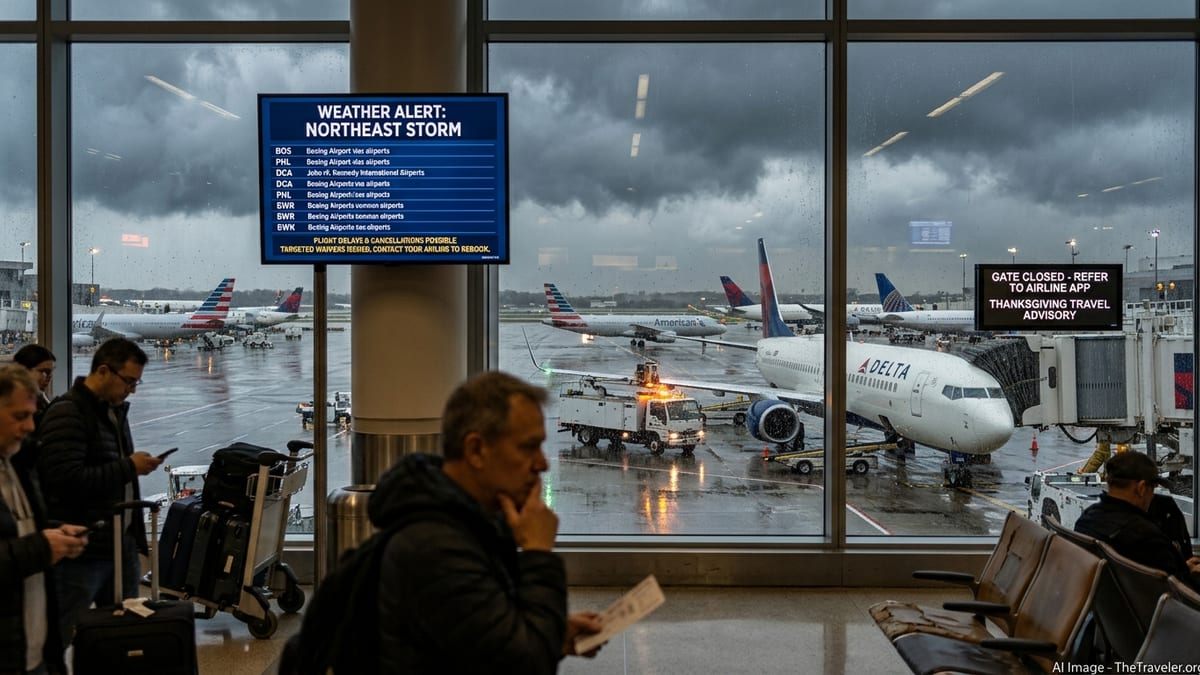
Storm forecast triggers targeted waivers at busy Northeast hubs
National Weather Service forecasts describe a coastal low strengthening along the Eastern Seaboard on Thanksgiving Day, with heavy rain, strong easterly winds and coastal flooding from the Carolinas into southern New England. Advisories in place on Thursday mention wind gusts at advisory level inland and damaging gusts closer to the coast, along with 2 to 5 inches of rain for parts of the Mid‑Atlantic and Northeast and coastal flood warnings around tidal peaks in vulnerable areas.
Meteorologists expect the worst conditions from Thursday afternoon into early Friday for many major aviation markets, including the New York area, Philadelphia, Baltimore and Boston. The combination of low cloud ceilings, strong crosswinds and potential standing water on runways raises the risk of arrival and departure delays, ground stops and flow‑control measures at already congested Thanksgiving gateways. Forecast discussions from local weather offices explicitly flag the potential for travel disruption and recommend that holiday travelers consider adjusting plans where possible.
The storm arrives during one of the busiest travel periods of the year. AAA’s national holiday outlook projects that about 81.5 million people in the United States will travel at least 50 miles from home between Tuesday 24 November and Monday 30 November, only slightly below last year and still near record levels. Airline trade and federal data indicate that carriers scheduled dense holiday operations into major East Coast hubs, limiting spare seating capacity to absorb disruptions once the storm’s impacts peak.
Delta, American and United outline change windows for Thanksgiving flights
Delta Air Lines has issued what it describes as a Northeast Thanksgiving weather waiver for customers booked to travel on Thursday 26 November to, from or through a defined list of East Coast airports. According to a summary published by an aviation news outlet and consistent with Delta’s advisory, eligible customers with tickets dated for November 26 can change to another flight departing no later than Saturday 28 November, provided they keep the same origin and destination and the same fare type. For rebooked travel within that window, Delta is waiving both its standard change fee and, in most cases, any fare difference when customers remain in the same cabin.
The waiver covers nine major Northeast gateways, including Boston Logan, New York John F. Kennedy, LaGuardia, Newark Liberty, Philadelphia, Baltimore/Washington and at least two additional regional hubs. Delta’s advisory specifies that all published fares, including typically restrictive basic economy tickets, qualify if they were purchased by the cutoff date set out in the waiver. Customers who choose to move outside the permitted dates or to a different routing can still change under Delta’s general no‑change‑fee policy on most domestic tickets but may then be liable for any difference in fare.
American Airlines has posted a parallel Thanksgiving travel alert focused on many of the same storm‑exposed airports. Its current travel alerts page confirms that customers scheduled to fly on November 26 who bought tickets by November 23 can make a one‑time change without a change fee, as long as they keep the same origin and destination and travel between November 23 and November 29. American states that a fare difference may apply in some circumstances, for example when only more expensive remaining seats are available, but removing the fee itself lowers the cost for passengers trying to move away from the forecast peak of the storm.
United Airlines has adopted a slightly more segmented approach. The carrier has an active “Northeast Coastal Storm” travel waiver dated for November 26 that allows customers booked through several East Coast airports, including Boston, Newark, LaGuardia, Philadelphia, Baltimore/Washington and the Washington, D.C. airports, to change to other United or United Express flights departing between November 25 and November 28 without a change fee, provided they travel between the same city pair and in the same cabin. United has also published a separate “St. Louis Winter Weather” waiver for November 26, offering similar flexibility within a defined window for passengers scheduled through Missouri as a different storm system brings wintry precipitation to parts of the Midwest.
Southwest’s policy and how the waivers actually work
Southwest Airlines, which does not normally charge change fees on its tickets, has also issued weather‑related advisories linked to the Thanksgiving storm. For several East Coast airports expected to experience the heaviest rain and strongest winds on Thursday, Southwest is temporarily allowing customers to switch to other flights within a specified period, in some cases up to 14 days from the original travel date, without paying a fare difference. The practical effect is that travelers can shift off the highest‑risk hours of November 26 at no extra cost, something that is not always available under Southwest’s usual rules when new flights are selling at higher prices.
Across all four major carriers, the Thanksgiving waivers share several common structures that determine who benefits. Most apply only to tickets issued by a particular date, generally November 23 or 24, and focus on itineraries scheduled for travel on November 26. Passengers who purchase new tickets after a waiver is announced typically fall under each airline’s standard conditions rather than the special holiday exception, even though regular post‑pandemic policies still eliminate change fees on many domestic fares.
The waivers also typically require that customers keep their original origin and destination airports in order to qualify for free changes. In practice, this means that a traveler booked from Boston to Orlando for a Thanksgiving arrival can move that trip to another day within the waiver window, but could not use the policy to rebook instead from Boston to a different destination such as Tampa without incurring the usual fare recalculation. Where fare differences are waived, that generally applies only within a limited date range, and in the same cabin, which concentrates flexibility around the period when the National Weather Service expects the storm to cause the greatest disruption.
None of the policies currently in place convert weather delays or cancellations into an automatic obligation for airlines to pay for hotels, meals or ground transport. U.S. carriers classify storms and associated air traffic control restrictions as outside their control for compensation purposes. Federal guidance and each airline’s customer service dashboard distinguish clearly between controllable causes, such as crew misplacement or maintenance issues, and uncontrollable events like severe weather. The Thanksgiving waivers are therefore best understood as tools to encourage voluntary rebooking and to reduce pressure on the busiest storm‑affected travel day, not as guarantees of vouchers or reimbursements if flights are later delayed.
Interaction with recent system issues and constrained holiday capacity
The new holiday weather waivers come on top of a month already marked by several high‑profile operational problems. Within the last two weeks, the Federal Aviation Administration ordered a rare nationwide ground stop following an air traffic control systems issue, and major carriers including United and American introduced waivers to help passengers rebook without penalty. Shortly after that disruption, Delta reported an automation malfunction affecting its weight‑and‑balance calculations on Sunday 22 November, which led to widespread delays as flights were held until corrected data could be loaded.
Airlines report that they have largely recovered from those earlier technology‑driven incidents, and there is no current nationwide ground stop in effect on Thanksgiving Day itself. However, residual sensitivities remain: aircraft and crew rotations are tight at the best of times during the holiday peak, and any local weather‑related ground stop or extended holding pattern at key hubs reduces the margin for recovery. Analysts and federal briefings have highlighted that, when heavy travel demand and severe weather coincide within a network still readjusting from recent outages, moderate local issues can propagate into multi‑airport delays.
The broader holiday demand picture adds to the challenge. Travel forecasts from AAA and industry groups suggest that while Thanksgiving 2026 may come in slightly below the absolute records set just before the pandemic, air passenger volumes between November 20 and November 30 remain very high. Airlines scheduled dense banks of flights into New York, Boston, Washington, Chicago and other connecting hubs, leading to high load factors on many services. That reduces the number of open seats available to rebook passengers if Thanksgiving afternoon and evening flights in the Northeast are significantly disrupted, particularly for travelers hoping to arrive in time for evening gatherings.
There is also a pronounced regional imbalance in weather risk. Forecast maps for Thanksgiving show relatively calm and, in some cases, warmer‑than‑average conditions across broad swathes of the central and western United States. Passengers traveling entirely within those regions may see little weather‑related disruption and will not typically be covered by the Northeast‑focused waivers. By contrast, travelers whose itineraries touch any of the storm‑exposed coastal airports are more likely to encounter cascading delays, even if their departure or final destination is in a different part of the country, because connecting flights are tightly linked to hub operations.
What Thanksgiving travelers should verify and how to use the waivers
For travelers with flights scheduled on Thursday 26 November or on the surrounding days, the most important immediate step is to check whether their specific itinerary includes any airports named in the active weather waivers. Each airline’s website and mobile app hosts a travel alerts or travel waivers section that lists covered cities, eligible ticket purchase dates, permitted new travel dates and any conditions on fare differences. Because these policies are detailed and differ between carriers, passengers should not assume that all East Coast flights automatically qualify, even if they depart on Thanksgiving.
Once coverage is confirmed, travelers who have flexibility in their plans may wish to move their flights away from the hours when the storm’s impacts are expected to be greatest. For many routes through the Mid‑Atlantic and Northeast, that could mean rebooking to earlier departures on Wednesday evening or early Thursday morning, before the strongest winds reach their peak, or to Friday once local forecasts show conditions improving. Inventory on alternative flights is already limited on some routes because of heavy holiday demand, so passengers who intend to use the waivers are generally better served by making changes as soon as possible rather than waiting for day‑of‑travel disruption.
Those who decide to keep their original Thanksgiving plans should prepare for a slower journey. In practice this can involve allowing extra time to reach the airport in wet and windy conditions, signing up for airline notifications and checking flight status frequently, and understanding in advance what their carrier typically offers in terms of meal vouchers or overnight accommodation in the event of long delays. Travelers connecting through multiple hubs should pay particular attention to minimum connection times and consider earlier departures if an option exists under the waiver, since even modest inbound delays can cause missed onward flights on a busy holiday afternoon.
Looking beyond Thanksgiving Day, the coastal storm is expected to move northeastward and weaken heading into the weekend, with forecasts pointing to improving conditions across much of the Mid‑Atlantic and New England by Saturday. Airlines are likely to update, narrow or withdraw their special waivers as the weather system moves away and operational impacts become clearer. Passengers with travel booked later in the holiday period should therefore continue to monitor both local forecasts and carrier travel alert pages, in case the current waivers are adjusted or new, more targeted policies are issued for residual disruptions or for separate weather systems affecting other parts of the country.