


More news on this day
The United States has updated its travel advisory for mainland China to highlight the risk of wrongful detention of U.S. citizens, adding a new warning indicator to official guidance while leaving the overall alert at Level 2, or “Exercise increased caution.”
Get the latest news straight to your inbox!
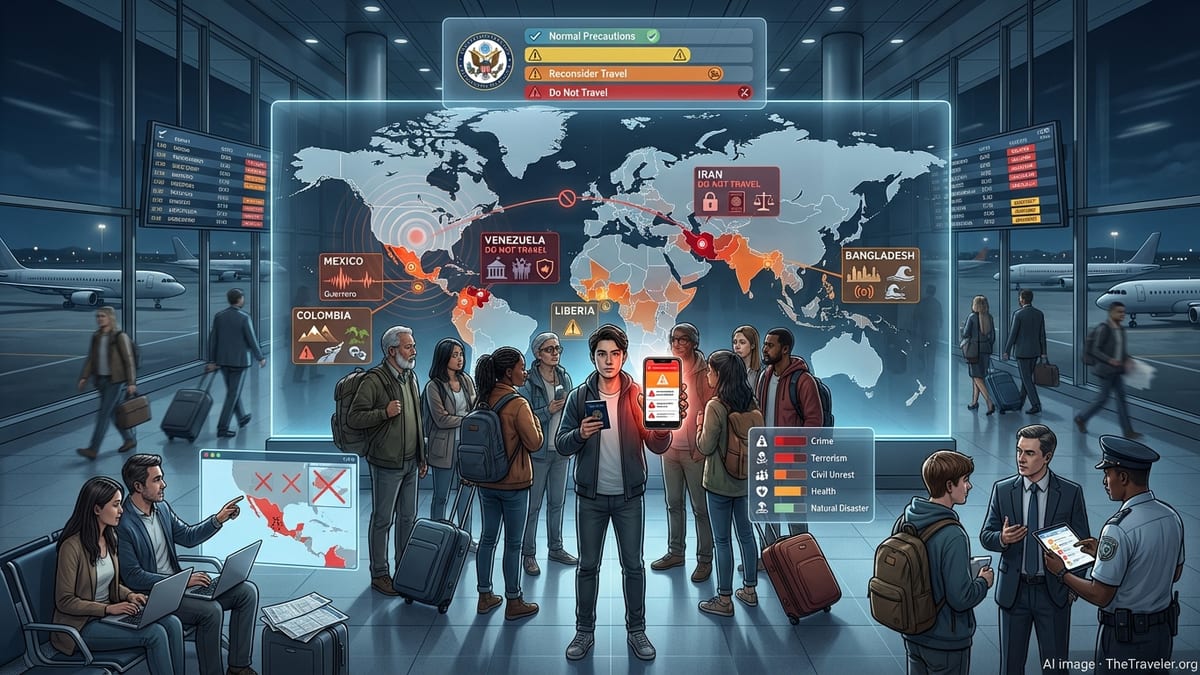
New “D” Indicator Highlights Detention Risks
Publicly available information from the U.S. State Department shows that on October 19, 2026, the China travel advisory was reissued with a new risk marker for wrongful detention, identified as the “D” indicator. The overall advisory for mainland China remains at Level 2, meaning travelers are urged to exercise increased caution rather than reconsider or avoid travel.
The advisory notes concerns over the arbitrary enforcement of local laws, the use of exit bans without clear legal process and the risk that foreign nationals, including U.S. citizens, could face detention that may later be deemed wrongful under U.S. law. The new designation puts China in a small group of destinations where Washington formally warns of the possibility that detentions could be politically motivated or otherwise unjust.
Advisory history on official platforms shows that China’s travel warning was previously updated in November 2024, when the overall level was lowered from Level 3, “Reconsider travel,” to Level 2. Subsequent updates in 2026 refined language on legal risks and surveillance, and the latest notice specifically adds wrongful detention to the list of highlighted concerns.
The wrongful-detention marker aligns with broader U.S. policy changes in recent years that seek to call out governments accused of using foreign nationals as leverage. Government notices and legal documents indicate that the “D” indicator is applied when the Secretary of State determines there is a pattern of detentions that may be arbitrary, linked to a traveler’s nationality or used to influence U.S. policy.
Arbitrary Enforcement, Exit Bans and National Security Laws
The State Department’s China advisory describes a legal environment in which travelers may face unpredictable application of laws, including broad national security and state secrets provisions. Reports indicate that foreigners in mainland China, including business travelers, academics, journalists and individuals with family or professional ties to politically sensitive issues, have encountered questioning, surveillance and detention related to such laws.
Guidance on official pages warns that exit bans can be imposed to prevent individuals from leaving the country during investigations or civil disputes. These measures may not always be communicated clearly in advance, and travelers can discover an exit restriction only at the airport or a border checkpoint. In some cases, people have been blocked from departing even when they are not formally charged with a crime.
Public summaries of U.S. hostage and wrongful-detention policy note that detentions can be considered wrongful for reasons such as discrimination based on nationality, denial of due process, or efforts to pressure the United States. While individual cases are typically handled privately, congressional records and policy statements have cited China among the countries where U.S. nationals have been held under circumstances Washington regards as arbitrary or politically driven.
The advisory also refers to enhanced monitoring and limitations on privacy for foreign visitors. Travelers are advised that hotel stays, electronic communications and financial transactions may be subject to scrutiny and that certain online content or private messages could attract official attention if deemed politically sensitive or critical of authorities.
Policy Context and Congressional Pressure
The addition of a wrongful-detention warning comes against the backdrop of expanding U.S. legislation and executive actions aimed at addressing the detention of Americans abroad. Federal statutes such as the Robert Levinson Hostage Recovery and Hostage-Taking Accountability Act created a formal framework for designating detentions as wrongful and for coordinating efforts to assist affected families and negotiate releases.
In recent sessions of Congress, resolutions and draft measures have specifically referenced China when discussing the use of detention as a diplomatic tool. Publicly available congressional documents show that lawmakers have urged the executive branch to strengthen language in the China travel advisory, including separate calls to add a “D” indicator and to scrutinize whether the overall risk level should be raised.
In parallel, presidential directives in 2025 and subsequent policy statements emphasized a strategy of “peace through strength” that includes sanctions, visa restrictions and other tools for governments identified as engaging in wrongful detention of U.S. nationals. These measures are intended both to deter new cases and to increase pressure in ongoing ones, without halting legitimate travel or exchange outright.
Advocacy groups focused on hostage and detainee issues have welcomed clearer labeling of risk indicators in official advisories, according to open-source commentary, arguing that the visibility of a wrongful-detention warning can influence how travelers, universities and companies assess the safety of sending people to particular destinations.
Practical Implications for Travelers to China
For individual travelers, the advisory update does not impose new legal restrictions on visiting China but signals that the U.S. government views the risk profile differently than it did before the wrongful-detention marker was added. The State Department recommends that U.S. citizens considering travel carefully review the full advisory text, including sections on entry and exit requirements, local laws and dual-nationality issues.
Business travelers are urged in public guidance to conduct thorough risk assessments, especially if activities involve sectors that could intersect with export controls, data security or national security concerns. Compliance teams are encouraged to stay current with both U.S. and Chinese regulations to reduce exposure to legal disputes that could escalate into criminal investigations or travel bans.
Families of dual nationals and individuals with personal ties to politically sensitive topics are advised to be particularly cautious. Official materials note that Chinese authorities may treat dual nationals solely as Chinese citizens, limiting the ability of U.S. consular officers to provide assistance if there is an arrest or exit ban. This dynamic can complicate efforts to secure access, legal representation or information on a person’s whereabouts.
The advisory further encourages all U.S. travelers to enroll in the Smart Traveler Enrollment Program before departure. This free registration allows embassies and consulates in China, including those in Beijing, Shanghai, Guangzhou, Shenyang and Wuhan, to send security updates and to contact citizens more easily in emergencies ranging from natural disasters to legal difficulties.
What Travelers Should Monitor Next
While the wrongful-detention warning is already reflected in the advisory’s risk indicators, further changes remain possible. Congressional documents and public statements have called for a review of whether China’s overall level should remain at “Exercise increased caution” or be raised to “Reconsider travel” if conditions deteriorate or additional cases emerge.
Travelers are encouraged to keep track of updates on the advisory’s date of issue and any revisions to risk indicators or summary language. Official history pages show that advisories may be reissued multiple times in a year as security conditions, legal frameworks or diplomatic relations evolve.
Those planning trips several months in advance may wish to revisit the advisory closer to their departure date, since new policies or high-profile incidents can prompt adjustments. Similar wrongful-detention markers have appeared in advisories for other countries, and changes have at times followed developments such as new arrests, court rulings or shifts in bilateral negotiations.
For now, the addition of the wrongful-detention indicator serves as a prominent warning that, even as travel between the United States and China resumes after pandemic-era disruptions, legal and political risks remain central considerations for U.S. citizens deciding whether, when and how to visit the country.