


More news on this day
The United States has reissued its travel advisory for Ecuador, maintaining a complex security picture in which one urban area remains under the strictest Level 4 “Do Not Travel” warning even as the country overall stays at a lower alert level.
Get the latest news straight to your inbox!
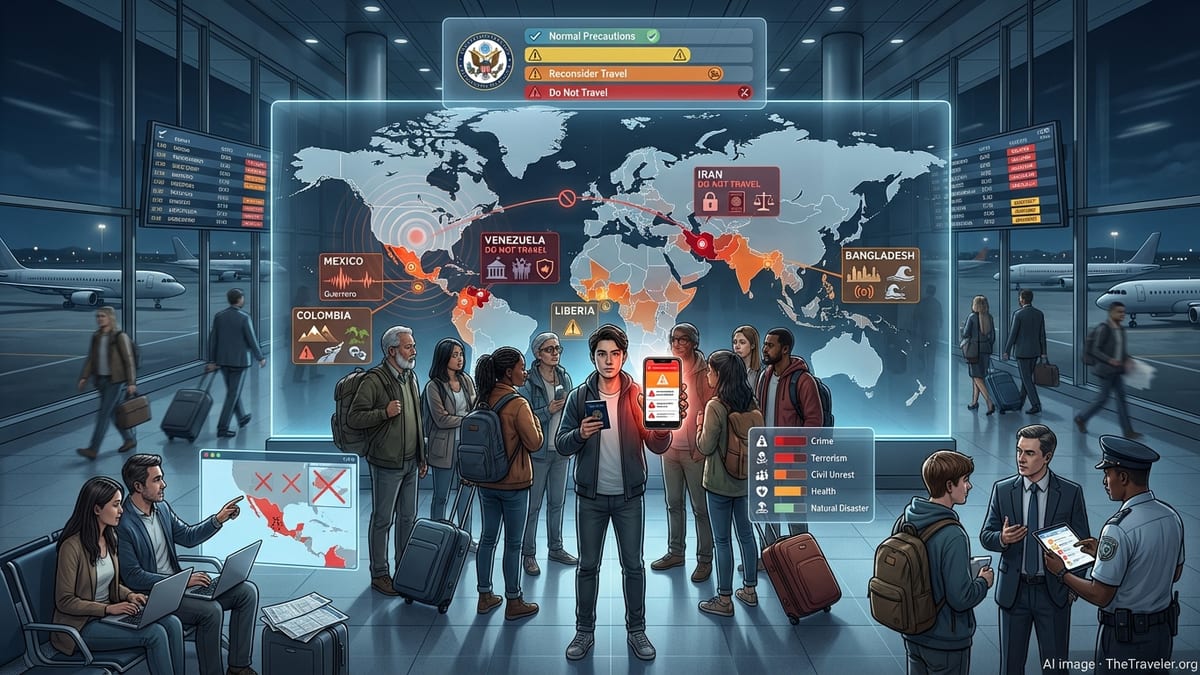
Advisory Reissued with Mixed Risk Profile
Publicly available information indicates that the latest US State Department advisory for Ecuador, issued on August 18, 2026, keeps the country’s overall rating below the highest global risk tier, but underscores a patchwork of security conditions across regions. Reports describe Ecuador as remaining at an intermediate nationwide level on a four-step scale, reflecting persistent concerns over crime, terrorism, unrest, and kidnapping without classifying the entire territory as off limits.
The advisory update follows a period of prolonged insecurity, particularly along the Pacific coast and near the border with Colombia, where transnational criminal groups and local gangs have expanded their activities. Domestic and international coverage note that homicide rates, extortion, and bomb attacks surged in recent years, especially around major ports and logistics hubs, drawing sustained attention from foreign governments and risk analysts.
While the advisory does not change Ecuador’s overall tier, it reiterates that the security environment can shift quickly, especially in areas where criminal organizations dispute territory. Travelers are urged, according to open-source guidance, to monitor local media, remain alert in crowded urban zones, and be prepared to change plans on short notice if conditions deteriorate.
One Area Remains at Level 4 “Do Not Travel”
Despite the broader country rating, the United States continues to single out a specific urban district as Level 4, the highest risk category under its system. At this level, travel is strongly discouraged due to the potential for violent crime and limited ability for outside actors to assist in an emergency. The designation reflects a concentration of gang-related activity, targeted killings, and other serious offenses that have made the zone a focal point for Ecuador’s internal security challenges.
Earlier US advisories and subsequent institutional summaries highlight parts of Guayaquil, Ecuador’s largest city and principal commercial port, as especially exposed to organized crime. References to areas south of key arteries in the city and adjacent municipalities describe a pattern of assassinations, extortion, kidnappings, and bombings attributed to transnational criminal groups and local gangs. These conditions have kept one district within the metropolis at Level 4 even as surrounding regions register slightly lower, though still elevated, ratings.
Academic and institutional travel guidance drawing on the US advisory notes that restrictions for government personnel often mirror the Level 4 designation. Such limitations are typically cited as evidence that security incidents are frequent and unpredictable, and that movement in and out of the affected neighborhoods is tightly controlled or requires special authorization.
New Level 3 Zones Along the Coast
The August 2026 update also reshapes the map of Level 3 “Reconsider Travel” areas, particularly along Ecuador’s coastal provinces. Coverage in Ecuadorian media details how Manabí and Santa Elena were recently added to the list of territories where travelers are urged to reassess nonessential trips because of crime and terrorism risks. These provinces join existing Level 3 zones that include parts of Guayas, Los Ríos, El Oro, Esmeraldas, Sucumbíos, and Santo Domingo.
Local reporting describes how coastal cities have become contested spaces for rival criminal groups seeking control over drug routes, ports, and highways. Periodic curfews, security operations, and states of emergency have been implemented in some municipalities as authorities respond to attacks on police stations, explosions near public buildings, and targeted violence in commercial districts.
International travel advisories from other governments echo concerns about Ecuador’s coastal corridor, advising heightened caution or discouraging nonessential travel to select coastal and border zones. These notices point to the cumulative effect of gang-related crime, the risk of kidnapping, and sudden security operations that can disrupt transport and basic services.
Internal Armed Conflict and Border Pressures
The reissued US advisory coincides with growing references by foreign governments to Ecuador’s situation as an internal armed conflict. Allied travel advisories stress that the security environment may change with little warning, especially in areas near Colombia, where long-standing smuggling and trafficking routes intersect with newer criminal networks.
Regional and international guidance commonly urges travelers to avoid most areas within a fixed distance of the Colombian border, with the exception of designated official crossings. These recommendations are based on the risk of kidnapping, ambushes, and clashes involving criminal groups and security forces. In practice, the overlapping alerts from different countries reinforce the message that border areas warrant a different level of risk tolerance than many interior destinations.
Foreign travel pages also emphasize that, while many visits to Ecuador proceed without serious incident, law-abiding visitors can still be affected by roadblocks, transport disruptions, or localized violence tied to broader security dynamics. Short-notice security measures, such as temporary curfews or operations targeting gangs, can arise with limited advance notice in cities and border regions alike.
What Travelers Should Watch Now
For prospective visitors, the reissued advisory signals that granular planning is essential. Open-source recommendations include reviewing neighborhood-level guidance rather than relying solely on the national rating, checking for recent security incidents in planned destinations, and building flexibility into itineraries to accommodate sudden changes.
Travel and risk analysts advise that those who proceed with trips to Ecuador consider the location of accommodations and transit routes in relation to identified Level 3 and Level 4 zones. Staying in well-established tourist areas away from high-risk districts, arranging reliable transportation, and avoiding movement late at night in major cities are commonly cited precautions.
International advisories further recommend that travelers register with their government’s notification systems where available and maintain updated contact information while abroad. Insurance policies that explicitly cover travel disruption and medical evacuation for security incidents are also highlighted as part of prudent preparation in a country that currently presents both attractive tourism opportunities and a complex security backdrop.
US Department of State: Ecuador Travel Advisory
Primicias: Estados Unidos actualiza alerta de viaje para Ecuador
El Comercio: EE. UU. actualizó la lista de lugares en Ecuador