


More news on this day
The United States has moved to align its Gulf travel guidance with stricter advisories already issued by Canada and Australia, sharpening warnings for trips to the United Arab Emirates, Saudi Arabia, Bahrain, Qatar and neighboring states as high regional tensions continue to unsettle aviation and raise the risk of sudden escalation.
Get the latest news straight to your inbox!
US Raises Middle East Risk Profile for Gulf Destinations
Publicly available information on the US State Department’s travel advisory system shows that Bahrain, Qatar, Saudi Arabia and the United Arab Emirates are now grouped at Level 3, meaning travelers are urged to reconsider nonessential trips due to the regional security climate. Iran, Iraq, Lebanon, Syria, Gaza and Yemen remain at the highest Level 4, advising against travel altogether as conflict and instability persist across multiple fronts.
The revised US language for the United Arab Emirates in early March 2026 highlights the threat of armed conflict and terrorism and directly links the change to hostilities between the United States and Iran. The advisory notes an ongoing risk of drone and missile attacks and reports of significant disruption to commercial flights in and around the country, reflecting the growing nexus between military activity and civil aviation in the wider Gulf.
Similar wording appears in the advisories for Saudi Arabia and Bahrain, emphasizing the possibility that the regional situation could deteriorate with little warning. While individual cities and regions within these countries may remain calm, US guidance now treats the broader cross-border environment as volatile, urging travelers to maintain flexible plans and remain prepared for sudden shifts in airspace status.
The updated US posture comes alongside a separate security alert issued for all countries in the Middle East, circulated through public channels in recent weeks. That alert underscores what officials describe as the potential for hostilities and calls on US citizens already in the region to identify nearby shelter options and monitor local developments closely.
Canada and Australia Take a Harder Line on Gulf Travel
Canada and Australia have for months maintained some of the most restrictive public guidance on travel to the Gulf as the conflict has widened. A recent cross-border advisory summary compiled by an international consultancy shows Canada now broadly advising against all travel to Bahrain and strongly warning against nonessential travel to several other Gulf states due to ongoing military activity and what it describes as an unpredictable security picture.
Australia’s official Smartraveller service has issued a dedicated hub on the Middle East conflict and continues to signal heightened risk levels for much of the region. Its standalone advisory for the United Arab Emirates, updated in mid-July, urges travelers to reconsider their need to travel and warns that UAE airspace may open or close at short notice, affecting flights into and out of major hubs in Dubai and Abu Dhabi.
Australian travel advice also flags elevated caution for Bahrain, Qatar and Saudi Arabia, in some cases telling Australians not to travel while current conditions persist. A global update released this week reiterates that military conflict in the Middle East has triggered flight cancellations, fuel shortages and operational disruptions well beyond the immediate theaters of fighting, a message that closely mirrors the tone now adopted by Washington.
In practice, the convergence between US, Canadian and Australian guidance reflects a shared assessment that Gulf countries once regarded as stable transit points are now closely exposed to the evolving confrontation between Iran, the United States and regional partners. For long-haul travelers who depend on Gulf hubs to connect between Europe, Asia and Oceania, this coordination among Western advisories signals that rerouting and contingency planning may remain necessary for some time.
Airspace Closures and Widespread Flight Disruptions
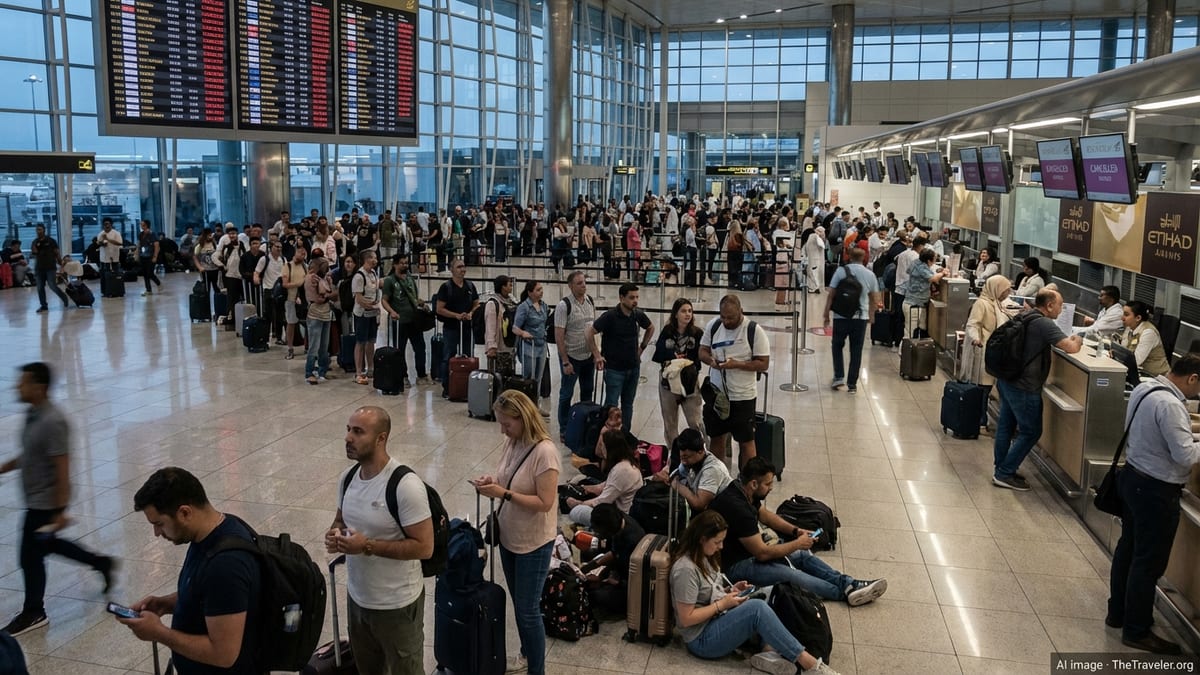
The tightening of travel advisories follows months of rolling disruptions across Middle Eastern airspace. During peak phases of the recent escalation, multiple Gulf states, including Qatar, Bahrain and the United Arab Emirates, temporarily closed their skies, forcing airlines to cancel or reroute a dense web of long-haul services that typically cross the region.
Industry updates and aviation notices compiled by shipping and logistics firms describe a patchwork of airport operations that has fluctuated since early spring. In early April, port and airport advisories for Saudi Arabia reported suspensions of flights to several neighboring capitals, including Dubai, Abu Dhabi, Doha and Kuwait City, as operators reassessed routes in light of missile and drone threats. Bahrain International Airport and Hamad International Airport in Doha have reported phased or partial resumptions of flights as conditions allowed.
Information from travel risk consultancies and specialized trackers indicates that carriers such as Emirates, Etihad, Qatar Airways and major European airlines have at various points reduced schedules, cut particular city pairs or implemented rolling waivers to accommodate passengers whose journeys relied on Gulf stopovers. Some airlines have continued to fly through the region using altered routings, while others have opted to avoid certain airspace entirely until risk assessments improve.
Australia’s Smartraveller platform, in a global briefing published this week, notes that conflict in the Middle East has contributed to fuel supply strains and disruptions that are now impacting aviation networks far outside the region. Travelers on routes between Europe, Asia and the Pacific have reported longer journey times and higher fares as airlines absorb extra operating costs and capacity constraints.
Risk of Sudden Escalation Keeps Travelers on Edge
Although a recent US Iran understanding announced in mid June aimed to reduce the likelihood of a broader war, subsequent attacks and retaliatory actions documented in foreign travel advisories and regional security bulletins suggest that the risk of rapid escalation remains. Updates from the United Kingdom’s travel guidance for Bahrain, for example, point to further Iranian strikes on targets in the kingdom even after the memorandum of understanding was reported, underscoring how quickly conditions can change.
The Federal Aviation Administration in the United States continues to maintain a conflict zone advisory covering much of the Gulf and adjacent waters, urging American carriers to exercise caution when operating in or near affected airspace. That notice, referenced in the State Department’s UAE country information, forms part of a broader mosaic of international aviation warnings that influence how airlines plan and price routes through the region.
Security analysts and risk consultants who publish open-source assessments on Middle East travel consistently highlight the potential for new missile or drone attacks, cyber incidents targeting critical infrastructure and unrest linked to developments in Gaza, the Red Sea and the Gulf itself. These risks, while often geographically concentrated, can produce ripple effects across national borders as governments close airspace, adjust security postures or impose temporary movement restrictions with minimal advance notice.
For travelers, this environment translates into a premium on flexibility. Public advisories now emphasize the importance of monitoring airline communications in real time, allowing extra time for connections, and considering alternative routings that avoid the most exposed air corridors. Travel insurance providers have also issued their own Middle East bulletins, warning that cover may be limited for newly declared conflict zones or for itineraries that ignore government-level guidance.
What the New Guidance Means for US Travelers
With the United States now more closely aligned with Canadian and Australian assessments, prospective travelers to the UAE, Saudi Arabia, Bahrain, Qatar and neighboring countries face a more complex decision-making landscape. Level 3 recommendations do not prohibit travel, but they signal that individuals should weigh their plans carefully, particularly where tourism or discretionary business trips are concerned.
Publicly available State Department material encourages US citizens considering travel to the Gulf to stay informed through local news, sign up for alert services and maintain contingency plans for both entry and exit. In recent months, regional governments have periodically granted temporary relief on immigration penalties for visitors stranded by flight cancellations, but such measures have been time limited and subject to rapid revision.
Airlines and specialist travel agents report that some travelers are choosing to connect through alternative hubs in Europe or Southeast Asia rather than route through Dubai, Doha or Riyadh, even when flights are available. Others are continuing to use Gulf carriers but building in longer layovers or fully flexible tickets that allow rebooking if airspace conditions change.
For now, the alignment of US, Canadian and Australian travel messaging suggests that the turbulence affecting the Gulf’s role as a global aviation crossroads is unlikely to settle quickly. Travelers planning journeys that rely on Middle Eastern transit points are being advised, through multiple national channels, to keep a close eye on advisories in the weeks leading up to departure and to be ready to adjust plans at short notice if the regional security picture shifts again.