


More news on this day
New United States guidance on travel and aviation risks in the Middle East is casting a fresh spotlight on how Iran-related tensions continue to disrupt the dense web of flights linking the United Arab Emirates, Qatar, Saudi Arabia and Jordan, leaving millions of Emirates, Qatar Airways and Etihad passengers watching routing changes and schedule updates with unusual intensity.
Get the latest news straight to your inbox!
US Travel and Aviation Warnings Grow More Explicit
Updated US travel advisories in 2026 place much of the Gulf and wider region under higher-risk categories, with Iran-related hostilities cited as a central concern for air travel. Country pages for the United Arab Emirates, Saudi Arabia and Jordan all refer to drone and missile threats, rapidly shifting security conditions and the potential for sudden flight disruptions affecting commercial passengers.
In the UAE, the advisory highlights the spillover from the conflict that escalated after 28 February 2026, pointing to the threat of attacks and the possibility of significant disruption to commercial aviation. The notice refers to cautionary guidance from US aviation regulators for carriers transiting Middle Eastern airspace, signaling that the risk is not limited to local airlines but also to foreign operators that rely on Gulf hubs for global connections.
Saudi Arabia’s advisory stresses the risk of Iranian drone and missile targeting and urges particular care near the Yemen border and other sensitive areas. Separate guidance for Jordan notes ordered departures of non-emergency US government staff in early March and warns that regional tensions have already led to flight cancellations and intermittent disruption of air links.
These updates, combined with a broader security alert for the Middle East that remains in effect, frame a picture of an aviation environment where conditions can change quickly and where even airports that remain operational may experience rolling delays, cancellations and re-routings as airlines respond to security assessments in near real time.
A Complex Flight Network Under Strain
The Middle East’s air traffic map has been repeatedly redrawn since open hostilities between the United States, Israel and Iran flared at the end of February. Airspace closures and military activity across parts of the Gulf and Levant triggered waves of cancellations and diversions in the weeks that followed, with regional hubs forced to adjust routing around sensitive corridors and, at times, pause operations entirely on certain routes.
Industry and government bulletins describe a patchwork of restrictions that vary by day and by corridor. Some countries have intermittently closed airspace or imposed tight altitude and routing constraints, while others have remained technically open but subject to advisories urging carriers to exercise “extreme caution” over conflict-affected areas and coastal zones. Episodes of GPS interference reported in the Gulf of Oman and off Fujairah have added an extra layer of concern for flight crews and planners.
Against that backdrop, operational updates from maritime and aviation coordination centers show that airports in the UAE, Saudi Arabia and Jordan generally remain open, but with a pattern of cancellations to or overflying high-risk destinations. Notices circulated in late spring and early summer describe normal operations at most major Gulf airports while simultaneously documenting suspended services on select routes and the need for passengers to wait for confirmed departure times due to rapidly shifting schedules.
The result is a network that is functioning but under strain, with airlines continually recalibrating which corridors are viable on any given day. For connecting passengers relying on the Gulf’s major hubs, it translates into a travel environment where flights usually operate as planned but where sudden disruptions can ripple across multiple continents with little warning.
How Emirates, Qatar Airways and Etihad Are Adapting
The three largest Gulf carriers, Emirates, Qatar Airways and Etihad Airways, sit at the center of this turbulence. All three serve extensive long haul networks that funnel passengers through Dubai, Doha and Abu Dhabi, so any constraint on east west overflight rights, Gulf coastal airspace or access to neighboring states can quickly cascade into global schedule changes.
Industry coverage since March indicates that the carriers have used a mix of route suspensions, diversions and timetable adjustments to manage risk. Periods of heavy airspace restriction earlier in the conflict prompted temporary halts to flights into and over certain countries, while more recent advisories from foreign governments describe a shift back toward regular schedules on most core routes, coupled with intermittent cancellations to destinations deemed higher risk.
Qatar Airways, in particular, has emphasized the gradual rebuilding of its regional network over the northern summer season, announcing phased resumptions of services to key Middle Eastern destinations while maintaining flexibility for passengers through more lenient rebooking policies. Reports on Etihad and Emirates operations show a similar pattern: continued focus on core trunk routes linking the Gulf to Europe, Asia, Africa and the Americas, alongside localized suspensions such as reduced operations from specific secondary airports in Saudi Arabia at various points this year.
Aviation safety agencies outside the region have at times recommended that operators avoid segments of Gulf airspace or apply strict risk mitigation measures on overwater routes near Iran’s coastline. These advisories have shaped how carriers plan long haul flights, with some traffic re-routed to add distance around sensitive zones. For travelers, these adjustments may appear as slightly longer flight times or altered connection patterns rather than outright cancellations, but they are a direct response to the elevated geopolitical risk profile.
Passengers at Gulf Hubs Face Persistent Uncertainty
For the millions of passengers who pass through Dubai, Doha and Abu Dhabi each month, the current tension has introduced a new level of uncertainty. While the majority of flights are operating, social media discussions and traveler forums are filled with questions from passengers wondering whether to maintain bookings that route through the Gulf or to seek alternatives via Europe or Asia.
Travelers report heightened anxiety around trips that involve overnight connections or long layovers, particularly when itineraries include sectors near conflict-affected areas. Publicly available airline guidance encourages passengers to monitor their booking status closely and to ensure that contact details are up to date so that they can receive short notice notifications of schedule changes. Many carriers continue to offer some degree of flexibility on date changes for itineraries touching the region, reflecting the ongoing volatility.
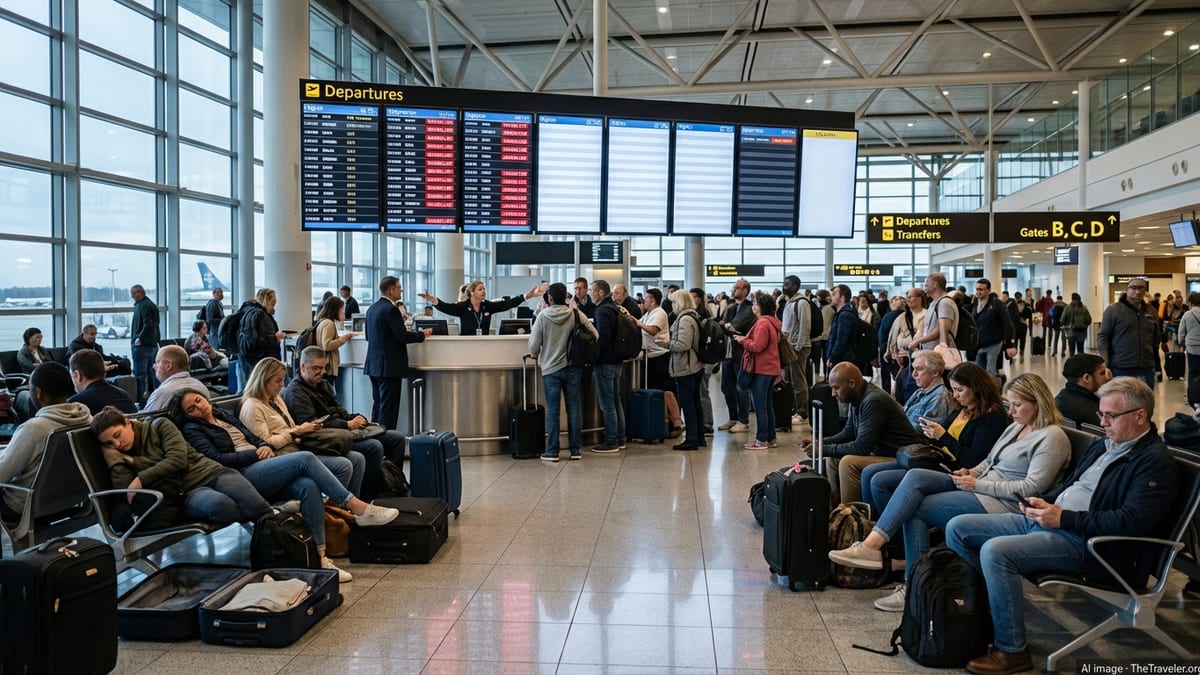
At the airport level, operational bulletins describe terminals that remain busy but subject to occasional congestion as banks of flights are compressed into narrower operating windows or rearranged around temporary restrictions. Ground handlers and airport authorities are tasked with accommodating surges of passengers whose flights have been delayed or re-routed, even as official statements maintain that overall airport infrastructure remains fully functional.
The current pattern suggests a prolonged phase in which travel through the Gulf is neither halted nor fully predictable. Passengers connecting on Emirates, Qatar Airways and Etihad are still moving across the global network, but they are doing so in an environment where regional security events can influence flight timing and routing with limited notice.
What the Latest US Warning Means for Future Itineraries
The latest US guidance does not prohibit travel to the UAE, Qatar, Saudi Arabia or Jordan, but it underscores that the security environment is dynamic and subject to rapid escalation. References to potential drone and missile threats, as well as to prior evacuations of diplomatic staff, reinforce concerns that major aviation and tourism centers could be affected again if hostilities intensify.
For airlines, the advisory landscape translates into continued pressure to run detailed risk assessments for each route, maintain contingency plans for rapid rerouting and ensure that crew and aircraft are not exposed to unacceptable levels of danger. It also means ongoing coordination with international regulators and aviation safety bodies that issue notices influencing where and how commercial flights can operate.
For travelers planning multi leg journeys through the Gulf, the practical impact is likely to be a greater need for flexibility. Same day schedule changes, rebookings onto different routings and unexpected overnight stays remain possibilities as long as Iran related tensions continue to test the resilience of the Middle East flight network. The hubs of Dubai, Doha and Abu Dhabi are still functioning as vital crossroads, but the risks identified in Washington’s latest warnings are a reminder that the region’s role in global aviation is now operating under a sharper security spotlight.