


More news on this day
Value Group will use the 27th Annual GHI Conference at Olympia London from 1 to 3 December 2026 to demonstrate how its “Global Oversight, Local Action” disruption management model, built around the RUBIK digital ecosystem and a 24/7 operations centre, can help airlines and ground handlers coordinate passenger recovery more consistently during irregular operations while adapting to local airport conditions.
Get the latest news straight to your inbox!
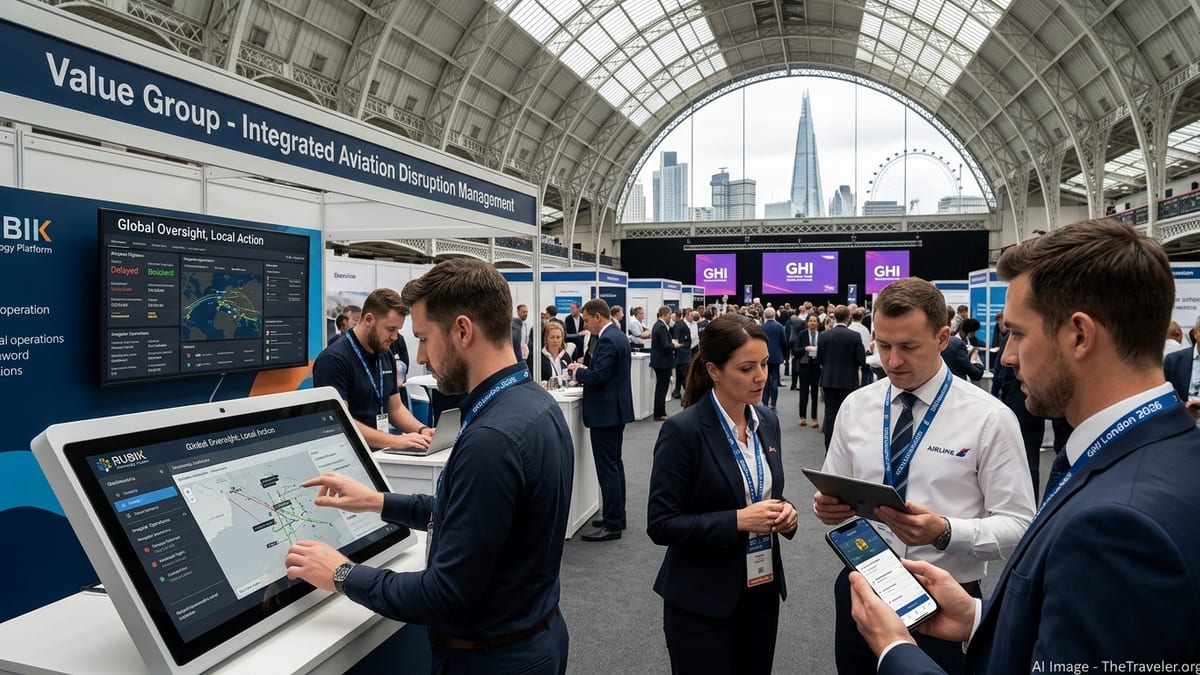
GHI London 2026 puts disruption management in the spotlight
The 27th Annual GHI Conference is scheduled to take place at Olympia London from 1 to 3 December 2026, bringing together more than 1,000 expected industry decision makers from airlines, ground handling companies, airports and technology suppliers for meetings, conference sessions and an exhibition focused on ground operations. Organised by Ground Handling International as its flagship annual event, the London edition follows a 2025 conference that hosted around 1,100 stakeholders and more than 90 exhibiting ground support equipment and IT suppliers, underscoring the show’s role as a key forum for operational leaders in the aviation services sector.
Within that context, Value Group is positioning its participation as part of a broader industry conversation about how airlines and handlers cope with irregular operations, often referred to as IROPS. The company, which specialises in integrated aviation disruption management, confirmed that it plans to showcase its RUBIK technology platform alongside its 24/7 Operations Control Center and a global supplier network. Its stated objective is to show carriers and handlers how a coordinated framework can combine central visibility with rapid local decision making when flights are delayed, cancelled or otherwise disrupted.
This will be the second consecutive year that Value Group has exhibited at the Annual GHI Conference, reflecting the company’s view that ground handlers sit at the point where disruption becomes most visible to passengers. Conference organisers have trailed disruption management, resource planning and service quality as among the operational themes under discussion, making London 2026 a timely stage for technology providers that focus on recovery processes rather than just flight operations themselves.
How the “Global Oversight, Local Action” model is structured
At GHI London, Value Group plans to present what it describes as a “Global Oversight, Local Action” approach to managing IROPS. In practice, that model brings together three main components: the RUBIK digital ecosystem, a 24/7 Operations Control Center and a network of local suppliers across accommodation, transport and passenger services. According to the company, these elements are intended to sit within a single operational framework that connects airlines, ground handlers and service providers while reinforcing airline policies and regulatory obligations.
The RUBIK platform is positioned as the digital layer of this model, providing tools for passenger reallocation, hotel and transport booking, voucher issuance and communication across multiple channels. The Operations Control Center then acts as a central coordination hub, monitoring disruptions across an airline’s network, triggering predefined IROPS workflows and supporting ground teams when local capacity is under strain. The supplier network is designed to translate those decisions into concrete services for passengers on the ground, particularly when disruption affects multiple stations or lasts longer than a few hours.
Value Group argues that this combination is intended to increase visibility and traceability across the disruption lifecycle, from the first indication that a schedule may unravel through to the moment passengers reach their final destination or overnight accommodation. By presenting the model in London, the company aims to show that network-level governance does not necessarily need to slow local decisions, provided that ground handlers have clear parameters, live access to inventory and the ability to escalate complex cases to a central team.
Role of ground handlers and airport-level delivery
Ground handlers are expected to feature prominently in Value Group’s messaging at GHI London 2026. In advance comments about the event, the company’s co-CEOs, Thomas Sergnese and Daniele Bocchieri, have emphasised that handlers are often the first line of contact for passengers once a disruption occurs, responsible for rebooking, accommodation arrangements and on-the-spot communication at airport counters or gates. The company’s model treats handlers as strategic partners rather than purely as execution arms for airline instructions.
Under the RUBIK-based workflow, ground handling agents can be given access to tools that automate aspects of the recovery process, such as identifying eligible passengers for hotel stays, allocating rooms from a contracted pool and arranging onward transport within airline policy and regulatory frameworks. Routine steps are intended to be automated as far as possible, which in theory reduces manual data entry and repetitive phone calls between stations, suppliers and central airline teams.
This approach may be of particular interest to handlers that work with multiple airline customers across a single station. According to Value Group, its platform can be configured to apply different rules by carrier, helping agents navigate varying contract terms and service obligations while working from one interface. At the same time, the company acknowledges that the system is designed to complement, rather than replace, existing airline IT and operational control systems, which continue to drive core schedule and crew decisions.
Automation, self-service and passengers needing extra support
A central theme of Value Group’s participation in GHI London 2026 is the balance between automation and human assistance in disruption scenarios. RUBIK is designed to support digital self-handling for passengers who are able and willing to manage their own recovery tasks, such as choosing alternative flights within airline-defined options, selecting hotel rooms from a pre-booked inventory or confirming ground transport. The goal is to resolve straightforward cases at scale, particularly when high volumes of passengers are affected by weather, air traffic control restrictions or wider operational issues.
For passengers who require additional assistance, including those with reduced mobility, families with young children or travellers facing complex itineraries, Value Group plans to highlight the role of dedicated operational teams and ground staff using companion tools such as RUBIK GO. These teams can intervene directly, overriding automated choices where necessary, handling special service requests and liaising with suppliers when standard capacities are exhausted. The company’s co-CEOs have stated that the intention is to free up staff time for these more demanding cases by moving simpler rebookings and hotel assignments into automated workflows.
From a traveller perspective, the practical impact of such systems depends heavily on how airlines choose to implement them. While Value Group can offer technology and coordinated processes, carriers retain control of their disruption policies, compensation thresholds and service standards. At GHI London, airline and handler delegates are expected to use meetings with providers such as Value Group to examine how far they are prepared to push automation, and how they will ensure that digital flows remain accessible to passengers who are less familiar with self-service tools.
Preparing for foreseeable disruptions and capacity constraints
Beyond reacting to sudden irregular operations, Value Group also intends to use the London conference to discuss how airlines and handlers can prepare for foreseeable disruptions, such as seasonal weather patterns, airport infrastructure works or large-scale events that may constrain accommodation and transport capacity in specific cities. The company says that, in such cases, its Operations Control Center can monitor local capacity via its supplier network, send pre-alerts to hotels and transport providers, and help airlines position operational resources in advance.
In practice, this form of preparation could involve reserving blocks of hotel rooms ahead of peak disruption periods, establishing contingency transport options between airports and city centres, or adjusting staffing levels at key stations. By the time passengers are affected, the intention is that recovery options have already been scoped and that handlers can see remaining capacity in real time. For airlines with large or fragmented networks, this kind of forward planning is presented as a way to avoid the last-minute scramble for rooms and buses that often accompanies major weather events or airspace restrictions.
However, the effectiveness of such preparation depends on accurate forecasting, contractual arrangements with suppliers and coordination among airlines, handlers and airport operators. GHI London is expected to feature broader discussions on resilience and operational planning, giving carriers and service providers an opportunity to compare different models and assess how a centrally supported disruption management framework, such as Value Group’s, fits alongside their existing contingency plans.
What airlines and handlers should look for at GHI London 2026
For delegates attending GHI London 2026, Value Group’s presence adds to a wider line-up of disruption management and ground operations technology providers. Airlines and ground handling companies considering changes to their IROPS processes may use the London event to compare how different platforms integrate with passenger service systems, departure control, revenue management and existing operations centres. In the case of Value Group, that assessment is likely to focus on how RUBIK interfaces with airline and handler systems, the extent of automation available and the support model offered by its 24/7 Operations Control Center.
Travel buyers and operational managers visiting Olympia London from 1 to 3 December should verify practical details directly with organisers and exhibitors, including conference session timings, exhibitor stand locations and any live demonstrations or case studies on the programme that relate to disruption management. Those interested in Value Group’s model may wish to confirm whether the company is offering closed-door briefings or workshops alongside its exhibition presence, as well as which airline and handler use cases can be discussed publicly.
With the conference now firmly scheduled and pre-event materials highlighting disruption management as a key topic, GHI London 2026 is set to give airlines, ground handlers and airports an opportunity to test the claims of IROPS technology providers against their own operational realities. For travel professionals and corporate buyers following developments from afar, the period immediately after the event, once airlines begin to announce any new partnerships or pilots, will be the moment to look for concrete outcomes from the conversations held at Olympia.