


More news on this day
Air travel across the Gulf is facing renewed turbulence after a drone attack on Riyadh’s tallest skyscraper wounded 11 people and prompted airlines and regulators to extend flight cancellations, airspace warnings and schedule cuts into early 2027.
Get the latest news straight to your inbox!
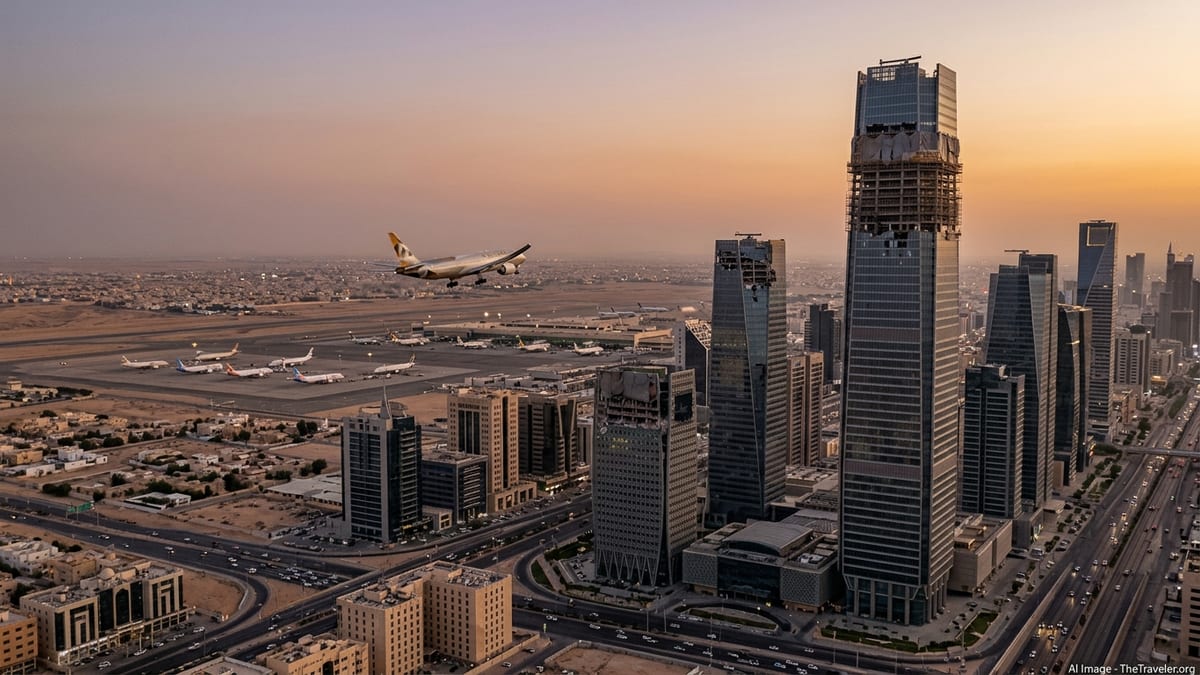
Riyadh’s financial district targeted again as Houthi campaign intensifies
Saudi authorities confirmed on Tuesday 24 November 2026 that a tower in Riyadh’s King Abdullah Financial District was struck in what they described as a terrorist attack carried out by Yemen’s Houthi movement. The General Directorate of Civil Defense said 11 people were injured in the incident, including two Saudi nationals and nine foreign residents, after projectiles hit the Public Investment Fund Tower, the capital’s tallest building. The injuries were described as non life threatening, but images and footage from the scene showed visible damage to several upper floors of the skyscraper.
The attack was the second strike on a landmark building in Riyadh’s financial hub in less than three weeks, following a Houthi missile hit on the nearby Aramco Tower on 8 November. It was also the second time in under a week that the PIF Tower itself had been targeted, after an earlier projectile impact on 19 November caused material damage but no reported casualties. The Saudi led coalition fighting the Houthis said the latest assault was carried out using an explosive laden drone and vowed a forceful response, highlighting what it called a sustained campaign against civilian and economic infrastructure.
Saudi officials have not released an updated cumulative tally of intercepted projectiles in recent days, but state media and coalition briefings throughout October and November have documented frequent interceptions of missiles and drones aimed at Riyadh, the Eastern Province and key energy facilities. While many of these attacks have been neutralised before reaching their targets, the two successful strikes in the financial district in November have heightened concerns about the vulnerability of major transport and commercial hubs and triggered a fresh round of risk assessments by airlines and aviation regulators.
Conflict zone warning extended over Gulf airspace
The European Union Aviation Safety Agency (EASA) has extended its conflict zone information bulletin for the Persian Gulf and Gulf of Oman, advising carriers to exercise extreme caution and avoid certain portions of regional airspace until at least 31 January 2027. In an updated bulletin issued on 16 November 2026, EASA cited the risk of misidentification and potential military activity in the airspace above the waters of Bahrain, Kuwait, Qatar and the United Arab Emirates, as well as the Gulf of Oman west of longitude 58 degrees east.
The advisory, which applies to EU member state operators and third country airlines authorised by EASA to fly to and from the bloc, does not impose an outright ban on flights using Gulf airspace. Instead, it urges carriers to conduct thorough risk assessments, follow national and company security guidance, and closely monitor any new aeronautical information published by regional authorities. Some European and Asian airlines have responded by filing flight plans that keep their aircraft over land where possible, or by routing services further south to avoid the most sensitive air corridors, adding time and fuel costs to certain long haul routes.
While Gulf governments have kept their main airspace open, the combination of EASA’s extended warning, the ongoing attacks on Saudi territory and heightened military activity around the Strait of Hormuz has contributed to a patchwork of operational decisions by airlines. For passengers, this has translated into longer flight times on some routes, last minute reroutings and, in the case of Saudi destinations, outright cancellations.
Saudi routes remain the most heavily affected
Within the region, services to and from Saudi Arabia continue to experience the most significant disruption. Etihad Airways has extended the suspension of all passenger and cargo flights between Abu Dhabi and Riyadh and between Abu Dhabi and Dammam until Monday 30 November 2026, citing the security situation and regulatory guidance. The extension, confirmed in updates published between 17 and 21 November, affects traffic in both directions on the two routes for the remainder of the month, although Etihad’s flights from Abu Dhabi to other Saudi cities such as Jeddah have gradually resumed on a limited schedule.
Dubai based flydubai has also kept its Saudi network curtailed. The airline’s public advisories and booking engine show services to Riyadh and Abha suspended through at least mid November, with subsequent updates indicating that frequencies to other Saudi cities are subject to short notice changes. Other Gulf carriers, including Emirates and Air Arabia, are operating reduced or irregular schedules to Riyadh, Jeddah and Dammam, periodically cancelling or consolidating flights as the situation evolves. Qatar Airways, which had earlier halted services to Riyadh and Dammam, has begun restoring daily flights to both cities, but warns that further adjustments remain possible.
The impact is not limited to Middle Eastern airlines. Several European carriers that previously served Saudi Arabia non stop have yet to reinstate their flights. Public timetables and airline statements indicate that Air France and Italy’s ITA Airways, which had both planned to resume Paris and Rome links to Riyadh in late 2026, have postponed their return until sometime in 2027, pending an improvement in security conditions. Some Asian airlines that briefly relaunched services to Saudi Arabia earlier in the year have again removed the country from their near term schedules, choosing instead to offer connections via hubs in Doha, Dubai or Abu Dhabi where local carriers still operate selected Saudi routes.
Dubai and wider Gulf network slowly stabilising
Elsewhere in the Gulf, airlines are cautiously rebuilding parts of their network even as the conflict continues. British Airways has followed through on previously flagged plans to restore passenger flights between London Heathrow and Dubai International, with a once daily service resuming on Tuesday 3 November 2026 after an eight month suspension linked to the broader Middle East conflict. The return of the route gives UK based travellers a nonstop option to Dubai for the first time since early spring, although British Airways is operating a slimmer schedule than before the crisis and has yet to commit publicly to specific restart dates for Bahrain or Saudi Arabia.
Dubai itself remains accessible via a wide range of carriers, including Emirates and several Asian and European airlines, but schedules are thinner than they were before the escalation of regional tensions in early 2026. Operators such as KLM, Singapore Airlines and Air Canada, which had initially removed Dubai from their networks for part of this year, have extended those cancellations into at least the first quarter of 2027 according to their latest published timetables. The decisions reflect not only security concerns over Gulf airspace but also broader capacity constraints and shifting demand as travellers reconsider itineraries involving stopovers in the region.
Other hubs, including Doha and Abu Dhabi, continue to function as major gateways, but with altered patterns of connectivity. Qatar Airways has focused on maintaining a wide global network from Doha, while trimming frequencies to a handful of destinations that are directly affected by the conflict. Abu Dhabi’s schedule has been reshaped by Etihad’s Saudi suspensions and by rerouted long haul flights that avoid some of the higher risk air corridors highlighted in EASA’s advisory. For travellers, this means that connections that were once straightforward may now require longer layovers, different routings or, in some cases, entirely different hub choices.
Government travel advice and sanctions tighten constraints
Government advisories have increasingly become as important as airline decisions in determining whether trips go ahead. The United Kingdom’s Foreign, Commonwealth and Development Office continues to advise against all but essential travel to much of Saudi Arabia and against all travel within 10 kilometres of the border with Yemen. Its most recent guidance, updated in November, highlights the risk of further attacks on Riyadh’s King Khalid International Airport and other critical infrastructure and notes that the security situation can deteriorate quickly without warning.
In a sign of its concern about the reliability of air links, the UK government has advised British nationals who wish to leave Saudi Arabia to consider overland travel to neighbouring countries where flight options may be more predictable, while also warning that land borders can close at short notice during periods of heightened tension. The United States, for its part, continues to urge its citizens across the Middle East to exercise increased caution. A renewed security alert issued by the US embassy in Riyadh in early November called attention to the risk of missile and drone attacks on civilian areas and key infrastructure and encouraged Americans to maintain a high level of situational awareness, avoid large gatherings and review their personal emergency plans.
Sanctions policy is also shaping the regional aviation landscape. The US government has imposed additional sanctions on Iran’s civil aviation sector in response to its role in supporting allied armed groups, including the Houthis. Following these measures, the United Arab Emirates’ General Civil Aviation Authority has ordered a suspension of all flights operated by Iranian airlines to and from the UAE, effectively cutting direct commercial links between many Iranian cities and Gulf hubs such as Dubai and Abu Dhabi. For travellers, the immediate effect is a need to transit via alternative points outside the UAE or to rely on non Iranian carriers that still serve Iran under their own governments’ regulations.
What travellers should check before flying through the region
With the security situation in flux and official advisories changing on a regular basis, travellers planning to fly to, from or through the Middle East in the coming weeks face a higher than usual level of uncertainty. Flight schedules into Saudi Arabia, in particular, are subject to rapid alteration as airlines respond to new incidents and regulatory guidance. Even in more stable hubs such as Dubai and Doha, routings can change at short notice as carriers adjust to airspace restrictions or seek to minimise exposure to higher risk corridors.
Passengers with imminent travel should monitor their booking directly on the airline’s website or app rather than relying solely on third party travel agents or static timetables. Many carriers are offering flexible rebooking policies for itineraries touching Saudi Arabia or other affected destinations, allowing date changes or alternative routings without change fees, although any fare differences still apply. Where foreign ministries advise against all but essential travel, some travel insurance policies may not provide cover unless the trip meets specific conditions, making it important to confirm the terms of any policy before departure.
Looking ahead to December 2026 and into early 2027, much will depend on whether the frequency and severity of attacks on Gulf infrastructure ease, and on whether regulators such as EASA adjust their conflict zone assessments. Until there is a sustained improvement in the security picture, airlines are likely to continue operating conservative schedules to Saudi Arabia and to limit exposure to the most sensitive airspace over the Gulf. Travellers considering bookings that involve transits in the region should expect potential schedule changes, build extra time into connections where possible, and remain alert to updated government travel advice in the days before they fly.