


More news on this day
A confirmed missile or drone strike that damaged Riyadh’s Public Investment Fund (PIF) Tower in November 2026, combined with renewed conflict-zone warnings over Gulf airspace, is prompting airlines and regulators to prolong Saudi Arabia flight suspensions, reroute long-haul services and keep enhanced risk advisories in place into at least early 2027.
Get the latest news straight to your inbox!
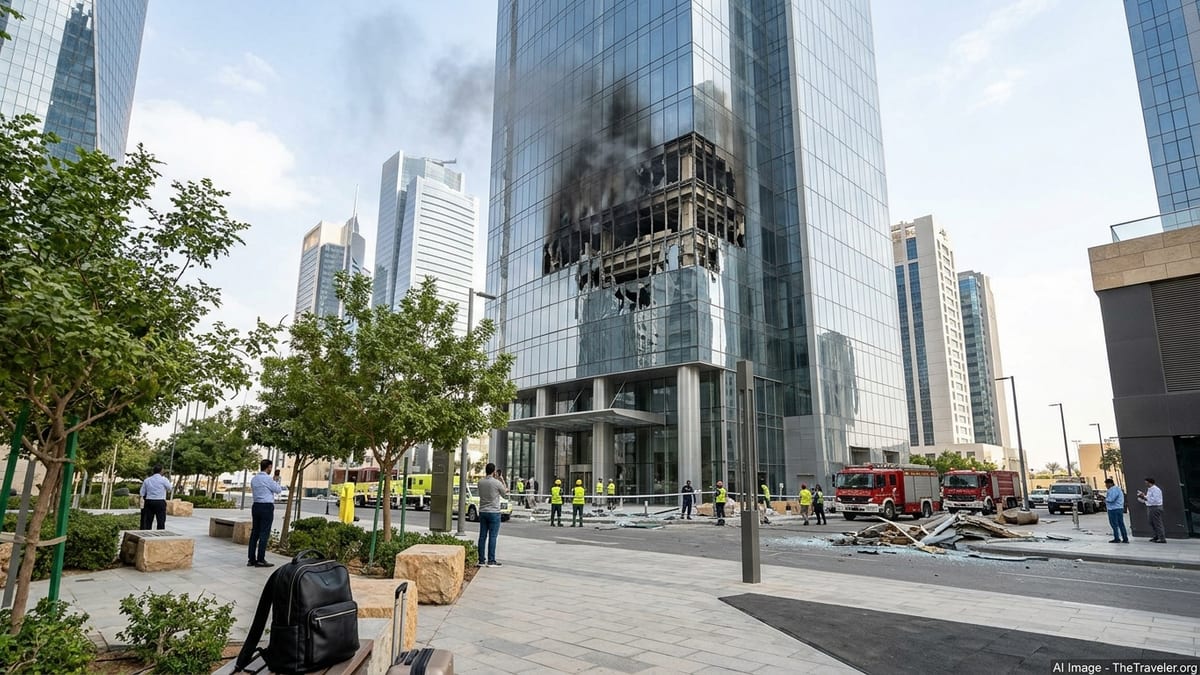
What is confirmed about the Riyadh PIF Tower attack
Saudi authorities and coalition spokespeople have confirmed that a major tower in Riyadh’s King Abdullah Financial District, identified by regional and international media as the headquarters of the Public Investment Fund, sustained damage in a strike in mid November 2026. Video verified by several outlets shows an explosion partway up the glass-and-steel skyscraper, followed by plumes of smoke and shattered facade panels across multiple upper floors, with debris scattered at street level in the surrounding business district.
The Saudi-led coalition has described the incident as a “terrorist attack” and has publicly blamed Yemen’s Houthi movement, which has claimed responsibility for a series of recent long-range attacks on the Saudi capital. Diplomatic notes filed at the United Nations in November refer to repeated missile and drone strikes on Riyadh and other cities during the month and to a pattern of targeting civilian and economic infrastructure, including schools, energy facilities and transport hubs. Local officials have said that at least 11 people were injured in the financial district when the tower was hit. As of late November 2026, there have been no widely reported, independently confirmed fatalities directly linked to this specific strike, although casualty figures for several incidents elsewhere in the city remain under review.
The attack on the PIF Tower followed earlier projectiles and debris falls in the Riyadh area in October and early November, including incidents affecting King Khalid International Airport and nearby infrastructure. International risk consultancies and open-source analysts tracking the conflict have documented frequent interceptions of incoming weapons around the capital, with Saudi air defences destroying many drones and missiles before impact but with a smaller number, including the one that hit the PIF Tower, breaching those defences and causing visible damage. This pattern has reinforced long-standing concerns among aviation insurers and airline security departments about operating in and near the Riyadh terminal area, particularly in phases of flight close to the ground where options for evasive manoeuvres are limited.
Conflict-zone bulletins keep Gulf airspace under heightened scrutiny
Alongside the tower strike itself, the most concrete regulatory signal for airlines is the European Union Aviation Safety Agency’s conflict-zone guidance. EASA’s Conflict Zone Information Bulletin covering the airspace of the Persian Gulf and Gulf of Oman, designated CZIB-2026-07R4, was last revised on 16 November 2026. The bulletin is currently listed as active until at least 31 January 2027 and recommends that operators exercise a high level of caution when planning or conducting flights over or near the waters of Bahrain, Kuwait, Qatar, Oman and the United Arab Emirates, as well as over parts of the Gulf of Oman.
Separate EASA documentation identifies a related bulletin for Saudi Arabian airspace, initially issued in late September and updated on 16 November with the same 31 January 2027 review date. These advisories do not impose a blanket ban on overflights but urge airlines to carry out robust risk assessments, to consider alternative routings and altitudes where feasible and to follow any additional instructions issued by national civil aviation authorities. The text also calls on carriers to monitor aeronautical information publications, notices to air missions and other official updates for short-notice changes to available routes or altitude constraints.
In practical terms, flight-tracking data in November indicates that a number of European and Asian airlines have already adjusted their routings around the most sensitive parts of the Gulf. Some long-haul services between Europe and South or Southeast Asia that previously tracked close to the Strait of Hormuz or central Gulf shipping lanes are now tending to take more southerly or inland paths, accepting a modest increase in flight time and fuel burn in return for reduced exposure to potential military activity. Where flights continue to use established Gulf corridors, some operators are maintaining higher cruising altitudes or scheduling departures at times that align with their own security assessments. These measures are precautionary and can be revised quickly if the risk picture improves or deteriorates.
Saudi Arabia remains at the centre of airline suspensions
The clearest commercial impact so far is on direct air links with Saudi Arabia, particularly Riyadh and Dammam. Abu Dhabi based Etihad Airways has progressively extended earlier short-term cancellations into longer suspensions, and its current public notices state that all passenger and cargo flights between Abu Dhabi and Riyadh, and between Abu Dhabi and Dammam, are cancelled through 30 November 2026. The airline continues to operate other routes to Saudi Arabia, including Jeddah and Medina, although schedules have been adjusted several times since October and remain subject to change at short notice.
From Dubai, Emirates has retained some connectivity to Saudi cities but has repeatedly pulled flights from its published schedule in response to specific incidents and risk assessments. Local media and airline statements in November describe intermittent suspensions or limited operations on routes to Riyadh, Jeddah and Dammam, with Medina sometimes serving as the carrier’s only consistently operating Saudi destination on certain days. Low cost carrier flydubai and Sharjah based Air Arabia have taken similar steps, temporarily suspending or consolidating services on particular Saudi routes while maintaining others. Regulators in Oman and Kuwait have also signalled that national airlines may adjust or suspend selected flights to affected Saudi airports when security conditions worsen.
The effects are not confined to Gulf based carriers. Schedule filings, airline statements and booking-system displays in late November show several European and Asian airlines either postponing planned launches or reintroductions of Saudi services or extending existing suspensions. For example, notices tracked by aviation-specialist publications indicate that some European flag carriers have pushed back their intended winter 2026 relaunch of flights to Riyadh into the 2027 northern summer season, citing security concerns and weaker demand. A number of Asian airlines that had tentatively resumed flights to Riyadh or Jeddah earlier in 2026 have again removed those routes from their near-term network plans, instead selling Saudi itineraries via third-country hubs where partner carriers still operate.
Dubai, Doha and Abu Dhabi adapt their roles as connecting hubs
Elsewhere in the Gulf, key transfer airports remain open and functioning but are operating in a more constrained and fluid environment than they were before the latest escalation. Dubai International continues to handle large volumes of long haul traffic, with Emirates and multiple foreign airlines operating passenger and cargo flights through the hub. Winter 2026/27 schedules filed with global distribution systems suggest that frequencies on some inbound routes, particularly from Europe, are still below levels seen before February 2026, reflecting both security considerations and softer demand. Airlines have been trimming or restoring flights in increments of days or weeks rather than whole seasons, which increases the likelihood of timetable changes during the booking window.
In a notable capacity move for travellers from the United Kingdom, British Airways has returned to the London Heathrow to Dubai market. Documentation prepared for UK based corporate-travel clients and British Airways’ own destination lists indicate that the airline resumed passenger services on the route in early November 2026 following an extended suspension linked to the wider Middle East security situation. The restored link is currently described as operating once daily, which is significantly below the multiple daily frequencies the carrier mounted before 2026. British Airways continues to fly to Doha, but its previously operated services to Bahrain and Jeddah remain suspended, with internal planning documents pointing to a cautious approach to reinstating those destinations.
Doha’s Hamad International Airport and Abu Dhabi’s Zayed International Airport continue to function as major connecting hubs for itineraries between Europe, Africa, Asia and Australasia. Qatar Airways is operating a broad network from Doha but has adjusted frequencies or temporarily halted flights on particular routes where airspace risks or demand drops are most acute, including links to certain Saudi cities earlier in the autumn. Abu Dhabi remains a viable transfer point for many long haul journeys, although Etihad’s ongoing cancellations to Riyadh and Dammam and the rerouting of selected services to avoid specific conflict-affected corridors have altered the structure of some connection banks. Travellers report that minimum connection times have not always been revised in booking systems to reflect the higher risk of delays, which can increase the chances of missed onward flights when routings or departure slots change late in the process.
Travel advisories, sanctions and what passengers should check next
For individual travellers, government advisories and sanctions are shaping options almost as much as airline decisions. The United Kingdom’s Foreign, Commonwealth & Development Office continues to warn against all but essential travel to certain areas of Saudi Arabia and against all travel within a defined distance of the Yemeni border, highlighting the possibility of further missile and drone attacks on Riyadh and other major cities and the potential for the security situation to worsen rapidly with limited notice. The United States maintains a regional alert urging its citizens across the Middle East to exercise increased caution in light of ongoing hostilities, and several European governments have issued similar warnings, in some cases advising travellers to avoid particular transit points if practical alternatives exist.
Parallel US sanctions on Iran’s aviation and logistics sectors, expanded earlier in 2026, are further constraining flight options around the Gulf. Gulf regulators have responded by restricting or suspending services by certain Iranian carriers to local airports, which has reduced the number of direct flights between Iranian cities and hubs such as Dubai and Abu Dhabi. Passengers who previously relied on those routes may now need to travel via third countries or to book onto non Iranian airlines that retain permission to operate to both ends of their journey, often at higher fares or with longer total travel times.
Looking ahead to December 2026 and the first quarter of 2027, several factors will determine whether disruption eases or spreads. The key variables include the tempo and accuracy of further attacks on Saudi territory, any change in the capabilities or tactics of air defences around Riyadh and other hubs, and the outcome of periodic reviews of EASA’s conflict-zone bulletins and similar national guidance. Until there is a sustained improvement in the security environment, airlines are likely to keep hedging their exposure by operating reduced schedules to Saudi Arabia, by routing intercontinental flights along paths that avoid the most sensitive corridors and by maintaining the option to extend or reinstate suspensions at short notice.
Travellers planning to book flights to, from or through the Gulf in the coming months should therefore verify several points before committing. First, check the current status of government travel advisories for Saudi Arabia and nearby states shortly before booking and again close to departure, as changes in advice can affect both insurance cover and airline policies. Second, confirm the operating airline and flight number for every sector of an itinerary, ideally through the carrier’s own website or mobile application, and monitor reservations for schedule changes. Many airlines are currently offering more flexible rebooking or refund options for itineraries touching Saudi Arabia or other directly affected destinations, but these concessions are typically limited to tickets issued within a particular time frame and to flights that meet defined disruption thresholds. Finally, given the heightened risk of delays and rerouting, travellers using Gulf hubs as connection points may wish to allow more generous layover times than usual and to keep alternative routings in mind in case airlines or regulators extend or adjust suspensions as the situation develops.