


Vancouver’s cherry blossom season is not a single dramatic peak but a rolling wave of color that moves across the city through different tree varieties and neighborhoods. Early cultivars can open in late February or early March, most Akebono street trees follow in late March, and deep-pink Kanzan blossoms surge into April. For travelers planning a 2027 visit, this extended season is good news: you do not need to hit one perfect day, but you do need to understand where and when to look.
Get the latest updates straight to your inbox!
How Vancouver’s 2027 cherry blossom season really works
Vancouver Cherry Blossom Festival organizers have already confirmed that the 2027 festival season will run across March and April, following their now-established pattern rather than a single long weekend. The official programme typically stretches over several weeks to accommodate the reality that blossoms open at different times across the city. Early-blooming streets in the West End can be pink while higher, cooler spots near Queen Elizabeth Park are still in tight bud.
Festival information for 2027 is still partial. The festival has announced that marquee events such as the Big Picnic, Blossoms After Dark, Sakura Days Japan Fair, Tree Talks and Walks and Bike the Blossoms will return, but exact 2027 dates have not yet been published as of November 2026. Recent editions have clustered major events between late March and mid April, which is a reasonable planning assumption for 2027, but travelers should treat this as a guide rather than a guarantee and check closer to departure using the festival’s official channels.
Historically, Vancouver’s early flowering cherries, such as Whitcomb and some early Yoshino types, can bloom from late February or the first half of March in warmer low-lying neighborhoods. Popular pale-pink Akebono street trees usually peak in the second half of March, with some locations holding into early April. Double-flowered cultivars like Kanzan and Shirofugen generally follow from mid to late April, with some years stretching into early May in cooler pockets. Weather in any given winter can accelerate or delay this progression by a week or more.
Elevation and proximity to the ocean both matter. Inner-city areas near sea level, including downtown, Yaletown and parts of Kitsilano, warm earlier and often reach peak bloom first. Neighborhoods around Queen Elizabeth Park, which sits on Vancouver’s highest hill, and farther south or east residential districts can run noticeably later. A cold March can compress the whole season into April, while a mild winter might bring the first showy streets into bloom before the festival’s opening ceremonies.
Key neighborhoods and signature blossom streets
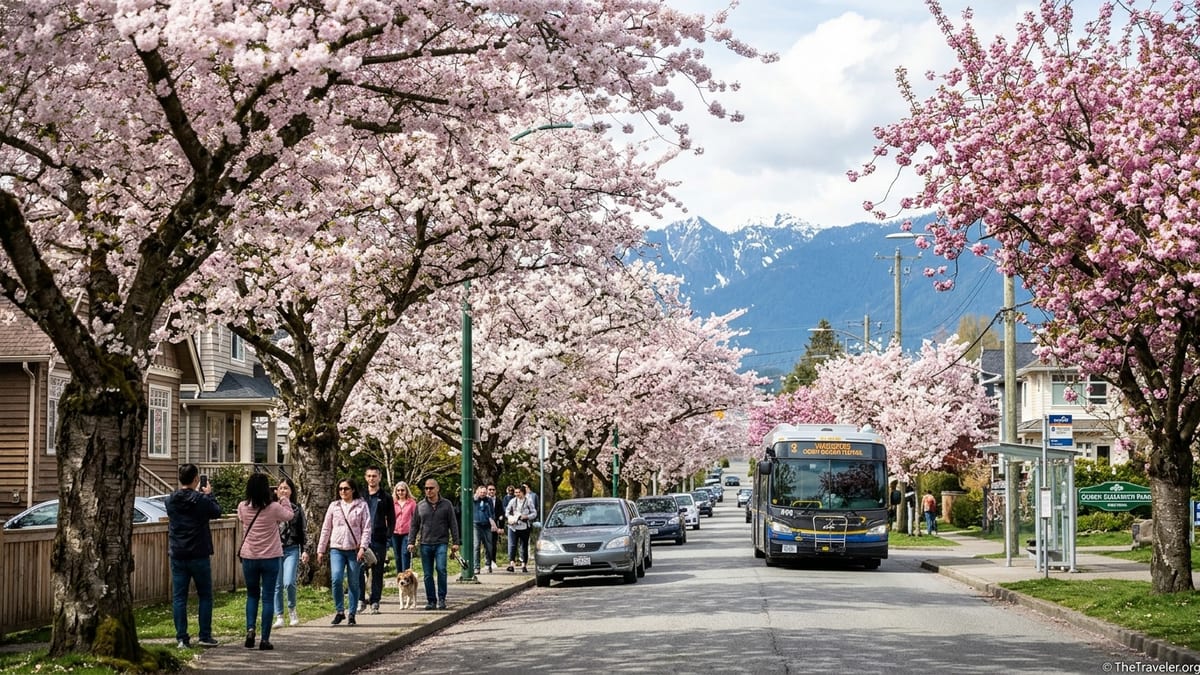
Visitors often start downtown and in the West End, where cherry trees line many residential blocks. Pale Akebono trees near Burrard Station and throughout the West End can create cloudlike canopies in late March. Streets leading toward English Bay, and the residential blocks bordering Stanley Park, are especially rewarding for walkers who like to duck off main arteries and discover quiet side streets.
Across False Creek, Kitsilano combines beach views and blossoms. Many of its residential avenues host rows of cherries that form short tunnels of pink in late March and April, especially around the gentle slopes running down toward Kits Beach and the waterfront. Here it can be hard to tell cherries from nearby plum trees, which often bloom slightly earlier with darker petals and bronze leaves, but festival maps and local signage help visitors focus on genuine cherry varieties.
Mount Pleasant and Riley Park, just south of the downtown core, have a dense mix of older housing stock and newer townhomes threaded with blossom-lined streets. These neighborhoods sit on the rise up toward Queen Elizabeth Park, so they can lag a little behind downtown. In many years this staggered timing allows visitors to see Akebono in the city center, then walk or bus uphill a few days later for another round of peak bloom among different cultivars.
Farther west and south, Kerrisdale, South Cambie and several South Vancouver districts hold some of the city’s most photogenic residential blossom avenues. Long stretches of Kanzan cherries create dramatic overhead tunnels in late April, especially on quiet side streets where cars and buses are infrequent. These locations owe their fame to being ordinary residential roads that happen to have perfectly spaced trees. Because people live here, visitors need to be especially careful about noise, blocking driveways or standing in the roadway for photos.
Festival events in 2027: what is known and what is not
The Vancouver Cherry Blossom Festival has confirmed an in-person programme for March and April 2027, including many staple events that blend horticulture, arts and community building. The Big Picnic is expected to return to a downtown waterfront park under a grove of Akebono trees, with live music, food trucks, and family activities. In recent years this flagship gathering has been scheduled for a late-March weekend to align with downtown’s Akebono peak, and travelers can tentatively pencil in a similar time frame while waiting for official 2027 dates.
Blossoms After Dark, an evening experience that uses lighting installations and performances to showcase a curated grove of cherry trees, is also slated to come back for 2027. Previous editions have run across several consecutive nights, often in early April, with timed-entry tickets sold online. Because capacity is controlled, this event can be a calmer photography opportunity than daytime crowds, particularly for those interested in long-exposure night shots or more atmospheric images.
Sakura Days Japan Fair, typically held at VanDusen Botanical Garden, brings together food vendors, tea ceremonies, martial arts demonstrations and cultural performances. For travelers, the key logistical detail is that VanDusen is a ticketed garden: visitors must pay regular garden admission, and Sakura Days usually requires either a special event ticket or timed-entry reservation purchased in advance. Pricing in recent seasons has been in the tens of dollars per adult plus standard garden entry, so it is prudent to budget accordingly and check 2027 details when they are released.
Tree Talks and Walks and Bike the Blossoms round out the educational and active side of the festival. Tree Talks and Walks are expert-led, free or low-cost guided walks in specific neighborhoods, explaining cultivars and local history. Bike the Blossoms is a guided group ride linking several blossom hotspots along comfortable cycling routes. Both programmes depend on volunteer leaders and spring weather, so 2027 routes and dates have not yet been finalized. Travelers arriving from out of town should build flexibility into their plans and use the festival’s Blooming Now updates as their primary reference closer to March 2027.
Iconic parks, gardens and residential streets
Queen Elizabeth Park is both a horticultural highlight and a key reference point for blossom timing. Perched on Vancouver’s highest hill, it offers sweeping city and mountain views, landscaped gardens and multiple cherry cultivars. Entry to the park grounds is free, but the enclosed Bloedel Conservatory at the summit charges admission. Cherry trees around the park’s perimeter paths and sunken gardens usually bloom from late March into April, sometimes a few days later than similar trees downtown because of the elevation and cooler nighttime temperatures.
Stanley Park, wrapping around the northwest edge of downtown, combines forest, seawall views and carefully planted ornamental cherries near its entrances and open lawns. Cherry trees frame sections of the Seawall and cluster near landmarks like the Japanese Canadian War Memorial. There is no admission charge to enter Stanley Park, and most cherry trees are accessible from paved paths suitable for strollers and wheelchairs, although some inner trails have steeper grades.
VanDusen Botanical Garden in South Cambie offers one of the most diverse curated collections of ornamental cherries in Vancouver, along with magnolias and other spring-flowering trees. The garden charges admission, with adult ticket prices in spring sitting in the mid-teens in Canadian dollars before tax, with slightly lower rates in March and higher peak-season rates applied from April onward. During Sakura Days Japan Fair, special event tickets and timed entries are usually required, and these can sell out on popular weekends, so advance purchase is important for 2027 visitors.
Some of Vancouver’s most photographed blossoms, however, are on unassuming residential streets. Long arcs of Kanzan cherries in East Vancouver and South Vancouver, and shorter Akebono tunnels near schools or small parks, have become social media darlings. These locations are not controlled attractions: they are people’s front yards and narrow local roads. Photographers should stay on sidewalks, avoid standing in the middle of active streets, keep driveways and doorways clear, and lower their voices early in the morning or late in the evening to respect residents who experience this influx every spring.
Walking routes for 2027: downtown, Kitsilano and South Vancouver
A classic downtown and West End circuit starts at Burrard Station, where Akebono cherries usually frame the sky in late March. From here, visitors can walk roughly 1.5 kilometres south and west through the downtown grid toward Robson Street and into the residential West End, detouring along tree-lined blocks as blooms dictate. Continuing on foot to English Bay and the edge of Stanley Park adds another 2 to 3 kilometres, creating a half-day outing that combines blossoms, cafes and waterfront views. The area is largely flat, and sidewalks and crosswalks are plentiful, which suits families and visitors with mobility concerns.
A Kitsilano and neighborhood streets route works best from mid-March into April. Travelers can reach Kitsilano by taking the SkyTrain to Burrard or Granville and then a TransLink bus across the Burrard Bridge, or by using the Canada Line to Broadway–City Hall and connecting to buses heading west. Once in Kitsilano, a 4 to 6 kilometre loop linking the beach, several residential avenues and small parks gives access to both early and midseason cultivars. The slopes can be gentle but noticeable in places, so comfortable shoes and rain-ready outerwear are advisable.
For a Queen Elizabeth Park and South Vancouver circuit, begin at King Edward Station on the Canada Line. From there, it is about 1.5 kilometres uphill along a mix of residential and arterial streets to the park’s main entrances. After exploring the park’s sunken gardens and cherry groves, walkers can continue south and west through quiet residential grids toward neighborhoods with late-season Kanzan plantings. Depending on detours, this can become a 6 to 8 kilometre day. Those preferring a shorter version can ride a north–south bus directly to stops near the park and limit walking to the park’s interior paths.
All three routes integrate easily with TransLink. Most of the mentioned neighborhoods fall within Zone 1, so visitors staying centrally can ride buses and SkyTrain with either stored-value Compass Cards or Compass DayPasses. As of mid 2026, an adult DayPass valid across all zones costs around 12.55 Canadian dollars, which gives a useful benchmark for budgeting spring 2027 outings until any future fare changes are announced.
Cycling, TransLink access and avoiding the biggest crowds
Vancouver’s cycling infrastructure makes it tempting to explore blossoms by bike. Protected lanes run along much of downtown’s core, across the Burrard Bridge into Kitsilano, and around the Stanley Park Seawall. Several rental shops operate near the park and in the West End, typically offering city bikes and e-bikes by the hour or day. For experienced urban cyclists, a blossom loop that starts downtown, crosses to Kitsilano, continues through Mount Pleasant and Riley Park, and finishes via Queen Elizabeth Park and South Cambie is entirely feasible in a single day, especially if using an e-bike.
Cycling has clear benefits for cherry blossom seekers. It reduces reliance on scarce parking near popular residential streets, allows photographers to reach less crowded backstreets quickly, and gives flexibility when weather windows are tight. However, riders should be prepared to dismount and walk in congested areas, especially where sidewalks are narrow and many visitors are stepping into the road for photos. In parks and gardens, posted rules may limit cycling to designated paths or require bikes to be walked through certain sections, particularly during special events such as Sakura Days Japan Fair.
Public transport remains the backbone of blossom-season movement. The Canada Line connects the airport to downtown in about 25 minutes, with a one-way fare from Vancouver International Airport that includes a supplemental airport surcharge. Once in the city, most cherry blossom neighborhoods lie within a short bus or SkyTrain ride: for example, King Edward Station for Queen Elizabeth Park, Burrard Station for downtown blossoms, and various stops along Broadway for Kitsilano and Mount Pleasant. Frequent service on north–south bus corridors makes it easy to retreat to your hotel quickly if a rain band sweeps through.
To avoid the peak crowds at popular photography locations, visitors can time their visits for early morning on weekdays, when local streets are quietest and light is often softer. Another strategy is to focus on less publicized neighborhoods: instead of heading straight to the most famous tunnel-like streets that circulate on social media, consider walking two or three blocks away in any direction. Many of these adjacent streets have equally beautiful trees but see only a fraction of the visitors.
Weather, photography after rain and 2027 budgets
Environment Canada climate records for Vancouver show that March and April are transitional months: average daytime highs sit in the low to mid-teens Celsius, with frequent light rain and occasional heavier showers. March is generally wetter, with more rain days, while April brings slightly warmer temperatures and more breaks of sun between showers. For photographers, this can be an advantage. Blossoms often look richer in color under bright overcast skies, and the period just after a shower, when petals are beaded with droplets and pavements are reflective, can produce striking images.
Given this variability, travelers should pack waterproof jackets rather than relying on umbrellas alone, and choose footwear that can handle puddles on park paths and residential sidewalks. Layering is important, as a chilly morning can give way to a mild afternoon, especially if the sun breaks through. It is sensible to build flexible time into your 2027 itinerary so you can shift blossom walks to the brightest windows and use rainy periods for indoor attractions such as museums, the Bloedel Conservatory or Vancouver’s many cafes.
Accommodation prices in Vancouver have risen sharply in recent years, especially downtown. Recent spring data suggest that centrally located midrange hotels in March and April often price in the range of several hundred Canadian dollars per night, with festival weekends, conferences and cruise departures pushing some properties higher. Visitors seeking better value can look at hotels and short-term rentals along the SkyTrain lines in neighborhoods such as Mount Pleasant, South Cambie or Richmond, trading slightly longer transit times for noticeably lower nightly rates.
Public transport costs are easier to predict. As of mid 2026, an adult Compass DayPass costs about 12.55 Canadian dollars and covers unlimited travel across all three zones for a day, while individual stored-value fares within Zone 1 are lower for short hops. Unless there are substantial fare changes before 2027, budgeting around 10 to 15 Canadian dollars per person per full day of transit use is a practical starting point. Cycling, walking and clustering activities by neighborhood can reduce that further.
Sample two-day spring itinerary and alternatives in poor weather
A two-day 2027 cherry blossom visit can balance festival events, neighborhood exploration and weather risk. On Day One, start with an early walk through downtown and the West End, catching softer light on Akebono canopies near Burrard Station and residential streets leading toward English Bay. Late morning, follow the Seawall paths into Stanley Park for blossoms and views, then break for lunch in the West End. In the afternoon, either continue on foot through less crowded local streets or join a scheduled Tree Talks and Walks session if dates align. Evening can be reserved for Blossoms After Dark, allowing for night photography and performances.
Day Two could focus on Kitsilano and Queen Elizabeth Park. Take SkyTrain and bus connections into Kitsilano for a mid-morning neighborhood loop, pausing at small parks and cafes as you go. After lunch, ride the bus or SkyTrain toward King Edward Station and walk up to Queen Elizabeth Park for afternoon and sunset views among cherry trees and formal gardens. If Sakura Days Japan Fair happens to fall on your weekend, you may instead devote much of Day Two to VanDusen Botanical Garden, combining cultural programming with blossom viewing and saving Queen Elizabeth Park for an evening stroll.
In terms of budgeting, a representative daily spend for a midrange couple in 2027 might include several hundred Canadian dollars for central accommodation, 25 to 40 dollars per person for casual meals and snacks, 10 to 15 dollars per person for transit, and additional funds for garden admissions or special event tickets. Those staying outside downtown or self-catering some meals can reduce costs, while travelers seeking luxury properties or fine dining should expect substantially higher daily totals.
If blossoms run late in 2027 because of an unusually cool winter, visitors in late March will still find plenty to do. Magnolias, camellias and early rhododendrons flower in many of the same parks and gardens, and Vancouver’s coastal scenery is attractive in any season. Conversely, if heavy rain dominates a particular weekend, it is possible to rearrange outdoor blossom walks around shorter dry spells and spend longer blocks of time indoors at museums, markets or waterfront districts. Because the cherry season stretches across several weeks, even a stormy day rarely wipes out all viewing opportunities for the rest of the trip.
Bloom stages, trip styles and following live updates
Thinking in terms of stages can help align your 2027 visit with your interests. An early-stage visit in early to mid March catches the first warm neighborhoods and early cultivars, with bare branches still dominant in many areas. A midseason visit in late March into early April aligns more closely with the festival’s main events and Akebono peak in many central neighborhoods. A late-season trip in mid to late April, or even early May in some years, trades the pale clouds of earlier blossoms for dense, frilly, deep-pink Kanzan tunnels in residential districts.
Photographers may prefer the mid to late stages, when tree canopies are fuller and streets are carpeted with petals, but they should also consider crowd levels and light. Families with younger children might aim for a midseason weekend that combines open-air festival events like the Big Picnic with short, stroller-friendly walks in parks and along the Seawall. Visitors primarily interested in cultural programming could decide based on Sakura Days Japan Fair dates and Blossoms After Dark scheduling, accepting whatever tree stage they happen to encounter.
Because Vancouver’s weather is inherently variable, and cherry trees respond to accumulated spring warmth rather than calendar dates, the most reliable planning tool for 2027 will be live updates rather than fixed predictions. The Vancouver Cherry Blossom Festival publishes Blooming Now information each spring, mapping cultivars and indicating which neighborhoods are at bud, early bloom or full peak. Cross-referencing those updates with your accommodation location and willingness to walk, bike or ride transit will make your time on the ground far more productive than relying on long-range peak bloom estimates.
In short, a successful 2027 cherry blossom trip to Vancouver means embracing flexibility. Instead of chasing a mythical single peak day, focus on matching your travel dates with probable bloom stages, choosing neighborhoods that fit your interests, and leaving enough open space in your schedule to pivot with the forecast. By doing so, you will be well positioned to enjoy Vancouver’s streets and parks at their most delicately colorful, whether you arrive under early March mist or late April sunshine.
Bloom-stage comparison table
Early season (roughly early to mid March): earliest cultivars begin to flower in warmer, low-lying neighborhoods such as parts of downtown, the West End and Kitsilano. Some trees may still be in tight bud in cooler areas like Queen Elizabeth Park. Good for quieter streets, moody photography in mixed weather and spotting the transition from winter to spring.
Midseason (roughly late March to early April): widespread Akebono and other midseason cultivars in downtown, Yaletown, Kitsilano, Mount Pleasant and many parks, often overlapping with major festival events. This is the best window for combining blossoms with the Big Picnic, Blossoms After Dark or Sakura Days Japan Fair, but also the busiest for crowds at well-known photo spots.
Late season (roughly mid to late April, sometimes edging into early May): deep-pink double-flowered cultivars such as Kanzan dominate residential tunnels in Kerrisdale, South Cambie, East Vancouver and South Vancouver. Petals often drift across roads and sidewalks, creating strong visual effects but also slippery surfaces after rain. Ideal for travelers focused on dramatic streetscapes rather than formal gardens.
Across all stages, photographers and families should track official festival and weather updates as their trip approaches, adjusting specific locations and walking routes once 2027’s real-time bloom reports begin. Fixed predictions can be a helpful framework, but in Vancouver’s maritime climate it is the on-the-ground reports that will tell you exactly when a particular neighborhood street or park grove is at its fleeting best.