


Landing at Velana International Airport can feel surreal: one moment you are above endless turquoise water, the next you are stepping onto a tiny airport island in the middle of the Indian Ocean. The good news is that getting from the airport to Malé is quick and straightforward, whether you choose the public ferry, a speedboat or a taxi across the bridge. This guide walks you through all the short-transfer options, what they cost, how long they take, how to handle luggage and money on arrival, and whether it is worth spending a few hours or a night in the Maldivian capital before continuing to your resort or local island.
Get the latest updates straight to your inbox!
Understanding the layout: Velana, Hulhulé and Malé
Velana International Airport sits on its own island, Hulhulé, directly next to Malé and close to Hulhumalé. The three are connected by bridges and short boat rides, so transfers are measured in minutes rather than hours. You will step out of arrivals into an open-air forecourt framed by piers on one side and the main road on the other, with the public ferry jetty and speedboat jetties just a short walk away.
For most travellers the first decision on arrival is simple: if you are heading to a resort, your transfer is usually arranged by the property and someone will meet you just outside customs with a sign. If you are staying in a guesthouse in Malé or Hulhumalé, or connecting onward to a local island on a public ferry, you will use the public airport ferry, a taxi over the Sinamalé Bridge, or a pre-booked independent speedboat.
Distances are very small. The public ferry crossing from the airport to Malé takes around 10 minutes jetty to jetty in normal conditions. By road, the taxi ride across the bridge from the airport to central Malé or the main part of Hulhumalé is typically 10 to 20 minutes depending on traffic. Even when you arrive late at night, there is almost always a practical way to reach the city or your overnight stop without long waits.
Because of this compact geography, a short visit to Malé is logistically easy to add on arrival or departure. Many travellers with evening flights fly in early, store their luggage at a hotel or locker service, then spend a few hours exploring the capital before taking the short hop back to the airport for check in.
Airport to Malé by public ferry
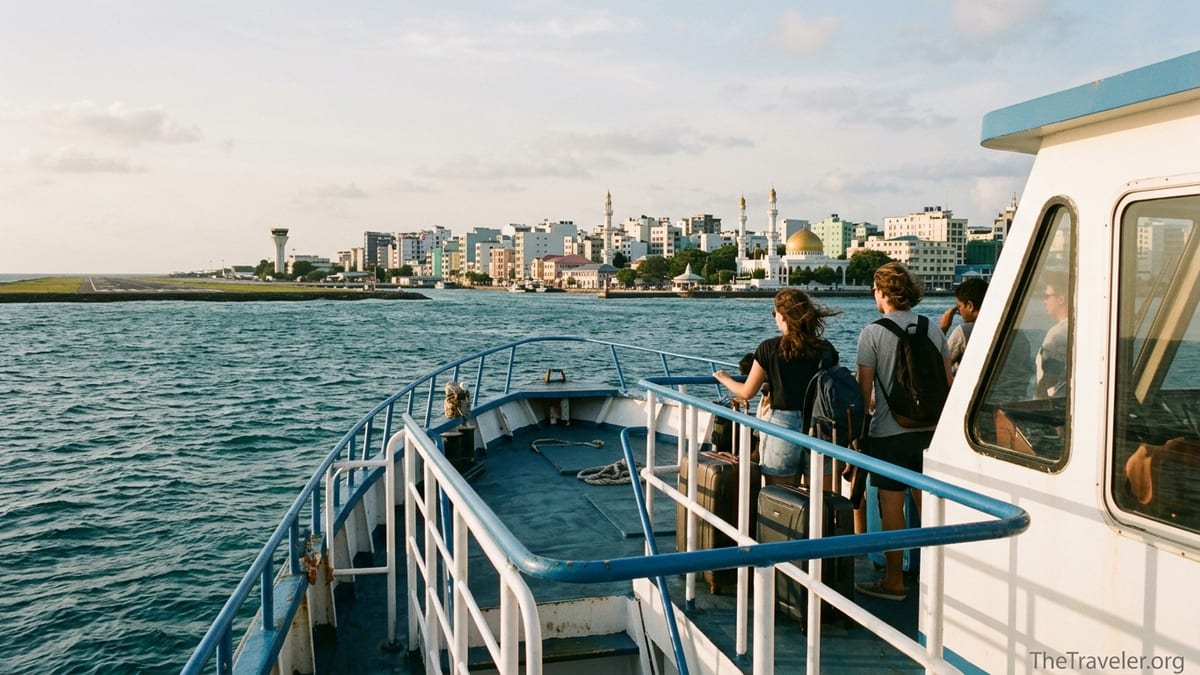
The classic way to travel between Velana International Airport and Malé is the public ferry that runs directly between the airport jetty on Hulhulé and the main jetty on the northern waterfront of Malé. In normal daytime hours this boat runs roughly every 10 to 15 minutes and operates 24 hours a day, with slightly reduced frequency overnight. The crossing itself is brief and scenic, with views of the Malé skyline and the airport runway almost the entire way.
As of mid 2026, the fare is in the low single digits in US dollar terms per person, typically quoted locally in Maldivian rufiyaa. Travellers report paying about 15 rufiyaa during the day and a little more in the early morning hours. You buy a simple paper ticket at the small booth at the terminal, queue on the jetty and board the next boat. There is no need to book in advance; the ferry is designed for both locals and visitors and absorbs the flow of arriving flights smoothly most days.
Luggage rules on the ferry are relaxed compared with many city transport systems. Standard checked suitcases, backpacks and a couple of smaller bags are routinely carried by arriving passengers without surcharges as long as you can manage them yourself. Very large or bulky items may occasionally attract an extra fee or be refused if the boat is crowded, but this is not common for ordinary holiday luggage. Once you arrive at Malé’s airport ferry terminal you will find yourself on the northern edge of the city, within walking distance or a short taxi ride of many guesthouses and the main atoll ferry terminals.
The public ferry is ideal if you are on a budget, staying in Malé for a night, or connecting to a public atoll ferry such as the south Malé services to Maafushi, Gulhi or Guraidhoo from the city’s different harbours. For example, a common pattern is to land around midday, ride the airport ferry into Malé, walk or taxi to the Vilingili or Maafushi ferry terminal, then continue by provincial ferry for just a few dollars more to your local island.
Taxi and ride options over the Sinamalé Bridge
Not all transfers require a boat. The Sinamalé Bridge now links the airport island of Hulhulé with both Malé and Hulhumalé, making taxis and car transfers a straightforward alternative to the ferry. Outside the arrivals hall you will see a line of licensed taxis and pre-arranged car services. Fares are regulated and typically set as a fixed price per vehicle for trips between the airport and different parts of the city.
Recent reports from travellers in 2025 and 2026 suggest that a taxi from Velana to Hulhumalé costs the equivalent of roughly 5 to 6 US dollars at the official rate, and similar prices apply for a standard car from the airport to Malé’s city centre or ferry terminals. Hotels in Hulhumalé often offer private airport pickups for around 10 US dollars per car, which is slightly higher but includes meet-and-greet in the arrivals area. If you are travelling as a couple or a small group with several bags, this can be the most comfortable and efficient choice.
Taxis are well suited to late-night arrivals when you may prefer to avoid waiting on a jetty with luggage. They are also useful if you are staying in Hulhumalé, which has grown into a major accommodation hub for budget and mid-range travellers. A common pattern is to take a taxi from the airport to a Hulhumalé guesthouse for an overnight stay, then travel back to Malé by bus or taxi the next morning to catch a public ferry to islands such as Maafushi or Fulidhoo.
Do keep in mind that taxis are paid in cash, and drivers may not always have change for large US dollar notes straight off a long-haul flight. If possible, break larger notes at an airport café, exchange counter or ATM before joining the taxi queue, or withdraw a small amount of rufiyaa which can be used for both taxis and ferries.
Resort speedboats and independent speedboat transfers
If you are heading to a resort in North or South Malé Atoll or nearby atolls, chances are your booking includes a speedboat transfer from the airport pier. Resort speedboat transfers are usually arranged in advance and charged by the resort either per person or per round trip. Rates vary widely but for a 20 to 45 minute shared speedboat journey many mid-range resorts quote figures in the region of 150 to 250 US dollars per adult round trip, sometimes more for luxury properties.
Travel time depends on distance and sea conditions. Resorts within about 15 kilometres of Velana, such as Kurumba or Bandos, may be reached in 10 to 20 minutes in calm seas. Islands 15 to 35 kilometres away, such as some of the South Malé Atoll resorts, might take 20 to 40 minutes. Further-flung islands within 60 to 90 kilometres can require 45 to 90 minutes by speedboat. On calmer northeast monsoon days between December and April, these rides can feel almost like a pleasure cruise. During the southwest monsoon months from May to October, seas can be choppier and longer crossings in smaller boats may feel rough, particularly for those prone to motion sickness.
Independent speedboat operators also run scheduled and charter services between the airport, Malé and popular local islands such as Maafushi, Gulhi and Guraidhoo. For example, a scheduled shared speedboat from the airport jetty to Maafushi might cost on the order of 25 to 40 US dollars per person one way, while a private charter boat for a small group can cost upwards of 100 to 150 US dollars for the same route. These services often depart directly from the airport pier, which means you can bypass Malé entirely if your local island stay is on one of the well-connected routes.
Speedboat luggage allowances are generally generous, similar to or slightly more flexible than airline checked baggage rules. Resorts expect guests to arrive with suitcases, dive gear and camera bags, and boats have designated luggage areas. Overly large or heavy items like surfboards or dive tanks should be confirmed with your resort or operator beforehand as they may incur extra handling fees or require specific boats.
Timing your transfer: late arrivals, early departures and connections
One of the biggest concerns for new visitors is whether they will be able to reach their hotel or next transfer if their international flight lands late or early. For Malé and nearby islands the answer is usually yes. The public airport ferry operates 24 hours a day, though at slightly lower frequency in the very early morning hours, and taxis across the bridge run late into the night. This makes it realistic to reach central Malé or Hulhumalé even after a midnight arrival.
Resort and independent speedboat transfers, however, are more sensitive to timing. Many resorts group arriving guests into combined speedboat transfers that depart every 1 to 3 hours during daylight and early evening, with limited late-night sailings. A resort on an island about an hour away might schedule its last standard shared speedboat by around 21:00 or 22:00, after which private transfers may still be possible but at higher cost. This is why many travel agents recommend avoiding very late-night arrivals if your resort relies solely on speedboats.
For onward connections to domestic flights or seaplanes, plan for generous buffers. Airlines and seaplane operators in the Maldives typically require you to check in at the domestic terminal or seaplane terminal at least one to two hours before departure, and some seaplane services only operate in daylight. If your international flight arrives after mid-afternoon, you may be routed onto a later domestic flight plus speedboat combination or asked to overnight in Malé or Hulhumalé and travel onward the next morning. In those cases, the short airport ferry or a taxi into town is your link between terminals and hotels.
On departure, aim to be back at the airport at least three hours before an international flight, especially if you are taking the public ferry. While the crossing is short, queues can build up around popular flight banks and during local rush hours. A simple rule of thumb is to plan to leave Malé or Hulhumalé at least 3.5 hours before your scheduled international departure, which gives breathing room for a busy ferry, a brief wait in the taxi queue or an unexpected luggage repack before check in.
Money, tickets and handling luggage on arrival
Stepping out of customs at Velana, you will find currency exchange counters, bank branches and ATMs on your right-hand side before you reach the outer doors. Several Maldivian banks operate here and most machines and counters dispense both local rufiyaa and US dollars. Exchange rates at the airport are usually slightly less favourable than mid-market rates but convenient if you need small cash immediately for ferries and taxis. Many travellers now also rely on international debit or credit cards, which are widely accepted in resorts and larger guesthouses, though small local cafés, market stalls and public ferries still expect cash.
For the short transfer from the airport to Malé, it is perfectly acceptable to pay in local currency. You can withdraw the equivalent of 20 to 50 US dollars in rufiyaa, which is usually more than enough to cover the ferry, a taxi and small purchases on your first day. US dollars are also widely accepted in the tourism economy, particularly for resort extras and speedboat transfers, but change may be given in rufiyaa. Carrying a mix of both gives you flexibility.
Tickets for the public airport ferry are bought directly at the small ticket counter by the jetty. Independent speedboat rides can often be paid in cash on boarding or in advance by card when booking online or through your guesthouse. Resort transfers are usually charged to your hotel bill or prepaid via your travel agent. Taxi fares are cash only in almost all cases, and tipping is not mandatory; rounding up to the nearest convenient amount is appreciated but not expected.
With luggage, remember that the airport island is compact but uncovered in many areas. If you are carrying multiple heavy bags, you may prefer a short taxi ride to the ferry jetty or a resort speedboat pier instead of walking across in the midday heat. On the Malé side, some guesthouses offer a porter service from the ferry terminal. Otherwise, you will be responsible for wheeling or carrying your own bags along often narrow and busy streets. Choosing light, wheeled luggage pays off here, particularly if your hotel is a few blocks inland.
Is Malé worth visiting before heading to your island?
Many visitors see Malé only from the windows of the airport ferry or speedboat, but the compact capital can be a rewarding short stop if you adjust expectations. It is one of the most densely populated cities in the world, busy and urban rather than a postcard beach destination, yet it offers a glimpse into everyday Maldivian life that you will not find on a secluded resort island.
With just half a day you can stroll from the airport ferry jetty along the waterfront to the fish market and local produce market, where fishermen land their catch and stalls sell coconuts and tropical fruit. From there it is a short walk to Republic Square, the Islamic Centre with its striking golden dome and the narrow grid of streets lined with small cafés and shops. Many travellers choose to stop for a simple Maldivian breakfast of mas huni and roshi at a local tea shop before continuing to their islands.
For an overnight stay, Malé and nearby Hulhumalé offer a range of guesthouses and small hotels that are considerably cheaper than most resort rooms. This makes them a practical base if you arrive too late for a domestic flight or seaplane, or if you have an early morning departure the next day. Hulhumalé in particular has a more relaxed seaside feel with a long artificial beach and a growing café scene, while still being only a short taxi or bus ride back to the airport.
If your time is limited to a tight international connection or you are exhausted from long-haul travel, it is perfectly reasonable to go straight to your resort or local island. But if you have a spare morning or afternoon, building a short Malé visit into your arrival or departure day adds texture to a Maldivian trip, costs very little and makes the simple airport to city transfer feel like the start of your journey rather than a chore.
The Takeaway
Getting from Velana International Airport to Malé is one of the simplest parts of travelling in the Maldives. A short public ferry ride or taxi over the bridge gets you into the capital in minutes, and resort or independent speedboat transfers from the airport pier carry you directly to many islands in under an hour. Costs range from the equivalent of a dollar or two for the ferry to tens or hundreds of dollars for premium speedboats, but all options are straightforward once you know where to go and what to expect.
On arrival, organise a small amount of local cash, follow signs to the ferry or taxi stands, and confirm your transfer times if your resort is arranging a boat. Allow comfortable buffers around domestic flights or seaplane connections, and be realistic about late-night arrivals and early departures when choosing flights. With a bit of planning, your first journey across the water or bridge from the airport will feel less like a logistics task and more like the moment your Maldivian adventure truly begins.
FAQ
Q1. How long does the airport ferry from Velana to Malé take?
The public airport ferry crossing usually takes about 10 minutes jetty to jetty in normal conditions, plus a few minutes for boarding and disembarking.
Q2. How much does the airport ferry cost and how do I pay?
The fare is in the low single digits in US dollar terms per person, paid in Maldivian rufiyaa at the ticket counter by the jetty. Bring small cash or withdraw rufiyaa from an airport ATM before boarding.
Q3. Are taxis available from Velana Airport to Malé and Hulhumalé?
Yes. Licensed taxis wait outside the arrivals hall and use fixed fares for trips over the Sinamalé Bridge. Expect to pay roughly the equivalent of 5 to 10 US dollars per car depending on destination and hotel-arranged markups.
Q4. Do I need to book a speedboat transfer in advance?
For resort speedboats you almost always need to book in advance through your hotel or travel agent. For popular local islands with scheduled shared speedboats it is wise to reserve a seat, especially in high season or if you land late in the day.
Q5. What happens if my international flight arrives late at night?
If you are staying in Malé or Hulhumalé, you can still use the 24-hour airport ferry or a taxi to reach your hotel. If your resort transfer or domestic flight cannot operate late at night, you may be asked to overnight near the airport and continue the next morning.
Q6. How much time should I allow to get back to the airport from Malé?
Plan to leave Malé or Hulhumalé at least 3.5 hours before your international departure. This allows time for the 10 to 20 minute transfer, ticket purchase or taxi queue, airport security and check in.
Q7. Can I take large luggage on the airport ferry or speedboat?
Yes. Standard suitcases and backpacks are accepted on both the public ferry and most speedboats. Very large or heavy items should be checked in advance with your resort or operator and may incur extra handling fees.
Q8. Is Malé worth visiting before going to my resort?
If you have half a day or more, Malé offers an interesting look at local life with markets, mosques and cafés. It is not a beach destination but can be a worthwhile cultural stop, especially on arrival or departure days.
Q9. Do I need local currency for the transfer or can I use US dollars?
It is best to have some Maldivian rufiyaa for the ferry and taxis, though many tourism services and resorts accept US dollars. Withdraw or exchange a small amount at the airport for convenience.
Q10. Is the sea crossing rough between the airport and Malé?
The short ferry route between the airport and Malé is usually calm, although winds can pick up during the southwest monsoon. Longer speedboat rides can be bumpy in rougher seas, so consider motion sickness medication if you are prone to seasickness.