


More news on this day
Rail travel between Mumbai and Gujarat faced significant disruption on Tuesday morning after the Virar–Bharuch Mainline Electric Multiple Unit (MEMU) partially derailed while entering Bhilad station in Gujarat, forcing route diversions, delays and cancellations on one of Western Railway’s busiest intercity corridors.
Get the latest news straight to your inbox!
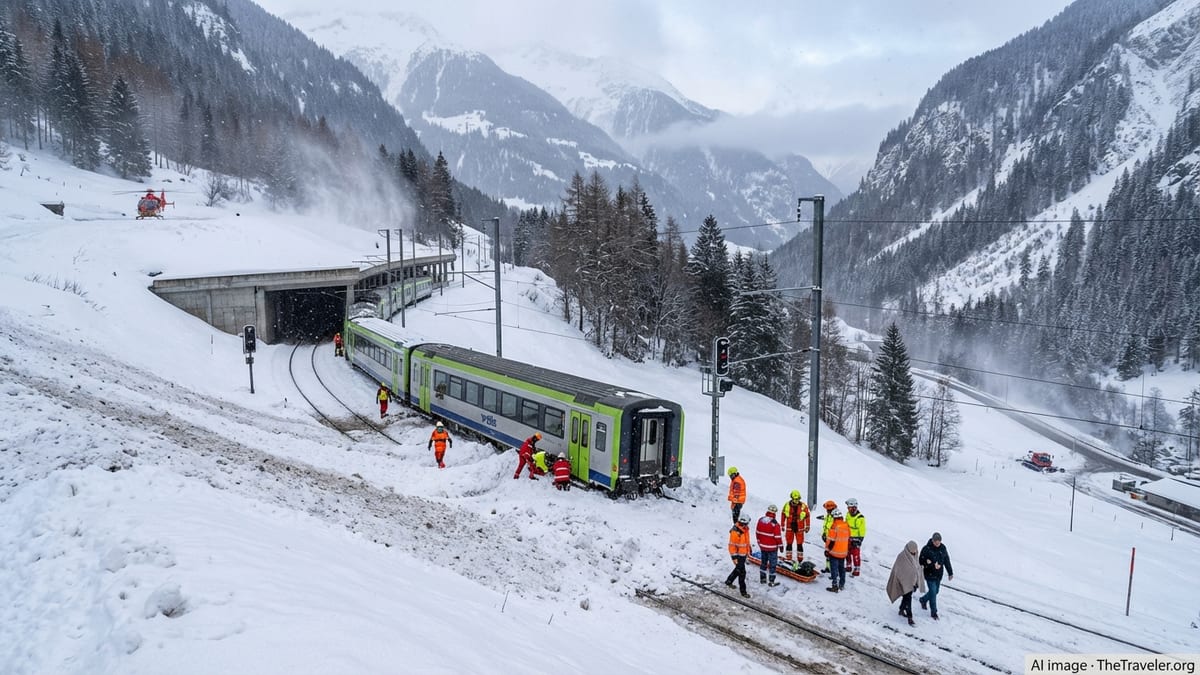
Early-morning derailment on busy Western Railway link
According to published coverage, the incident occurred at around 6.25 am on July 28 when the Virar–Bharuch MEMU, train number 19101, was drawing into Platform 1 of Bhilad station in Valsad district. Initial reports indicate that four wheels of the leading coach came off the track as the train was negotiating the point near the platform.
Visuals shared in local media show the MEMU standing askew near the platform face, with its front portion tilted slightly off the rails but still largely upright. The train had departed Virar in the early hours and was heading north toward Bharuch, serving daily commuters and short-distance travelers across the Maharashtra–Gujarat border.
Publicly available information indicates that there were no major injuries among passengers on board. Local language reports describe the episode as a narrowly averted major accident, noting that the low speed of the train while entering the station and the fact it was approaching the platform likely reduced the impact.
Railway technicians and permanent way staff were mobilised to the site shortly after the incident, and re-railing work on the affected coach and wheels began during the morning peak. The derailment remained confined to station limits, but its timing and location on the main line immediately affected movements across the Mumbai–Surat–Ahmedabad axis.
Mumbai–Gujarat services delayed, diversions ripple across corridor
The partial derailment created an operational bottleneck on Western Railway’s Mumbai Central division, with both long-distance and local passenger services impacted. Published updates from railway-focused outlets and regional news platforms describe delays to several intercity trains running between Mumbai, Surat, Vadodara and Ahmedabad as traffic was regulated around Bhilad.
Some trains were reported as halted at preceding stations such as Umargam Road, Sanjan and Dahanu Road as control offices worked out revised pathing. Others were diverted on available lines through the affected section at restricted speeds while engineering teams inspected the track, points and sleepers near the derailment site.
For travelers, the disruption translated into extended journey times during the morning hours, missed connections and crowding on platforms as passengers waited for revised departure and arrival times. Social media posts highlighted passengers standing by stationary coaches for extended periods, especially on commuter-heavy MEMU services that link satellite towns with major cities along the coast.
By mid-morning, reports suggested that partial normalisation of traffic was under way, with some trains cleared past Bhilad under caution. However, rail information trackers still showed cascading delays for services scheduled through the stretch later in the day, a common pattern when an early-morning incident affects a dense timetable.
Re-railing, safety checks and restoration efforts
Re-railing operations at Bhilad focused initially on stabilising the affected MEMU rake, jacking up the derailed wheels and guiding them back onto the track. Images carried in regional media show on-track maintenance equipment, hydraulic jacks and crews working around the front coach, while other personnel assessed the condition of nearby points and crossings.
Publicly available information indicates that rail traffic on one line through Bhilad remained blocked during the most intensive phase of the recovery effort, with the parallel line used selectively for regulated movements. Before regular speeds could be restored, track geometry, signalling circuits and overhead equipment in the vicinity all required inspection.
Standard operating procedures in such incidents typically involve a joint inspection of the affected track, the rolling stock and the surrounding infrastructure to look for signs of damage or anomalies that could have contributed to the derailment. While early coverage has not attributed a definitive cause, attention is expected to focus on rail alignment, the condition of the points and the running gear of the MEMU set.
Once the rake is cleared from the station and maintenance teams certify the section fit for traffic, trains can gradually return to normal running. However, even a brief block during peak hours on the Mumbai–Gujarat route tends to trigger knock-on effects, and timetable recovery can take much of the day, particularly for long-distance services already operating close to capacity.
About the Virar–Bharuch MEMU and its role for commuters
The Virar–Bharuch MEMU is a key short-distance passenger service linking the northern edge of the Mumbai metropolitan region with industrial and residential centres in southern Gujarat. The MEMU halts at a series of smaller stations including Palghar, Boisar, Dahanu Road, Gholvad, Umargam Road, Sanjan, Bhilad and Vapi, providing an important option for workers and regular travelers who commute across the state border.
With an early-morning departure from Virar and a late-morning arrival in Bharuch, the train is widely used by daily wage earners, small traders and office workers. Its MEMU configuration, designed for frequent stops and quick acceleration, allows it to serve many intermediate stations that are not always covered by long-distance express trains.
Tuesday’s incident at Bhilad underscores the dependence of coastal towns along this corridor on a relatively small set of passenger services. When a single MEMU or express train is disrupted, local travelers often have limited alternatives, especially during the morning rush when seats on subsequent trains are already heavily booked or crowded.
For the wider Mumbai–Gujarat travel market, the episode serves as a reminder that even non-fatal infrastructure incidents can significantly affect connectivity, particularly on routes where road journeys are lengthy and rail remains the preferred option for speed and cost.
What travelers on the Mumbai–Gujarat route should expect
By midday Tuesday, rail inquiry platforms and app-based trackers still reflected residual delays on several Western Railway services, suggesting that passengers planning same-day journeys between Mumbai, Valsad, Surat and Bharuch may encounter revised timings. Travelers are being advised in public reports to check the latest running status of their trains before setting out for stations.
For those with flexible schedules, shifting to later trains or alternative routes within Gujarat could help avoid the heaviest of the disruption. However, for time-sensitive business or onward connections, the derailment at Bhilad may mean allowing additional buffer time at interchange points such as Surat or Vadodara.
Travel industry observers note that short-lived but disruptive rail events such as this can push some passengers toward overnight buses or shared road transport, particularly if they experience repeated delays over a short period. The Mumbai–Gujarat corridor has a dense network of private and state-run buses, but these modes are also vulnerable to monsoon weather and highway congestion.
As re-railing and inspections conclude and regular speeds resume through Bhilad, the priority for travelers will be clarity on updated schedules. With more information expected to emerge about the technical causes and any subsequent safety measures, rail users along the Western Railway corridor will be watching closely for signs of more stable operations in the days ahead.