


More news on this day
Hundreds of international passengers were left waiting for hours at Chennai airport this week after a wave of delays and cancellations linked to tensions in West Asia disrupted flight operations and exposed ongoing strains at one of India’s busiest gateways.
Get the latest news straight to your inbox!
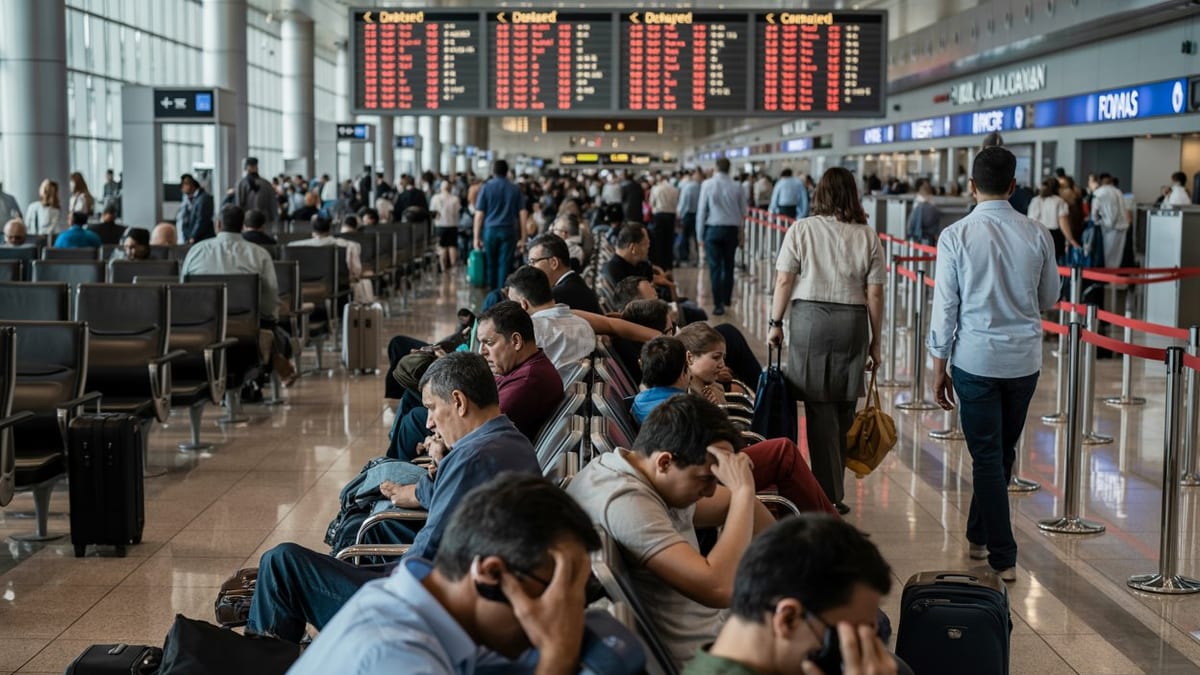
Chain reaction of delays at the international terminal
Flight tracking data and local media coverage indicate that international operations at Chennai’s Anna International Terminal were heavily disrupted on Monday, 20 July, after airspace restrictions and reroutings in West Asia triggered a chain reaction of delays. Services to key Gulf and Southeast Asian hubs experienced extended waits on the ground, with several departures rescheduled multiple times.
Reports from the terminal describe crowded holding areas, passengers stuck in long queues after clearing immigration, and families resting on the floor near departure gates as they waited for revised boarding calls. With aircraft arriving late from overseas sectors, some outbound flights departed several hours behind schedule, while others were cancelled outright.
The disruption affected both point to point travellers and transit passengers connecting through Gulf hubs. People who had already checked in and cleared immigration had limited options to leave the secure zone, effectively trapping them inside the terminal while they waited for new flight information.
While large airports across the region have been grappling with operational knock on effects from shifting flight paths, the situation in Chennai has highlighted how quickly congestion can build when multiple overseas sectors are disrupted at once.
Hundreds stranded as communication gaps add to frustration
Local news outlets and social media posts from Chennai passengers describe a particular flashpoint on 20 July, when around 20 international flights were reported delayed and at least two Colombo bound services cancelled. Travellers spoke of minimal public announcements inside the terminal and said information about revised departure times was often shared late or inconsistently across different channels.
Several passengers recounted having already passed security and immigration in the early hours, only to learn of significant delays once they had reached the gate area. With duty free and food outlets limited in parts of the newer terminal, some travellers reported restricted options for meals and seating during the extended wait.
Publicly available information shows that more than 400 passengers scheduled to fly on affected services spent much of the day in the international departure concourse, with many unable to access their checked luggage or leave the controlled area without formal clearance. Images circulating online show long queues at airline counters and crowded seating zones near the gates.
The experience has drawn renewed criticism from frequent flyers who contend that, even when disruptions originate outside India, the impact on passengers is often worsened by patchy communication inside the terminal and limited real time updates across displays and mobile channels.
Infrastructure strains at a growing regional hub
The latest disruption comes at a time when Chennai airport is undergoing a multi year modernisation intended to expand capacity and replace aging infrastructure. The integrated Terminal 2, opened for international operations in 2023, has increased the airport’s notional passenger handling capability, but travellers have repeatedly highlighted bottlenecks during peak hours.
Travellers posting online in recent weeks have pointed to long walking distances, constrained seating, and a relatively small number of aerobridge equipped gates at the international side of the airport. Some also describe a lack of wayfinding clarity between check in, immigration, and departure gates, particularly for first time international passengers and unaccompanied seniors.
Government documents on the expansion project note that Chennai remains among India’s busiest airports by passenger traffic and underline the need to manage flows carefully while construction continues around the existing terminals. In practice, that means temporary layouts, shifting security lanes, and occasional closures of parts of the building, all of which can amplify the impact of any major operational disruption.
When schedules are running normally, such constraints may be manageable. When dozens of flights are pushed back or cancelled within a short window, however, the limited space inside departure and arrival halls quickly becomes apparent, and crowding can escalate.
Recent incidents underline vulnerability to disruption
The latest wave of delays is not an isolated episode. Earlier this month, local coverage highlighted another morning of extended waits at the international terminal after two long haul flights to Abu Dhabi and London were delayed due to the late arrival of incoming aircraft. In that case too, hundreds of passengers reported being confined to the secure zone for several hours.
Separate reports have also drawn attention to infrastructure issues at the airport, including a recent incident involving a partial collapse of false ceiling elements in a terminal building. While no serious injuries were reported in that event, passenger groups argued that it reflected wider concerns about maintenance and construction quality in parts of the facility.
Air travel from southern India is additionally sensitive to disruptions because a large share of international traffic consists of migrant workers and connecting passengers headed to or through Gulf hubs. When those sectors are affected, delays can cascade to onward journeys, affecting employment commitments, visa windows, and personal plans.
Analysts observing the situation note that extreme weather, geopolitical tensions, and airspace closures are likely to remain recurring challenges for airlines operating in and out of India, making airport side resilience and passenger handling capabilities increasingly critical.
Calls grow for better passenger care and clear protocols
The scenes at Chennai’s international terminal have prompted renewed debate over how Indian airports and airlines handle large scale disruptions. Traveller forums and passenger rights advocates are urging clearer minimum standards for care, including access to food, water, seating and, where necessary, accommodation when delays extend beyond a set threshold.
Some frequent flyers argue that information protocols need to be tightened so that passengers are notified of significant schedule changes before they clear immigration and security, giving them more flexibility to rebook or adjust their plans. Others want more visible staff presence inside the terminal during disruption events, along with clearer multilingual announcements and signage.
Industry observers suggest that Chennai’s experience this week will likely feed into the broader national conversation about airport capacity, contingency planning, and the pace of infrastructure upgrades. With peak season and festival travel periods still ahead this year, there is pressure on operators to show that lessons are being learned from each episode of large scale disruption.
For the hundreds of passengers who spent much of their travel day stranded at the international terminal, the immediate concern was simply getting airborne. For Chennai airport and the carriers using it, the challenge now is to restore confidence that future disruptions will be managed with less chaos and greater care for those caught in the middle.