


More news on this day
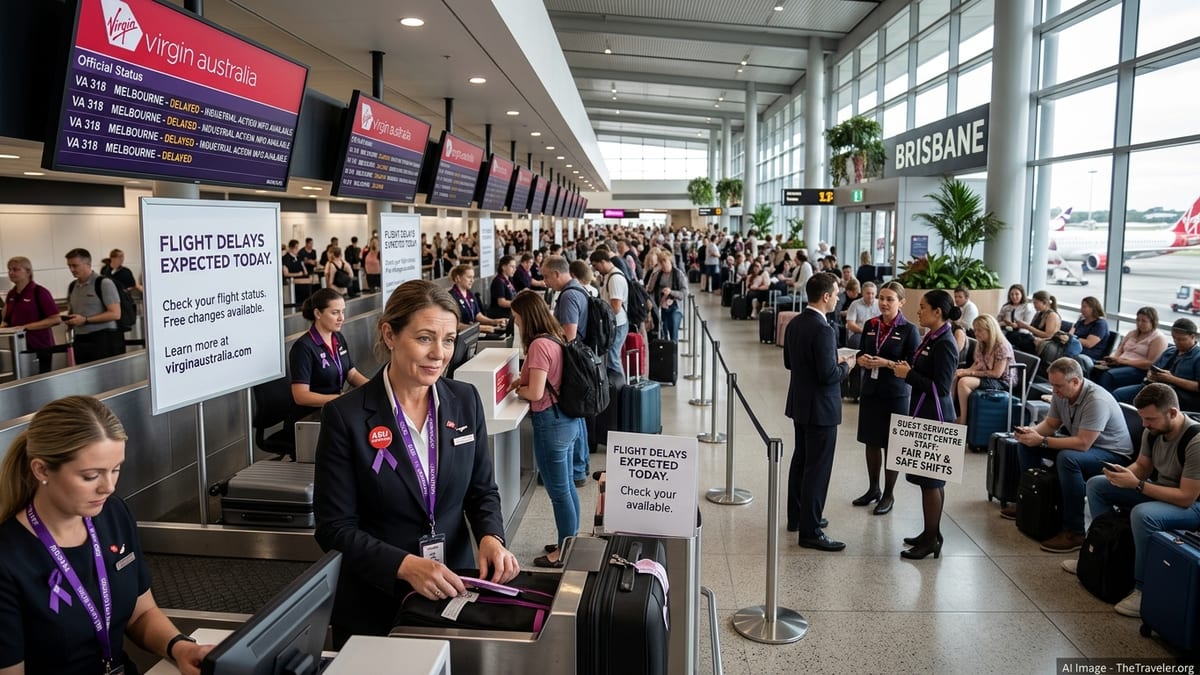
Virgin Australia passengers face renewed disruption as Australian Services Union-represented check-in, gate and contact centre staff escalate protected industrial action at major airports, with further work stoppages scheduled while negotiations over a new guest services enterprise agreement remain deadlocked.
Get the latest news straight to your inbox!
What is driving the latest Virgin Australia stoppages?
The current wave of industrial action involves Virgin Australia guest services and airport customer-facing staff, including check-in and bag-drop agents, boarding gate teams and baggage counter staff, along with guest contact centre employees. These workers are covered by the Virgin Australia & ASU – Guest Services & Guest Contact Centre Agreement 2023, an enterprise agreement approved by the Fair Work Commission and currently operating with a nominal expiry date of 30 June 2026.
Bargaining for a replacement deal has intensified through 2026 as the agreement approaches its nominal end date. The Australian Services Union argues that Virgin’s latest offer does not keep pace with living costs in major cities or reflect the complexity and responsibility of front-line airport roles. Union material highlights concern about a proposed move to nine-hour shifts at ordinary pay rates, protections for days in lieu for staff working public holidays and weekends, and rostering changes that members say would make family and caring responsibilities harder to manage.
Virgin Australia maintains that it is bargaining in good faith and that its offer is consistent with other wage outcomes across the company. Public reporting of the airline’s current proposal indicates base pay increases of around 5 per cent in each of the first two years and 4 per cent in the third, with the company stating that some classifications would see total increases of roughly the high teens to high twenties in percentage terms over three years once penalty rates and related adjustments are included. The offer is also understood to include more full-time positions, clearer progression through skill and tenure classifications and rosters that the airline says deliver additional days off each year.
Timeline and scope of the protected industrial action
Protected industrial action at Virgin Australia’s domestic airports has unfolded in stages through October and November 2026 after guest services staff secured a protected action ballot order from the Fair Work Commission. The successful ballot gave ASU members a legal framework to implement industrial measures ranging from uniform variations to work stoppages once the required notices were given to the airline.
The first actions were largely symbolic and designed to raise awareness without directly affecting flights. Staff at major airports, including Melbourne and Sydney, wore union-related items with their uniforms, distributed flyers to passengers explaining the dispute and observed limitations on voluntary tasks outside their core duties. These measures coincided with ongoing bargaining meetings but signalled that staff were prepared to escalate if no agreement was reached.
From mid-November, the union moved to time-limited stoppages and tighter work practices. On dates including Monday 16 November, ASU members implemented one-hour work stoppages at peak times at Sydney, Melbourne, Brisbane and Adelaide, combined with bans that delayed boarding until closer to departure. According to travel-industry advisories and union communications, the strategy aimed to increase pressure on Virgin by creating operational bottlenecks during busy morning and late-afternoon banks of flights, while stopping short of an indefinite strike.
The dispute is now entering a more disruptive phase. Notices issued in late November confirm that on Thursday 26 November 2026, ASU-represented check-in and gate staff intend to stop work for four hours at Sydney, Melbourne and Brisbane and for two hours at Adelaide. The stoppages are scheduled at times that coincide with regular domestic peaks, and the union has warned that passengers should be prepared for queues, delays and a risk of some cancellations during and after the strike windows.
Union demands and Virgin Australia’s response
For the ASU, the Virgin Australia bargaining round has become a focal point for wider concerns about pay and job quality in Australia’s aviation ground and customer service sector. Union representatives argue that guest services staff accepted wage restraint and significant upheaval during the pandemic and Virgin’s voluntary administration, and that the airline’s recent return to profitability should now be reflected in stronger wage growth and firmer protections for conditions.
Union statements reference Virgin Australia’s most recent financial results, which reported a solid underlying profit, as evidence that the company has scope to improve its offer to some of its lowest-paid employees. The ASU has been particularly critical of proposed nine-hour shifts at ordinary rates, arguing that such rosters would extend working days without appropriate compensation and further strain staff dealing with irregular hours, long commutes and high housing costs in capital cities.
Virgin Australia has not published a comprehensive, line-by-line version of its proposed enterprise agreement in the public domain but has outlined key elements through statements to media and staff. The airline stresses that its pay proposal would deliver cumulative increases above several earlier aviation bargains, especially when shift loadings and progression through new classification structures are taken into account. It also points to commitments to convert more team members from part-time or casual arrangements into permanent roles and to provide rosters that it says offer 13 to 15 more days away from work each year for full-time staff compared with current patterns.
Despite these elements, negotiations remain at an impasse. The union says that while it acknowledges improvements in the latest offer, it does not yet meet members’ expectations on base rates and safeguards for days in lieu and rostering. Virgin Australia, for its part, argues that it must balance fair pay with the need to keep its cost base sustainable in a domestic market where ticket prices and competition are under pressure. Both sides continue to meet, and there is no indication at this stage that the dispute has been referred to intractable bargaining processes or binding arbitration.
Impact on airports and what passengers are experiencing
In practical terms, the industrial action has its greatest impact at Virgin Australia’s main domestic terminals in Sydney, Melbourne, Brisbane and Adelaide. Check-in, bag drop and boarding gates are labour-intensive points in the passenger journey, and even a modest shortfall in staff at peak times can quickly lead to queues and slower aircraft turnarounds, particularly at airports already operating close to capacity.
On earlier industrial action days in November, travel-industry reports described longer-than-usual lines at self-service kiosks and bag-drop counters, with some flights boarding later than scheduled when staff enforced bans on commencing boarding before a set time prior to departure. While there have been delays, there is so far limited evidence of widespread cancellations attributed solely to the ASU actions. Virgin Australia has consistently stated that it is working to minimise disruption, including by rostering managers and non-union staff into customer-facing positions and adjusting schedules where possible around notified stoppage periods.
The airline has also introduced temporary flexibility for affected passengers on notified strike days. For the upcoming 26 November stoppages, Virgin Australia is allowing customers booked on impacted routes to move to an alternative Virgin flight on the same city pair departing between 25 and 27 November 2026, subject to seat availability, without paying change fees or fare differences. Travelers are being encouraged to make changes through digital channels rather than at the airport to reduce pressure on remaining staff.
Airports and aviation regulators have not reported any compromise to safety or security functions as a result of the Virgin dispute. Security screening, air traffic control, ground handling for other airlines and emergency services are staffed under separate arrangements and have continued to operate normally. However, the passenger experience on Virgin-operated services can still be significantly affected, especially for travellers requiring special assistance, families with young children and those with complex itineraries or tight domestic connections.
Wider industrial context and what travelers should do next
The Virgin Australia guest services dispute is occurring in a broader context of more assertive wage bargaining in Australian aviation and transport. Since the lifting of pandemic-era travel restrictions, unions representing cabin crew, ground handlers and airport staff across several airlines have pursued higher pay and stronger rostering protections, arguing that years of wage freezes and high inflation have eroded living standards. At Virgin Australia, cabin crew represented by the Transport Workers’ Union have recently voted in favour of authorising their own protected industrial action, though no specific strike dates have been announced for that group.
For now, the most immediate operational impact remains concentrated in the ASU-led guest services actions. Under Australian workplace law, protected industrial action requires unions to give employers advance written notice, typically at least three working days. This means Virgin Australia has a degree of visibility over upcoming stoppages and can publish travel advisories in advance, but it does not completely remove uncertainty for travelers, because the exact impact on each flight depends on local staffing, the timing of the stoppage windows and any last-minute operational changes or weather-related disruptions.
Passengers booked to fly with Virgin Australia over the coming weeks should begin actively monitoring their bookings from about 48 hours before departure. The airline’s website and mobile app carry real-time flight status information and gate details, and Virgin has been using email and SMS to contact customers whose itineraries are expected to be affected. On declared industrial action days, travelers should allow extra time at the airport, especially for morning and late-afternoon departures when domestic terminals are generally busiest.
Those with onward connections on separate tickets, particularly international flights with other airlines, may want to consider moving to an earlier domestic leg where the fare rules and Virgin’s temporary waivers allow. It is also sensible to keep accommodation and transport plans flexible around the arrival city in case flights are delayed. While there is currently no sign of an open-ended or indefinite strike by Virgin Australia guest services staff, the pattern of rolling, time-limited actions is likely to continue until either a new enterprise agreement is endorsed by staff or the parties reach some other resolution. Travelers planning trips into the Australian summer period should therefore stay alert to further announcements from both the airline and the Australian Services Union as bargaining continues.