


More news on this day
Thirty‑four departures from Manchester Airport faced delays on 25 November 2026, affecting a mix of short and long haul services and prompting passengers to be advised to check live flight information before travelling to the airport.
Get the latest news straight to your inbox!
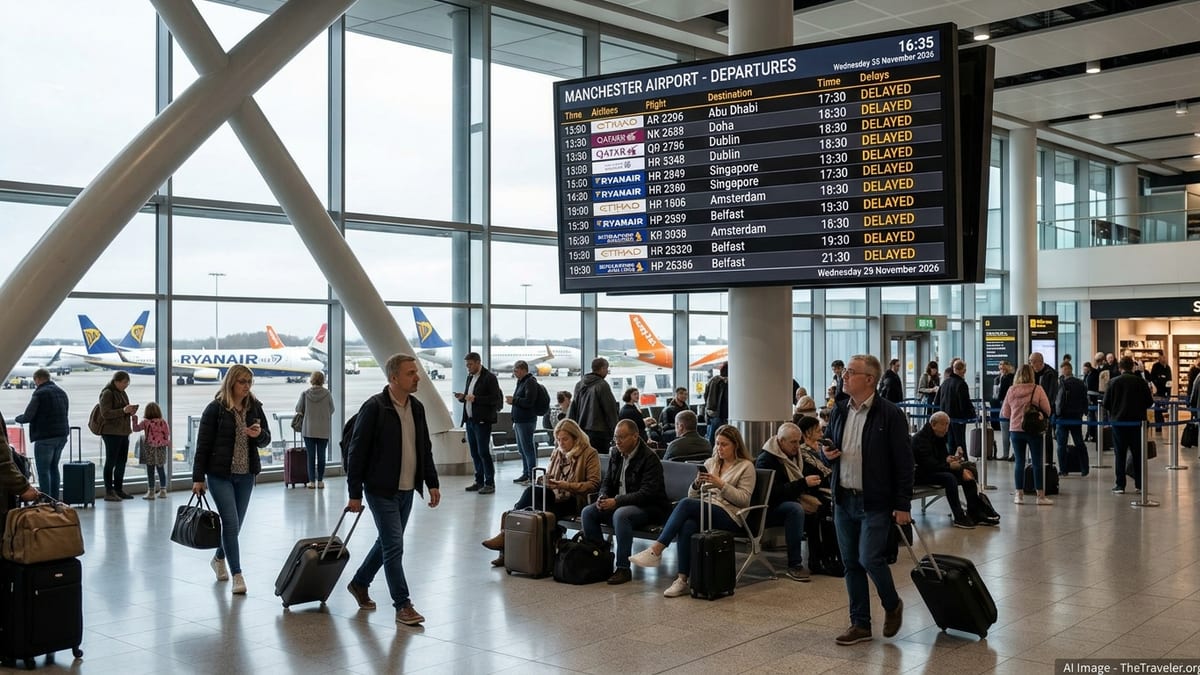
Which Manchester Airport flights were delayed
Live departure boards and aviation tracking data for Manchester Airport on Wednesday 25 November 2026 showed 34 departing flights operating behind schedule at various points during the day. These delays affected a cross section of carriers including Etihad Airways, Ryanair, Qatar Airways and Singapore Airlines, as well as several European short haul operators. The disrupted services covered a spread of departure times from early morning through late evening, rather than being concentrated in a single peak period.
The delayed departures included both European and intercontinental routes. Among the long haul services affected were flights from Manchester to Doha with Qatar Airways and to Singapore with Singapore Airlines, along with an Etihad service to Abu Dhabi. Short haul delays were recorded on routes such as Belfast, Amsterdam, Dublin, Brussels and a number of Mediterranean and central European destinations. Individual delay lengths varied, with some aircraft leaving around 15 to 30 minutes behind schedule and others facing longer waits before departure.
Flight tracking services indicated that, while most departures ultimately operated, several left sufficiently late for passengers to risk missing tight onward connections at hub airports. At the time the delays were recorded there was no single publicly confirmed technical failure or weather incident at Manchester itself that fully explained the pattern, and neither the airport nor the affected airlines had issued formal statements attributing the disruption to a specific cause. The picture was therefore of scattered operational delays rather than a complete breakdown in airport or air traffic control systems.
How 25 November compares with typical punctuality at Manchester
The number of delayed departures on 25 November sat within the kind of daily variation seen at large UK airports, but remains significant for travellers booked on the affected flights. Recent data from the UK Civil Aviation Authority on flight punctuality in the third quarter of 2026 shows Manchester Airport with a substantial proportion of services arriving or departing more than 15 minutes late, underlining that minor and moderate delays are a regular feature rather than an exceptional event. For individual passengers, however, even a short hold on departure can have outsized consequences, particularly when travelling on separate tickets or with tight connections.
Compared with severe disruption events driven by national air traffic control issues or major weather systems, operations at Manchester on 25 November were relatively stable. Live boards showed the majority of departures operating broadly to schedule, and there were no indications of a large cluster of cancellations linked to a single incident such as a radar outage or widespread airline systems failure. Instead, the day resembled many busy winter days in which scattered delays accumulate because of a mixture of late inbound aircraft, crew scheduling challenges and congestion at hub airports feeding into Manchester’s network.
For context, the wider European and UK network has seen several recent episodes of heavier disruption, including technical problems at UK air traffic provider NATS in September and a planned secondary surveillance radar outage at Manchester scheduled for 30 November 2026. Those larger network events can cause knock-on delays at airports like Manchester even when local conditions at the airport itself are unremarkable. By contrast, the 34 delays on 25 November were notable but did not amount to the kind of airport-wide operational crisis seen in those earlier episodes.
Likely drivers behind the day’s disruption
On 25 November there was no public indication of snow, freezing fog or high winds at Manchester Airport strong enough to force runway closures or large-scale ground handling suspensions. Aviation data for the day instead pointed to a familiar collection of operational factors. Some Manchester departures were delayed because the incoming aircraft arrived late from another airport that had its own congestion or weather issues, which then compressed turnarounds. This type of knock-on delay is common in winter when busy hub airports across Europe and the Middle East experience short-lived ground holds or de-icing queues.
Another potential contributor was pressure on airline and handling resources during a period of strong seasonal demand. Late November sits at the start of the winter schedule, when airlines adjust frequencies and aircraft rotations, and it is also close to peak leisure and visiting-friends-and-relatives travel around the end-of-year holidays. In such periods, any small disruption in the schedule, such as a technical inspection on an inbound aircraft or a crew duty time limitation, can leave fewer spare aircraft or staff available to absorb delays. This can cause a limited number of late departures without triggering widespread cancellations.
The existing network planning information for Manchester also points to upcoming air traffic management constraints, including the already scheduled secondary surveillance radar outage on 30 November that will temporarily increase separation distances between aircraft. While that particular event had not yet started on 25 November, it illustrates the more constrained operating environment in which airlines and air traffic control are working at the airport this winter. Even outside specific outages, busy periods and staff rostering challenges within air traffic control or ground handling teams can add minutes to pushback and taxi times, contributing to the moderate delays recorded.
What affected passengers experienced and how to respond
For passengers booked on the 34 delayed departures from Manchester on 25 November, the impact ranged from relatively minor inconvenience to missed onward connections and late-night arrivals. Those on short European hops typically faced a somewhat longer stay in the departure lounge or a late arrival at their final destination. Travellers on long haul services operated by airlines such as Etihad, Qatar Airways and Singapore Airlines risked disruption to onward connections in Abu Dhabi, Doha or Singapore if their layovers were short, although many connecting itineraries on these carriers are built with some buffer time.
Under UK and EU air passenger rights rules, the level of care and potential compensation available to passengers depends on several factors including the length of delay on arrival, the distance of the flight and whether the disruption was within the airline’s control. If delays resulted from issues such as late inbound aircraft due to earlier weather or air traffic control restrictions elsewhere, airlines may argue that compensation is not owed, although they are still generally required to offer meals, refreshments and, where necessary, accommodation when delays stretch into long waits. If a passenger believes an airline has not applied these rules correctly, they can escalate complaints via the airline’s internal process and, if unresolved, to an approved alternative dispute resolution scheme or the Civil Aviation Authority.
For travellers yet to fly from Manchester this winter, the pattern of delays on 25 November reinforces the value of practical steps to reduce the impact of potential disruption. Booking through itineraries on a single ticket rather than separate unprotected connections, allowing generous connection times and selecting earlier departures where possible can all create more flexibility if schedules slip. Arriving at the airport in line with airline check in advice, keeping contact details updated in bookings and monitoring both live departure boards and airline apps on the day of travel are equally important, particularly when travelling during busy holiday periods.
Key checks for upcoming departures from Manchester
While the 34 delays on 25 November were specific to that date, they highlight several useful checks for anyone due to depart from Manchester in the coming days and weeks. Passengers should first verify their flight’s status using the airline’s official website or app on the day of travel, as well as consulting live departure information for Manchester. Because schedules can change at short notice, particularly in winter, travellers should not rely solely on the original booking confirmation for departure times.
Those travelling around late November and early December should also be aware of planned changes in air traffic control arrangements at Manchester, including the scheduled radar outage on 30 November that is expected to reduce runway capacity for part of the day. This is a published technical plan rather than an unplanned failure, and air traffic managers and airlines will have factored it into schedules, but it may still contribute to slightly longer gaps between departures at peak times. As with any planned constraint, it is not yet clear exactly how individual flights will be affected, so passengers booked on that date are advised to keep a particularly close eye on pre-departure updates.
Looking ahead across the rest of the winter 2026/27 season, Manchester Airport is operating within its declared capacity limits and airlines continue to run full schedules. Travellers should therefore expect the occasional day of scattered delays similar to 25 November rather than constant severe disruption. Even so, the experience of those on the 34 delayed flights underlines that building some tolerance for change into travel plans remains prudent. Checking in online when offered, travelling with essentials such as medication and valuables in cabin baggage, and keeping digital copies of tickets and insurance details can all help passengers respond more easily if their flight out of Manchester does not run exactly on time.