


More news on this day
As more than 80 million Americans travel for Thanksgiving this week, holiday fliers using Michigan airports are being urged to track real-time flight delays, security lines and changing weather conditions before they leave for the airport.
Get the latest news straight to your inbox!
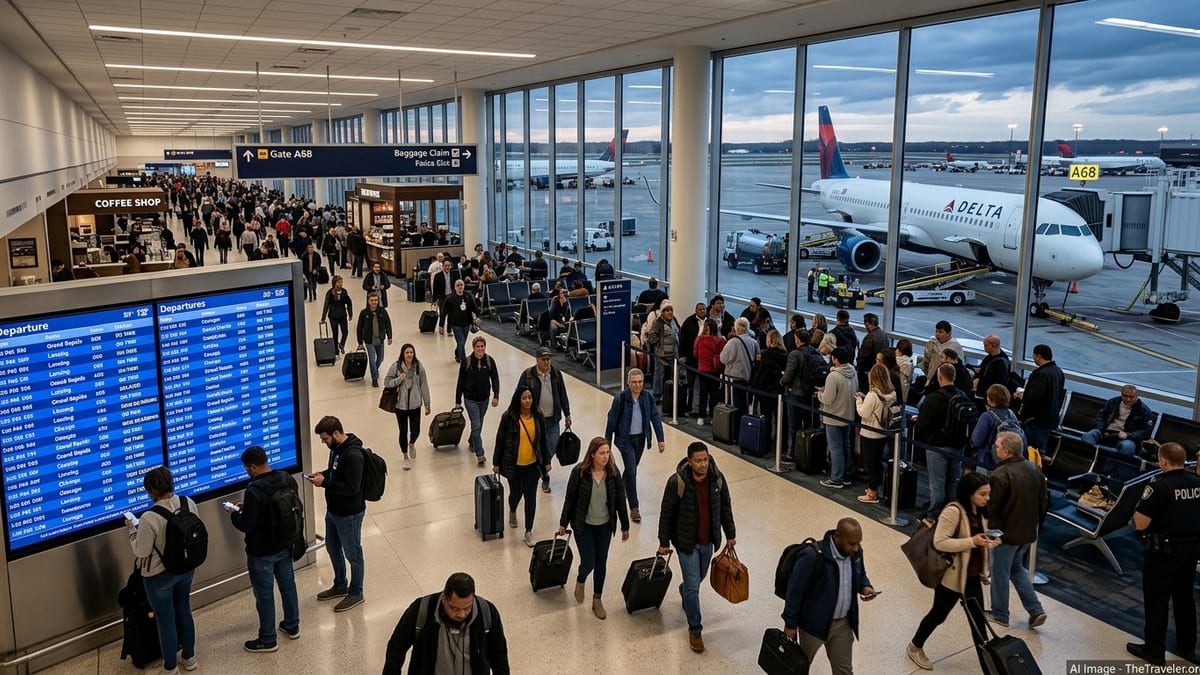
Holiday flight volumes stay near record levels despite small dip
AAA now projects about 81.5 million people in the United States will travel at least 50 miles from home for Thanksgiving between Tuesday, November 24 and Monday, November 30, 2026, a slight 0.1 percent decline from last year’s record but still close to an all-time high. Of those travelers, nearly 6 million are expected to fly on domestic routes, meaning airports are likely to feel as crowded as they have in recent years even if the national total edges down.
AAA attributes the modest drop partly to higher overall travel costs this year, including airfares and ancillary expenses such as parking and rental cars, while emphasizing that most travelers should still plan for busy terminals and longer-than-usual lines. The group notes that the heaviest outbound air travel typically clusters on the Tuesday and Wednesday before Thanksgiving, with the Sunday and Monday return period among the most delay-prone days of the year as weather and congestion compound.
Nationally, federal on-time data through September 2026 shows that roughly one in five domestic flights arrive at least 15 minutes late, with performance varying significantly by airport and time of day. For Michigan travelers, this means the specific airport and flight time they choose can materially affect their chances of an on-time departure, making localized information particularly valuable this week.
How to check flight status and delays at Michigan’s main airports
Detroit Metropolitan Wayne County Airport remains by far the largest gateway in Michigan and the state’s primary connection point for long-haul and international flights. Passengers can check real-time arrival and departure information on Detroit Metro’s official flight status page or through their airline’s website or mobile app. These tools typically show whether a flight is on time, delayed, diverted or canceled, and often include gate changes and estimated new departure times updated throughout the day.
Other commercial airports in Michigan maintain similar live tracking. Gerald R. Ford International Airport in Grand Rapids offers a real-time flight tracker that lists status, gate information and operating carrier. Capital Region International Airport in Lansing, Cherry Capital Airport in Traverse City, MBS International Airport serving the Saginaw area and Kalamazoo/Battle Creek International Airport all provide online boards where travelers can search by city, airline or flight number to verify departure and arrival times before they leave home.
Although major third-party platforms aggregate information from airlines and the Federal Aviation Administration, officials generally recommend that passengers rely on their airline and the airport operator for the most accurate and actionable updates. These sources are typically the first to reflect operational decisions such as an aircraft swap, a crew timing issue or a gate reassignment, all of which can affect when boarding begins even if the scheduled departure time appears unchanged.
What current data shows about Michigan airport performance
Federal on-time performance statistics through September 2026 indicate that Michigan’s largest airports are clustered near the national average for arrivals. Detroit, the state’s busiest hub, records on-time arrivals in the high 70 percent range so far this year, slightly better than many similarly sized hubs in the Midwest and Northeast that often contend with heavy congestion and weather-related disruptions.
Medium sized Michigan airports including Grand Rapids, Lansing and Traverse City generally report on-time arrival shares in the upper 60 to low 70 percent range for the first nine months of 2026. Smaller facilities such as Saginaw’s MBS International and Kalamazoo/Battle Creek show comparable performance, though their statistics can be more volatile from month to month because they handle far fewer daily flights. For travelers, this means that while delays are a possibility at any of these airports during a busy holiday period, there is no single outlier in Michigan that routinely performs far worse than the rest.
Passenger traffic figures compiled by the Michigan Department of Transportation highlight the scale of travel this year. Through late summer 2026, Detroit had handled more than 10 million departing passengers, with Grand Rapids surpassing 1.4 million and Traverse City approaching 400,000. Flint, Saginaw, Lansing, Kalamazoo and Marquette each reported tens of thousands of enplanements over the same period. These volumes are important because higher passenger counts can stretch parking capacity, check in lines and security screening resources even at airports that are operating on time from an air traffic perspective.
Tools to monitor security lines, border waits and wider system delays
Beyond flight status boards, federal agencies now provide several ways for travelers to gauge security and border congestion before they reach the terminal. The Transportation Security Administration’s mobile app allows users to view historical checkpoint wait times and crowd sourced current conditions reported by other passengers. Although these figures are estimates rather than guarantees, they can help travelers decide whether to leave earlier than usual on peak days such as the Wednesday before Thanksgiving or the Sunday after.
For trips that involve land border crossings, U.S. Customs and Border Protection publishes estimated wait times for major ports of entry, including crossings between Michigan and Canada. These dashboards show typical delays by hour and direction of travel, which can be especially useful for travelers driving to or from Canadian airports or combining air and car travel during the holiday period. Since weather and staffing changes can alter conditions quickly, CBP encourages travelers to check again close to their planned crossing time.
To see how the aviation system is performing overall, passengers can look at national delay maps created from Federal Aviation Administration data. Commercial services compile these into consumer facing websites that display which airports are currently experiencing significant arrival or departure delays, ground stops or ground delay programs. For Michigan residents, this kind of overview can clarify whether a late arriving flight stems from local conditions such as snow and deicing operations or from broader network disruptions at a connecting hub.
What airlines owe passengers when flights are delayed
Despite periodic public discussion of stronger passenger protections, the U.S. Department of Transportation has not implemented a nationwide rule that requires airlines to pay automatic cash compensation when flights are significantly delayed or canceled. A previous proposal to explore such requirements was formally withdrawn in 2025, and federal officials instead direct travelers to a dashboard that compares what each major carrier voluntarily offers in terms of meal vouchers, hotel accommodations and rebooking assistance during controllable disruptions.
Under current rules, airlines must refund passengers when a flight is canceled or significantly changed and the traveler chooses not to accept alternative transportation, but they are not obligated to provide additional compensation for time lost. What counts as a significant change can vary by carrier and situation, and the Department of Transportation reviews complaints on a case by case basis. For delays and cancellations caused by events outside an airline’s control, such as severe weather or air traffic control issues, carriers are generally required only to transport passengers on their next available flight.
Individual airline contracts of carriage may include more generous policies, particularly for delays that stem from maintenance problems, crew scheduling issues or other factors considered within the airline’s control. Some carriers commit to providing hotel rooms or meal vouchers in these circumstances, while others limit assistance to rebooking on their own flights. Because these commitments differ from one airline to another and can change over time, Michigan travelers are advised to review their carrier’s current contract of carriage and customer service plan in advance of peak holiday travel and to keep documentation of any delays if they later decide to file a complaint with regulators.
How Thanksgiving week travelers can use this information
Given the combination of near record traveler volumes, the potential for early winter weather in the Great Lakes region and continuing pressure on airline and airport operations, Michigan passengers this Thanksgiving week are likely to benefit from more preparation rather than less. Checking flight status on airport and airline platforms repeatedly in the 24 hours before departure can reveal schedule adjustments that might not trigger a formal notification until closer to departure time. Travelers with tight connections may wish to consider earlier flights or longer layovers where possible to reduce the risk of missed onward journeys.
Monitoring TSA wait time estimates, parking availability alerts and border crossing dashboards can help travelers decide when to leave for the airport or land border. On the busiest days, both Detroit and Grand Rapids recommend that passengers flying domestically arrive at least two hours before departure, and earlier if they need to check bags or travel with young children. Those using smaller regional airports may find security lines shorter but could have fewer alternative flights available in the event of a disruption, making proactive communication with their airline especially important.
As the holiday period continues through Monday, November 30, travelers are also encouraged to watch for evolving weather forecasts that might trigger ground delay programs at major hubs, as these often ripple through to Michigan flights even when local skies are clear. Keeping airline apps installed, opting in to text or email alerts and knowing in advance what each carrier offers during controllable delays can help passengers respond quickly to schedule changes, rebooking options and refund eligibility in one of the busiest travel weeks of the year.