


More news on this day
Italy-based disruption management specialist Value Group has confirmed plans to demonstrate its RUBIK-powered “Global Oversight, Local Action” model for handling airline irregular operations at the 27th Annual Ground Handling International (GHI) Conference, which is scheduled to take place at Olympia London from 1 to 3 December 2026, bringing together more than 1,000 aviation decision makers to discuss ground handling, resilience and disruption management.
Get the latest news straight to your inbox!
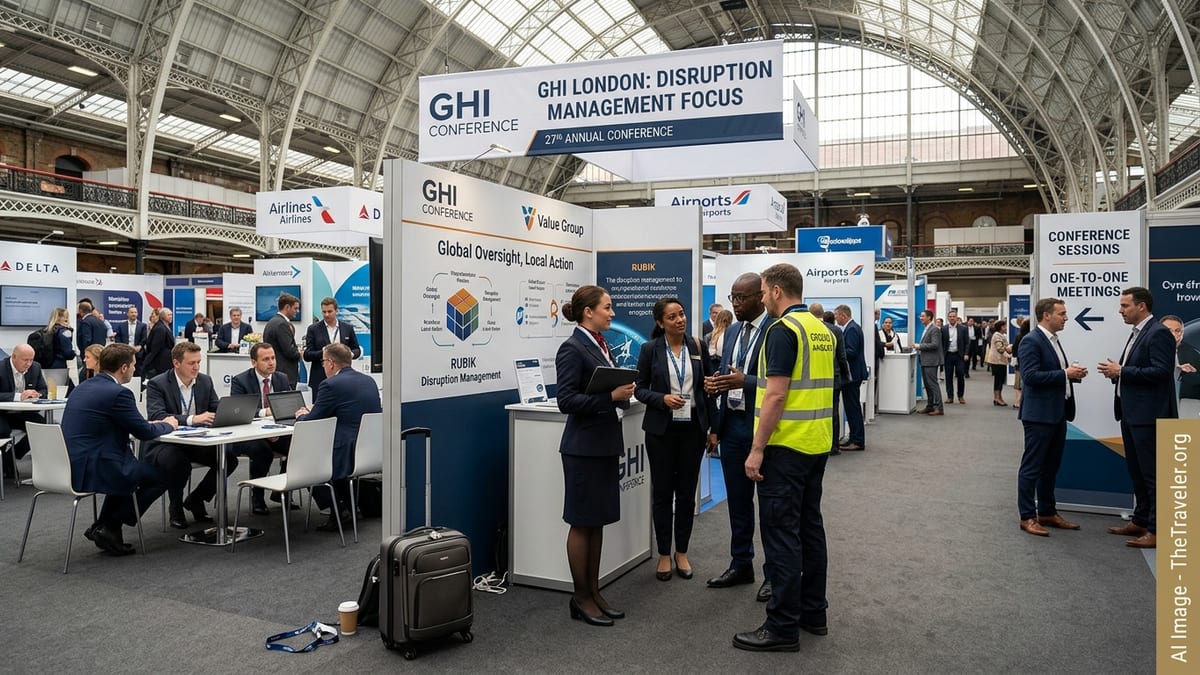
London’s 27th GHI conference set to focus on resilience and disruption
According to the official event site and Olympia’s listings, the 27th Annual GHI Conference remains scheduled for 1 to 3 December 2026 at Olympia London, with opening hours broadly aligned to standard daytime trade show timings and a mix of conference sessions, exhibition time and structured one-to-one meetings. Organiser information indicates that the 2026 edition is expected to host around 1,100 attendees, including representatives from more than 115 airlines, roughly 120 ground handling companies, airports and a broad range of ground support equipment and IT providers.
Recent promotional material aimed at airports and suppliers confirms that disruption management, operational resilience and regulatory developments will feature prominently on the London agenda. The published conference programme highlights sessions on upcoming global and European rules for ground handling, safety and wellness on the ramp, digitalisation of ground operations and the role of automation and data in improving service quality during disruption events. For suppliers focused on irregular operations, including Value Group, the event provides a forum where airlines and handlers can assess tools in the context of a broader industry conversation about reliability under capacity constraints and weather-related disruption.
External trade fair calendars and Olympia’s own event page continue to list the GHI Annual Conference on the same dates and at the same venue, with no public indication as of late November 2026 of changes to the location or timing. Registration, detailed session descriptions and exhibitor floor plans are being handled through the organiser’s official channels, while third-party listings primarily reiterate the dates, venue and target audience for planning purposes.
Value Group’s confirmed role and the scope of its RUBIK ecosystem
In an external communication distributed through a wire service in November 2026, Value Group confirmed that it will attend the GHI Annual Conference in London for the second consecutive year as an exhibitor focused on integrated disruption management. The company describes itself as a provider of services and technology for managing irregular operations across airlines, rail operators and airport handling companies, with particular attention to accommodation, transport and passenger assistance when schedules are disrupted.
Value Group’s RUBIK ecosystem is presented as the digital layer of a wider operational model that connects airlines, ground handlers and local service providers. Public descriptions from the company state that RUBIK is designed to support passenger rebooking and reallocation, arrange hotel accommodation and ground transport from contracted inventories, issue meal and expense vouchers under airline-defined rules, and manage passenger communication within a single configurable environment. Rather than replacing core airline systems, RUBIK is positioned as a disruption-specific layer that interfaces with existing passenger service and departure control tools so that data on bookings and flight status can be used to identify who is eligible for care and what options can be offered.
Alongside the software, Value Group operates what it calls a 24/7 Operations Control Center that monitors irregular operations across customer networks. According to company material, this centre coordinates with RUBIK to track emerging disruption patterns, support over-stretched local stations and provide airlines with consolidated oversight of how recovery efforts are progressing. A global supplier network, covering hotel accommodation, ground transport and related services at a range of destinations, is intended to translate digital decisions into actual services, enabling the platform and control centre to request and confirm capacity without relying solely on manual calls from airport staff.
How the “Global Oversight, Local Action” model is intended to work
For GHI London 2026, Value Group says it will emphasise a “Global Oversight, Local Action” framework, which aims to combine central coordination with practical airport-level delivery. In this model, the RUBIK platform provides a centralised view of an airline’s disrupted flights, affected passengers, remaining recovery options and the status of supplier capacity. Airline-specific policies, contractual rules and regulatory requirements can be configured within the system so that the platform can automatically identify eligible passengers and standard entitlements when a flight is delayed, cancelled or subject to other irregular operations.
Local implementation takes place at airports through ground handlers and airline station teams, who are typically the first point of physical contact for passengers when disruption occurs. Within the framework outlined by Value Group, handlers use RUBIK interfaces that present airline-configured rules in a structured workflow. This can include guided steps for confirming identity and eligibility, selecting from pre-approved hotel and transport options, issuing digital or printed vouchers and documenting the assistance provided. The company argues that this approach allows handlers working for multiple carriers at the same station to apply different airline policies from within a single interface, rather than switching between separate systems or relying heavily on manual reference documents.
Value Group has also developed tools such as RUBIK GO, which the company describes as a companion interface for operational staff handling cases that cannot be fully automated. This includes passengers with reduced mobility, unaccompanied minors, families requiring adjacent rooms, or travellers whose itineraries cross multiple carriers or transport modes. In these scenarios, staff can review and override automated proposals within the limits of airline policies, escalate to the Operations Control Center if required and coordinate with suppliers when standard contracted capacity is exhausted, such as during large-scale weather events or airspace closures.
Ground handlers’ role and integration questions for London delegates
Recent statements attributed to Value Group’s leadership emphasise that ground handlers are not treated simply as downstream executors of central decisions but as strategic partners in the disruption recovery chain. Handlers are responsible for explaining options, delivering vouchers, accompanying vulnerable passengers and arranging onward travel or overnight stays. Within the RUBIK framework, the company contends that giving handlers clear parameters and access to live information on remaining recovery capacity can support more consistent decision making and reduce the risk of different stations interpreting rules in divergent ways.
For ground handlers attending GHI London 2026, a key area of scrutiny is likely to be how systems such as RUBIK integrate with existing station processes and tools. Many handlers already operate multiple airline-specific applications, internal resource systems and regulatory reporting platforms. According to Value Group’s public material, RUBIK is designed to interface with airline passenger and departure control systems rather than replace them, but practical questions remain for each potential customer about data connections, user access management, training requirements and the division of responsibilities between airline control centres and outsourced handling partners when discretionary cost decisions must be made.
Conference information published by Ground Handling International indicates that wider sessions will address themes such as the balance between safety, operational pressures and workforce welfare, as well as the impact of upcoming regulations and the growing use of automation in ground operations. Against this backdrop, Value Group’s model will be one among several disruption and operations tools on display in the exhibition hall, with airlines and handlers able to compare different approaches on criteria such as integration effort, policy configuration granularity, reporting capabilities and the level of operational support that vendors provide during major irregular operations events.
Balancing automation, digital self-service and human support for passengers
Value Group’s public communications repeatedly highlight the need to balance automated self-service with human assistance during irregular operations. The company positions RUBIK as a platform that can support digital “self-handling” by passengers who are comfortable using mobile or web channels, allowing them to accept alternative flights, select from hotel options within an allocated inventory or confirm ground transport according to the airline’s rules. In theory, this can help airlines and handlers process large numbers of straightforward cases quickly when disruptions affect entire waves of departures or arrivals.
However, the company also acknowledges that a significant share of travellers will still need or prefer in-person assistance. For these passengers, including those with special service requests or limited digital access, Value Group points to the roles of airline call centres, dedicated disruption support teams, ground handlers at the airport and the RUBIK GO interface, which staff can use to intervene directly in complex cases. This may involve manually arranging alternative routings that fall outside standard automated choices, coordinating with multiple suppliers in tight local markets or ensuring that regulations and airline policies on vulnerable passengers are correctly applied.
From a traveller perspective, the practical experience of any such system will depend on how individual airlines choose to implement these options. Value Group’s tools are configurable, but it is the airline that decides which disruption scenarios trigger automated messaging or digital self-service, what set of options passengers see on their devices and what thresholds apply for providing accommodation, meals or alternative transport. As of late November 2026, publicly accessible material does not yet list specific new airline contracts tied to the GHI London conference itself, so any future impacts on particular routes or carriers will become clearer only if and when airlines issue their own announcements about adopting or expanding use of RUBIK or similar platforms.
Preparing for predictable disruption and what travellers should monitor
Beyond sudden events such as technical faults or unexpected airspace restrictions, Value Group has indicated that it plans to use the London conference to discuss how its Operations Control Center and supplier network can help airlines prepare for disruption that follows more predictable patterns. Company explanations suggest that the centre can monitor local hotel and transport capacity in key markets and, in cooperation with airlines and suppliers, help position resources for known peaks, such as winter weather seasons in certain regions or major events that draw large numbers of visitors to a single city.
In operational terms, this preparation can involve pre-negotiating or reserving blocks of rooms in locations with limited accommodation near the airport, setting up standby coach or taxi capacity for transfers between terminals and city centres, or advising airlines when forecast disruption could quickly exhaust contracted capacity. When integrated with RUBIK’s live inventory view, the aim is that airport teams and contact centres see in real time what recovery options remain available and can adjust entitlements or escalation paths accordingly, rather than relying solely on ad hoc calls during the height of an event.
For airlines, the effectiveness of this type of structured preparation will depend on broader commercial and operational decisions, including how much budget they allocate to contingency contracts, how they coordinate with airport operators and how clearly they communicate disruption plans to customers in advance. For travellers and corporate travel managers, the immediate impact of Value Group’s presence at GHI London will remain indirect. The conference is designed as a business-to-business forum where airlines, handlers and suppliers evaluate tools, and any changes to passenger-facing disruption handling will occur only once individual carriers complete their own selection and implementation processes.
Looking ahead to late 2026 and 2027, travellers who want to understand how their airline manages irregular operations may wish to monitor carrier communications for references to integrated disruption management platforms or new partnerships with companies such as Value Group. Before booking, it can be useful to review airline policies on care and rebooking in the event of disruption, check whether mobile and web channels support self-service options for rebooking and accommodation, and confirm that offline support at airports remains available for those less comfortable with digital tools. If new agreements arising from discussions at GHI London 2026 are announced in the months after the conference, airlines are likely to set their own timelines for deployment, which may vary across routes and regions.