


More news on this day
A global Microsoft 365 outage on 12 November 2026 and a nearly five-hour nationwide US ground stop the next day, followed by hoax bomb threats to multiple European flights, have exposed how dependent modern travel is on shared digital systems and how often travel insurance and business cover still hinge on physical damage that never occurs.
Get the latest news straight to your inbox!
Verified timeline: outages and hoaxes that hit travel in early November
According to Microsoft status advisories and independent monitoring, disruption to Microsoft 365 began on Thursday 12 November 2026 at around 16:15–16:20 UTC, initially affecting Exchange Online mailbox access in the Americas before widening to a global service degradation. Users struggled to open mailboxes, send and receive email or access Exchange-dependent features in Outlook, Teams, Copilot and other services for many hours, with partial disruption persisting into 13 November in some regions as Microsoft throttled and restarted components during recovery.
Post‑incident notes from Microsoft and technical summaries released in the days after the event attribute the outage to a combination of issues in the networking gateway infrastructure that fronts many Microsoft 365 workloads. A latent software defect introduced during a wider summer upgrade, combined with configuration changes on 12 November, caused the gateway layer to become unstable. As a result, clients around the world saw timeouts, connection resets and server errors despite no evidence of malicious activity or physical damage to Microsoft data centres or hardware.
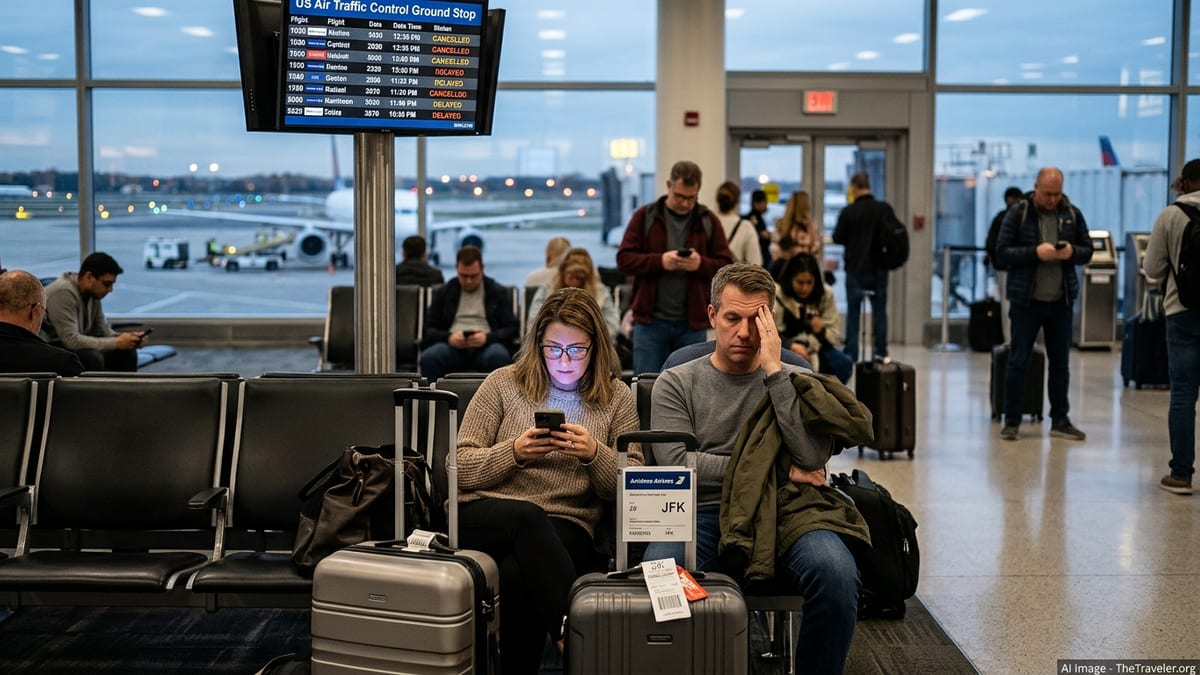
On Friday 13 November 2026, a separate failure hit US air traffic control. The Federal Aviation Administration has confirmed that a telecommunications disruption in its network led it to order a nationwide ground stop that afternoon, described in official summaries as the longest nationwide halt to US air traffic in about 25 years. A detailed question‑and‑answer note from the FAA and parallel briefings to Congress report that a new router introduced during a network upgrade at a key facility overwhelmed older equipment, destabilising communications and some radar feeds used by controllers, which prompted the decision to halt departures while systems were stabilised.
FAA documents and a subsequent Congressional Research Service brief state that the order remained in place for roughly four hours and 45 minutes. During that window and the recovery period that followed, operators cancelled or significantly delayed thousands of flights. Federal tallies cite around 12,400 cancellations attributed to the event on 13 November alone, along with many more delayed services as aircraft and crews fell out of planned positions and airlines attempted to rebuild their schedules through the weekend.
Separately, in the first week of November 2026, a wave of hoax bomb threats affected airline operations in Europe. Authorities in several countries, along with airlines including Aer Lingus, Finnair and LOT Polish Airlines, reported receiving threats that led to diversions and precautionary responses. Public statements and media reports describe at least one Aer Lingus flight from Dublin to Rome being diverted to the Évreux military air base in France, a Finnair Helsinki–Rome service escorted by fighter jets to Rome, and multiple flights diverted or temporarily held at airports such as Warsaw Modlin and Prague while security checks were completed. In every publicly confirmed case, no explosive devices were found.
How travel operations were disrupted on the ground and in the air
The immediate impact of the Microsoft 365 outage on leisure trips was relatively indirect compared with a flight cancellation or an airport closure, but it rippled through many parts of the travel chain. Corporate travel teams, tour operators and online agencies that rely on Microsoft email and calendars to issue itineraries, approvals and travel alerts reported delays in sending documentation and responding to changes. Where Teams and Outlook meeting invitations are used to distribute virtual meeting links, some business travellers found that key connection details were unavailable while systems were degraded.
Because global distribution systems, airline reservation platforms and departure control systems usually run on separate infrastructure, actual booking and check‑in processes broadly continued during the Microsoft failure. However, travel management companies and in‑house travel desks that had concentrated their communications in Microsoft channels needed to move quickly to alternatives such as web portals, mobile apps, SMS or non‑Microsoft messaging tools. Some corporate users reported reverting to phone calls and manual confirmations, an approach that kept trips moving but reduced efficiency and could complicate later efforts to document disruptions for insurance or service‑level claims.
The US ground stop on 13 November produced a more visible shock. When the FAA ordered all departures halted nationwide, flights already in the air were allowed to continue to their destinations, but aircraft scheduled to depart were held at gates or on taxiways until controllers were satisfied that communication and surveillance systems were stable enough to resume standard operations. Once the halt was lifted, airlines had to rebuild the network with aircraft and crew now out of place, a process that in some cases extended disruption over several days as rotations were adjusted and crews reached duty limits.
Major US carriers publicly characterised the disruption as an air traffic control event originating within the federal system, rather than an airline operational failure. Even so, many offered voluntary waivers or rebooking options, and some provided hotel accommodation or meal vouchers when overnight stays became unavoidable. The level of support varied between airlines and airports, and was shaped in part by local availability of rooms during what was, in many cities, a busy travel period. Passengers transiting US hubs on itineraries that combined domestic and international legs were particularly exposed to missed connections once departure banks slid significantly out of their planned slots.
In Europe, the series of hoax bomb threats produced a more fragmented pattern of delay. Flights that received threats typically continued to a diversion airport or, if already on the ground, were parked in isolated areas while law enforcement, bomb disposal teams and security staff conducted checks. In some cases, national air forces scrambled fighter jets to escort aircraft until they landed. These responses triggered closures or capacity restrictions at several airports while runways and stands were reserved for incident handling, which in turn delayed unrelated services using the same facilities or airspace.
Why business and travel insurance often did not respond as expected
For both individual travellers and travel‑reliant businesses, the November incidents highlighted a structural issue in many forms of insurance: cover for disruption is still commonly anchored to physical damage thresholds that software outages, configuration errors and hoaxes do not meet. Standard business interruption clauses in commercial property policies usually require material damage to insured property at the policyholder’s premises before losses such as lost profit or additional operating costs can be claimed. Contingent business interruption cover, which extends protection to damage at key suppliers or service providers, typically carries the same requirement.
In the Microsoft outage, there has been no official suggestion of physical damage to data centres or hardware. Publicly available technical explanations instead point to defects and misconfigurations in network gateways and routing within Microsoft’s cloud environment. Because these did not damage buildings or equipment, businesses seeking to claim under traditional property‑linked business interruption wordings are unlikely to find a trigger. The same reasoning applies to many of the costs airlines and airports incurred on 13 November in the United States, where the telecommunications failure and router interaction problems affected functionality without destroying assets.
Cyber insurance was initially developed around threats such as malware attacks, data breaches and extortion. As a result, many policies are drafted so that cover for interruption depends either on a defined cyberattack on the insured’s own systems or on a security breach at a named service provider. Over the past few years, some insurers have broadened these wordings to include non‑malicious system failures at specified third‑party providers, including cloud and software vendors. However, this evolution has been uneven, and several current wordings still require a malicious act or explicit security breach for business interruption cover to apply.
Even when non‑malicious outages are contemplated, waiting periods pose a further hurdle. Market commentary and sample policies indicate that waiting periods for cyber business interruption commonly range from four hours for smaller risks to 12 or even 24 hours for larger organisations. The Microsoft outage met or exceeded those thresholds in some regions, but many companies reduced their losses by switching to alternative communications channels or rescheduling time‑sensitive tasks. For them, it may be difficult to demonstrate a clear, quantifiable loss of gross profit directly attributable to the outage, which is typically required for recovery.
For the US ground stop, travel insurance for individuals interacts with federal rules. US law does not require airlines to compensate passengers for delays and cancellations when the cause lies with air traffic control or other government decisions, although passengers are entitled to refunds if their flight is cancelled or significantly changed and they choose not to travel. Travel insurance policies that offer trip delay or missed connection benefits sometimes cover air traffic control decisions as a named peril, but others exclude events attributable to government authorities or treat them as outside the airline’s control. Where such exclusions apply, policyholders caught in the 13 November disruption may have found that extra accommodation, meals or alternative transport were only partly reimbursed or not covered at all.
In Europe, the hoax bomb threats sit awkwardly between security and war‑risk language in many policies. Some travel insurance products include broad exclusions for war, terrorism or related threats, which can extend to incidents that later turn out to be hoaxes. Others limit exclusions to confirmed acts of terrorism, but focus on actual attacks rather than threats that trigger precautionary measures. Airline and airport declarations after the early‑November incidents consistently described the events as threats with no explosives discovered, and in some cases as malicious hoaxes. Where policy wording requires an actual act of terrorism, travellers affected by diversions and delays in those incidents may lack a clear basis for claims beyond standard delay benefits, if those are even triggered.
Implications for travellers, airlines and travel‑reliant businesses
The clustering of three different types of disruption in early November 2026 highlights several operational vulnerabilities in contemporary travel. First, critical communication and coordination now rely heavily on cloud platforms that sit outside the direct control of airlines, travel agencies, hotels and corporate travel departments. A global vendor outage can simultaneously hinder internal coordination, customer communication and the delivery of digital travel documents, even when core reservation systems remain available. Organisations that have standardised on a single productivity suite may be particularly exposed when that provider experiences a widespread failure.
Second, national aviation systems are in the midst of complex modernisation programmes. The US ground stop stemmed from a routine upgrade intended to retire older communications infrastructure and move toward IP‑based networks. Early federal summaries acknowledge that testing did not fully predict how new routers would interact with legacy equipment under real traffic loads, and that the resulting instability threatened the reliability of controller communications and radar feeds. Travellers are unlikely to see technical details, but they experience the consequence when an entire country’s departures are paused as a precaution while engineers work to stabilise upgraded systems.
Third, the European hoax bomb threats underline that not all severe disruption involves technological failure. Established aviation security protocols require airlines and air traffic authorities to treat bomb threats as credible until proven otherwise, diverting or holding aircraft while checks are carried out. Even when no explosive device is found, the time spent on diversions, isolating aircraft, screening baggage and interviewing passengers can upend schedules for the rest of the day. For airlines, these incidents generate additional fuel, handling and crew costs and can create crew‑duty and maintenance‑window pressures; for passengers, they translate into missed connections, late arrivals and unexpected overnight stays.
Taken together, these developments pose questions for how travellers and businesses assess risk. Many planning assumptions still concentrate on weather, strikes and mechanical failures, yet the November events show that configuration changes in distant data centres or telecommunications hubs, as well as hoax threats delivered by email or phone, can produce comparable levels of disruption. At the same time, the lack of physical damage and the involvement of government or third‑party systems often mean that statutory compensation schemes and traditional property‑linked insurance do not respond in the way travellers might intuitively expect.
What travellers and organisations can check and plan for now
For individual leisure or business travellers, the most practical response lies in preparation and documentation rather than an attempt to anticipate specific technical failures. Before booking, travellers can review airline commitments published through government customer service dashboards or airline websites, paying close attention to what carriers promise during controllable disruptions and what they say about events linked to air traffic control or other government actions. Since carriers may still offer assistance on a goodwill basis during such events, enabling airline apps and SMS or app notifications can help ensure that rebooking options or gate changes are not missed when systems are under stress.
When purchasing travel insurance, travellers who are sensitive to same‑day connections, separate tickets or time‑critical meetings can look closely at trip delay, missed connection and additional accommodation sections. Key points to check include whether delays due to air traffic control decisions, widespread telecommunications failures or security incidents such as bomb threats are explicitly covered or excluded, what minimum delay is required before benefits apply, and what documentation will be needed. Keeping boarding passes, written confirmation of delays or cancellations, and receipts for hotels and meals can make the difference between a successful and an unsuccessful claim.
For airlines, airports and travel‑reliant businesses, the events of November 2026 may prompt a wider review of operational resilience and risk transfer. Organisations can map their reliance on specific technology vendors, including productivity suites, identity providers, payments platforms and reservation systems, and assess whether current contracts, service‑level agreements and insurance cover provide meaningful recourse if a prolonged outage occurs. Some cyber policies now offer specific extensions for non‑malicious system failures at named cloud or IT providers, but the definition of those providers, the length of the waiting period and the scope of excluded causes all matter for real‑world recoveries.
At a practical level, many of the most effective steps do not depend on policy wording. Corporate travel programmes and tour operators can ensure they have at least one communication channel that does not rely on a single cloud provider, and that travellers know how to reach support teams if primary systems fail. Saving or issuing offline copies of key documents, such as tickets, visas and hotel confirmations, can help travellers navigate airport procedures if email access is unavailable at critical moments. For both individuals and organisations, rehearsing how to operate for several hours with limited access to primary communication tools or national air traffic networks can turn an unexpected outage from a crisis into a managed disruption.
Regulators and policymakers in affected regions are still examining the root causes of each November incident and considering whether additional safeguards, testing regimes or reporting requirements are needed. For now, travellers planning trips in the coming months are unlikely to see immediate structural changes, but can factor recent events into their own risk assessments and itinerary planning. Allowing more generous connection times, favouring through‑ticketed itineraries where possible, and understanding in advance what support airlines and insurers are likely to offer if shared systems fail can all help reduce exposure to the kinds of disruptions that dominated early November 2026.