


More news on this day
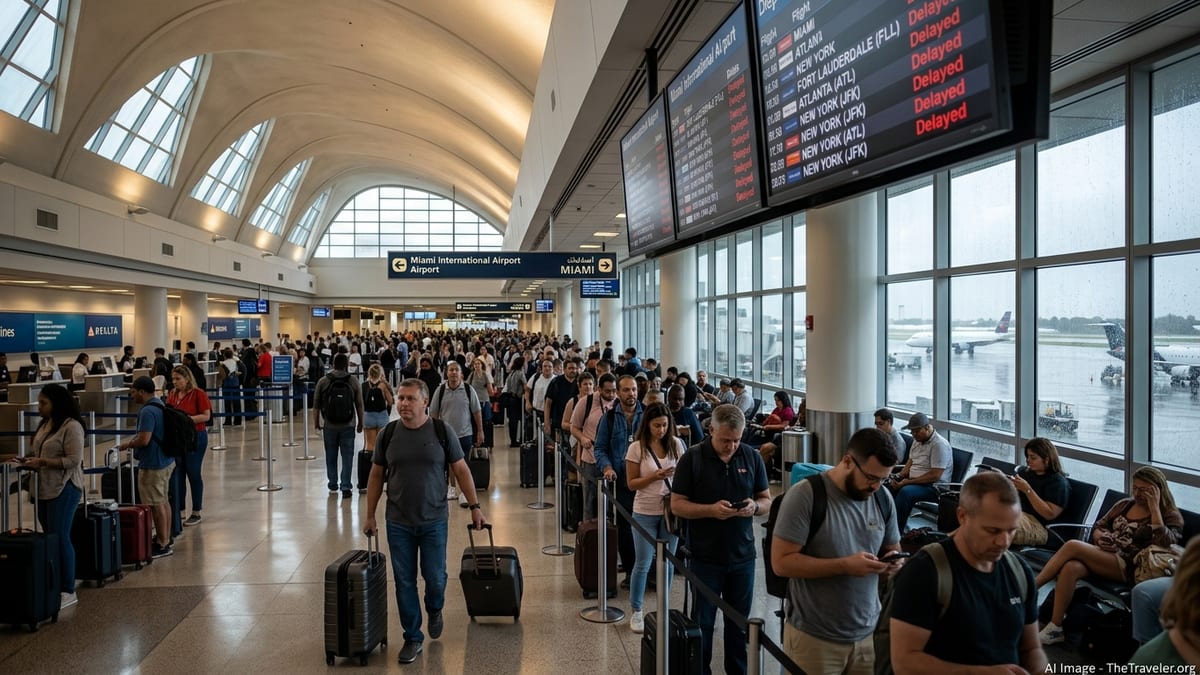
Thanksgiving week is bringing significant flight delays and scattered cancellations at both Fort Lauderdale–Hollywood International Airport and Miami International Airport, as South Florida’s two busiest hubs work through a surge of holiday passengers on the heels of recent nationwide air‑traffic and airline technology disruptions.
Get the latest news straight to your inbox!
How Hard Fort Lauderdale and Miami Are Being Hit
Real-time data and recent statistics show that both Fort Lauderdale–Hollywood International Airport and Miami International Airport are entering Thanksgiving week with elevated disruption levels compared with a typical November period, even though operations on the morning of November 25, 2026 are officially listed as experiencing only minor arrival delays. Federal Aviation Administration status information for Fort Lauderdale early on November 25 reports general arrival delays of 15 minutes or less, a category the agency uses when traffic is moving but congestion is noticeable for some flights rather than across the entire schedule.
Underlying those relatively modest headline figures, however, is a more difficult picture over the days leading into the holiday rush. Aggregated performance data for Fort Lauderdale departures over the 10 days to November 23 indicate an average departure delay of just over 50 minutes, with about 6% of flights cancelled during that period. That level of disruption is significantly higher than the single-digit average delays typically seen when airports are operating normally in early November, and it has left many travelers who were already in transit arriving late or needing to be rebooked into the core Thanksgiving travel window.
At Miami International Airport, which expects nearly 2 million passengers to pass through during the current Thanksgiving travel period from late November into the holiday weekend, airport officials and local media are warning of long lines and packed concourses. While Miami’s real-time delay picture has fluctuated day to day, the combination of very high passenger volumes and cascading schedule changes elsewhere in the country means that even relatively small operational hiccups can quickly translate into longer waits for check-in, security, boarding and baggage claim for passengers using the airport.
Recent Ground Stop and Airline Tech Issues Still Cascading
The disruption now visible at South Florida’s major airports does not stem from a single local failure but from a series of national and airline-specific problems that began earlier in November. A nationwide Federal Aviation Administration ground stop earlier this month temporarily halted departures across the United States because of communication-system issues, leading to widespread cancellations and multi-hour delays as airlines tried to reposition aircraft and crews once the restriction was lifted. Passengers at Fort Lauderdale and Miami were among those affected while carriers slowly rebuilt their networks over several days.
On top of that system-wide event, major U.S. carriers have faced their own technology glitches as Thanksgiving approached. Within the past week, both United Airlines and Delta Air Lines experienced outages that disrupted operations across their networks, including flights into and out of South Florida. Delta reported a software issue on Sunday, November 22 that briefly halted flights into its primary hub in Atlanta, which in turn triggered a ground delay program from the FAA for traffic headed to the airport. Because so much of the country’s east coast flying, including many Miami and Fort Lauderdale connections, flows through large hub airports such as Atlanta, disruptions there have continued to ripple outward as aircraft and flight crews end up out of position.
Local coverage in Florida has highlighted the effect of these combined problems on individual travelers. Reports from South Florida describe passengers missing cruise departures out of Miami after weather and delay programs left them stuck along the route, and others at Fort Lauderdale spending hours in the terminal as airlines worked through backlogs of delayed and cancelled flights tied to earlier operational issues. Although those stories are anecdotal, they align with the higher-than-usual delay and cancellation statistics reported for Fort Lauderdale in the 10 days before November 24 and with the recent national pattern of technology and weather-driven disruptions impacting pre-holiday travel.
Weather, Holiday Crowds and Historic Thanksgiving Patterns
Weather is another factor adding strain just as the holiday rush peaks. Forecasts for the eastern United States in the days surrounding Thanksgiving call for stretches of rain and unsettled conditions along parts of the East Coast, which can slow traffic into heavily used corridors and cause knock-on delays downstream. Miami officials have already noted that the region faces a generally rainy week, and forecasters warn that systems moving through key airspace could require rerouting or spacing aircraft further apart for safety, limiting the number of flights that can land or depart in a given time window.
Those short-term concerns slot into a broader pattern of elevated Thanksgiving disruption at Fort Lauderdale specifically. Analysis of historical Thanksgiving performance at the airport between 2021 and 2025 indicates that roughly 9% of departures during the holiday period were significantly disrupted, defined as operating at least an hour late, or being cancelled or diverted, compared with under 7% of flights in surrounding weeks. That record also identifies the Sunday after Thanksgiving as the most disruption-prone day at Fort Lauderdale, with a notably higher share of flights affected as many travelers return home at once. While history does not guarantee that 2026 will look the same, it underscores that Thanksgiving week at Fort Lauderdale is frequently more fragile than average even in years without a preceding national ground stop.
Meanwhile, passenger volumes this year are projected to be exceptionally high. National forecasts point to the busiest Thanksgiving air travel period in more than a decade, and Miami International Airport’s expectation of nearly 2 million passengers across the season reflects that surge on a local level. When airports operate so close to capacity, even moderate weather or logistical challenges can have outsized effects: queues lengthen, aircraft push-backs are held, and late-arriving inbound flights compress turnaround times for the next departure. In these conditions, travelers may experience long waits and crowded gates even when their own flight is operating close to schedule.
How Airlines and Airports Are Responding
Airlines serving Miami and Fort Lauderdale have been adjusting schedules, issuing travel alerts and encouraging passengers to build in extra time as they head to the airport. After the nationwide ground stop in mid-November, some carriers offered flexible rebooking options to help passengers change their plans without additional fees, and at least one major airline extended its alert through mid-month to cover continuing irregular operations. More recently, airlines impacted by technology glitches have issued apologies and allowed customers whose flights were cancelled to claim refunds if they chose not to travel, while others have focused on rebooking passengers as quickly as possible on available seats.
Airport operators, for their part, are emphasizing communication and crowd management. Miami International has been publicizing its city and route network along with reminders for passengers to verify their airline’s latest travel requirements and real-time flight status directly before arriving at the terminal. At the county level, Miami-Dade officials have discussed efforts to use better scheduling and technology, including artificial intelligence tools, to reduce the effect of surges and delays on the airport experience over the long term, such as by improving the timing of international arrivals and using visual messaging to make waiting times feel less stressful.
Fort Lauderdale–Hollywood International Airport provides its own flight-tracking tools that allow passengers to check arrival and departure status across nearly 300 flights per day, and travelers can compare that information with independent aggregators that track delays and cancellations. Although these resources cannot prevent delays, they can help passengers spot evolving problems sooner and, in some cases, work with their airline on alternative routings before aircraft become completely full. The airport is also operating under the FAA’s broader traffic-management system, which is designed to meter arrivals and departures to keep any one facility from becoming overwhelmed when disruptions occur elsewhere.
What Thanksgiving Week Travelers Should Expect and Check Next
For travelers heading through Miami or Fort Lauderdale during the remainder of Thanksgiving week, the latest data suggests that some level of disruption is likely to persist even if there are no additional major outages or storms. Elevated average delays in the period leading up to November 24 indicate that airlines are still recovering from earlier issues, and historical Thanksgiving statistics for Fort Lauderdale show that the busiest travel days, particularly the Sunday after the holiday, have often been the most prone to significant late departures and cancellations. Miami’s forecast passenger volumes also imply that security, check-in and baggage lines may be longer than usual throughout the week, especially during peak morning and late-afternoon banks.
Passengers who have not yet departed should closely monitor their flight status from 24 hours before scheduled departure until they are at the gate, using both their airline’s official app or website and, where helpful, third-party trackers and airport-specific tools. If a flight shows a substantial delay or is tied to a connection at a hub such as Atlanta or another weather-affected city, it may be worth contacting the airline proactively to ask about alternative routings before options become limited. Travelers whose itineraries involve tight connections at Miami or Fort Lauderdale in the next few days may want to explore whether they can be rebooked onto earlier originating flights to reduce the risk of misconnecting if upstream delays recur.
Looking beyond Thanksgiving Day itself, the busiest travel period often extends through the weekend, and forecasts of unsettled East Coast weather suggest that operational challenges could continue to flare up even as airlines work to normalize schedules. Anyone traveling between Friday, November 27 and Monday, November 30 should be prepared for crowded terminals and potential knock-on delays from weather or traffic-management programs elsewhere in the national airspace system. Before leaving for the airport, it remains important to verify gate assignments, departure times, baggage rules and any airline-issued travel waivers, which can change quickly as conditions evolve. In a year when national systems issues, airline-specific technology problems and high seasonal demand have all converged, up-to-the-minute information and flexible planning are likely to be as essential to a smooth journey as the ticket itself.