


More news on this day
The U.S. Federal Aviation Administration has introduced stricter supervision requirements for a key takeoff procedure at airport control towers, a safety-focused change that takes effect just as Thanksgiving air traffic is forecast to reach its highest level in 16 years.
Get the latest news straight to your inbox!
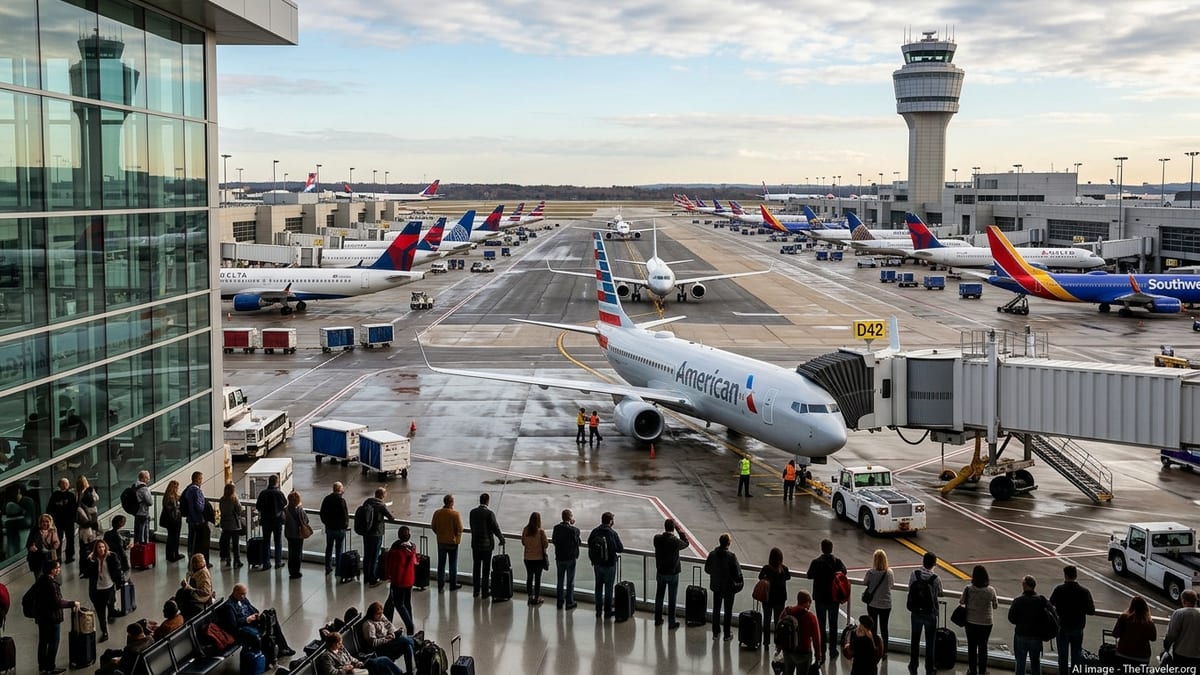
What the new LUAW supervision rule actually changes
The Federal Aviation Administration’s Notice JO 7210.979, which became effective on November 24, 2026, tightens how controllers may use the “Line Up and Wait” procedure, commonly known by its acronym LUAW. Under LUAW, a tower controller can instruct an aircraft to taxi onto the runway and hold in position, ready to depart as soon as takeoff clearance is issued. The practice is widely used at busy airports to keep departure queues moving and maximize runway use.
The notice requires that whenever LUAW is in use, a dedicated watch supervisor or controller-in-charge must be on duty overseeing operations and not simultaneously responsible for another control position. If a facility cannot staff that separate supervisory role, it is not permitted to conduct LUAW operations and instead must have aircraft hold short of the runway until they receive both taxi and takeoff clearance in sequence.
The new requirement applies to FAA-operated towers and runs through June 10, 2027, when the notice is currently set to expire. The directive sits alongside broader changes to the FAA’s facility operations order, which also now specifies that the local control position responsible for runway movements cannot be combined with other tower roles while LUAW is being used. Together, the changes are intended to ensure that someone in the tower is focused on monitoring runway status and clearances whenever aircraft are instructed to enter an active runway and wait.
Why Thanksgiving travel is the first major test
The timing of the rule means its first large-scale stress test comes during one of the busiest periods of the U.S. travel calendar. The FAA forecasts about 417,775 instrument flight rules movements nationwide between November 23 and December 1, 2026, an increase of a little more than 2 percent compared with last year and around 7 percent above 2019 levels before the pandemic. Tuesday, November 24, was projected to be the single busiest day in the nine-day window, with more than 52,000 flights.
Trade association Airlines for America expects nearly 29 million passengers to fly on U.S. carriers across the Thanksgiving travel period. American Airlines alone has scheduled roughly 85,000 flights between November 19 and December 1 and says it anticipates transporting more than 8 million customers, illustrating how much of the broader holiday travel volume is concentrated in the skies.
On the ground, the Transportation Security Administration has said it is prepared for higher checkpoint throughput, while AAA projects about 81.5 million people will travel at least 50 miles from home by all modes during the holiday week. For travelers, the interaction of these passenger numbers with the new runway rules is most likely to be felt at large hubs with tight departure banks, where LUAW is a routine part of keeping departure lines moving during peaks.
Runway safety focus after ground stop and near-miss concerns
Regulators are framing the change primarily as a safety measure rather than a deliberate capacity reduction. LUAW operations inherently carry risk if communications are misunderstood or if controllers lose track of which runways are occupied, since aircraft may be waiting on the runway without yet having takeoff clearance. The FAA’s notice emphasizes the need to reduce distractions and enhance independent oversight of controllers responsible for runway movements, especially at times of high traffic.
The decision comes shortly after a nationwide ground stop on November 13, 2026, triggered by a telecommunications problem in the FAA’s air traffic control network. That disruption halted departures for several hours and led to thousands of delays and cancellations, underscoring the fragility of the system in the face of technical failures. Although unrelated in cause, the new LUAW supervision rule is part of a broader push by the agency to tighten procedures around known safety pinch points in the system, including runway operations.
Separately from the ground stop, the last two years have seen heightened scrutiny from lawmakers, aviation unions and safety investigators over a series of close calls on U.S. runways, some involving aircraft that had been instructed to line up and wait. While not all of these incidents have been publicly linked to supervisory gaps, they have reinforced a long-standing concern that towers operating at or near staffing limits may struggle to maintain the level of independent oversight that complex runway configurations demand.
Persistent controller staffing gaps shape how towers apply the rule
The effect of the new requirement will depend heavily on each tower’s staffing profile. Under a revised staffing model adopted in 2026, the FAA currently targets about 12,563 fully certified professional controllers systemwide. As of April 2026, the agency reported having approximately 11,000 certified controllers on duty across its more than 300 air traffic facilities, along with about 4,000 trainees and previously certified controllers in various stages of facility-specific training.
In written testimony this autumn, FAA officials acknowledged that the workforce remains short of the desired target, particularly at some of the most complex facilities. While trainees and certified-in-training staff can contribute to operations, they do not count as independent watch supervisors or controllers-in-charge. That means that at towers where staffing is already tight, it may be challenging to dedicate one controller exclusively to supervisory duties anytime LUAW is being used.
The National Air Traffic Controllers Association has for several years highlighted that the number of fully certified controllers has not kept pace with traffic growth at key hubs and major approach control facilities. A chart released by the union in early 2026 showed total certified staffing drifting down from levels above 11,700 in the early 2010s to just under 10,700 by late 2025, before the latest hiring push. Under the new LUAW rule, facilities that cannot staff a separate watch supervisor during peaks may have to curtail or forgo LUAW even when departure queues lengthen, trading some throughput for what the agency views as a more robust safety posture.
Potential impact on delays and where travelers may notice it
The FAA has not published a national estimate of how much the supervision requirement could affect runway capacity or average delays, and there is no blanket restriction on departures. At adequately staffed towers, LUAW operations can continue largely as before, provided a dedicated supervisor is on position. However, controllers interviewed by several U.S. media outlets in recent days warned that at facilities with lean staffing, the inability to use LUAW during certain shifts could increase the time aircraft spend waiting before they are cleared onto the runway.
Historical data suggests delays were already common around the holidays even under the previous rules. An analysis of federal statistics for late 2025, for example, found that nearly a quarter of U.S. flights in November and December that year arrived at least 15 minutes behind schedule, with late-arriving aircraft and airline-related issues the dominant causes. Against that backdrop, any incremental constraint on departure flow in 2026 could contribute to congestion, even if it is just one factor among many that include weather, airline crew availability, and airport infrastructure limits.
Travelers are most likely to see the effect, if any, in the form of longer taxi-out times rather than sudden schedule overhauls. Aircraft may wait slightly longer at taxiway hold lines before crossing or entering departure runways when towers suspend LUAW because they lack the required supervisory staffing. For passengers, that could mean more time seated on the aircraft before takeoff, particularly at the busiest hubs during the peaks of the morning and evening departure banks.
How airlines and regulators are preparing for the holiday peak
Major airlines and federal agencies have been working to shore up operations ahead of the Thanksgiving rush, aware that a confluence of heavy traffic, weather and new procedures could amplify disruptions. Airlines say they have increased spare aircraft and crew coverage where possible, while also warning customers to allow additional time at airports. Delta Air Lines, which experienced a separate technology issue affecting aircraft weight-and-balance calculations on November 22, has been working to restore normal operations in time for the midweek peak after more than 1,000 of its flights were delayed that day.
On the regulatory side, the FAA has promoted its holiday command center approach, in which traffic managers, airlines and other agencies coordinate closely on rerouting flows around storms and adjusting departure rates at constrained airports. Officials have stressed that the new LUAW supervision rule is one element in a broader set of measures intended to maintain both safety and reasonable efficiency during the holiday period. They point to the strong rebound in total flight numbers as a sign that, nationally, the system still has capacity to handle the forecast traffic despite local bottlenecks.
Weather remains a wild card. Forecasters have cautioned that storm systems and strong winds in parts of the country could limit arrival and departure rates at several major hubs during parts of the Thanksgiving window. In most cases, those weather-driven reductions will outweigh any impact from LUAW supervision rules alone, but the two could interact to produce longer ground queues when both constraints apply at the same time.
What travelers should watch for in the weeks ahead
The LUAW supervision requirement is currently scheduled to remain in force until June 10, 2027, giving the FAA two full summer travel seasons and multiple peak periods to assess its operational effect. The agency has not indicated whether it expects to fold the rule into a permanent update of its tower operations manual or adjust it in response to feedback from facilities once more data are available.
For travelers planning flights over Thanksgiving and into the December holidays, the most practical step is to anticipate that ground delays may occur and to build additional time into itineraries involving tight connections, especially at the largest U.S. hubs. Because the rule applies uniformly across FAA-operated towers, its presence will not normally be visible in airline schedules or consumer booking tools. Any impact will instead show up in day-of-operation metrics such as taxi times and departure queues.
Looking ahead, the evolution of controller staffing will strongly influence how noticeable the rule is in daily operations. If the FAA meets its hiring and training targets and can staff more towers to their full supervisory levels, facilities will have greater flexibility to use LUAW even at busy times. If staffing gaps persist at particular locations, local workarounds such as adjusted departure banks, voluntary schedule reductions or continued limited use of LUAW during certain shifts could extend beyond the Thanksgiving period. Travelers flying through these airports may wish to monitor airline and airport advisories for any location-specific updates as the new supervision requirement settles in.