


Flying with VistaJet promises a seamless, global private jet experience, but turning glossy marketing into hard numbers can feel opaque. Rates are not displayed like airline tickets, and pricing depends on aircraft type, membership structure, route and timing. This guide breaks down how VistaJet really prices its flights today, what you can expect to pay on a per hour and per trip basis, and how it compares to typical private jet charter costs so you can decide if it makes sense for your travel pattern.
Get the latest updates straight to your inbox!
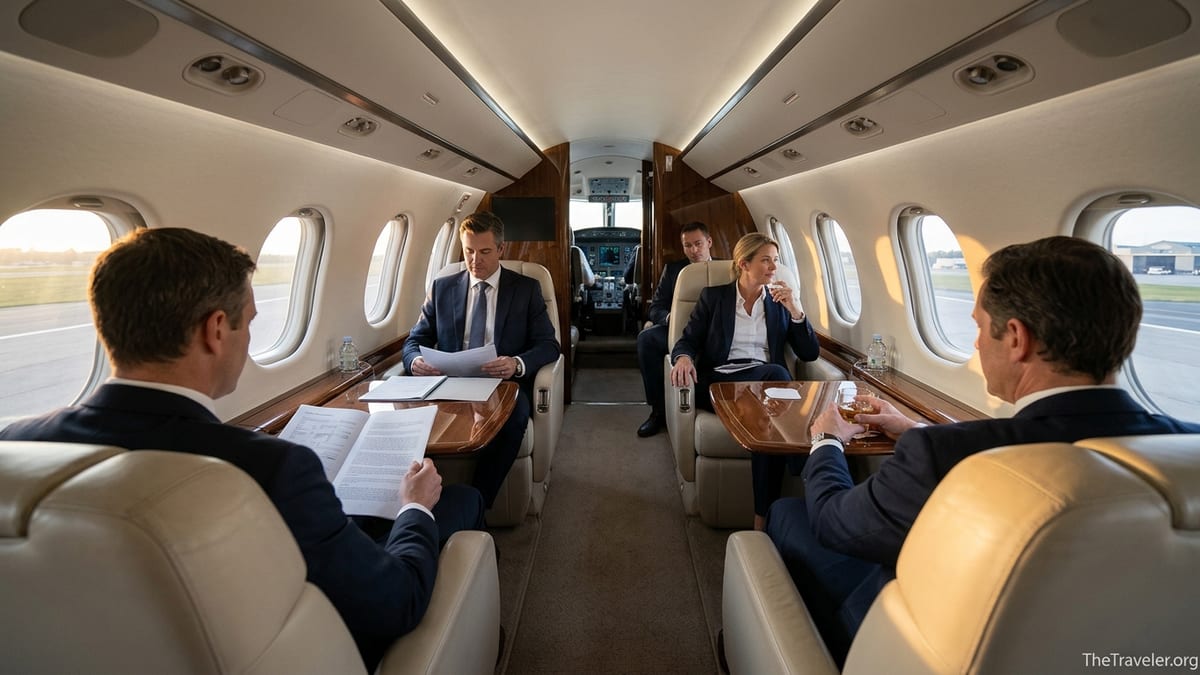
How VistaJet Pricing Works in Practice
VistaJet sits in a specific corner of private aviation. It owns and manages a large fleet of business jets, then sells access to that fleet primarily through membership-style programs with fixed hourly rates. Unlike many charter brokers that list a changing mix of third-party aircraft, VistaJet controls its core fleet and focuses on consistent service rather than simply finding the lowest one-off price. For travelers, that means you trade some price flexibility for predictability and guaranteed availability.
On its US site, VistaJet says that charter prices "start from" around 11,000 dollars per flight hour for on-demand bookings, with actual costs varying by aircraft, route and market conditions. Independent charter analysts and aviation advisors currently place VistaJet’s typical hourly rates roughly in the 10,000 to 20,000 dollars range, from midsize and super midsize jets at the lower end up to ultra long range aircraft at the top. That aligns with published examples for aircraft like the Bombardier Global 5500, where estimated charter rates often run from the low teens to just under 20,000 dollars per hour for similar global-class jets.
It is important to understand that VistaJet’s headline hourly rate is not the entire story. Final trip costs are driven by billable flight time, minimum usage rules, taxes, positioning flights if required and various surcharges such as fuel, de-icing and out-of-hours handling. Where VistaJet differs from pure on-demand charter is that its core Program members lock in fixed hourly rates and a well-defined set of inclusions. You are paying not only for the flight itself but also for the certainty that an aircraft of a given category will be available almost anywhere you need it, often with as little as 24 hours’ notice.
VistaJet Program Membership: Fixed Rates and Commitments
The flagship VistaJet product is the Program, essentially a flight-hours subscription. Members commit to a block of hours per year, deposit or prepay a substantial amount and in return receive guaranteed access to the fleet at a pre-agreed hourly rate. VistaJet’s corporate material describes this as a way to enjoy the benefits of owning a jet without the capital expenditure, depreciation or aircraft management burden that comes with full or fractional ownership.
Although VistaJet does not publish public rate cards, industry insiders and brokers who work with these contracts regularly report that Program rates for large cabin and ultra long range aircraft cluster at the top of the private jet market. Some recent advisory commentary comparing large fleet programs suggests that for a Global 7500 level aircraft, effective hourly rates on 150 to 200 hour contracts can sit in the mid-teens to high teens per flight hour in US dollars once all fees are considered. For smaller large-cabin jets such as a Challenger 350 or Global 5500, the contracted rates are typically somewhat lower but still significantly above the broad on-demand market average.
Program membership usually comes with a defined minimum annual commitment. For example, a traveler might sign up for 50 to 100 hours per year, which for a large cabin aircraft can mean budgeting 700,000 to 1.5 million dollars or more annually when hourly costs, fuel surcharges and taxes are included. Contracts may allow some rollover of unused hours and provide perks such as guaranteed availability, short booking windows, fixed rates in multiple regions and cabin consistency across trips. The trade-off is that if your actual flying falls far short of your contracted hours, your effective cost per hour climbs rapidly.
On-Demand and VistaJet Direct: Pay-As-You-Go Options
Not every VistaJet client wants or needs a full Program commitment. For more occasional travelers, the company offers on-demand charter and app-based access through VistaJet Direct and related Vista platforms. In these cases you do not pre-purchase large blocks of hours. Instead, you request a specific trip and receive a quote based on current market rates and aircraft availability, sometimes with access to empty leg opportunities at discounted prices.
Here the pricing behaves more like any high-end charter. VistaJet’s own language about prices starting around 11,000 dollars per hour is a useful anchor, but real-world quotes move significantly based on aircraft size, route and date. A short notice trip on a large cabin jet during a busy holiday period can quickly move into the high teens or around 20,000 dollars per hour. At quieter times or on efficient routes where an aircraft is already positioned, your effective rate might fall closer to the low end of VistaJet’s range and become more competitive with other global fleet operators.
For example, consider a New York to Miami direct flight of around 2.5 hours of actual flying time. An on-demand quote from VistaJet on a super midsize or large cabin aircraft might price the billable segment at something like 3 hours to account for taxi time and minimum flight charges. At a simplified headline rate of 13,000 dollars per hour, that would place the base aircraft cost near 39,000 dollars before taxes and surcharges. If that flight is part of a repositioning that suits VistaJet’s fleet schedule, the company might also offer it as a discounted empty leg on VistaJet Direct, lowering the price substantially for flexible travelers who can adjust their timing.
Hourly Rate Ranges by Aircraft Category
To understand VistaJet pricing, it helps to place it against broader 2026 private charter benchmarks. Across the wider market in North America and Europe, typical on-demand hourly rates recently reported for light jets often fall in the 6,000 to 8,000 dollars range, midsize and super midsize around 8,000 to 11,000 dollars, and large cabin or ultra long range jets stretching from the low teens to 20,000 dollars or more per hour depending on aircraft type and demand. VistaJet positions itself at the upper end of those bands because it focuses on larger, longer-range aircraft and a service-intensive model.
For instance, private aviation rate trackers have recently shown average hourly charter prices for a representative light jet such as a Citation CJ3 well under the 10,000 dollar mark, while quotes for a Global 5500 operated by VistaJet are typically observed in a band from roughly 11,000 up to nearly 20,000 dollars per hour. Aviation consultancies that specialize in comparing membership programs summarize VistaJet’s overall pricing by stating that its hourly rates generally span from about 10,000 dollars for midsize jets to around 20,000 dollars for ultra-long-range flagships, which matches what travelers report when comparing quotes with other leading fleet operators.
The exact figure you pay will also depend on which part of the Vista family you use. Vista as a group also includes brands like XO in the United States, which can sometimes surface lower per-hour rates on smaller jets or third-party aircraft, while VistaJet-branded flights concentrate on a more uniform, silver-and-red fleet and usually command a premium. For a traveler, the key takeaway is that VistaJet is rarely the least expensive option in raw dollars per flight hour but can deliver strong value if you prioritize cabin quality, global reach and consistent service.
What Drives Your Final Trip Cost
Although hourly rates are a primary driver of VistaJet’s pricing, the final number on your trip confirmation is the result of several layered components. The first is billable flight time. This includes not only airborne time from wheels up to wheels down but also taxi and any minimum block requirements. A two-hour hop may be billed as 2.4 or 3.0 hours, depending on fleet policy and contract terms. Program members usually see these details codified in their agreements, while on-demand clients see them wrapped into a simple total for the trip.
Next come surcharges and fees. Fuel surcharges are common across the industry and adjust periodically as fuel prices move. Some membership comparisons involving VistaJet reference fuel bases set at relatively low hypothetical levels, with any price above that base charged as a per-hour surcharge. Over a 50-hour flying year, that can add tens of thousands of dollars to a Program member’s total cost. Other add-ons can include de-icing in winter, hangar or special handling at smaller airports, and out-of-hours operations at locations with limited staffing. In some cases, there may also be catering upgrades and ground transportation arranged through VistaJet’s lifestyle partners.
Taxes round out the picture. In the United States, most private charter flights incur a federal excise tax of 7.5 percent on the base fare plus certain segment fees. For a 40,000 dollar one-way VistaJet charter, that FET alone could add 3,000 dollars or more to the invoice. International flights involve a patchwork of passenger taxes, airport charges and security fees that are usually itemized. When you look at an all-in VistaJet quote, it is important to ask whether the hourly number you are comparing includes or excludes these items so that you can make apples-to-apples comparisons with other providers.
Real-World Trip Scenarios and Approximate Pricing
To put these principles into context, consider three typical VistaJet-style itineraries with approximate, rounded 2026 figures. These are not official VistaJet quotes but realistic ballpark ranges that mirror what travelers and brokers commonly report for similar trips on comparable aircraft.
First, a US business traveler flying New York to Chicago roundtrip in a super midsize jet such as a Challenger 350, staying one night. The flight time each way is around 2 hours, but VistaJet might bill a total of 5 to 6 flight hours to account for taxi and minimums. At an effective Program rate of 11,000 to 13,000 dollars per hour, the base aircraft portion might land between 55,000 and 78,000 dollars, with taxes and surcharges on top. An on-demand traveler booking the same route through broader charter marketplaces might find competitive midsize options in the 30,000 to 45,000 dollar range, illustrating the premium VistaJet commands for its particular service model.
Second, imagine a family trip from Los Angeles to Honolulu on a large cabin jet. Actual flying time is about 5 to 6 hours one way. For a one-week stay, it could be more economical for VistaJet to reposition the aircraft back to the mainland rather than let it sit. A Program member might see a quote structured around 12 to 14 billable hours for the roundtrip, at perhaps 14,000 to 17,000 dollars per hour. That would imply 170,000 to 240,000 dollars before taxes. By contrast, a pure on-demand charter using a mix of operators across the Pacific might sometimes shave that cost slightly but cannot match VistaJet’s promise of a consistent cabin and crew across every trip.
Third, consider an ultra long range business itinerary such as London to Singapore for a board meeting on a Global 7500 class jet. Flight time is around 12 to 13 hours one way. With turnaround and positioning, a Program client might be quoted 26 to 30 billable hours for the full mission, at an effective rate that can approach the high teens or around 20,000 dollars per hour once surcharges are factored in. The total flight cost could easily exceed half a million dollars. For the kind of multinational corporations and ultra-high-net-worth individuals who are VistaJet’s core customers, that premium is often justified by the ability to work and sleep in a familiar, well-equipped cabin with a fully synchronized ground and in-flight service team.
How VistaJet Compares to Other Ways of Flying Private
When deciding whether VistaJet pricing makes sense, you need to compare it not only to cheaper ad hoc charters but also to ownership and other membership models. Fractional ownership programs, for instance, often require a large upfront capital outlay to purchase a share of an aircraft plus ongoing monthly management fees. They can deliver lower apparent occupied hourly costs on paper, but when you account for opportunity cost of capital and depreciation, many travelers find that the all-in cost per flight hour converges with or even exceeds premium membership programs such as VistaJet’s for similar usage levels.
At the other end of the spectrum, pure on-demand charter via local operators or digital marketplaces frequently yields lower trip prices than VistaJet, especially on simple point-to-point routes in popular corridors like New York to South Florida or London to Geneva. Typical recent market data shows that in 2026 a competitive light or midsize jet on these routes might cost in the 15,000 to 35,000 dollar range per leg, often lower than VistaJet’s large cabin quotes. The trade-off is variability in aircraft age, cabin layout, Wi-Fi performance and service culture. For some travelers, that variability is acceptable in exchange for lower costs. For others, uniformity and brand-level control are worth paying a substantial premium.
Finally, for occasional long-haul flyers who are flexible on timing, scheduled first or business class on major airlines remains dramatically cheaper than VistaJet for the same routes, even at today’s premium fares. A roundtrip in international business class from New York to London can often be found for 4,000 to 8,000 dollars outside of peak holidays. That is often less than the cost of a single flight hour on an ultra long range private jet. The reason travelers still choose VistaJet is rarely price alone; it is privacy, saved time at airports, direct access to secondary airports and the ability to treat the aircraft as an extension of the office or home.
The Takeaway
VistaJet operates at the top end of the private aviation market, both in terms of product and price. Hourly rates that start in the low five figures and climb toward 20,000 dollars per hour for its largest aircraft make it a solution for travelers who value global reach, guaranteed availability and a consistent cabin experience above straightforward cost savings. When you view VistaJet through that lens, its pricing structure becomes easier to understand: you are buying reliability and standardization across continents, not just a metal tube with wings for a particular day.
If your flying pattern involves 50 or more hours per year spread across multiple regions, particularly on long-haul or ultra long range routes, a VistaJet Program may be worth a careful look alongside fractional and other membership models. For travelers who fly only a few times a year on simple domestic routes, locally sourced on-demand charter or even premium cabin airline tickets will usually be more economical. The right choice depends on how often you fly, where you go and how much you value seamless, concierge-style service over pure price competition.
Before signing any contract or confirming a charter, it is wise to request detailed, all-in quotes from VistaJet and at least one or two alternative providers for the exact trips you plan to fly over the next year. Use those side-by-side comparisons to calculate your likely cost per hour, including taxes and surcharges, and then decide whether VistaJet’s premium pricing aligns with the comfort, reliability and brand experience you are seeking every time you step on board.
FAQ
Q1. How much does it usually cost per hour to fly with VistaJet?
Most current estimates place VistaJet’s hourly rates roughly between 10,000 and 20,000 US dollars, depending on aircraft size and membership type, with ultra long range jets at the upper end of that range.
Q2. What is the minimum commitment for a VistaJet Program membership?
VistaJet does not publish a single minimum, but in practice Program contracts often start around 50 hours per year, with many clients committing to 50 to 100 hours or more, which translates into a budget in the high hundreds of thousands to low millions of dollars annually.
Q3. Are VistaJet’s published hourly rates all-inclusive?
No. The headline hourly rate typically covers the aircraft, crew and basic operations but does not always include fuel surcharges, de-icing, certain airport or handling fees, catering upgrades or taxes such as US federal excise tax, all of which can add significantly to the final invoice.
Q4. Can I book a single VistaJet flight without joining a Program?
Yes. VistaJet offers on-demand charter and access through its digital platforms, allowing you to book one-off flights. You will usually pay a higher effective rate than a high-usage Program member, but you avoid long-term commitments.
Q5. How does VistaJet pricing compare to other private jet memberships?
Compared with many jet card and membership programs, VistaJet generally sits at the premium end of the price spectrum, especially on large cabin and ultra long range aircraft, but offers a globally standardized fleet and strong availability guarantees in return.
Q6. Is VistaJet cheaper than fractional jet ownership?
On a pure hourly basis fractional ownership can sometimes look cheaper, but once you factor in acquisition costs, depreciation and monthly management fees, many travelers find that VistaJet’s pay-as-you-fly structure can be competitive or even more economical for moderate to high but not extreme usage levels.
Q7. Do VistaJet prices change by season or peak days?
Yes. Like most of private aviation, pricing is influenced by demand. Peak holiday periods, major sporting events and business travel seasons can all push effective rates higher, especially for on-demand bookings, though Program members are often insulated by fixed contracted rates.
Q8. Can I get discounts by flying empty legs with VistaJet?
VistaJet occasionally offers empty leg and repositioning flights at reduced prices through its digital channels. These can be much cheaper than standard charter but require flexibility on timing, route and aircraft type since they are tied to the fleet’s existing schedule.
Q9. What kind of traveler gets the best value from VistaJet?
The strongest value usually goes to frequent international travelers who fly 50 or more hours per year, often on long-haul routes, and who place a high premium on consistent cabins, global coverage and concierge-level service rather than simply hunting for the lowest possible charter price on each trip.
Q10. How should I compare a VistaJet quote with other providers?
Ask each provider for an all-in price including taxes, fuel and fees for the exact trip, then divide by billable flight hours to compare effective hourly costs. Consider not only price but also aircraft age, cabin size, safety record and service guarantees when deciding which option offers the best overall value.