


More news on this day
More than 350 flights at Denver International Airport were delayed on Sunday, as a mix of unsettled weather, air traffic flow restrictions and ground congestion disrupted operations at one of the country’s largest connecting hubs.
Get the latest news straight to your inbox!
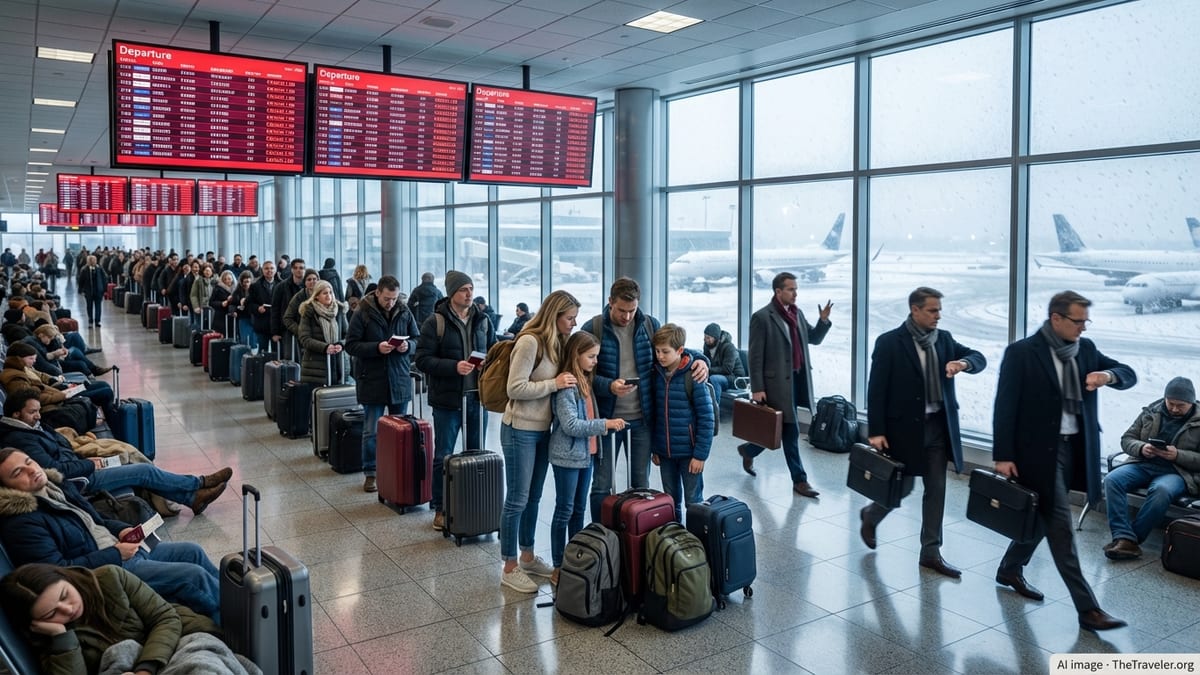
Heavy Day of Disruptions at a Major U.S. Hub
Tracking services and airport-status dashboards for Denver International Airport showed a heavy concentration of late departures and arrivals, with delayed flights running into the hundreds over the course of the day. The disruption affected both domestic and international services, underscoring how quickly conditions can deteriorate at a major hub where banks of flights are tightly timed.
Denver, which regularly ranks among the busiest airports in the United States by passenger volume and flight movements, is particularly sensitive to knock-on effects. When one wave of departures is pushed back by even modest delays, subsequent aircraft rotations and inbound connections can quickly fall out of sequence, turning a handful of late flights into widespread schedule changes.
Publicly available data indicated that the majority of Sunday’s disruptions at Denver involved delays rather than outright cancellations. While this spared many travelers from being stranded overnight, it produced long lines at check-in counters, crowded gate areas and tighter-than-planned transfer windows for connecting passengers.
The scale of the disruption was notable for a single day, but it fits into a broader pattern of variability at large hubs during late summer and early fall, when convective weather, thunderstorms and shifting jet stream patterns can complicate flight planning across large parts of the interior United States.
Weather, Airspace Programs and Ground Congestion Intertwine
Weather around Denver and across the broader region played a central role in Sunday’s delays. National weather products for the airport pointed to unsettled conditions over the weekend, with changing winds and showers triggering periodic adjustments to arrival and departure configurations. When runways must be reconfigured or visibility drops, air traffic managers typically reduce the rate at which flights are permitted to land and take off.
Those changes often lead to air traffic control programs that meter the flow of aircraft into constrained airspace. When such programs are in effect, aircraft destined for Denver may be held at their origin airports or slowed en route, lengthening travel times and causing rolling delays throughout the day. Carriers then have to manage aircraft and crew schedules around these constraints, sometimes swapping planes or crews at the last minute to keep as much of the operation moving as possible.
On the ground, a reduction in the pace of arrivals and departures can paradoxically create congestion as aircraft accumulate at gates or wait on taxiways for departure slots. Ramp crews, fuelers, caterers and baggage handlers must work around shifting pushback times and compressed turnarounds, which can add a few more minutes to each operation and further stretch already tight schedules.
At a hub like Denver, where multiple airlines operate dense connecting banks, even short ground holds can cascade. Late-arriving aircraft may miss their designated gates, inbound passengers can lose their planned connections, and crews may reach duty-time limits just as flight banks are set to depart, forcing additional scheduling adjustments.
Impact on Airlines and Travelers
Sunday’s wave of delays was spread across a mix of large network carriers and low-cost airlines that use Denver as a key connecting point or focus city. Real-time boards and third-party tracking platforms showed late operations on routes ranging from short regional hops into surrounding states to longer-haul flights linking Denver with coastal cities and international gateways.
For travelers, the practical effects ranged from modest schedule shifts of 30 to 60 minutes to multi-hour waits for some departures. Some passengers reported having to rebook missed connections or accept reroutes through other hubs when Denver-centric itineraries no longer aligned with the operating schedule. The situation highlighted how disruptions at a single airport can ripple outward to affect travelers far beyond the immediate region.
Customer-facing channels for major U.S. carriers encouraged passengers to use mobile apps and airport kiosks to monitor changing departure times, gate assignments and rebooking options. Many airlines also make provisions to waive certain change fees or fare differences during periods of significant disruption, though the specific terms vary by carrier and ticket type.
Within the terminals, reports described busy concourses as travelers sought out seating, power outlets and food options while waiting for updated departure information. Airport staff typically adjust staffing and terminal operations in response to prolonged irregular operations, but surges in delayed passengers can still strain amenities during peak periods.
Denver’s Role in the National Air Network
Denver International’s position at the center of the national air network magnifies the impact of any prolonged disruption. The airport serves as a major connecting point between the West Coast, the Midwest and the Mountain West, with a large share of its passengers transferring between flights rather than beginning or ending their journeys in Colorado.
That role means operational challenges at Denver do not remain local. When flight banks there are delayed, aircraft and crews may arrive late to their next assignments at other airports, transferring the disruption to subsequent legs. Travelers whose itineraries do not pass through Colorado may still feel the effects in the form of delayed inbound aircraft, reduced connection times or last-minute aircraft swaps.
Operational performance metrics compiled over recent months show that while airlines at Denver complete the vast majority of scheduled flights, on-time performance can fluctuate from day to day based on weather patterns and national airspace constraints. Sunday’s figure of more than 350 delayed flights sits at the high end of that range and serves as a reminder that even well-run hubs remain vulnerable to sudden changes in conditions.
As airlines and airport operators continue to adopt new tools for forecasting demand, managing turn times and coordinating with air traffic control, the goal is to limit how far such disruptions spread. However, the complexity of the system and the influence of weather mean that passengers traveling through major hubs like Denver may continue to face occasional days of widespread delays, particularly during seasons when storms are more frequent.