


More news on this day
More than 350 flights at Denver International Airport faced delays as a fast-moving storm system and resulting operational disruptions rippled through one of the nation’s busiest hubs, stranding travelers and complicating weekend connections across the United States.
Get the latest news straight to your inbox!
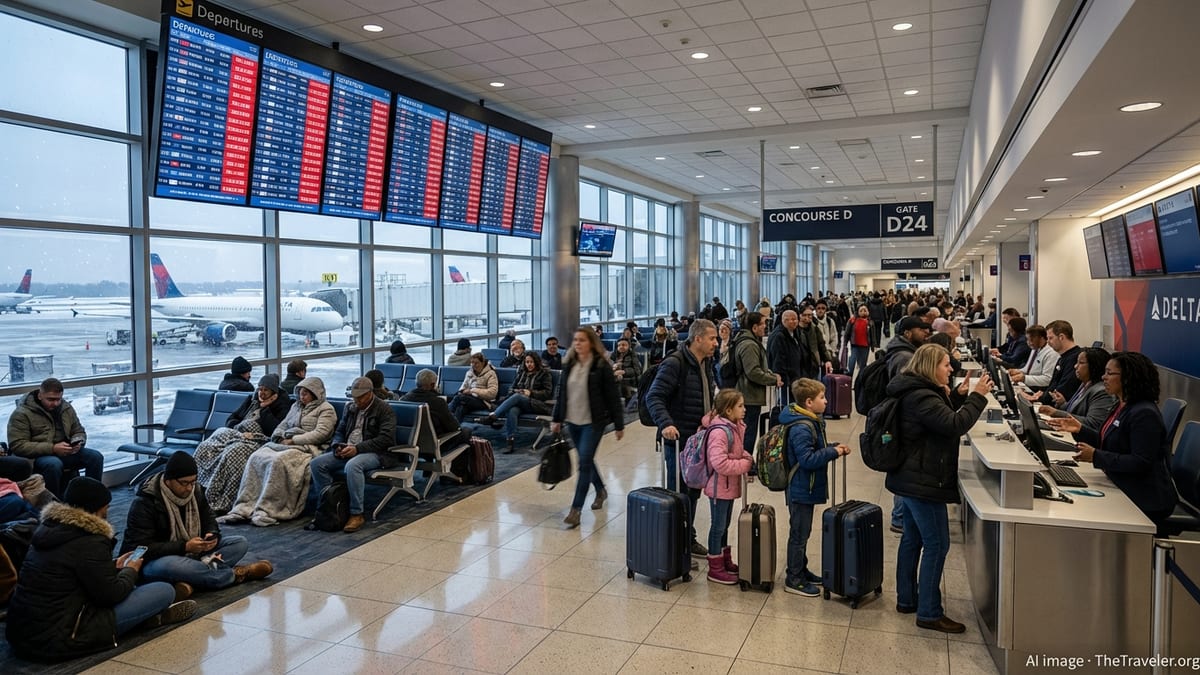
Weather Disruptions Trigger Widespread Delays
According to live flight-tracking boards and airport status dashboards on Sunday and Monday, Denver International Airport experienced several hours of heavily disrupted operations, with departures and arrivals repeatedly pushed back as thunderstorms moved across the Front Range and into the central plains. Publicly available aviation data shows that the storm cells brought reduced visibility, shifting winds and scattered lightning close to flight paths, conditions that typically require air traffic controllers to increase spacing between aircraft and may temporarily halt ground movements.
Those constraints led to a rapid buildup of late departures and backed-up arrivals on concourses serving major U.S. carriers. Real-time airport information pages monitored during the disruption indicated long columns of flights listed as delayed in the afternoon and evening banks, particularly among domestic services connecting through Denver to the West Coast, Midwest and East Coast. As aircraft waiting to depart sat in queues and inbound jets circled or diverted, the backlog of flights quickly climbed into the hundreds.
Weather-driven slowdowns at high-altitude airports such as Denver can be especially complex for schedulers, because the thinner air and terrain surrounding the region leave less flexibility for rerouting and altitude changes around storm cells. Operational data compiled over the past several years for Denver departures also shows that flights leaving during the evening peak hours are more vulnerable to cascading delays when bad weather arrives late in the day, due to already tight utilization of aircraft and crews.
Ripple Effects Across Airlines and Routes
The disruption at Denver did not impact all airlines or routes equally. Published performance statistics for Denver show that some carriers generally record higher on-time rates on key routes, such as connections from Salt Lake City and Dallas, while others experience longer average delays when things go wrong. When a large hub like Denver begins to stack up postponed departures, those differences can magnify, leaving some travelers facing much longer waits than others bound for similar destinations.
On routes linking Denver with major regional centers, historic data from July 2023 through June 2026 indicates that nearly one quarter of flights on some city pairs typically arrive 15 minutes or more behind schedule, even in normal conditions, with late services often running more than an hour behind. During the latest disruption, real-time tracking suggested that the number of affected flights surged well beyond those baseline patterns, with a sizable share of departures posting estimated delays of 45 minutes or longer.
Once a large number of aircraft fall out of their planned rotations at a hub, recovery becomes increasingly difficult. Planes arriving late into Denver are more likely to depart late on their next legs, while downline airports begin to feel the impact in the form of misaligned gates, displaced crews and passengers missing onward connections. Travel data sites tracking national delay patterns showed elevated disruption on routes touching Denver throughout the rest of the operating day, illustrating how a localized storm can temporarily reshape air traffic flows over a wide area.
Passenger Experience: Long Lines and Tight Connections
For passengers on the ground, the operational complexity translated into long security lines, crowded gate areas and mounting frustration as estimated departure times were repeatedly revised. Social media posts and traveler forums from the affected period described busy concourses, limited seating near heavily delayed flights and gate changes announced with little notice. Some travelers reported sitting on aircraft parked away from gates while crews waited for clearance to take off or for a new parking position to open.
Travel-planning tools tracking typical connection windows at Denver advise that many itineraries are built around relatively short layovers, often between 45 and 90 minutes, particularly on domestic connections. When departure banks are hit with wide-scale delays, those margins quickly disappear, leaving travelers with missed onward flights and the need to be rebooked. With more than 350 flights delayed in a single operational period, the number of disrupted connections likely ran into the thousands, affecting both outbound and inbound journeys.
Published on-time performance data suggests that travelers with early morning departures generally fare better at Denver than those flying in the late afternoon and evening, when the airport’s schedule is more congested and thunderstorms are more common. The latest disruption fit that pattern, with the heaviest concentration of delays observed in the late-day banks, underlining long-standing advice from travel analysts that passengers who can choose earlier flights have a better chance of avoiding serious schedule changes.
Operational Pressures at a Fast-Growing Hub
Denver International Airport has grown rapidly in recent years, with passenger traffic and daily flight counts placing it among the busiest hubs in North America. Airport fact sheets and state aviation reports highlight steady increases in operations as airlines have added routes and frequencies to capitalize on Denver’s geographic position as a connecting point for cross-country and mountain-region travel. That growth has expanded choices for travelers but has also added strain to infrastructure during periods of disruption.
High volumes of aircraft movements mean that any slowdown, whether for weather, runway inspections or air traffic control spacing, can quickly translate into queues on taxiways and crowded gate areas. Operational records from earlier years at Denver show that even modest schedule adjustments can ripple through departure and arrival banks when the airport is running close to capacity. The latest wave of delays illustrated how vulnerable tightly packed schedules can be when unexpected constraints emerge during peak hours.
In response to recurrent weather and congestion challenges along Colorado’s Front Range, regional transport planners have continued to adjust ground transport links and public transit services to and from the airport. Recent service-change announcements from Denver’s regional transportation agency include new and expanded bus connections aimed at improving access to Denver International Airport. While those changes focus primarily on surface travel, they reflect broader recognition that reliable connections to a fast-growing hub depend on resilient systems both on the ground and in the air.
What Travelers Can Do Next Time
For travelers looking ahead to upcoming trips through Denver, recent performance data and the latest disruption offer several practical lessons. Historical departure statistics suggest that early morning flights from Denver record significantly higher on-time rates than those later in the day, reinforcing the value of choosing earlier departures when schedules allow. Booking longer connection windows, particularly during the summer and early autumn thunderstorm season, can also create a buffer against rolling delays.
Travelers are also encouraged by consumer advocates to monitor flight status through airline apps and independent tracking tools, rather than relying solely on gate displays. During the recent disruption, mobile alerts often reflected changes more quickly than overhead boards, giving some passengers a head start in requesting rebooking, adjusting ground transport or arranging overnight stays when necessary. Keeping contact details up to date in airline profiles and enabling notifications can help ensure those messages reach travelers in real time.
Finally, passengers flying from or through Denver during peak travel periods may benefit from building additional time into their journey. Longer check-in and security queues are common when large numbers of flights are delayed, and the combination of busy road traffic, parking constraints and unpredictable security wait times can add stress at the beginning of a trip. As the latest episode of more than 350 delayed flights demonstrated, even a single round of severe weather can significantly extend door-to-door travel times for thousands of passengers whose journeys intersect at Denver International Airport.