


More news on this day
On a hot night in July, an Australian backpacker boarded a flight to a capital city listed as “Do Not Travel” on the government’s Smartraveller website, joining a small but growing group of travellers who are choosing to cross borders that official advisories mark in red.
Get the latest news straight to your inbox!
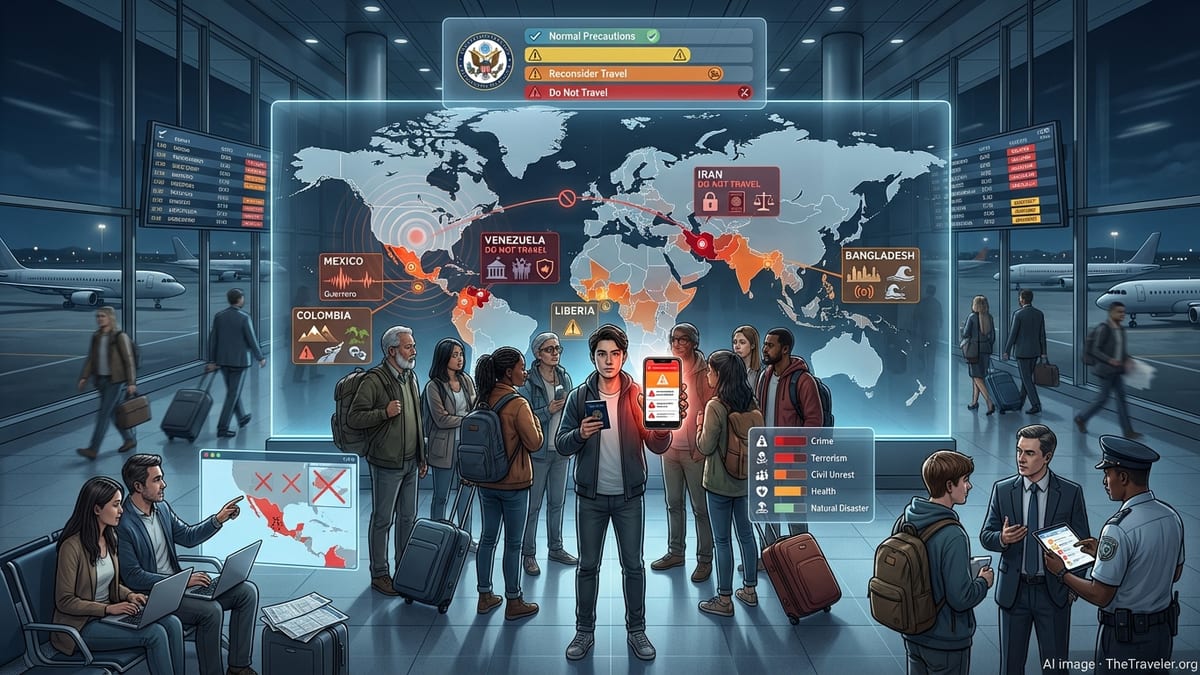
What “Do Not Travel” Actually Means
Smartraveller, run by Australia’s Department of Foreign Affairs and Trade, rates 178 destinations on a four-tier scale ranging from “Exercise normal safety precautions” to “Level 4: Do not travel.” Publicly available information describes the top level as advice to avoid travel to that country or region altogether due to a very high threat to personal safety, extremely volatile security conditions or a situation where the Australian government’s ability to provide consular help is severely limited.
The official Smartraveller site groups all destinations carrying Level 4 advice on a dedicated page, with recent examples including Afghanistan, Russia and parts of Myanmar, each citing combinations of armed conflict, terrorism, civil unrest and arbitrary detention risks as key reasons. In some cases, such as parts of the Middle East, aviation security and the potential for airspace closures also contribute to the highest warning level.
Government guidance stresses that a “Do Not Travel” label is not a casual suggestion but a formal risk assessment. Other Australian government resources on overseas travel underline that individuals are urged to read Smartraveller advice carefully and follow it, especially where destinations or specific provinces are designated Level 4, because events like sudden border closures, infrastructure collapse or targeted violence can unfold with little or no warning.
Australian government travel health advice similarly directs would-be travellers to check Smartraveller before making medical, dental or cosmetic travel bookings. The reasoning is that a country facing a major security or health crisis may not be able to provide reliable hospital care, medications or evacuation options, even in large cities that ordinarily cater to tourists.
The Small but Persistent Group Who Go Anyway
Despite the blunt wording of Level 4 warnings, a segment of Australian travellers continues to book trips into red-listed countries. A joint survey commissioned by Smartraveller and the Insurance Council of Australia, released as part of an awareness campaign, found that roughly a quarter of respondents said they might still consider travelling to a destination flagged “Do not travel,” even after being presented with the government’s description of the risks.
Travel industry commentary suggests this determination is driven by a mix of motivations: long-planned itineraries, cheaper airfares following a crisis, a desire to see destinations before they change further, or family obligations that override safety concerns. Adventure travel forums and social media posts sometimes frame these trips as badges of honour, emphasising deserted historic sites and cut-price hotel rooms, while giving less attention to curfews, checkpoints or fast-changing front lines.
Australian consumer-facing articles on travel advisories note that some travellers place more weight on their own research, including on-the-ground reports from bloggers and content creators, than on government dashboards. International coverage of similar behaviour among citizens of other countries, including those ignoring United States “Do Not Travel” notices, points to a broader pattern in which official advisories are treated as one reference point among many rather than a final word.
This tension between personal risk tolerance and official assessments has become more visible as global crises multiply. Mapping projects based on Smartraveller data shared on social platforms in recent years show large parts of the world shaded amber, orange or red, leading some frequent flyers to argue that an overly cautious view of risk would narrow their travel horizons more than they are willing to accept.
Insurance, Money and Fine Print at Level 4
One of the least understood consequences of flying into a Level 4 destination is financial rather than physical. Travel insurance policies for Australians routinely treat government advisories as a key reference point when defining what is and is not covered. Publicly available policy documents and consumer explainers show that many standard policies exclude cover for claims arising from travel to countries or regions where the government has issued a “Do Not Travel” warning, or where the traveller ignored a subsequent upgrade in the advice level.
This can affect far more than cancellations. If a traveller is robbed at gunpoint or injured in an explosion in a Level 4 city, their insurer may decline to pay medical bills, evacuation costs or lost property claims if the trip took place against explicit government advice. Even policies that offer limited cover for Level 3 destinations, rated “Reconsider your need to travel,” often draw a firm line at Level 4, requiring customers to scrutinise exclusions section by section.
Financial services commentary also notes that airlines and tour operators are not automatically obliged to refund trips just because the advice level shifts. Unless the carrier cancels a flight or a package operator voluntarily offers refunds or credits, travellers who change their minds after a warning is upgraded to “Do Not Travel” may find themselves negotiating at their own expense.
For those still intent on going, published consumer guidance recommends checking whether any specialised insurers offer cover in high-risk locations, and documenting that research carefully. Even then, travellers are reminded that an evacuation or medical airlift from a conflict zone can run into six figures in Australian dollars, far exceeding the limits of many mid-range policies.
Consular Limits When Things Go Wrong
Travel advisories are closely tied to what consular officials can realistically do if a situation deteriorates. Government information on overseas travel and foreign interference warns that in “Do Not Travel” locations, embassies may be closed, have minimal staff on the ground or be restricted by host governments from moving freely. This can sharply limit their ability to provide basic consular services such as issuing emergency travel documents, arranging safe passage to airports or liaising with local authorities about detained citizens.
International reporting on crises in recent years highlights cases where foreign nationals in conflict zones struggled to secure exit routes, even from countries with which their home governments had strong diplomatic ties. In some situations, travellers reported relying on private security contractors, local fixers or personal contacts rather than consular channels to leave besieged cities or closed borders.
Australian guidance stresses that consular services are not a guaranteed emergency rescue mechanism, particularly where security conditions prevent staff from reaching certain areas. Travellers who disregard a Level 4 warning may therefore find that, at the very moment help is needed most, the government has the least capacity to intervene because it has already assessed the area as too dangerous for its own personnel.
Advisories also interact with other countries’ systems. For example, coverage in international travel media points out that in some crises, commercial airlines scale back services in line with multiple governments’ warnings and insurer decisions. That can leave foreign visitors competing for a shrinking number of outbound seats at short notice as carriers reroute aircraft away from unstable regions.
Reading the Risk Map Before Booking
With more red and orange zones on the map than in previous decades, governments and travel experts are placing fresh emphasis on how to read advisories before pressing “book.” Smartraveller guidance encourages Australians not only to check the overall colour for a destination but to read through subpages detailing specific provinces, border areas and transit hubs, since some countries are split into multiple advice levels.
Australian government campaigns such as “Have adventures, not regrets” present Smartraveller as a planning tool rather than a last-minute hurdle, urging would-be travellers to sign up for updates and treat shifts in advice levels as triggers to reassess itineraries, insurance and contingency plans. The message is that awareness at the planning stage can prevent harsh surprises at the boarding gate.
Comparisons with other national systems, such as the United States State Department’s four-level advisory scale, show that while wording and thresholds differ, the underlying intent is similar: to synthesise security, health and infrastructure data into a format that ordinary travellers can quickly understand. Recent features in international travel magazines explain how a single high-profile incident or regional conflict can tip a destination into the highest warning category, even though many neighbourhoods remain calm on an average day.
For the Australian backpacker stepping off the plane into a Level 4 city this year, the gamble might result in the story of a lifetime and a safe journey home. Smartraveller’s own messaging, however, is unambiguous. Once a country is marked “Do Not Travel,” those who go anyway are accepting that the risks, and the potential costs, will largely be theirs alone.