


For many travelers, visiting Canada’s national parks means snagging a hard‑to‑get Parks Canada reservation for a campsite, backcountry permit, or shuttle. Yet every season, would‑be campers watch Banff, Jasper, Pacific Rim, or Fundy fill up in minutes, lose money to avoidable fees, or discover that a small oversight has derailed a long‑planned trip. Most of these problems are not bad luck. They are the same avoidable mistakes repeating year after year.
Get the latest updates straight to your inbox!
Misunderstanding When Reservations Actually Open
One of the biggest mistakes travelers make is assuming that Parks Canada reservations open on a single national date, or that they can book casually “a few months before” a summer trip. In reality, the system uses rolling launch dates that vary by park and even by campground. For the 2026 season, the national reservation portal opened in mid‑January, but Parks Canada published separate launch days for each destination, such as Glacier National Park, Gulf Islands National Park Reserve, and Mount Revelstoke. Travelers who only noted “January” often logged in on the wrong day, long after the most coveted dates at campgrounds like Lake Louise, Tunnel Mountain in Banff, or Green Point in Pacific Rim were gone.
This misunderstanding is especially painful for backcountry itineraries, where space is even more limited. For example, blogs that track Parks Canada openings list specific times like 8:00 a.m. local time for routes in Riding Mountain or for backcountry sites in the Rockies. If you assume that every park opens at the same hour across Canada, you can easily show up an hour late and find the West Coast Trail, Skyline Trail in Jasper, or Lake O’Hara bus seats fully booked for your preferred window.
The fix is simple but requires discipline. Before you book flights or lock in vacation days, check Parks Canada’s official reservation page for your exact park, campground, and offer type. Note not only the date but the time zone and whether a virtual queue will be used. Then set multiple alarms and calendar reminders. Treat your opening day like buying concert tickets: log in early, be ready with a short list of acceptable dates, and understand that the window for popular July and August weekends can be measured in minutes, not days.
Underestimating Demand for Popular Parks and Shuttles
Travelers often assume that if they are flexible by a day or two, they can casually pick up a campsite or shuttle seat once they arrive in Canada. That may have been true a decade ago, but it no longer matches reality in marquee parks. In Banff and Jasper, frontcountry campsites at Tunnel Mountain, Two Jack Lakeside, and Whistlers typically book out for prime summer weekends as soon as the season opens, with nightly fees commonly in the range of about 35 to 60 Canadian dollars depending on services. Blogs documenting trip costs now routinely treat a confirmed Parks Canada campsite as something that must be secured months in advance, not days.
The same shock hits visitors who discover that some trails now require shuttle or day‑use reservations. The shuttle from the Lake Louise Park and Ride to Moraine Lake and Lake Louise has become one of the most contested items in the Parks Canada system. In recent seasons, online discussions show people logging into the reservation portal before 8:00 a.m. Mountain Time only to find themselves in a virtual queue with thousands ahead of them. Those who assumed they could simply park at the trailhead are turned back by car‑access restrictions or long traffic controls, burning an entire day of their holiday.
This mismatch between expectation and reality leads to risky behavior, such as driving loop after loop around Banff or Jasper looking for an overflow site, or entering an area like Moraine Lake by bike or on foot in unsafe conditions just to “beat the system.” A better approach is to treat anything associated with the most photographed spots in Canada as a top‑tier reservation. Book campsite and shuttle dates first, then build the rest of your itinerary around whatever you can actually secure, not the other way around.
Not Preparing for the Virtual Queue and Technical Glitches
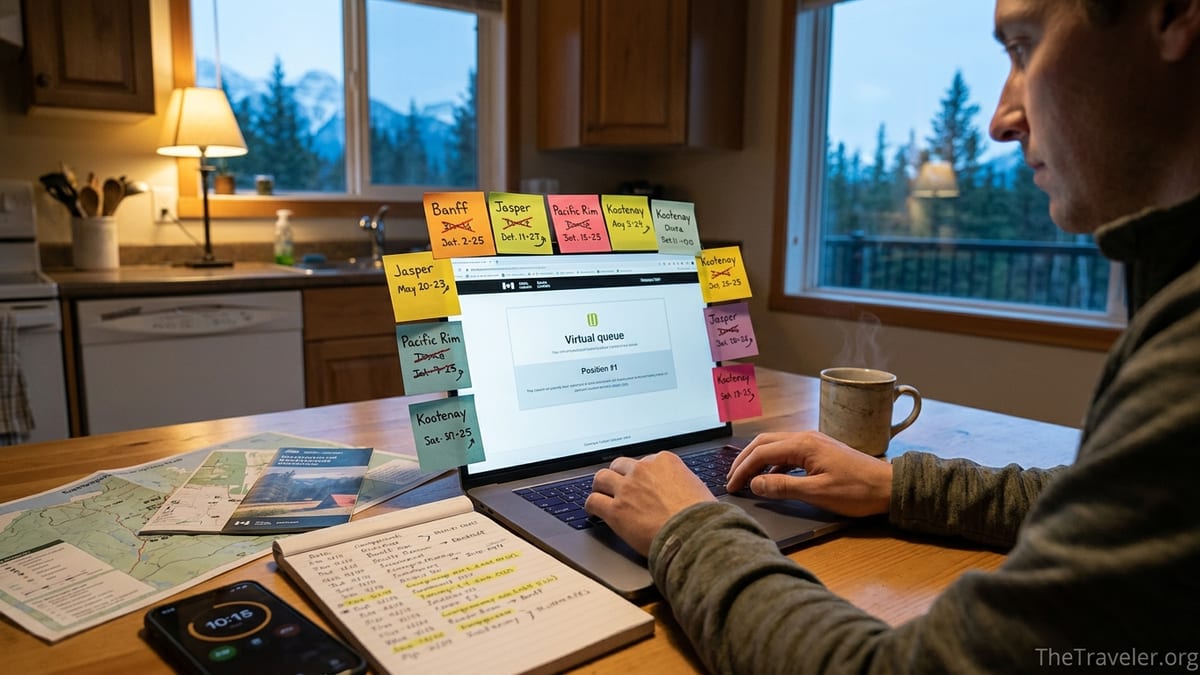
A newer mistake is failing to understand how Parks Canada’s virtual queue works on busy launch days, or assuming that the system will be perfectly stable. The reservation service now commonly activates a waiting room in the minutes before high‑demand sales, such as Banff frontcountry openings or shuttle releases. Travelers who show up at 8:01 a.m. are often pushed to the back of a very long line, while those who refreshed the page a few minutes earlier landed in better positions.
Real‑world examples show that even being in the queue is no guarantee. In January 2026, an IT outage affecting federal government services hit during a major reservation launch. Some users reported queue numbers in the low hundreds, only to be greeted by a notice that the day’s reservations had been postponed and that a new date would be announced later. Others who were trying for Glacier National Park campsites found that the system crashed entirely mid‑process. Travelers who had assumed a smooth booking that morning faced a scramble to rebook vacation time and shift backup plans.
Since you cannot control outages, you need to build resilience into your strategy. Log in early on a stable connection, avoid office Wi‑Fi that may log you out or block key pages, and use a laptop rather than a phone if possible so you can navigate quickly once it is your turn. Take screenshots of any error messages or pending bookings, in case you need to follow up with Parks Canada staff. Most importantly, resist the urge to panic‑book any random date when you finally get through. Have a prepared list of “must‑have,” “nice‑to‑have,” and “fallback” options so you can make fast but rational choices under time pressure.
Ignoring Fees, Passes, and Penalties
Travelers are often surprised by how many separate costs are involved in a Parks Canada stay. It is common to budget only for the campsite nightly fee and then be blindsided by the additional cost of daily park entry, reservation fees, fire permits, and specialized services. For instance, visiting Banff or Jasper means paying a per‑person or per‑vehicle daily entry charge that is separate from your campsite price. As of the mid‑2020s, adult day passes across many national parks are around the ten‑dollar range, with children under 17 typically free and discovery passes offering better value for longer trips. On top of this, frontcountry campsites in flagship parks frequently cost in the mid‑thirties to near sixty dollars per night depending on services like electricity.
The financial surprises are not limited to frontcountry sites. Backcountry and specialty accommodations come with their own structures: oTENTik cabin‑tent hybrids, for example, often sit in the roughly 100 to 140 dollar per night range, while backcountry sites may be priced per person instead of per campsite. Travelers comparing national parks to some provincial or state systems, where you pay a low flat fee per site, sometimes feel misled when a family of four is charged per person for multiple nights in the backcountry. Add in mandatory reservation and modification fees each time you change dates and the total can easily climb far beyond what you expected.
Another costly mistake is failing to understand penalties for no‑shows or late cancellations. Parks Canada encourages visitors to cancel unused reservations so others can book them, and it generally charges a non‑refundable reservation fee plus additional charges if you cancel close to your arrival date. Online discussions are full of reports of people who grabbed ten‑night blocks at popular campgrounds just to “hold something,” then either forgot to adjust or realized too late that shortening or canceling would incur fees for every change. Before you click “book,” read the current fee table for entry passes, fire permits, and reservation changes, and calculate your total cost for the full length of your stay, not just the headline nightly rate.
Booking the Wrong Type of Site or Services
Another common error is reserving a site that does not match your actual needs because you were rushing or did not understand the terminology. Parks Canada distinguishes between frontcountry and backcountry camping, and within frontcountry there are unserviced, powered, and fully serviced sites. Unserviced sites provide a parking pad, picnic table, fire ring, and access to basic washrooms, while serviced sites add electrical hookups and sometimes water and sewer. Travelers who accidentally book an unserviced site for a large RV, or who assume that “electrical” means full hookups, can arrive at Tunnel Mountain or Wapiti to discover they have nowhere appropriate to dump waste or plug in their refrigerator.
The confusion extends to comfort camping options like oTENTiks, yurts, and cabins. These structures typically include beds or sleeping platforms, a table, and basic furnishings, but not always bedding, cooking gear, or running water. Many first‑time visitors see photos that look like small chalets and assume hotel‑style amenities, only to show up at Fundy or La Mauricie with no sleeping bags or cookware. Similarly, some backcountry sites are designated as hike‑in only, with parking limits at the trailhead, while others are boat‑access or paddle‑in. Reserving the wrong access type can leave you with a booking you cannot physically use.
The solution is to slow down during the last step of the reservation process and carefully read the site description, including length, pad type, surface, and service level. If you are traveling in an RV, compare the site length with your actual rig including tow vehicle. If you are new to camping, look up what a typical unserviced site looks like in that specific park. For comfort camping, confirm whether bedding, dishes, and heat are included and what you are allowed to cook indoors versus at the firepit. A five‑minute review before booking will save you from an unpleasant surprise when you pull into your loop after a long day of driving.
Failing to Match Reservations to Weather, Season, and Access
Even travelers who secure their dream reservations often mishandle the basics of seasonality and access. Parks Canada operates across wildly different climates, and an early‑season campsite that looks perfect on paper may be miserable in real life. In Banff, for instance, official information notes that even in late spring and early summer, daytime highs may hover around the low teens Celsius while night temperatures drop below freezing. Yet campers routinely book May or early June sites at elevated campgrounds, arrive with only summer‑weight gear, and spend their nights shivering instead of sleeping.
Another seasonal oversight involves road and trail access. Many campgrounds and backcountry routes open later than people expect due to snowpack, flooding, or maintenance. A backcountry reservation for a site like Eva Lake in Mount Revelstoke or certain passes in Jasper may not be valid until mid‑July, and early dates come with significant lingering snow and icy conditions. Travelers who book the first week of the season simply because it is the only thing left often find that bridges are out, trail sections remain closed, or the experience is far more technical than their group can safely handle.
Access rules can also change year to year. Some popular roads convert to shuttle‑only or have strict parking windows, like the approach to Moraine Lake or seasonal restrictions in Yoho and Kootenay. If your campsite or permitted route assumes a shuttle, you must verify that your park entry time, shuttle ticket, and campsite reservation align. It is a recurring story: visitors who successfully book a Lake Louise campground then discover that the departure times for their desired shuttle connection are already sold out for their dates. To avoid this, confirm the latest operational details for your specific season a few weeks before departure and adjust your daily plan, not just your overnight reservations, to match the conditions on the ground.
Overbooking, Placeholder Reservations, and Poor Backup Planning
Scarcity breeds bad habits, and the Parks Canada system is no exception. A pattern has emerged where travelers book the maximum allowable stay at a high‑demand campground, such as ten nights at Lake Louise or Whistlers, just to beat others to any availability. They then intend to shorten the trip later once flights or work schedules are finalized. Online discussions show how quickly this escalates: people hold overlapping stays across different parks, forget to cancel unneeded nights, or change their dates in multiple small steps, paying modification fees each time. Meanwhile, genuine visitors are locked out of those dates even though the sites sit empty.
This approach backfires when cancellation policies tighten, or when you simply run out of time to adjust. Some travelers only fully confront their overbooking a week before departure, when penalties for late cancellation are higher. Others are caught off guard when Parks Canada adjusts policies mid‑season to discourage hoarding, for example by limiting the number of active reservations per account or enforcing stricter rules on no‑shows. Although such measures evolve, the risk remains that a short‑term placeholder tactic ends up costing more money and stress than it saves.
A healthier strategy is to decide in advance on one or two realistic core itineraries and book only what you genuinely expect to use. Keep a written list of backup options at less famous parks within driving distance. For instance, if Banff frontcountry is already full for your chosen weekend, you might pivot to Kootenay, Yoho, or Waterton, or to a quieter campground at the edge of Jasper. Set weekly reminders in the months leading up to your trip to check for cancellations; many travelers do release sites as their summer plans firm up, especially around shoulder seasons like early June and early September. By combining modest flexibility with consistent monitoring, you can often secure good sites without resorting to mass placeholder booking.
The Takeaway
Parks Canada’s reservation system can feel intimidating, but most of the heartache travelers experience comes from a familiar set of mistakes: misreading launch dates, underestimating demand, ignoring how the virtual queue works, glossing over fee structures, choosing the wrong campsite type, misjudging conditions, and overbooking out of fear. Each of these missteps has played out publicly in recent seasons, from IT outages that derailed carefully planned mornings to travelers who learned only at the tollbooth that they needed both an entry pass and a reserved shuttle.
The good news is that every one of these pitfalls is manageable with a bit of homework and realistic expectations. Start by identifying your must‑see parks and experiences, then study their specific reservation launch dates, opening windows, and access rules. Build redundancy into your plans with backup parks and dates, understand the real cost of your stay including passes and fees, and make a point of canceling anything you will not use as soon as your plans solidify. With this approach, the Parks Canada reservation system becomes less of a gatekeeper and more of a tool, helping you secure the national park experience you truly want rather than the leftovers you happen to stumble into.
FAQ
Q1. Do I really need to book Parks Canada campsites months in advance?
For the most popular parks and summer weekends, yes. Frontcountry sites in places like Banff and Jasper often sell out within hours of reservations opening, while shoulder‑season dates and lesser‑known parks may remain available closer to the travel date.
Q2. How do I find the exact reservation launch date for my park?
Check the official Parks Canada reservation information for the upcoming season and look for the table listing each park, campground, or offer with its specific launch date and time. Do not rely on old blog posts or last year’s dates, since these can change from season to season.
Q3. What is the virtual queue and how can I improve my chances?
The virtual queue is a waiting room that Parks Canada activates on busy launch days to manage heavy traffic. Log in a few minutes before the stated opening time on a stable connection, keep your browser open, and be ready with a shortlist of acceptable dates so you can act quickly when your turn comes up.
Q4. Why am I being charged both a camping fee and a park entry fee?
Camping fees pay for your campsite or accommodation, while park entry fees cover access to the national park itself. You must usually pay both. If you plan to visit multiple parks or stay several days, a seasonal or annual pass is often cheaper than paying day by day.
Q5. How can I avoid booking the wrong type of campsite?
Carefully read the site description before you confirm. Check whether the site is frontcountry or backcountry, serviced or unserviced, and whether it is suitable for tents, RVs, or both. Confirm maximum vehicle and trailer length, access type, and any restrictions on generators or fires.
Q6. What happens if there is an outage during my reservation time?
If an IT outage disrupts bookings, Parks Canada typically posts a notice on the reservation site and may postpone that day’s launch to a later date. Take screenshots of your queue position or error messages and monitor official updates so you know when reservations will resume.
Q7. Is it a good idea to book extra nights and cancel later?
Generally no. Overbooking can tie up sites others could use and may cost you money in modification and cancellation fees. A better approach is to book only what you realistically expect to use and then watch for cancellations if you need to adjust dates.
Q8. How far in advance should I book shuttles for places like Moraine Lake?
Treat high‑demand shuttles like Moraine Lake or popular day‑use passes as a priority. Book them as soon as their reservation window opens, often on a separate launch date from campsites, and coordinate them with your campground reservations and travel days.
Q9. Are there any last‑minute options if everything looks full?
Last‑minute openings do appear as other travelers change plans, especially in the weeks before peak holiday periods. Check the reservation site regularly for cancellations and consider nearby, less famous parks or campgrounds as backups instead of focusing only on marquee destinations.
Q10. What should first‑time international visitors do differently?
First‑time visitors from abroad should plan even earlier, since flights and fixed vacation dates leave less flexibility. Prioritize securing key reservations, understand visa and border requirements, budget for the full cost of entry fees and camping, and build in a rest day on arrival so that any unexpected reservation issues do not derail the entire trip.