


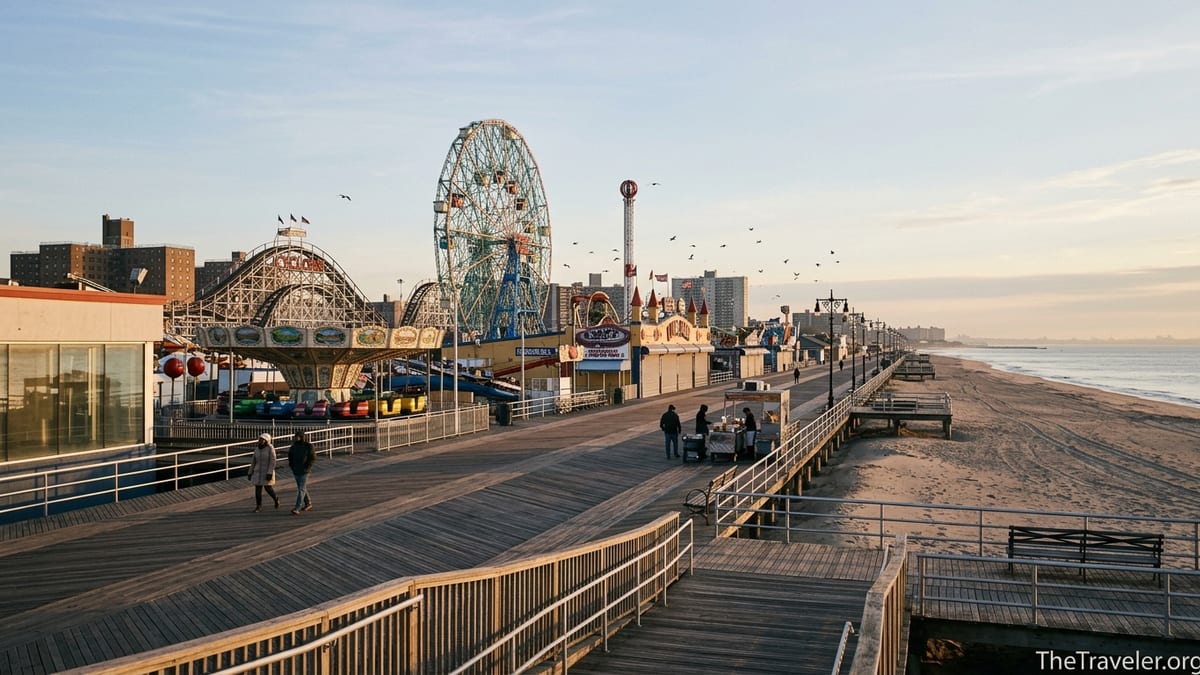
Coney Island is not just another amusement park. On summer weekends the boardwalk becomes a moving river of New Yorkers and visitors, the air thick with the smell of Nathan’s Famous hot dogs, the rattle of the Cyclone’s wooden track and the shouts from arcade barkers. Few places in New York City condense so much history, pop culture and pure seaside fun into a few blocks as this stretch of Brooklyn sand, where Luna Park and Deno’s Wonder Wheel Amusement Park still anchor what many locals simply call "the People’s Playground."
A Living Time Capsule of New York Entertainment
Coney Island’s theme park district is one of the few places where you can stand on a modern boardwalk, phone in hand, and still trace more than a century of New York leisure culture in front of you. In the early 1900s, this barrier island at the edge of Brooklyn was home to three legendary amusement parks: Luna Park, Dreamland and Steeplechase Park. At their height they drew millions of visitors each season and helped define the very idea of a seaside amusement resort in the United States. Although those original parks are gone, the current Luna Park and Deno’s Wonder Wheel Amusement Park consciously preserve that legacy in their ride names, architectural details and even their flashing light packages.
Today’s visitors experience this history in tangible ways. The Coney Island Cyclone, a wooden roller coaster that opened in 1927 and now operates inside Luna Park, remains one of the most recognizable silhouettes on the New York skyline, just as it did in black and white newsreels. A few steps away, Deno’s Wonder Wheel, first opened in 1920 and now over a century old, still lifts riders in its swinging and stationary cars 150 feet above the sand. Both rides are protected New York City landmarks and sit alongside thoroughly modern attractions like Luna Park’s steel Thunderbolt coaster and the Phoenix family coaster at Deno’s, creating a rare side by side mix of historic and contemporary engineering.
The result for travelers is an atmosphere that feels unlike newer, master planned theme parks. The streets between Surf Avenue and the Riegelmann Boardwalk are tight and irregular, with small arcades, independent kiddie rides and food stands squeezed between the banner attractions. Many families who came here as children in the 1970s and 1980s now bring their own kids to ride the same Wonder Wheel or to compare bruises from a first ride on the Cyclone. That multigenerational loyalty keeps the park rooted in its neighborhood and makes even a first time visit feel like stepping into a story that has been going on for decades.
The Rides That Built the Legend
Ask most New Yorkers what makes Coney Island iconic and many will start with the Cyclone. This wooden roller coaster, with its white lattice structure and tight turns, has been thrilling riders for nearly a century. The ride is not especially tall by modern standards, but its 85 foot drop, 60 mile per hour top speed and aggressively banked curves deliver a level of intensity that surprises visitors used to smoother, steel coasters. Regulars advise first time riders to sit over the front wheels if they want a gentler experience, and over the back wheels if they want to feel every rattle and pop of the track.
Just as important to Coney Island’s identity is the Wonder Wheel at Deno’s Wonder Wheel Amusement Park. Unlike ordinary observation wheels, this one features 16 swinging cars that slide along inner tracks as the wheel turns, creating a surprising side to side motion that feels part Ferris wheel and part family coaster. Eight additional stationary cars cater to visitors who prefer a slower, view focused ride. On clear afternoons riders can see the Verrazzano Narrows Bridge to the south, the Manhattan skyline to the north and the sweep of Brooklyn’s beaches running east. The wheel’s perfect safety record over its century of operation is a point of pride for the Vourderis family, who have owned and operated the park since the 1980s.
The modern Luna Park adds headliners that keep Coney Island relevant in the age of high tech thrill rides. Thunderbolt, a steel coaster introduced in the 2010s, flips riders through a vertical loop and several inversions, while newer attractions like the Tony’s Express family coaster and the Big WaveZ splash ride are designed so that mixed age groups can ride together. In 2024 Luna Park introduced Electric Eden Raceway, an electric go kart track that swaps the smell of gasoline for a quieter, cleaner racing experience and reflects a broader industry move toward more sustainable operations.
Yet many of the most beloved rides here are smaller and quirkier. Deno’s Spook A Rama, a classic dark ride dating to the mid 20th century, still sends two person cars through a sequence of hand built scares and black light scenes that would feel at home in an old carnival. Kiddie rides like the Sea Serpent coaster at Deno’s and the collection of junior flat rides inside Luna Park remain rite of passage experiences for Brooklyn children. The combination of world famous roller coasters and modest, nostalgic attractions makes the parks feel approachable to travelers who might be intimidated by all thrill destinations.
Boardwalk Culture, Street Life and the Atlantic Ocean
Part of what makes Coney Island special is that the theme parks are inseparable from their setting. Unlike landlocked suburban parks, Luna Park and Deno’s sit steps from the Riegelmann Boardwalk and the broad Atlantic beach. Visitors routinely split their day between rides and the water: a morning on the sand, an afternoon of coasters, and an evening watching the sky turn pink and orange over the ocean. Plenty of New Yorkers come only for the free parts of the experience, strolling the boards with a soda or ice cream and listening to the Cyclone’s lift hill climb in the background.
The boardwalk itself is an attraction. Street performers set up around busy corners on summer weekends, from breakdancers and buskers to sand sculptors working intricate castles near the water’s edge. You may encounter volunteers from the Coney Island History Project inviting passersby to step inside their small exhibition space beneath the Wonder Wheel for vintage photos and oral histories, or members of the polar bear club promoting their winter swims. Everything feels slightly worn and improvised, a reminder that this is a real working neighborhood as well as a tourist site.
Food is another essential part of the Coney Island ecosystem. Nathan’s Famous, which started as a stand at the corner of Surf and Stillwell Avenue in 1916, still sells hot dogs and crinkle cut fries in the shadow of Luna Park’s entrance. A classic order, with a hot dog, fries and a drink, typically runs between 12 and 18 dollars today depending on toppings and size. Nearby boardwalk vendors sell soft serve cones, funnel cakes, cotton candy and Italian ices for roughly 5 to 10 dollars per item. More substantial meals can be found at casual sit down spots near the New York Aquarium and along Surf Avenue, where pizza slices, tacos and burgers cater to families looking for a break from rides.
This integration of amusement rides, street food and public shoreline is part of why Coney Island still feels like “the People’s Playground.” The beach and boardwalk remain free to enter, and many visitors with limited budgets skip the major rides altogether in favor of people watching, dipping their toes in the surf and playing arcade games where a handful of quarters can last an hour. Compared to highly controlled ticketed theme resorts, the experience feels looser and more democratic, closer to the spirit of the early 20th century amusement boom that made Coney Island famous.
Access, Affordability and How the Park Actually Works
For travelers planning a visit, one of the most practical advantages of Coney Island’s theme parks is that they are integrated into New York City’s public transit network. Multiple subway lines, including the D, F, N and Q, terminate at Coney Island Stillwell Avenue, a large elevated station that drops you within a short walk of Luna Park’s main gate. From Midtown Manhattan the ride typically takes about 45 to 60 minutes, and you pay the standard subway fare rather than a premium tourist ticket. This makes Coney one of the easiest major amusement destinations to reach without a car anywhere in the United States.
Admission works differently here than at many stand alone theme parks. There is no fee to walk along Surf Avenue or the boardwalk, and no general gate admission to enter Luna Park’s outdoor areas or Deno’s Wonder Wheel Amusement Park. Instead, rides are priced either as individual attractions or bundled into time limited wristbands. At Luna Park, visitors can buy a four hour unlimited ride wristband that, as of 2025, commonly falls in the range of 40 to 80 dollars per person depending on age, day of the week and whether major holidays or special events are running. Deno’s uses a point system, where families might load 40 or 80 dollars onto a card and tap for each ride, from a few dollars for kiddie rides to a higher rate for the Wonder Wheel and the Phoenix coaster.
Because the beach and public areas are open, it is easy to customize how much you spend. Some families invest in a full day of rides, while others buy just enough credits to ride one or two classics such as the Cyclone and Wonder Wheel and then spend the rest of their time exploring free attractions. The nearby New York Aquarium offers combination tickets that can extend a Coney Island visit without committing entirely to thrill rides. On many summer weekends, minor league baseball games at Maimonides Park, home of the Brooklyn Cyclones, add another optional cost for sports fans.
Seasonal scheduling is an important practical detail. The amusement parks typically open on a limited schedule starting in late spring, expand to daily operations in the heart of the summer and then scale back to weekends and holidays in September and October. In colder months, Luna Park has experimented with events such as Frost Fest, where a portion of rides operate alongside winter themed light displays and food. Hours and ride availability can vary with weather and private events, so visitors who care about specific rides are wise to check operating calendars and occasional advisories about maintenance closures before setting out.
Pop Culture, Memory and Coney Island’s Global Image
Coney Island’s theme parks exert an influence far beyond Brooklyn’s shoreline because they have been a fixture in film, photography and literature for generations. Early newsreels and silent films featured Luna Park’s towers and Dreamland’s electric lights as symbols of modernity at the beginning of the 20th century. Later, directors used the Cyclone’s curves and the boardwalk’s signage as visual shorthand for urban grit or youthful freedom. Contemporary visitors sometimes find that they recognize angles of the park before realizing they have seen them in movies, music videos or fashion shoots.
This constant visual presence has made Coney Island almost archetypal in conversations about amusement parks. When travel writers and broadcasters describe other seaside resorts, they often compare them to Coney, even if the other destination is cleaner, newer or larger. CBS News coverage of the area, for example, has focused on the Wonder Wheel as an enduring symbol of analog fun in a digital age, noting that the main thrill of its inner cars is a simple gravity trick that has delighted riders for over 100 years. That kind of coverage reinforces the idea that a day here is not just entertainment but a connection to a broader cultural story about how people play.
Personal memory plays an equally powerful role. For many New Yorkers, Coney Island is where they rode their first roller coaster, had their first unsupervised trip with friends, or stayed out late on a school night to watch fireworks. Travelers who visit only once often report that the place feels more emotionally charged than they expected, especially at dusk when the rides light up and the ocean turns dark. Photographers can spend hours capturing details like the peeling paint on a game stand, the patina on an old ticket booth or the way LED lights reflect on wet boardwalk planks after a summer rainstorm.
Social media has given the parks a new kind of visibility. Riders film themselves screaming down the Cyclone’s first drop, shoot slow motion videos inside the swinging Wonder Wheel cars and post carousel like sequences of cotton candy, sunburned shoulders and stuffed animal prizes. Hashtags dedicated to Coney Island spike on major holidays and during special events like the annual Mermaid Parade, even though that parade is organized by a local arts nonprofit rather than by the park operators themselves. This constant stream of user generated imagery strengthens Coney’s reputation as a destination where anyone can find their own version of the classic amusement park story.
Ongoing Revival, Local Community and Future Plans
Coney Island’s theme parks have experienced cycles of boom, decline and revival, and the current era is widely seen as one of renewed investment. The creation of the new Luna Park in 2010 on the site of the former Astroland marked a turning point after decades when large swaths of the amusement district sat underused or empty. Since then, operators have steadily added new rides, signage and amenities, while preserving the most significant historical attractions. The continued operation of Deno’s Wonder Wheel Amusement Park as a family run business provides a counterweight to corporate ownership and helps ensure that decisions are informed by long term relationships with the neighborhood.
Recent recognitions underscore that the parks are valued as more than just businesses. In 2023 Deno’s Wonder Wheel Park was added to New York State’s Historic Business Preservation Registry, which highlights enterprises that contribute meaningfully to local heritage and identity. This formal recognition sits alongside earlier designations, such as the Wonder Wheel’s status as an official New York City landmark and the Cyclone’s listing on the National Register of Historic Places. For travelers, these honors translate into a certain confidence that the rides they experience today are likely to be maintained and protected in the years ahead.
At the same time, the neighborhood around the parks is changing. New residential developments and proposals for large scale entertainment complexes have sparked debates among residents, preservationists and city planners about how much growth the area should absorb. Some locals welcome the prospect of year round attractions and additional jobs, while others worry that too much high rise construction could erode the quirky, low slung character that distinguishes Coney from more generic waterfront developments. Visitors can already see this tension in the contrast between new glass clad buildings along Surf Avenue and the older, hand painted rides and storefronts nearer the boardwalk.
Environmental concerns also shape the conversation about Coney Island’s future. As a low lying barrier island exposed to storm surges and sea level rise, the area requires investment in resilient infrastructure to protect both residents and attractions. Park operators work within this context when they plan expansions or refurbishments, balancing the desire for new thrill rides with the realities of building in a coastal flood zone. Travelers who ride the Wonder Wheel or walk the boardwalk after reading about major storms in the news may find themselves thinking not only about the past but also about how this iconic playground will adapt in the decades to come.
Making the Most of Your Visit
Understanding what makes Coney Island iconic can help visitors shape a day that goes beyond simply standing in line for the biggest rides. One practical strategy is to arrive late morning on a fair weather day, when the parks are fully open but the afternoon crowds have not yet peaked. Many travelers start with a lap along the boardwalk to orient themselves, then head first to the Cyclone and the Wonder Wheel before lines lengthen. This approach ensures that you experience the historic anchors while you are fresh and can decide later how much additional thrill riding your group wants.
Budget conscious visitors often combine one Luna Park wristband with a more selective approach at Deno’s. For example, a family of four might purchase two four hour wristbands that the teens use intensively on Luna’s coasters and spinning rides while younger or less ride focused family members buy a smaller number of Deno’s points just for the Wonder Wheel and a couple of gentler attractions. Sharing snack style meals, such as a tray of Nathan’s fries or a large order of boardwalk funnel cake, also helps keep costs manageable compared to multiple full sit down meals.
Comfort is another key factor in making the most of the day. The open nature of the site means there is little shade on the boardwalk or in the ride areas, especially around midday. Sunscreen, hats and light clothing make a practical difference, as does planning a mid afternoon break either on the beach, inside the aquarium or at an indoor arcade when the sun is strongest. Evening visitors should consider light layers, since breezes off the Atlantic can feel noticeably cooler even on warm days once the sun sets.
Finally, travelers who want to tap into Coney Island’s deeper story can look beyond the rides. The small Coney Island History Project exhibition space near the Wonder Wheel often features free or donation based displays on local history, including artifacts from long vanished parks like Dreamland and Steeplechase. The presence of longtime vendors, ride operators and neighborhood regulars offers informal opportunities for conversation; many are happy to share memories of how the area looked in different eras. Treating the day as both an amusement park visit and a neighborhood walkabout reveals why Coney Island resonates so strongly for so many people.
FAQ
Q1. Is Coney Island’s theme park area open year round?
The beach and boardwalk are open year round, but Luna Park and Deno’s Wonder Wheel Amusement Park primarily operate from spring through fall with reduced hours outside peak summer.
Q2. Do I have to pay an entrance fee to visit Luna Park or Deno’s Wonder Wheel Amusement Park?
No. There is no general gate admission. You can walk through the parks for free and pay only for rides, games and food.
Q3. How much should I budget for rides at Coney Island?
Many visitors spend between 40 and 100 dollars per person on rides, depending on whether they buy unlimited wristbands at Luna Park, points at Deno’s or just sample a few classics.
Q4. Are the Cyclone and Wonder Wheel safe for children?
Both rides are closely regulated and maintained, but they have height and in some cases age recommendations. Families with younger children often start with gentler coasters and observation rides before trying the major landmarks.
Q5. Can I visit Coney Island on a rainy day?
Light rain may not shut down the parks, but heavy rain, strong wind or thunderstorms can close many rides temporarily. On marginal days it is wise to check operating updates before traveling.
Q6. Is Coney Island worth visiting if I do not like thrill rides?
Yes. Many visitors come for the beach, boardwalk, food, people watching, minor league baseball games and the New York Aquarium without riding more than one or two gentle attractions.
Q7. How long should I plan to spend at Coney Island?
A half day is enough for a few key rides and a walk along the boardwalk, while a full day allows time for both parks, the beach, meals and possibly the aquarium or a ballgame.
Q8. Is Coney Island safe at night?
The amusement district is usually busy and well lit on warm evenings, especially on weekends. As in any big city, visitors should stay aware of their surroundings and stick to populated areas and main routes to the subway.
Q9. What is the best way to get to Coney Island without a car?
Most visitors use the New York City subway, taking lines such as the D, F, N or Q to Coney Island Stillwell Avenue, which is a short walk from the parks and boardwalk.
Q10. Why is Coney Island considered one of New York City’s most iconic attractions?
Because it combines century old landmark rides, a working class seaside boardwalk, pop culture history and easy subway access in a way that no other New York destination does, creating a uniquely layered and memorable experience.