


Most people arrive at Ljubljana Castle, snap a panoramic shot from the viewing tower, maybe ride the funicular back down, and feel they have “done” the castle. Yet this hilltop fortress above Slovenia’s capital hides a surprising number of quiet corners and layered stories that rarely make it onto hurried itineraries. Slow down for a couple of hours and an apparently polished tourist sight turns into a living place of history, everyday Ljubljana life and unexpected green spaces.
Get the latest updates straight to your inbox!
The Overlooked Soul of the Castle: Chapel of St George
Walk into the main courtyard on a busy afternoon and the last thing many visitors think to do is step inside the modest Chapel of St George tucked along one side. From the outside it can look like just another small historic building, overshadowed by the viewing tower and the terraces. Inside, however, this Gothic chapel is one of the castle’s most atmospheric spaces, with fresco fragments and soft light catching painted coats of arms on the walls. Because it is often empty, you can stand close to the details, from heraldic shields to delicate decorative borders, and imagine the centuries of ceremonies that took place here while the hilltop was still a true fortress.
Many group tours barely linger, sometimes pointing out the entrance in passing before moving on to the tower. Independent visitors can easily miss it altogether, especially if they focus on the ticketed attractions and restaurants. Yet a quiet ten minutes in the chapel can give you more sense of the castle’s original purpose than any souvenir stand. Simple practical tip: after entering the main courtyard, look for the clearly signed chapel door on the side facing the city. Entry is usually included in general castle access, so you rarely need an extra ticket, only the time and curiosity to step inside.
Because the chapel interior is compact, it rewards visiting early in the day or late in the afternoon, when the crowds thin out and the natural light is softer. Photographers should be respectful of worshippers when services or special events are taking place, which happens occasionally on religious feast days and during cultural festivals. Otherwise, it is one of the easiest places in the castle complex to experience a moment of quiet in a site that now welcomes well over a million visitors per year.
Castle Vineyard: A Working Urban Hillside Most Guests Never Reach
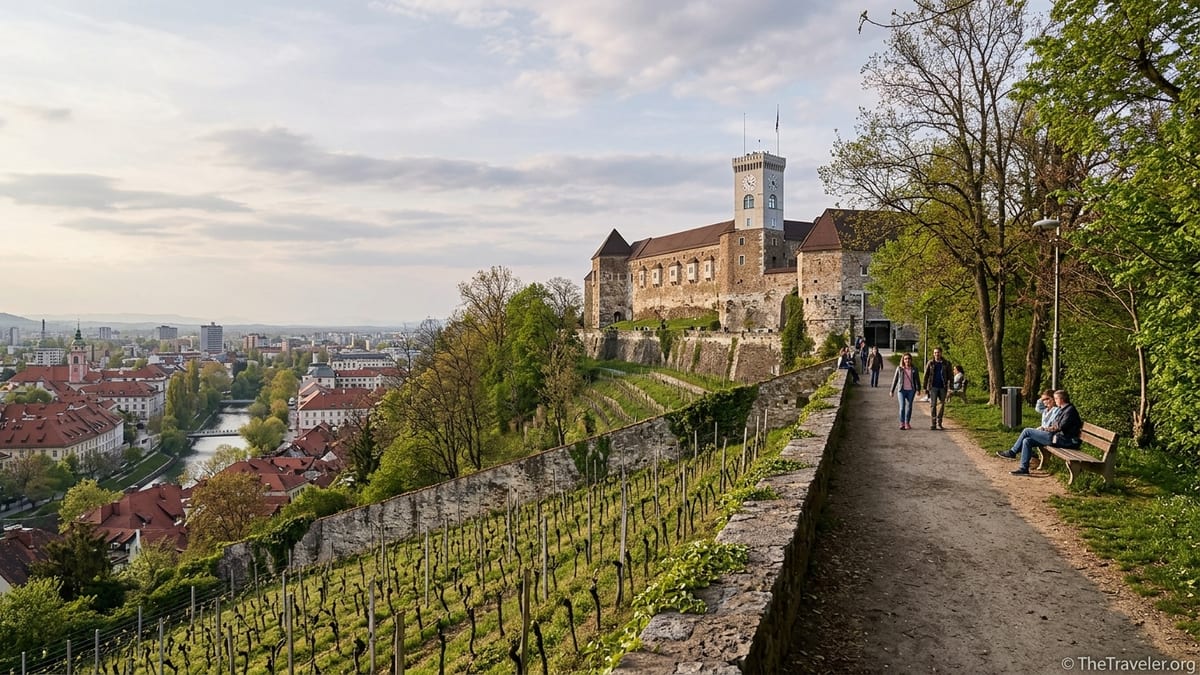
From most postcards of Ljubljana Castle you would never guess there is a real vineyard stretched across its southern slope. Yet since 2016, around 1,050 grapevines have been growing just a short walk away from the main complex, planted to revive the city’s historical tradition of hillside viticulture. The vineyard is planted with two varieties: Belpin, a white grape closely related to Chardonnay, and Rdečegrajc, the local name for Zweigelt, a red variety with soft tannins and bright berry notes. These are not just decorative rows for photographs; the vines are professionally tended and harvested, producing limited quantities of castle wine that the city uses for special occasions and sells in the on-site wine shop.
Most visitors never see this hillside because it does not sit directly under the main walls or viewing terraces. To reach it, you follow signed paths leading from the castle courtyard across the Castle Hill, usually ten to fifteen minutes on foot through light woodland. The walk itself is part of the appeal, especially on warm evenings when locals use the same paths for their daily exercise. While many tourists descend by funicular or minibus immediately after visiting the tower, those who continue on foot find themselves on a quieter side of the hill, where the hum of the city fades and the clink of wine glasses from occasional events drifts up from between the rows of vines.
The vineyard is also the setting for seasonal experiences like “Picnic among the Castle Grapevines,” a guided walk followed by a prepared picnic basket laid out between the rows. Places for these small-group events are limited, often capped around 16 participants, and must be reserved in advance through the castle’s official channels. Given that a ticket covers up to two hours with guiding, food and at least a glass of castle wine, the price tends to be higher than a simple entrance ticket but still reasonable compared with private wine tastings elsewhere in Slovenia. Even if you do not book the full experience, simply walking to the vineyard viewpoint is free and gives you an offbeat angle on the city’s roofs and the Ljubljanica River.
If you are planning your time at Ljubljana Castle, it is worth budgeting an extra hour specifically for the vineyard, especially on clear afternoons from late spring to early autumn when the vines are in leaf. Comfortable walking shoes are important, particularly after rain, as some of the paths can be a little muddy. The reward is seeing how Ljubljana combines urban life and agriculture on the same hill, something you miss entirely if you confine your visit to the walls and towers above the funicular station.
Beyond the Tower: The Virtual Castle and Hidden Exhibitions
The viewing tower justifiably gets attention for its 360-degree panorama, but it also draws the bulk of the crowds, often leaving the indoor exhibitions relatively calm. For a fuller picture of the fortress, seek out the Virtual Castle, a compact multimedia projection that traces the site’s history from a medieval stronghold to a former prison and finally to its current role as a cultural venue. The show lasts around 12 minutes, which makes it easy to fit between other activities, and it is designed for visitors with no prior knowledge, using clear visuals rather than heavy blocks of text. Many people skip it, assuming it is an optional extra for history enthusiasts, yet it helps make sense of everything else you will see.
Scattered through the castle are further permanent exhibitions that see only a fraction of the tower’s footfall. The Exhibition of Slovenian History is better curated than many short-stay visitors expect, using artifacts, models and bilingual explanations to trace the broader story of the region and the city below. The Museum of Puppetry, often overlooked by adults traveling without children, shows how Slovenia’s strong puppetry tradition connects with national culture and politics, including characters that locals grew up watching on television. For many travelers, this is an unexpected highlight, especially on rainy days when outdoor views are limited.
Another quiet corner is the Penitentiary, where you step into preserved prison cells that recall the period when the castle functioned as a detention center. Simple information panels describe how inmates lived and the types of offenses that could land someone on the hill. The modest scale makes the experience more intimate than grand, and because it is usually uncrowded, it is easier to imagine the lives of the people once held there. Combined with the nearby Castle Armoury exhibition in the Erasmus Tower, which displays historical weapons and armor pieces, this part of the complex illuminates the more practical, martial side of the castle beyond its current event spaces.
Ticket options vary, but in practice a combined ticket that includes the tower, Virtual Castle and history exhibition tends to be better value than paying separately for individual components. Prices are generally moderate by Western European standards, with discounts for families, students and seniors. If your time is short, it can still be worth choosing at least one of the lesser known exhibits to balance the tower visit. On a typical visit of two to three hours, many travelers find they can comfortably fit the Virtual Castle, a walk through the history rooms, a quick look at the Penitentiary and a coffee break, without feeling rushed.
Castle Hill Paths and Plečnik’s Promenades
One of the most distinctive aspects of Ljubljana Castle does not lie behind stone walls at all. The entire hill is laced with paths, staircases and small landscaped corners that many visitors ignore when they ride the funicular to the top and back. In the 1930s, the influential Slovenian architect Jože Plečnik reimagined some of the ruined bastions and ramparts as a green promenade known as Šance, turning parts of the former fortifications into walkways and terraces. Today, locals still treat these routes as an extended city park, using them for jogging, dog walking and quiet escapes from the Old Town streets just below.
From the city center, you can reach the castle on foot in around 10 to 20 minutes, depending on your starting point and chosen path. One popular climb begins near the Central Market and winds up through forested slopes, emerging behind the main entrance bridge. Another approaches from the south, connecting eventually to the vineyard area. Because the trails intersect, you can ascend on one and descend on another, creating a small loop that reveals different angles of the city and the surrounding hills. Along the way you will pass several viewpoints and small monuments, including a bronze sculpture commemorating peasant revolts that stands near a fortified terrace on the southern side.
Most short-stay visitors miss these routes because guidebooks and hotel desks tend to emphasize the funicular, often promoting it as a must-try attraction. While the glass cabin provides enjoyable views and is a boon for those with mobility challenges, it can also make the castle feel disconnected from its natural setting. Walking at least one direction, preferably up in the morning shade or down in the evening, restores that link and costs nothing. The paths are generally well maintained, though uneven in places, and are suitable for anyone with moderate fitness and sturdy footwear. In winter, some shaded sections can be icy, so care and perhaps hiking poles are advisable.
Spending time on the hill itself also gives you a chance to see how Ljubljana approaches urban green space. Benches and small clearings encourage lingering, and the castle’s landscaped surroundings are part of the reason the city was recognized as a European Green Capital in recent years. If you bring children, you will find that the climb and paths often become part of the adventure; for couples, the quieter terraces can be romantic at sunset, when the city lights begin to glow below and the castle walls take on a warm color in the last light of the day.
Culinary Time Machines and Castle Wine Culture
Another layer that many visitors overlook lies in the castle’s food and wine offerings. It is easy to assume that the courtyard cafes and restaurants mainly serve quick pizza and coffee for day-trippers, but the hilltop has quietly built up a reputation for more memorable culinary experiences. Among them is a themed tasting menu sometimes referred to as a “culinary time machine,” where local chefs reinterpret dishes from different periods of the castle’s history using modern techniques. Reservations are generally essential for such events, and prices are in line with mid- to upper-range Ljubljana restaurants, making them a splurge compared with a basic snack but still accessible for many travelers seeking a special evening.
Beneath the courtyard and in adjoining spaces you will find the Castle Wine Bar and shop, housed in vaulted cellars and opening onto a terrace with city views. Here the focus is firmly on Slovenian wines, from crisp whites of the Podravje region to fuller reds from the country’s western hills. Staff are used to introducing visitors to local grape varieties such as Rebula, Blue Franconian and the aforementioned Rdečegrajc, and they often offer tasting flights that allow you to compare styles side by side. Prices for a single glass are typically lower than in many Western European capitals, while full tastings naturally cost more but remain competitive with dedicated wine bars in Ljubljana’s Old Town.
The castle’s own labels, produced from the hillside vineyard below, have a protocol function and limited availability, which adds to their appeal. Bottles of the Belpin white and Rdečegrajc red can usually be purchased in the shop or offered during special events such as jazz evenings or harvest celebrations. For wine enthusiasts, this adds a tangible connection between the vines you can see on the slopes and the glass in your hand. Even if you are not a serious wine drinker, an hour at the wine bar can be a relaxing way to end a castle visit, especially in the shoulder seasons when the terrace is quiet and the light over the city is soft.
Because these experiences are not always highlighted on standard sightseeing itineraries, it helps to plan ahead by checking the castle’s event calendar when you know your travel dates. Concerts, food festivals and special tastings often take place in the evening, after the daytime crowds have dispersed. For many travelers, returning to the castle at night for a meal or event feels like discovering a different personality: illuminated walls, fewer tour groups and a local crowd dressed for dinner rather than sightseeing.
Casemates, Jazz Nights and Contemporary Culture in Old Walls
Ljubljana Castle is far from a static museum piece; it functions year-round as a cultural venue, yet many daytime visitors never realize how active its calendar can be. One of the most intriguing spaces is the Casemates, the largest castle hall, set within the thick walls that once protected the fortress. This multipurpose hall underwent extensive renovation, with work on ceilings, floors and modern installations completed as recently as early 2024, transforming it into a flexible venue for exhibitions, performances and video mapping shows. When not hosting private events, the space is sometimes open to the public as part of exhibitions or evening programs, offering a powerful contrast between ancient stone and contemporary light and sound.
Music lovers should look out for the Ljubljana Castle Jazz Club and other concert series that use both the Casemates and the open-air courtyard or vineyard terrace in warmer months. Summer schedules often feature Slovenian and international jazz ensembles, world music acts and classical performances. Tickets are usually priced comparably to small venue concerts in the city center, with separate charges from general castle admission. Because capacities are limited, popular performances can sell out in advance, but lesser-known artists may have tickets available on the day, especially on weeknights.
These events draw a mixed audience of locals and visitors, and attending one can change how you perceive the castle. Instead of a daytime stop en route to Lake Bled or the Postojna caves, it becomes a place where Ljubljana residents come to listen to new bands, watch film screenings or attend book launches. Bars in the courtyard and inside the event spaces stay open later during concerts and festivals, and it is common to see friends meeting for a drink beneath the lit-up towers long after the last daytime tour bus has left.
For travelers, the main challenge is awareness and timing. If you know you have a free evening in Ljubljana, it is worth checking the castle’s official listings a few weeks in advance to see what coincides with your stay. Even an unplanned visit can benefit from a quick look at posters around the funicular station or main entrance, which often advertise that week’s highlights. If you are traveling on a budget, remember that some outdoor events and open-air screenings are free or low cost, while others in more formal settings carry higher ticket prices. Either way, they offer a chance to see the castle as a living cultural hub rather than simply a backdrop for selfies.
Practical Ways to Experience What Others Miss
With so much happening in and around Ljubljana Castle, the risk is not a lack of things to see but a lack of time and planning. A common pattern is to allocate an hour, ride up on the funicular, climb the tower, buy a magnet in the gift shop and leave. To go beyond this, consider approaching the castle not as a single attraction, but as a small neighborhood of experiences linked by paths, walls and stories. Arriving on foot through the Castle Hill paths, allowing at least two to three hours at the top and planning a vineyard walk as well as one or two exhibitions will already move you beyond the typical visitor.
If your schedule in Ljubljana allows, one strategy is to split your castle encounter into two shorter visits rather than one rushed one. You might walk up in the morning, explore the chapel, tower and history exhibition, then descend into the city for lunch. Later, you could return by funicular in the evening for a wine tasting, dinner or a concert, discovering a different atmosphere after dark. This approach has the added benefit of spacing out ticket costs. While combined tickets and packages are often the best-value option, you can also tailor your spending by choosing which elements matter most to you on each visit.
Families with children can prioritize the Museum of Puppetry, more interactive parts of the history exhibition and the outdoor spaces, perhaps creating a simple treasure hunt for details like coats of arms, cannon ports and old well covers to keep younger travelers engaged. Couples might focus on the vineyard walk, wine bar and sunset views from quieter terraces instead of queuing at the tower during the midday rush. Solo travelers can take advantage of the calm exhibition rooms for unhurried exploration, then join a scheduled guided tour or picnic event to meet others.
Seasonality also affects what you will experience. In high summer, the hill can be hot at midday but delightful in the evening, when concerts and open-air events are most frequent. In shoulder seasons like April, May, September and October, foliage around the castle hill is at its most photogenic, and crowds are generally thinner. Winter visits sometimes coincide with Christmas markets or light displays, and the views from the tower on crisp, clear days can stretch across the snow-dusted Alps. Whenever you come, remember that Ljubljana Castle offers far more than a single photo opportunity; the most rewarding experiences often unfold once the initial view has been captured and put away.
FAQ
Q1. How much time should I plan for Ljubljana Castle if I want to see the lesser known areas?
Plan at least two to three hours. This gives you time for the viewing tower, one or two exhibitions, a walk on Castle Hill paths and a detour to the vineyard.
Q2. Is the castle vineyard free to visit, and how do I get there?
Walking to the vineyard viewpoint is free. Follow marked paths from the main castle complex across Castle Hill; the walk usually takes around ten to fifteen minutes.
Q3. Are the Virtual Castle and exhibitions suitable if I do not speak Slovenian?
Yes. The Virtual Castle projection and major exhibitions such as the history display and Museum of Puppetry include information and audio in English as well as Slovenian.
Q4. Do I need to book in advance for special experiences like the picnic among the grapevines?
Advance booking is strongly recommended. Group sizes are limited and dates can sell out, especially on weekends and during the main summer season.
Q5. Is it better to walk or take the funicular up to the castle?
If you are able to walk, consider at least one direction on foot to enjoy Plečnik’s promenades and forest paths. The funicular is convenient for those with limited mobility or tight schedules.
Q6. Can I visit the Chapel of St George at any time during opening hours?
In general, yes, but access may be restricted during religious services, weddings or special events. When the door is open and no ceremony is underway, visitors are welcome to enter quietly.
Q7. Are evening events at the castle suitable for families?
Many are. Open-air concerts, film screenings and light shows often attract mixed-age audiences, though some late-night jazz or wine-focused events are more adult oriented.
Q8. How expensive is food and drink at Ljubljana Castle compared with the city center?
Prices for coffee, snacks and casual meals are usually slightly higher than average Old Town cafes, while special tasting menus and wine flights are comparable to mid-range city restaurants and wine bars.
Q9. Is the castle accessible in bad weather or winter?
Yes. Indoor exhibitions, the chapel, the Virtual Castle and many event spaces remain open year-round. Some outdoor paths can be slippery in rain, ice or snow, so footwear and caution are important.
Q10. Can I visit Ljubljana Castle without buying any tickets?
You can walk up Castle Hill, explore the outer courtyards, enjoy some viewpoints and use the cafes without paying. Tickets are required for the tower, Virtual Castle and most permanent exhibitions.