


Riding a glass-walled funicular up to Ljubljana Castle feels very different from following a shaded forest path to the same hilltop. Both routes take only a few minutes, cost little or nothing, and end at the same medieval walls. Yet the choice you make quietly shapes how you experience Slovenia’s most famous castle, how much you spend, and even how the rest of your day in Ljubljana unfolds.
Get the latest updates straight to your inbox!
Why the Journey to Ljubljana Castle Matters
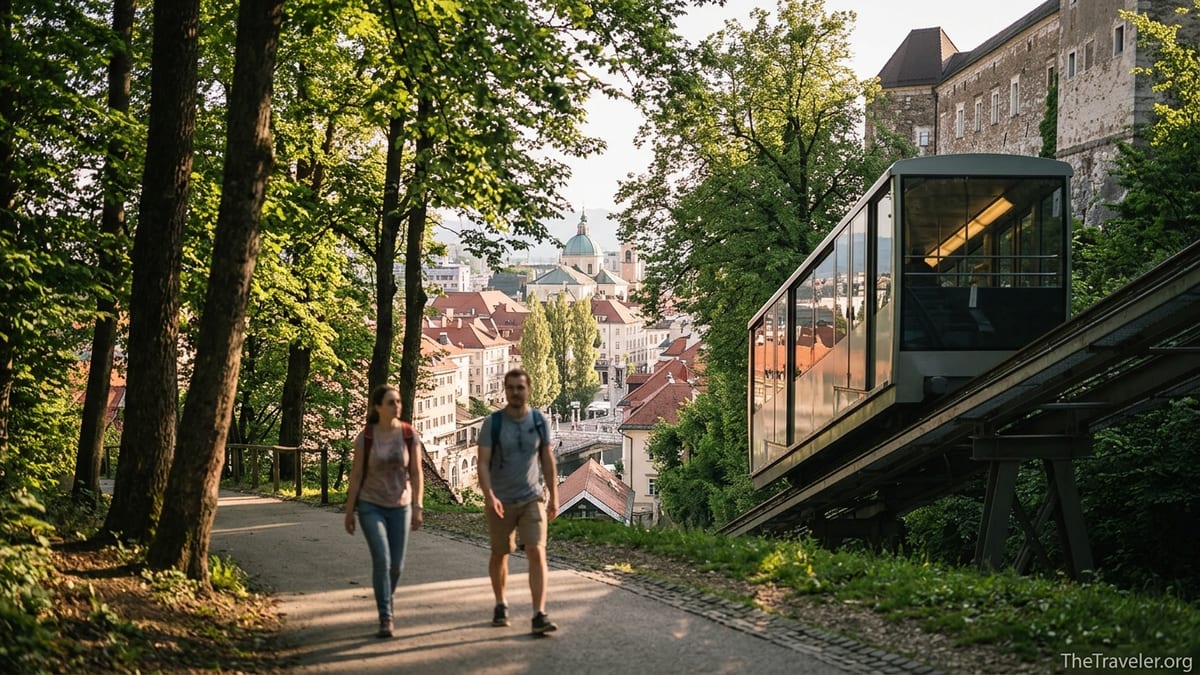
Ljubljana Castle sits on a low hill directly above the Old Town, visible from almost every café terrace along the Ljubljanica River. It is not just another viewpoint. The way you get there frames how you remember the visit. Step into the funicular at Krekov trg, opposite the central market, and you are in a bright, modern cabin that whisks you from city street to castle courtyard in about one minute, with the red roofs of the old town sliding away beneath your feet. Choose the walking path instead and you trade glass and steel for birdsong, tree roots and the satisfying rhythm of a short climb.
Because the castle is so close to the historic center, almost every visitor includes it in their Ljubljana stay, whether they are in town for just one night between trains or using the city as a base for day trips to Lake Bled or Postojna Cave. The decision to ride or walk is rarely about whether you can physically reach the top; it is more about the mood you want. Do you prefer to drift effortlessly into the courtyard and save your energy, or do you want to feel the distance between the riverbanks and the ramparts in your legs and lungs?
The good news is that neither option is difficult in absolute terms. The funicular is frequent and step-free, and the walking paths take roughly 10 to 20 minutes from the Old Town depending on the route and your pace. This makes Ljubljana Castle unusual compared with higher, more remote fortresses in Central Europe. You can easily combine both experiences in a single visit, walking up through the trees in the morning and letting the funicular carry you back down to the market stalls below for lunch.
Understanding Routes, Times and Terrain
From the Old Town, the most commonly used walking paths begin near Študentovska ulica or Ulica na Grad, just a few minutes from the river. Local tourism information and the castle’s own guidance describe the Študentovska route as the most direct option. In practice that means about 10 to 15 minutes of steady uphill walking through a small woodland park. The path is paved or well compacted for most of the way, with short steeper sections and occasional benches, and it remains shaded for much of the day thanks to the trees on Castle Hill.
A slightly more gradual alternative is the path that begins near Reber, on the western side of the hill. This route takes closer to 15 to 20 minutes but spreads the climb over a longer distance, which can be easier on the knees and lungs if you are not used to hills. Both paths are well signposted and feel like short urban hikes rather than mountain trails. You do not need hiking boots; ordinary trainers or city shoes with decent grip are more than enough in dry weather. In light rain the surface can be a little slippery with leaves, so slower, more careful steps are wise.
The funicular, by contrast, removes terrain and effort from the equation entirely. The lower station stands at Krekov trg beside the covered market and close to the triple bridge area, a spot most visitors will pass at least once. Cabins operate every few minutes in season, and recent information shows typical hours running from around 9:00 in the morning until late evening in summer months. The ride itself covers the short yet steep slope in about a minute, climbing from the old town level to just below the castle courtyard. The entire experience from entering the station to stepping out at the top rarely takes more than ten minutes, even when there is a small queue.
Timing can influence which option feels better. If you are heading up for a mid-afternoon castle tour in July heat, that shaded 15-minute climb may still feel sticky and slow, especially with small children. At the same time, an early-morning walk in April when the air is cool and the city still quiet can be one of the loveliest introductions to Ljubljana. Many visitors find a mix works well: walk one way when the temperatures and your energy levels allow, and rely on the funicular when time is tight or legs are tired.
Costs, Tickets and Value in 2026
The walking paths up Castle Hill are completely free and open at all hours, which makes them attractive to budget travelers and anyone who simply enjoys being outdoors. You only pay once you decide to enter paid areas inside the castle complex, such as tower viewpoints or exhibitions. The funicular, on the other hand, is a paid service with its own ticket categories, although it is frequently bundled with castle admission in combined offers.
As of spring 2026, typical pricing patterns in Ljubljana put a standard adult return ticket for the funicular at around the cost of a light café snack in the city center, with one-way tickets slightly cheaper. Children, students and seniors benefit from reduced fares, and children under a certain age often ride free with a paying adult. Full castle tickets, which include museums like the Slovenian History exhibition, the virtual or 3D “Time Machine” show, and access to the viewing tower, are priced higher but often include a funicular return journey when purchased as a package at the lower station or online.
Consider a concrete example. A couple visiting in June might decide to buy a bundled castle plus funicular ticket at the bottom station. For a modest premium over entry alone they gain step-free access up and down, admission to the main exhibitions and the tower, and the convenience of paying once. Another visitor, perhaps a solo backpacker staying in a hostel near Metelkova and watching every euro, might instead walk up for free, buy only a basic courtyard or tower ticket at the top, and skip the funicular entirely. Over a week of travel, choosing the path several times instead of riding can easily free up enough money for an extra dinner of štruklji and a glass of local wine by the river.
Value is not just about euros saved, however. For many, the funicular ride itself is part of the attraction. If you enjoy modern urban infrastructure and skyline views, that one-minute glide along the tracks can feel worth the cost, especially when it is included in a broader castle package. Families using the Ljubljana Card city pass should also check current benefits, as in some seasons the card has included the funicular and castle entry at no additional charge, which tips the calculation firmly in favor of riding.
Accessibility, Comfort and Who Should Take the Funicular
For travelers with mobility issues, the funicular is more than a novelty; it is often the key that makes Ljubljana Castle realistically accessible. The lower station is close to flat pedestrian areas in the Old Town, and cabins are designed to take passengers standing or in wheelchairs. Staff can slow or pause boarding when needed, and the short ride removes the uneven surfaces, gradients and occasional steps found on the forest paths. Once at the top, paved walkways and ramps connect much of the courtyard and main viewpoints, so visitors with limited mobility can enjoy the skyline and atmosphere without a strenuous approach.
Families with young children frequently choose the funicular at least in one direction. Pushing a buggy up a hill path can be tiring, especially after a morning of sightseeing along the riverbanks, and toddlers may lose patience halfway up. The funicular turns the climb into a small event. Children usually enjoy watching the city shrink below as the car climbs; it becomes a highlight rather than a chore. Parents often opt to ride up, let kids explore the courtyard and tower, and then decide whether the children still have enough energy to attempt a walk down.
Summer heat is another major factor. Ljubljana’s central streets can feel warm and still on July and August afternoons. While the castle paths are shaded, they still involve effort, and visitors unaccustomed to walking uphill may underestimate how quickly they tire in humid conditions. Older travelers, anyone recovering from injury, or simply those who do not enjoy steep walks often find that paying for the funicular protects their energy for later in the day. That might mean continuing on to Tivoli Park, cycling along the river, or joining an evening food tour without sore legs.
Comfort can also mean predictability. If you are arriving in Ljubljana for only a few hours, perhaps on a rail journey between Venice and Budapest, the funicular offers a quick, reliable way to fit the castle into a tight schedule. You can step off the train at Ljubljana station, walk through the center, ride up for the city panorama, and still be back at the platform for an afternoon departure. In such cases, the certainty of a timed, mechanical ascent may outweigh the gentle charm of a forest path.
The Walking Experience: Nature, Views and Local Rhythm
Choosing to walk up to Ljubljana Castle changes the emotional tone of the visit. Rather than being abruptly transported from market stalls to ramparts, you trace the transition at human speed. Leaving the cobbled streets behind, you pass small residential lanes and low stone walls before the path swings into the trees. Traffic noise fades, birds become louder, and shafts of light filter through the leaves. It is quite possible to have long stretches of the path almost to yourself, particularly in the early morning or outside July and August, even when the Old Town below is already busy.
About halfway up, glimpses of the city begin to open through gaps in the trees. You may see the green dome of the cathedral, orange terracotta roofs and the distant Alps on exceptionally clear days. Short side tracks or benches invite a pause to catch your breath. Many locals use these paths as part of their daily exercise, jogging up in trainers before work or walking dogs in the evening. Joining them, even briefly, gives a feel for Ljubljana as a lived-in city, not only a postcard backdrop. For slow travelers and those who like to sense the geography of a place, this can be more rewarding than the speed of a mechanical ride.
Walking also offers small serendipities that the funicular skips over. You might stumble upon a tiny viewpoint with just enough room for two people and a takeaway coffee, or notice how the castle walls reveal layers of building styles as you approach from below. In autumn, the hill glows with yellow and red leaves; in winter, a dusting of snow can make the path look almost storybook-like, as long as you have appropriate footwear and take care on icy sections. None of this is dramatic alpine scenery, but it is gentle, accessible nature wrapped around a historic monument in the middle of a European capital.
Descending on foot has its own pleasures. Instead of dropping straight back into the market square, you wander down among rooftops, perhaps detouring into lesser-known side streets or pausing at viewpoints where the castle towers above you. Many visitors who rode up choose to walk down for this reason. It is easier on the lungs than the ascent, takes roughly 10 minutes via the steeper route, and requires no ticket. If time allows, this combination of ride up, walk down can feel like the most complete way to experience the hill.
The Funicular Ride: Urban Design and Cityscape in Motion
The funicular is not just a piece of transport; it is part of Ljubljana’s contemporary story. Opened in the mid-2000s after decades of occasional proposals, it represents the city’s effort to connect a medieval landmark with a modern, largely car-free center in a sustainable way. The glass-sided cabins and clean, compact stations fit with Ljubljana’s broader emphasis on pedestrian zones, cycling routes and light-touch infrastructure. To many visitors, stepping aboard feels a little like entering a moving balcony suspended between the old town and the castle.
During the short ascent, your point of view changes rapidly. First you look back into the small lower station, then the roofs of the market arcades fall away and the curve of the Ljubljanica River becomes visible. As the car climbs, you may catch sight of the Triple Bridge, the green-topped Franciscan church on Prešeren Square, and the grid of 20th-century streets that extend beyond the historic core. On a clear evening, catching the last ride up or down as the city lights come on can be particularly memorable. The reflections on the glass, the shift from warm street lighting to cooler sky tones, and the glow from café terraces below create a layered, photogenic scene.
Practical details enhance the experience. The ride is brief enough that even those uneasy with heights usually tolerate it without stress, yet the angle is steep enough to impart a distinct sense of climbing. The cabins fit a modest number of passengers, so the atmosphere tends to be calm rather than crowded. You are unlikely to be jostled as on metro trains in larger European capitals. Simple information displays and announcements keep first-time visitors oriented, and staff are used to answering quick questions about tickets, opening hours or which exhibitions are included in particular passes.
For photographers, the funicular offers different compositional opportunities than the walk. Through the glass, you can capture a compressed, almost diagrammatic view of Ljubljana’s layers: river, bridges, market, rooftops and castle walls above. Early afternoon light may produce reflections that require careful angles, but morning and pre-sunset rides often generate more flattering soft light. While you cannot open windows or lean out, planning a second ride in the opposite direction, perhaps using a return ticket, can be worthwhile if you are seeking that one perfect cityscape shot.
Which Option Suits Your Travel Style?
Because walking and riding cost so little time relative to the rest of a day’s sightseeing, the choice between them often comes down to personality and priorities. Active travelers who already plan to hike at Lake Bohinj or explore the Path of Remembrance around Ljubljana may see the castle paths as an easy warm-up. For them, paying for a one-minute ride might feel unnecessary unless mobility or weather become limiting factors. By contrast, visitors who prioritize museums, cafés and architecture over physical exertion are often happy to invest in the funicular and save their energy for city streets and nearby excursions.
Your schedule matters. On a relaxed three-day stay in Ljubljana, there is little downside to walking at least one way. You have time to linger on the path, sit on a bench beneath the trees and watch joggers and dog walkers pass. On a rushed day-trip where you are also squeezing in a boat tour or a guided food walk, the funicular can act like a time-saving elevator. One common compromise is to walk up in the cool of the morning, perhaps grabbing a coffee at the central market first, then using the funicular to descend in the heat of the day or after sunset.
Travel companions are another key factor. If you are visiting with grandparents, a pushchair or someone recovering from knee surgery, defaulting to the funicular makes sense even if you yourself are fit. You can always return alone another morning for a contemplative climb, but it is harder to undo the fatigue caused by an over-ambitious group walk. Conversely, if you are traveling with a group of friends who enjoy casual exercise, turning the walk up into part of the outing, with a promise of ice cream or craft beer by the river afterwards, can make the castle feel more like a shared mini-adventure than a stand-alone attraction.
Finally, consider how you personally respond to heights, enclosed spaces and exertion. Those who dislike steep slopes underfoot may feel more secure in a stable cabin attached to tracks, while anyone who feels claustrophobic in enclosed glass spaces might prefer fresh air and freedom on the path. Listening to those instincts is reasonable. Ljubljana Castle offers both options in a compact, forgiving setting, so there is no single correct choice, only the one that will let you enjoy the hill and its views with the least stress.
Planning Your Visit: Timing, Weather and Crowds
To make the most of either route, it helps to think about timing. The castle is open every day of the year, with longer hours in spring and summer. The funicular schedule typically mirrors or slightly exceeds castle opening times, especially in peak season, with early morning starts and late evening finishes that allow visitors to catch sunrise or sunset views. Walking paths are technically accessible at all hours, but late-night walks may feel isolated, and in winter you should be mindful of ice or snow on shaded sections.
In high summer, mid-afternoon can be the least pleasant time to walk uphill, even in the shade. If your plans are flexible, aim to go up before 10:00 in the morning or after 17:00, when temperatures ease. On hot days, carry a small water bottle; there are cafés at the top but none along the wooded paths. In shoulder seasons like April, May, September and October, temperatures are milder, and walking is comfortable through most of the day. Light rain does not close the paths or the funicular, but you may want a rain jacket and footwear with good grip.
Crowding tends to be modest compared with larger European capitals, but patterns still matter. On sunny weekends in July and August, you may find short queues at the funicular lower station around late morning as tour groups arrive. These usually clear quickly given the short ride and frequent departures, but if you are impatient, walking can be faster in those moments. On the other hand, early evening just before sunset often sees a small surge of visitors hoping to watch the city lights come on from the castle. If that view is a priority, arrive slightly earlier than you think you need to, regardless of how you travel up.
Advance ticket decisions also play a role. Buying a combined castle plus funicular ticket online or at the tourist information center can save time, especially on busy days when the on-site ticket line stretches beyond the station doors. However, if you are still undecided about walking or riding, or you want to keep the option of a free ascent open, waiting to buy a ticket at the base or top once you see how you feel is perfectly reasonable. Ticket machines at the funicular station and counters inside the castle make it easy to decide spontaneously.
The Takeaway
Whether you step into a glass cabin at Krekov trg or follow a quiet forest path from the Old Town, reaching Ljubljana Castle is straightforward. What changes is the story you tell yourself about the visit. The funicular offers convenience, accessibility and a brief but satisfying moving panorama of the city. The walk offers a slower transition from riverbank to ramparts, a slice of urban nature and the gentle satisfaction of earning your viewpoint.
In practical terms, the choice rarely determines whether you see the highlight of Ljubljana; almost everyone makes it to the top. Instead, it shapes how rushed or relaxed you feel, how much energy you have left for the rest of the day, and how many small details you notice along the way. If time, budget and weather allow, the richest experience is to do both: walk one way, ride the other, and let the contrast itself become part of your memory of the city.
If you must choose only one, let your body, your schedule and your companions guide you. For tight connections, hot afternoons, small children or limited mobility, the funicular is the clear ally. For unhurried mornings, cooler seasons and travelers who enjoy feeling the contours of a place underfoot, the path up Castle Hill is worth every step.
FAQ
Q1. How long does it take to walk up to Ljubljana Castle from the Old Town?
The most direct paths from the Old Town typically take about 10 to 15 minutes uphill at a normal pace, or up to 20 minutes if you prefer a gentler route and regular pauses.
Q2. Is the Ljubljana Castle funicular worth paying for?
For many visitors the funicular is worth the cost because it saves energy, is step-free, and offers a short but memorable city view, especially if included in a combined castle ticket.
Q3. Can I walk up and take the funicular down, or vice versa?
Yes, you can walk in one direction and buy a one-way funicular ticket for the other, which is popular with travelers who want both the woodland path and the easy ride.
Q4. Is the walk to Ljubljana Castle suitable for children and older travelers?
The paths are short and well maintained, but they are uphill. Active children and fit older travelers usually manage fine, while those with limited mobility may prefer the funicular.
Q5. What should I wear if I plan to walk up to the castle?
Comfortable closed shoes with decent grip are enough in dry weather. In cooler or wet conditions, add a light jacket and be cautious on potentially slippery leaves or patches.
Q6. Are there any tickets or passes that include the funicular ride?
Combined castle tickets sold at the lower station or online commonly include a return funicular trip, and some city passes in certain seasons have also covered both in one price.
Q7. Does the funicular run in the evening for sunset views?
In main season the funicular usually runs into the evening, allowing visitors to ride up or down around sunset and enjoy views of Ljubljana’s lights from the castle.
Q8. Is the funicular accessible for wheelchairs and strollers?
Yes, the funicular is designed to take wheelchairs and strollers, with step-free access at both stations, making it the easiest option for visitors who need level entry.
Q9. Can I reach the castle by car instead of walking or taking the funicular?
There is limited parking near the castle, and the historic center is largely pedestrian, so most visitors find it simpler to approach on foot or by funicular from the Old Town.
Q10. If I am on a tight budget, should I skip the funicular?
Budget travelers often walk both ways to save money and still enjoy the castle. You can then decide whether to spend on tower access, exhibitions or a drink in the courtyard instead.