


On paper, Amsterdam Schiphol looks like a dream. One terminal, clear signage, a train station right underneath and a solid reputation as a European hub. In reality, your experience can swing from stress free to frantic sprint depending on when you land, which pier you use and how prepared you are for the quirks of this airport. Here is what nobody really tells you before you find yourself speed walking past a row of Dutch cheese shops with your boarding group already on the screen.
Get the latest updates straight to your inbox!
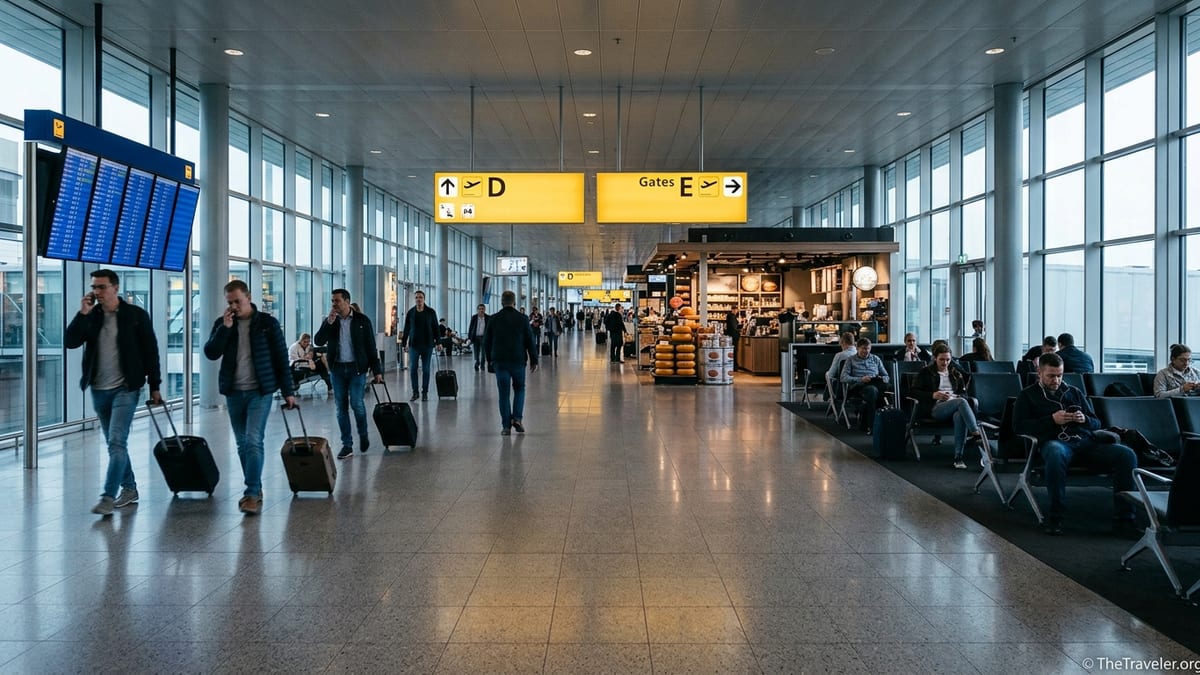
The “One Terminal” Myth and Those Surprisingly Long Walks
Schiphol is technically a single terminal, but that does not mean everything is close together. The terminal fans out into multiple piers: B and C for most Schengen flights, D as a huge mixed Schengen and non Schengen pier on two levels, E mainly for long haul, and F, G, H and M serving many intercontinental and low cost services. The whole complex is connected airside, so you almost never need a shuttle bus, yet some gate to gate transfers involve well over a kilometer of walking.
Travelers are often surprised by how long it takes to get from one end of the airport to another. Walking from an early D gate to the far end of pier B or G can easily take 15 minutes at a brisk pace, more if the concourses are crowded or you are with kids. One recent mapping guide calculated around 1,400 meters between certain D and B gates, which feels very different once you add a backpack, duty free bags and a winter coat. People with tight 45 to 60 minute connections discover this the hard way when their inbound flight parks at the far end of the wrong pier.
It is also easy to misread the layout because signage constantly points you toward a central “Lounge 1, 2 or 3.” From the middle of Lounge 2 near the large flight information boards, you might feel everything is just around the corner. In fact, the walk from that central spine out to the tips of E, F or G is an additional 8 to 12 minutes. If you are changing from a UK flight at C gates to a US flight at an F gate, factor in not only passport control but these walking times as well.
The trick is to treat Schiphol as if it were multiple terminals disguised as one. When you land, ignore the instinct to browse shops. First follow signs to your new pier and walk until you at least see your departure gate area. Only when you know how far it is, double back to grab a coffee or snack. This one habit prevents you from joining the visible minority regularly paged as “last passengers” despite technically arriving “on time.”
Security Queues, Timeslots and Priority: How It Really Works
Security at Schiphol is handled in large central checkpoints just beyond the departure halls, not at individual gates. On a normal day, many travelers report being through in 10 to 20 minutes, but during school holidays or early morning peaks lines can still back up far beyond the roped areas. Local news in the Netherlands periodically shows images of queues stretching past check in rows during busy Mondays or Fridays, even in 2025 and 2026 after the worst of the earlier staffing crisis.
One underused tool is Schiphol’s free security timeslot system. Via the airport app or website, you can book a 15 minute window that gives you access to a dedicated lane feeding into the main checkpoint. Regulars flying to London or Barcelona often report that with a timeslot they were through security in about five minutes, even on days when social media was full of complaints about queues. The catch is that slots typically start only around 2 hours before departure for Schengen flights and around 3 hours before for non Schengen. If you like arriving five hours early, your slot may fall later than your arrival time, so you still wait landside first.
Paid priority options exist too, but they are not always obvious. Schiphol’s own Privium membership provides fast track security and automated border control for frequent travelers, while most airlines offer priority security with business class tickets or elite status. In real terms, that can mean the difference between 45 minutes in a slow moving morning line and 5 minutes in a near empty lane. On peak holiday Saturdays, that difference has literally decided whether families made their 07:00 departures to Mediterranean resorts.
If you are connecting airside on a single ticket, you usually do not re clear security at all, which surprises passengers accustomed to US style re screening. Your main delays come instead from passport control and walking times. The people who get burned are those on self created connections across separate tickets who must exit landside, check in again and join the main security line like any departing passenger. For them, two and a half to three hours is a realistic minimum, especially during morning and evening peaks.
Passport Control, EES and Why Some Queues Crawl
One of the biggest recent changes affecting Schiphol transfers is the phased roll out of the EU’s Entry Exit System, often abbreviated as EES. Non EU passengers entering the Schengen Area through Amsterdam are gradually being enrolled in a biometric system that captures fingerprints and facial images alongside passport data. Airlines like KLM already warn that if Amsterdam is your first Schengen entry point, you may be directed to special EES kiosks and staffed desks for this extra step.
In practice, this means that passport queues can be highly unpredictable. European Union and many other European nationals can use automated e gates and typically clear within 5 to 15 minutes except at the busiest times. Non EU travelers, especially those arriving from long haul flights in the morning bank from North America or Asia, may experience 20 to 40 minutes or more, and first timers subject to full biometric capture sometimes report closer to an hour when several wide body flights arrive together.
For transfers, the critical detail is whether you are moving from a non Schengen arrival to a Schengen departure or vice versa. A traveler landing from New York to an E gate and connecting to Barcelona at a C gate must pass through full immigration, then walk across the Schengen concourses. Someone traveling from London to Tokyo via Amsterdam will usually stay in the non Schengen zone the entire time, skipping both passport control and security but facing a potentially long walk along D and E or F piers.
First time visitors often choose the wrong passport line, losing precious minutes. Signs distinguish EU plus certain other nationalities from “All Passports,” and within the non EU area staff may direct EES registrations to separate kiosks. If you have a tight connection, do not simply join the nearest queue. Look up at the overhead screens, ask staff about which line handles connecting passengers and have your boarding pass ready. This alone can shave 10 minutes off the process, which can be the difference between grabbing a coffee on Holland Boulevard and jogging straight to final call.
Sleep, Long Layovers and the Nighttime Reality
Schiphol operates 24 hours a day, but the atmosphere between roughly midnight and 4 a.m. is very different from the daytime terminal you see in airline videos. Shops and most restaurants close, cleaning crews take over large seating areas, and certain sections are roped off. Sleeping in Airports and frequent flyer forums describe it as safe but increasingly controlled, with fewer obviously comfortable spots than a decade ago.
Travelers on overnight layovers still manage to sleep airside, but you need to temper expectations. Soft benches without armrests are limited and fill quickly, concrete style seating around pillars is common, and lighting remains fairly bright throughout the night. Power outlets are scattered but rarely abundant enough for everyone at 2 a.m. A typical scenario: someone on a 00:15 arrival from the United States with an 08:00 departure to Southern Europe finds a reclining chair near the E pier early, only for late night flights from the Middle East to deposit more people hunting for the same scarce resting spots.
If you are tempted to leave the airport at night, the train station directly under Schiphol Plaza runs frequent services into Amsterdam Centraal until late evening, with night trains and night buses covering the small hours. An overnight layover of 8 to 10 hours can realistically include a quick tram ride through the canal belt and a late drink on Leidseplein before returning around 4 a.m. Just keep in mind that passport control and security must still be cleared on your way back, and some morning wave departures begin boarding shortly after 06:00.
For comfort seekers, landside and nearby hotels are the smartest option. There are in terminal airside hotels in the non Schengen zone that offer rooms by the hour for people in transit, along with a YOTELAIR like concept in the terminal and a citizenM and several chain hotels connected to the terminal by covered walkways. Prices fluctuate widely, but a basic in terminal cabin for six hours is often cheaper than losing a night’s sleep on a plastic bench and arriving at your long haul flight exhausted.
Money, Food and Practical Surprises Between Gates
Food and drink at Schiphol can feel more expensive than in central Amsterdam, particularly once you are past security. A simple coffee can run the equivalent of several euros at international chains, while a sit down meal before a long haul flight regularly costs more than what you would pay for similar dishes in the city. That said, there are a few relative bargains: Dutch style sandwich counters, supermarket style outlets and grab and go salad bars in Lounge 1 and Lounge 3 often charge closer to city prices, and water fountains are scattered around the concourses if you bring an empty bottle.
One thing many first time visitors do not expect is the layout of shops relative to gates. Major retail zones cluster around the central lounges, especially between D and E and along the so called Holland Boulevard. If your gate is at the far end of pier G or H, allowing “one last browse” in the main shopping area can easily add a quarter hour to your walk. Several people only realize this when the departure screens flip from “boarding soon” to “last call” just as they finish paying for stroopwafels and duty free gin.
Cash wise, the entire airport is heavily card oriented. Most outlets accept contactless payments from major credit cards and mobile wallets, and some small kiosks do not even take cash. Currency exchange desks remain, typically clustered in the arrivals hall and near the central lounges, but margins can be steep compared to withdrawing euros from an ATM. If you need coins for luggage trolleys or certain public toilets in the Netherlands, consider getting a small amount of cash while in the arrivals area, but do not rely on cash as your primary payment method inside the terminal.
Finally, keep an eye on closing times. Airside duty free and fashion stores often shut earlier than passengers expect, especially in quieter piers. If you land from an evening arrival and think you will browse after grabbing a snack, you may find half the shops already shuttered. Make your essential purchases first, then sit down to eat instead of the other way round.
Transfers, Self Connections and Why Minutes Matter
Schiphol’s reputation as an easy transfer hub is mostly deserved for passengers on through tickets. Airlines like KLM design their schedules so that banks of European flights feed long haul services, and information screens across the terminal show real time “minimum transfer time” indicators for many connections. As long as both flights are on one booking, missed connections caused by delays are usually re protected automatically, and the airline manages baggage retagging in the background.
Where travelers get caught out is with self connections on separate tickets. Lured by low fares from low cost carriers at H or M gates combined with long haul deals on non Schengen piers, they piece together itineraries that technically “connect” but are not recognized by any airline as a single journey. These passengers must clear immigration, collect bags from the carousel, walk up to departures, check in again and join regular security. Even when everything runs smoothly, this process typically takes well over an hour; any hiccup at baggage delivery or security can easily add another 30 minutes.
Real world accounts illustrate the risk. Travelers with two and a half hour self connections from intercontinental arrivals have reported success when flights were on time and queues were light. Others on similar schedules missed their onward low cost flights because their inbound landed 40 minutes late and passport control was overwhelmed by the morning long haul wave. Unlike airline protected connections, there was no free rebooking, only a need to buy a new ticket, sometimes at day of travel prices that wiped out any savings.
If you must attempt a self connection at Schiphol, build in at least three hours for non Schengen to Schengen transfers and consider four hours in peak holiday seasons. Travel with carry on only if possible, so you can skip baggage reclaim. Most important, book flights that operate multiple times a day on the same route, giving you fallback options if you misconnect. The airport’s seemingly simple layout tempts travelers into overconfidence; the reality of walking distances and queues punishes tight gambles.
The Little Things: Power, Smoking Areas and Hidden Calm
Beyond the big topics of security and transfers, small Schiphol quirks can shape your experience. Power outlets, for instance, are not as plentiful at some older gate areas as at many newly built terminals elsewhere. Newer seating clusters near D and E piers often have integrated USB and power points, but older rows of chairs at the far ends of B and G leave travelers hunting along walls and pillars. If you rely heavily on devices, recharge as soon as you sit down at a cafe or near a central lounge seating area rather than assuming your remote gate will have sockets.
Smoking rules also surprise some passengers. The Netherlands has steadily tightened smoking regulations, and airside smoking rooms that once dotted the concourses have largely disappeared or been repurposed. Today, most smoking takes place landside outside the terminal, meaning that if you are in transit airside you may not find a dedicated smoking room anywhere near your gate. If having a cigarette is essential between long flights, check current airport information and be prepared for the possibility that you will need to remain smoke free until your next destination.
On the positive side, Schiphol offers a few pockets of calm that many travelers walk straight past. Holland Boulevard between E and F gates hides a small library area with books and comfortable seating, a mini outpost of a major Amsterdam museum and family friendly play spaces. Quiet seating zones often cluster just beyond the busiest duty free areas, where the noise drops off sharply. Even at peak times, you can usually find a bench by walking a bit further along your pier instead of stopping at the first visible seats near the junction.
Another underused resource is the real time information on walking and waiting times that Schiphol has integrated into its digital screens and app. Data from previous passenger flows is used to estimate how long it will take to reach passport control, security or specific gates. While not perfect, these estimates give a far better sense of whether you can sit for another ten minutes or need to start walking now than your own guesswork based on the map.
The Takeaway
Amsterdam Schiphol remains one of Europe’s most important and generally efficient hubs, but the simplicity of its “one terminal” concept can mislead travelers into underestimating walking distances, security queues and transfer risks. The airport works best when you treat it with the respect due to a giant, busy machine rather than a small regional terminal. Booking a free security timeslot when departing, allowing realistic buffer times for transfers, and prioritizing passport control and walking to your pier before shopping all transform the experience.
Think in terms of stages. First, get your bearings: know your pier, your gate and your need to clear immigration. Second, clear all mandatory checkpoints before relaxing: passport, security, walking to your gate area. Third, use what Schiphol offers to make the wait more pleasant, from quiet corners on Holland Boulevard to the train station below if you have time for a quick trip into the city. With that mindset, the airport’s quirks become manageable details rather than stressful surprises, and your memories of Amsterdam’s hub are more likely to feature good coffee and smooth connections than sprinting down endless corridors.
FAQ
Q1. Is a 1 hour connection at Amsterdam Schiphol enough?
For a same ticket Schengen to Schengen connection, 1 hour can be enough if flights are on time and you do not need passport control. For non Schengen transfers or separate tickets, 1 hour is usually too tight because of walking distances and possible passport queues.
Q2. Do I have to go through security again when connecting at Schiphol?
If both flights are on a single ticket and you stay airside, you usually do not re clear security. You may still go through passport control when switching between Schengen and non Schengen flights, and you will re clear security if you exit landside during a self connection.
Q3. How early should I arrive at Schiphol before departure?
For European Schengen flights, arriving about 2 hours before departure is usually adequate, while 3 hours is sensible for long haul or non Schengen flights. During school holidays or peak early morning waves, consider adding another 30 to 60 minutes.
Q4. Is the free security timeslot at Schiphol worth using?
Yes. Booking a free timeslot through the Schiphol app or website typically lets you join a much shorter line feeding into the main checkpoint. Many travelers report clearing security in around 5 to 10 minutes this way, even on busy days.
Q5. Can I sleep in Amsterdam Schiphol during an overnight layover?
Yes, the airport remains open overnight and many people sleep on benches or reclining chairs. However, seating is limited, lighting is bright and some areas close for cleaning, so it is functional rather than comfortable. Nearby terminal hotels offer far better rest if your budget allows.
Q6. How easy is it to get into Amsterdam city from Schiphol during a layover?
The railway station under Schiphol Plaza has frequent trains to Amsterdam Centraal, often taking around 15 to 20 minutes. With a layover of 6 hours or more, it is realistic to clear passport control, visit the city briefly and return in time for security and boarding.
Q7. Are there good food options for special diets at Schiphol?
Yes. In the main lounges you will find chains and independent outlets that clearly label vegetarian, vegan and gluten free options, along with salad bars and supermarket style shops. Choice narrows at remote gates late at night, so buy what you need in the central areas first.
Q8. Is Amsterdam Schiphol a cashless airport?
Not entirely, but it is strongly card oriented. Most shops and restaurants prefer contactless card or mobile payments, and some do not accept cash at all. Keep a small amount of cash for situations outside the airport, but rely on cards inside the terminal.
Q9. What happens if I miss my connection at Schiphol?
If your flights are on one ticket and you miss a connection because of delays or airport queues, the operating airline usually rebooks you on the next available flight. If you created a self connection on separate tickets, you are responsible for buying a new onward ticket yourself.
Q10. Are there quiet places to work or relax at Schiphol?
Yes. Beyond the main shopping areas you will find calmer seating zones along the piers, a small library and lounge style spaces on Holland Boulevard, and various airline and pay per use lounges with desks, Wi Fi and showers for a fee.