


For many trips to Europe, the first real impression of your holiday is not a museum or a canal-side café. It is the airport where you land or connect. Two of the continent’s biggest gateways, Amsterdam Schiphol (AMS) and Paris Charles de Gaulle (CDG), handle tens of millions of passengers every year and often appear as interchangeable options on booking sites. In practice, they offer very different experiences. This guide compares both airports using current conditions, real transfer times and common itineraries, so you can decide which hub works better for your specific trip.
Get the latest updates straight to your inbox!
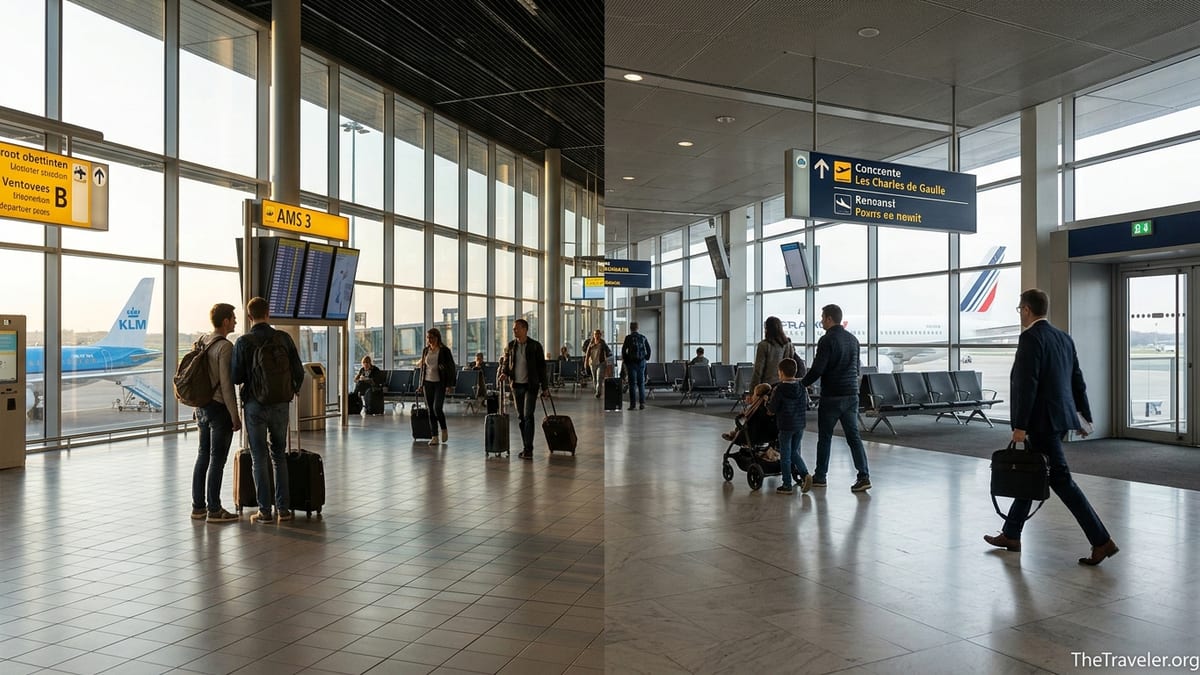
Overview: Two Giants of European Air Travel
Amsterdam Schiphol and Paris Charles de Gaulle are among Europe’s busiest hubs, each handling well over 60 million passengers a year in recent seasons. Schiphol serves as KLM’s primary hub and a key SkyTeam node, with direct connections to around 300 destinations worldwide. CDG is Air France’s main base and the largest airport in France, with three major terminals and a particularly wide long-haul network across Africa, the Middle East and the Americas.
For many travelers, the choice between them appears at the booking stage as two similar options: for instance, a New York to Rome ticket might route you either JFK–AMS–FCO on KLM or JFK–CDG–FCO on Air France for roughly comparable prices. Yet what happens between those flights can feel very different. Schiphol is essentially a single, sprawling terminal complex where most connections happen airside with relatively short walks. CDG, by contrast, is a campus of separate terminal buildings linked by trains, buses and corridors, which can make flight changes considerably more complicated.
Both hubs have had their reputational ups and downs. Schiphol drew headlines in 2022 for extreme queues and staffing shortages but has since invested heavily in security staffing and process improvements, with the airport reporting that a large majority of passengers now clear security in around ten minutes or less on typical days. CDG has long had a mixed reputation for confusing wayfinding and occasionally long passport control lines, particularly for non-EU travelers during peak summer, but remains extremely well connected and is constantly upgrading terminals and rail links.
Deciding which is better depends less on abstract rankings and more on the details of your trip: Are you starting or ending your journey in the city? Are you changing planes on a tight schedule? Are you flying within Schengen or to a long-haul destination? The following sections walk through these questions one by one.
Location and Ground Transport to the City
Schiphol has one of Europe’s most straightforward city connections. The airport’s train station sits directly beneath the terminal complex, reached by escalators and elevators in the central arrivals hall. From there, frequent Dutch Railways trains run to Amsterdam Centraal, usually in about 15 to 20 minutes. Tickets are typically in the low single digits in euros for standard second class, and there are also direct trains to cities such as Rotterdam, Utrecht and The Hague. For a visitor staying near Dam Square or in the Jordaan, the journey from customs to a hotel check-in desk can realistically be under an hour if baggage arrives promptly.
Paris Charles de Gaulle is farther from central Paris, roughly 23 kilometers to the northeast. The main public transport link is the RER B suburban rail line, which serves two airport stations: Aéroport Charles de Gaulle 1 for Terminal 1 and Terminal 3 (via the free CDGVAL shuttle) and Aéroport Charles de Gaulle 2 TGV beneath parts of Terminal 2. In normal conditions, the ride to central Paris stations like Gare du Nord or Châtelet–Les Halles takes around 35 to 40 minutes. Single tickets usually cost just over 10 euros per person, with occasional short-term variations for events and passes.
In practice, RER B can feel more complex than Dutch trains from Schiphol. Trains may be crowded at peak commuter times, and planned maintenance or strikes sometimes disrupt service, requiring replacement buses or rerouting. Alternative options such as dedicated airport buses and city taxis exist, but journey times into the city often stretch to 45 minutes to over an hour depending on traffic. A taxi or app-based ride from CDG to central Paris is typically considerably more expensive than a train ride from Schiphol to Amsterdam, especially during busy periods or at night.
For travelers heading straight out of the airport by longer-distance rail, both hubs offer strong options. Schiphol has intercity trains to other Dutch cities and regular services towards Belgium and Germany. CDG’s Terminal 2 sits above a major TGV station with high-speed trains to cities such as Lyon, Strasbourg, Lille or Brussels, and even occasional direct services to destinations like Bordeaux or Marseille. If you land at CDG and need to catch a TGV, it can still take 15 to 20 minutes to get from some parts of Terminal 1 or 3 to the station via CDGVAL, so connection times need to factor that in.
Layout, Wayfinding and Connection Experience
One of Schiphol’s biggest advantages is its largely single-terminal design. While the airport is divided into multiple piers (B, C, D, E and so on), most passengers connecting between flights can walk from gate to gate without changing buildings or passing through security again, especially for Schengen-to-Schengen or non-Schengen-to-non-Schengen transfers within the same zone. A traveler flying from Edinburgh to Athens with KLM, for example, may have a 60 to 90 minute layover at Schiphol and spend nearly all of it indoors, walking along clear concourses with frequent signage and information screens.
CDG is more fragmented. It has three main terminals, and Terminal 2 alone is broken into sub-terminals from 2A to 2G plus satellite halls such as 2E’s L, K and M gates. Changing between some of these areas can involve taking the CDGVAL automated train, waiting for internal buses, or navigating long corridors and escalators. A typical example is a traveler arriving from Boston into Terminal 2E and connecting to a short-hop Air France flight to Nice leaving from 2F: while both are in Terminal 2, the passenger often has to walk, clear passport control when entering Schengen and potentially pass security again. In peak hours, a 75-minute connection can feel rushed.
For straightforward connections, CDG can work very smoothly. Within the same Air France concourse or when remaining entirely in Schengen or entirely outside Schengen, the transfer might involve a short walk and a quick security check. However, self-transfers on separate tickets can be risky if terminals are far apart. Some independent guides describe CDG as one of Europe’s more challenging hubs for tight self-made connections, in part because some terminal-to-terminal transfers can genuinely feel like crossing a small town, especially when factoring in immigration queues.
Schiphol is not perfect. Long walking distances are common, and bus gates are still used for some regional flights, which can add time. But the linear, open-plan design means that even first-time visitors usually understand where to go quite quickly. Information desks and staff are generally easy to spot, and the combination of English and pictogram signage is clear. In practical terms, if you have a 50-minute protected connection at Schiphol on one ticket, it is usually more realistic than an equivalent 50-minute connection at CDG involving a terminal change.
Security, Passport Control and Reliability
Both airports have dealt with capacity issues, yet their recent trajectories differ. Schiphol’s problems in 2022 were widely reported: security staffing shortages led to queues stretching outside the terminal, and airlines were instructed to cap passenger numbers. Since then the airport has focused heavily on recruitment and process redesign. Recent airport communications indicate that on typical peak days roughly nine in ten passengers now pass through security in around ten minutes or less, and press statements for 2024 highlight that no major operational disruptions occurred through that year.
For a traveler, this translates into a more predictable experience. On a Tuesday morning, for example, someone flying from Amsterdam to Lisbon with only cabin baggage might arrive two hours before departure, check a boarding pass on their phone and often clear security in one short queue. During summer Saturdays or peak holiday weeks, lines can of course be longer, but the extreme multi-hour waits that once dominated social media posts from Schiphol are now the exception rather than the rule.
CDG’s reliability challenges tend to be different. Instead of one dramatic crisis period, passengers more often report variability depending on terminal, time of day and recent events like strikes in the wider French transport system. Non-EU passport control at busy times, especially early morning arrival waves from North America or late afternoon departures to Africa and Asia, can see waiting times stretch to 45 minutes or more. Domestic and Schengen flights usually move faster, but transferring from a non-Schengen long-haul flight to a short European hop may require a full passport control queue plus security screening.
As with any large European hub, conditions can change quickly with staffing levels or local disruptions, and individual experiences vary. One month, a traveler on an Air France connection through CDG may walk off a flight from Montreal and be at their next gate to Madrid within 30 minutes. Another traveler, arriving on a similar schedule during a busier summer weekend, might queue significantly longer at border control. The key practical takeaway is that CDG rewards generous connection buffers, especially for non-Schengen arrivals or when self-connecting between different airlines.
Airline Networks, Alliances and Where You Are Going
For many travelers, the airport “winner” is simply the one that offers better flight options for their route. Schiphol is dominated by KLM and its SkyTeam partners. From North America, this means excellent connectivity from Delta hubs such as Atlanta, New York JFK and Detroit into Amsterdam, with onward connections across Europe and to parts of Africa and Asia. If you are flying from Seattle to Krakow, for instance, a routing via Schiphol on Delta and KLM often involves one smooth connection in a single terminal and a short intra-Europe leg.
CDG, on the other hand, is the heart of the Air France network and one of the world’s key long-haul gateways. It is particularly strong for flights to French overseas territories, West and Central Africa, and many cities in the Middle East and Asia. Travelers from Los Angeles heading to Dakar, or from Toronto to Beirut, will often find more non-stop or one-stop options via CDG than via Amsterdam. CDG also hosts a wide range of other carriers, so connections between, for example, a Japanese airline arriving from Tokyo and a European low-cost carrier heading to a secondary city may often be more viable from Paris.
Within Europe, both airports provide dense networks. Schiphol connects efficiently to many mid-sized cities in Germany, the UK and Scandinavia which may not have strong direct service to Paris. CDG, meanwhile, offers deep coverage of French domestic destinations, including regional airports such as Biarritz or Brest, plus frequent flights to major European capitals. If your trip combines Paris with, say, Marseille and Nice, CDG can be very convenient as a starting or ending point.
Alliances also matter for frequent flyers. If you hold elite status with Delta or another SkyTeam member, Schiphol often offers smoother priority treatment at security, check-in and lounges alongside KLM and partner airlines. Air France and SkyTeam benefits at CDG are similarly strong, but the physical layout can dilute the feeling of seamlessness if your flights depart from more distant terminals or if you are mixing alliance and non-alliance carriers on one trip.
On-the-Ground Experience: Comfort, Food and Amenities
Schiphol and CDG both aim to be more than just transit points, offering shopping, dining and rest spaces. Yet the overall feel is different. Schiphol’s main airside area has an open, mall-like character, with long views down concourses, plenty of natural light in many sections and an array of casual dining options. You will find recognizable European chains like sandwich bars, coffee shops and fast-casual Asian and Mediterranean outlets, alongside Dutch touches such as cheese shops and stroopwafel stands. Seating areas are scattered along the concourses rather than concentrated in a few waiting zones.
One of Schiphol’s signature elements is its small “airport park” and quiet relaxation zones, which offer greenery-inspired decor, loungers and sometimes soft ambient sounds. There is also a branch of the Rijksmuseum that has, at various points, displayed a rotating selection of Dutch art for passengers, along with a library-like reading area. These touches will not transform a six-hour layover into a vacation, but they can make a two- to three-hour wait feel more pleasant and less claustrophobic.
CDG’s passenger experience varies substantially by terminal. Newly renovated areas of Terminal 2E, for example, feature high ceilings, modern seating, large windows and an upmarket selection of French and international brands. Travelers connecting on Air France long-haul flights through these gates may enjoy stylish lounges, well-regarded restaurants with French wine lists and a generally premium ambiance. In contrast, some older parts of Terminal 1 and 2A/2C can feel more cramped and dated, with narrower corridors, fewer food outlets and limited seating during peak waves.
In concrete terms, imagine a four-hour layover on a winter evening. At Schiphol, you could walk from your arrival gate, grab a coffee from a familiar chain, browse a bookstore, spend an hour in a quiet seating area with power outlets, then have a simple hot meal before boarding. At CDG, your experience will depend much more on where you are. In the best-case scenario, perhaps in Terminal 2E’s international zones, you might visit a pâtisserie, shop for French skincare brands and relax in a well-designed seating area. In a more basic concourse, you might find only a couple of snack bars and a small duty-free shop, making the layover feel longer.
Costs, Practicalities and Typical Traveler Profiles
Daily costs at and around both airports are relatively high by global standards but broadly comparable within Western Europe. A takeaway coffee in either Schiphol or CDG’s main terminals will likely run in the range of a few euros, while a simple sit-down meal such as a pasta dish or burger can easily cost around 15 to 20 euros per person. Bottled water and snacks are often slightly pricier airside than in the city, so filling a reusable bottle once past security can help keep expenses down.
Ground transport is where differences become more apparent. The short rail ride from Schiphol to central Amsterdam is typically cheaper than most reasonable taxi options in either city, and even with two or three travelers it can still undercut a taxi fare. In Paris, a family of four might find that RER B tickets add up quickly, prompting consideration of a prebooked shuttle or taxi to avoid wrangling luggage on crowded trains. However, given traffic around the périphérique and in central Paris, a road transfer can be more time-consuming and offers less predictable arrival times than the train.
Certain traveler profiles naturally gravitate to one hub over the other. First-time visitors to Europe who feel anxious about wayfinding and who plan a relatively simple trip within the Schengen zone often find Schiphol less intimidating. Someone flying from Boston to Rome with a connection and then taking a train from Rome to Florence, for instance, may value Amsterdam’s clear layout and quick trains to the city on a future separate trip. By contrast, experienced travelers comfortable with large, complex airports might not think twice about CDG, especially if it provides the only convenient one-stop option to a particular destination.
Families with young children may appreciate Schiphol’s more centralized layout and its kid-friendly play areas, which are easier to reach without changing buildings. On the other hand, a couple starting a French road trip who plan to pick up a rental car and drive straight to Normandy or Champagne may find CDG more logical, as it allows them to avoid Paris traffic entirely by heading directly to the autoroutes north or east of the city.
The Takeaway
So which airport is “better” for your trip: Amsterdam Schiphol or Paris Charles de Gaulle? For many travelers, Schiphol offers the smoother, more predictable experience. Its single-terminal design, integrated train station and recent improvements in security processing make it an attractive hub for straightforward connections and for trips that begin or end in Amsterdam. If you are choosing between similar fares and schedules for a classic North America to Europe itinerary, and the only variable is whether you connect in Amsterdam or Paris, Schiphol will often feel more user-friendly, particularly if your layover is under two hours.
However, Charles de Gaulle should not be dismissed. It is a powerful global hub with superior options for certain routes, especially to and from France, West and Central Africa and some parts of the Middle East and Asia. For travelers whose final destination is Paris itself, or who will continue on a TGV directly from the airport to another French city, CDG can be the most logical and time-efficient choice. Well-planned connections within the same terminal or alliance can also be perfectly manageable, especially when you allow ample buffer time.
If you prioritize ease of navigation, shorter average walks and a quick rail link into a compact city center, Schiphol often has the edge. If your priority is route network depth, access to Paris and the rest of France or specific long-haul connections, CDG may be the more strategic gateway. Consider not only the airfare and schedule but also the ground realities described here: how comfortable you are with complex transfers, whether you will be traveling with children or heavy luggage, and how much slack you are willing to build into your itinerary.
Ultimately, both airports can work well when you know what to expect. By matching the strengths of each hub to the needs of your particular trip, you can turn that first encounter with Europe from a stressful obstacle into a smooth start to your journey.
FAQ
Q1. Is Amsterdam Schiphol or Paris Charles de Gaulle better for a tight connection?
For short, protected connections on one ticket, Schiphol is usually the safer bet thanks to its mostly single-terminal layout and simpler wayfinding. CDG can work, but tight transfers that involve changing terminals or crossing the Schengen border are more vulnerable to delays at passport control or on internal shuttles.
Q2. Which airport is easier for a first-time visitor to Europe?
Most first-time visitors find Schiphol easier. Signage is straightforward, terminal areas are connected airside and the train into Amsterdam is simple to navigate. CDG can feel more intimidating at first because of its multiple terminals, reliance on shuttles and more variable passport control queues.
Q3. If my final destination is Paris, should I still consider flying into Amsterdam?
Usually it is better to fly into CDG if Paris is your main destination, as you avoid an extra flight or long train ride. You might consider arriving in Amsterdam only if fares are substantially cheaper, you want to visit the Netherlands first, or you find a particularly convenient connection that suits your schedule better.
Q4. How much time should I allow for a connection at CDG?
For a same-ticket connection within the Schengen area and in the same terminal, 75 minutes can be enough. For connections that involve switching from a non-Schengen long-haul flight to a Schengen short-haul flight, or that require changing terminals, aiming for 2 to 3 hours is more comfortable, especially in peak season.
Q5. Is public transport from Schiphol to Amsterdam more reliable than from CDG to Paris?
In general, yes. Trains from Schiphol to Amsterdam Centraal are frequent, straightforward and less subject to major disruption. RER B from CDG to Paris is also widely used but can be affected by maintenance work, strikes or occasional crowding, which can make the experience feel less predictable.
Q6. Which airport is better for accessing high-speed trains?
CDG has an advantage for high-speed rail thanks to its TGV station directly under parts of Terminal 2, with trains to cities across France and some neighboring countries. Schiphol also offers fast intercity trains but not the same density of domestic high-speed routes as CDG’s TGV network.
Q7. Are food and shopping options better at Schiphol or CDG?
It depends on the terminal. Schiphol offers a consistent mid-range selection of shops and eateries across its main concourses. CDG’s newest areas, particularly in Terminal 2E, can feel more upscale, with strong French food and retail, while some older concourses feel basic and crowded. The quality of your experience at CDG is more dependent on which terminal you use.
Q8. Which airport is more family-friendly?
Schiphol tends to be more family-friendly overall thanks to its compact, connected layout, clear signage and play areas that are easier to reach without terminal changes. At CDG, families can certainly manage, but may need to plan extra time for transfers and be prepared for more walking and occasional use of shuttles or buses.
Q9. Is it worth choosing a slightly more expensive ticket just to connect via Schiphol instead of CDG?
For travelers who are anxious about connections, traveling with young children or carrying a lot of luggage, paying a modest premium for a simpler connection at Schiphol can be worthwhile. If you are an experienced traveler comfortable with complex airports, and CDG offers a significantly better schedule or price, the savings may outweigh the extra complexity.
Q10. Which airport should I pick if I want the most scenic or enjoyable layover?
For a few hours airside, Schiphol usually provides a more uniformly pleasant experience, with open concourses, relaxation zones and easy access to amenities. CDG can offer a more distinctive French flavor in some terminals, with pâtisseries, wine bars and French brands, but the overall quality is more variable depending on which part of the airport you are using.