


For many travelers, seeing Canada’s national parks is a once-in-a-lifetime dream. But between entry fees, camping reservations, shuttles and private tours, it is not always obvious what Parks Canada actually covers and what falls outside its responsibility. Knowing the difference can help you budget accurately, avoid surprise costs at the gate, and get much better value from your visit.
Get the latest updates straight to your inbox!
Parks Canada in a Nutshell: What the Agency Actually Manages
Parks Canada is the federal agency responsible for managing Canada’s network of national parks, national park reserves, national historic sites and national marine conservation areas. In total, it oversees more than 80 major destinations across the country, from Banff and Jasper in the Rockies to Fundy on the Atlantic coast and Pacific Rim on Vancouver Island. The same basic rules around admission fees, passes and protection of natural and cultural resources apply across this network, even though each place feels very different on the ground.
When you pay a Parks Canada fee, you are contributing to the maintenance of this system. That money supports everything from trail building and boardwalk repairs in Gros Morne to wildlife monitoring in Jasper and restoration work at historic sites like the Fortress of Louisbourg. Visitors often only see the campground or parking lot in front of them, but the fees help fund a much larger operation: staff salaries, search and rescue readiness, visitor safety work, and infrastructure that may be hundreds of kilometers away from where you are standing.
Understanding where Parks Canada’s responsibility stops is just as important. Within park boundaries there are also private operators: gondolas, sightseeing cruises, hot springs concessions, hotels and restaurants that run as separate businesses. A day pass or even an annual Parks Canada Discovery Pass does not cover those services. For example, riding the Banff Gondola or booking a guided lake cruise in Jasper is an extra cost, even though those experiences take place entirely inside a national park and may share parking lots or signage with Parks Canada facilities.
For travelers from the United States or overseas, it can be confusing to arrive in Banff or Jasper and see both Parks Canada uniforms and private company logos in the same visitor area. A practical rule of thumb is that your Parks Canada fee covers park access, public facilities and most interpretive programs, while commercial sightseeing, equipment rentals and accommodation are charged separately. Once you recognize that distinction, the pricing structure of a typical Canadian park vacation becomes a lot easier to decode.
Admission Fees vs. the Discovery Pass: What Is Actually Covered
Every national park and most national historic sites charge an entry fee per person or per vehicle. If you are driving into Banff National Park for the day, for instance, you can buy a daily admission at the park gate and place the receipt on your dashboard. That daily fee lets you access roadside viewpoints like Lake Minnewanka, popular day hikes such as Johnston Canyon, and Parks Canada-run visitor centers and exhibits for the duration specified on the pass. If you head north the same day to neighbouring Jasper National Park, you do not pay again if your daily pass is still valid, because it covers all national parks for that period.
For travelers planning more than a few days of park time, the annual Parks Canada Discovery Pass often provides better value. The pass is valid for 12 months from the month of purchase and covers unlimited admission to over 80 Parks Canada locations nationwide. If you are road-tripping from the US border through Waterton Lakes, then up to Banff, Jasper and on to Mount Revelstoke and Glacier, a Discovery Pass means you are not buying a new day pass at each gate. Families especially tend to recoup the cost quickly when visiting several parks in one season.
It is crucial to understand what the Discovery Pass does not cover. It waives the daily admission fee but does not include separate charges like camping fees, backcountry permits, guided hikes with commercial operators, shuttles run by private companies or attractions such as canyon walks with glass platforms or evening wildlife tours. In Banff, for example, your Discovery Pass gets you into the park and its official day-use areas, but you still pay separately for the Banff Upper Hot Springs entry or a ticket on the privately operated gondola up Sulphur Mountain.
This distinction matters for budgeting. A couple driving from Calgary to Banff for a long weekend might see marketing that highlights the Discovery Pass and assume they are “covered” for the trip. In reality, they will also need to plan for nightly campground fees if they are camping at Tunnel Mountain, potential shuttle tickets to access crowded areas like Moraine Lake, and any commercial experiences they choose. Thinking of the Discovery Pass as a multi-park door key, not an all-inclusive package, helps set realistic expectations before you ever cross a gate.
Frontcountry Camping: What Parks Canada Provides at Drive-in Campgrounds
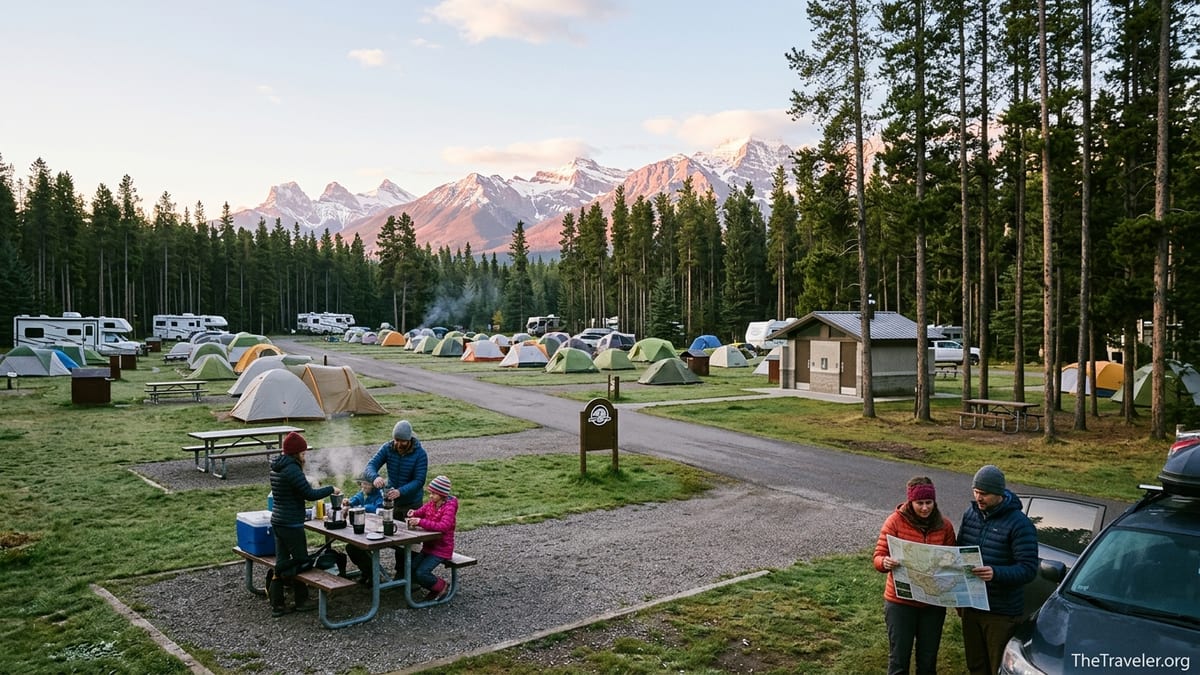
Frontcountry camping refers to developed, drive-in campgrounds near park roads, with a defined loop of sites, vehicle access and at least basic facilities. In Banff’s Tunnel Mountain Village or Jasper’s Whistlers Campground, for example, the camping fee you pay to Parks Canada covers your campsite pad, picnic table, a fire pit where fires are allowed, and access to shared washrooms or outhouses. In many of the larger campgrounds you will also find potable water taps, dishwashing stations and sometimes hot showers included in the nightly price.
Some campgrounds offer different tiers of service. At Tunnel Mountain or Whistlers, there are unserviced sites intended for tents and small trailers, sites with electricity only, and full-service sites with power, water and sewer hookups suitable for larger RVs. The more services a site offers, the higher the nightly fee, but the underlying principle is the same: the money goes to Parks Canada and supports both the campground and the broader park. You are paying for the right to occupy that specific campsite, use the provided facilities and rely on ranger presence and maintenance.
Many new visitors assume that frontcountry campsite fees include things like firewood or Wi-Fi, because that may be the case at some private campgrounds. In most national parks, that is not true. Firewood is often sold separately at kiosks or local gas stations, and internet access, if available at all, is usually limited to visitor centers or nearby towns, not guaranteed at your campsite. Similarly, frontcountry camping fees do not cover equipment such as tents, sleeping bags or stoves, though a small number of parks offer “equipped camping” where Parks Canada sets up a tent or oTENTik structure and charges a higher rate for that turnkey experience.
Reservation fees are another important detail. When you book a frontcountry site through the central Parks Canada reservation system, there is a separate, non-refundable transaction fee on top of the nightly rate. At busy parks like Banff, Jasper, Yoho or Pacific Rim, this is now a standard part of trip planning. If your plans change, you may be able to modify or cancel according to the posted policies, but the reservation fee itself is generally not returned. For travelers comparing costs, it helps to add up both the campsite rate and this extra charge to understand the true nightly cost.
Backcountry Camping and Permits: Where Coverage Ends and Personal Responsibility Begins
Backcountry camping moves you away from paved roads and developed loops into more remote wilderness. In places like Jasper’s Skyline Trail, Banff’s Rockwall area or the hiking circuits around Waterton Lakes, you usually need both a reservation and a backcountry permit to spend the night at designated wilderness campsites. The fee you pay to Parks Canada typically covers the right to occupy a specific pad or zone and contributes to minimal infrastructure such as tent pads, pit toilets and food storage cables or lockers at some sites.
Visitors are often surprised by how little is actually provided. In a typical backcountry campground along the Skyline Trail, for example, Parks Canada may maintain a few tent pads, a simple outhouse and a bear pole or locker to hang your food. There will be no potable water tap, so you must collect water from nearby streams or lakes and treat it yourself. There is no garbage pickup, so everything you pack in must be packed out. There are no staff on site; rangers may patrol occasionally, but in practice you are largely on your own, with your fee funding trail upkeep, campsite maintenance and emergency response capacity rather than direct services.
This model has practical implications. Because you are outside frontcountry infrastructure, you carry your own shelter, stove, fuel and emergency gear. Your permit does not include rescue insurance or evacuation guarantees. If a storm washes out a bridge and Parks Canada closes part of a route for safety reasons, trips that are cancelled due to that official closure are generally refunded, including the reservation fee, but otherwise you assume the usual risks of wilderness travel. Travelers should treat backcountry permits as permission to be there under certain conditions, not as a safety net that eliminates the need for planning and self-reliance.
There is also a difference between designated-site reservations and random camping zones. On heavily used routes like Banff’s Rockwall or Jasper’s Skyline, you must book specific campgrounds for each night; camping outside those sites is not allowed. In some other parks, backcountry permits may authorize camping within a wider zone where you choose your own spot under local rules. In both cases, the fee is paid to Parks Canada, but the level of on-the-ground infrastructure can vary significantly. Before committing to a trip, it is worth reading each park’s detailed description of what is provided so you know whether to expect tent pads and food lockers or simply a legal right to camp in a given valley.
What Parks Canada Fees Support: Trails, Conservation and Visitor Safety
From the traveler’s perspective, it can be tempting to view entry and camping fees as simple gate charges. In reality, they are a key part of how Parks Canada funds conservation and visitor services across a vast landscape. When you hike the well-maintained boardwalks at Fundy’s Hopewell Cape area, or cross sturdy bridges on trails in Yoho or Glacier, you are walking on infrastructure that costs money to build and continually repair in a harsh climate. Winter storms, spring floods and avalanches routinely damage trails and roads; fee revenue helps pay for the work crews and materials needed to reopen them each season.
Wildlife management is another area where your money is quietly at work. In Banff, for example, fencing and wildlife overpasses along the Trans-Canada Highway have dramatically reduced animal-vehicle collisions and allowed grizzly bears, elk and other species to move more freely between habitat areas. That kind of large-scale project is invisible when you are just pulling into a campsite at Two Jack Lake, but it is part of what your admission and camping dollars help sustain. Similarly, in Jasper and Kootenay, staff spend considerable time educating visitors about bear safety and food storage, patrolling campgrounds to prevent habituated wildlife and closing areas temporarily when animals need space.
Visitor safety and interpretation round out the picture. Parks Canada staffs visitor centers in key locations such as Banff townsite, Lake Louise, Jasper and Waterton with rangers who can explain current trail conditions, fire bans and closures. They run free or low-cost interpretive talks and walks in the high season, where naturalists lead evening programs on topics like glaciology, Indigenous history or stargazing. These services are not charged per person at the door; they are funded by the broader revenue stream that includes your entry pass and accommodation fees. When you attend a free campfire talk in Prince Edward Island National Park or join a guided daytime walk at Point Pelee run by Parks Canada staff, you are seeing that funding in action.
For international travelers, this broader context explains why Canadian national parks sometimes feel more expensive at the gate than some U.S. state parks or local recreation areas. The same federal agency is responsible not only for day-use areas and campgrounds, but also for scientific monitoring, law enforcement, wildfire management and historic preservation across a huge and varied country. Although Parks Canada also receives government funding, visitor fees remain one of the most direct ways that travelers contribute to keeping these places open, safe and ecologically healthy.
What Is Not Covered: Private Services, Shuttles and Nearby Town Costs
One of the biggest sources of confusion for visitors, especially first-time international travelers, is the boundary between what Parks Canada covers and what is operated by private companies. Within Banff and Jasper, for example, you will find sightseeing gondolas, lake cruises, wildlife tours, photography workshops and guided hikes offered by businesses that hold licenses to operate in the parks. Your day pass or Discovery Pass does not include these experiences. You pay the operator directly, often at a much higher rate than your daily admission, because those services are market-priced tourism products rather than public park services.
The same principle applies to accommodations beyond standard Parks Canada campgrounds. Hotels and lodges in Banff townsite, Lake Louise, Jasper and Waterton are privately owned and priced according to demand. Even within some parks, specialty stays such as luxury backcountry lodges, guided hut-to-hut treks or privately run cabins are separate from Parks Canada’s own oTENTiks and frontcountry sites. Your park pass might be required to access the road or trail leading to these places, but it does not lower the nightly rate or include any of the lodge services such as meals, gear transport or guiding.
Transportation is another grey area worth clarifying. Increasingly, popular areas like Moraine Lake and Lake Louise in Banff use shuttle systems to manage overcrowding and reduce traffic. Some shuttles are run by Parks Canada, while others are operated by regional transit authorities or private companies. In practice, even when a shuttle is coordinated with park management, there is usually a separate ticket cost that is not waived by a Discovery Pass. Travelers who assume that “free park buses” come with their pass can be surprised at these additional charges, especially when booking for a family in peak season.
Finally, any municipal charges in nearby towns fall outside Parks Canada’s control. In Banff, for example, you may pay for parking at certain lots within the town site, or city transit fares on local buses, in addition to your federal park pass, because the town operates as a separate municipality. In other regions, such as the small communities around Fundy National Park, local businesses set their own prices for lodging, restaurants and whale-watching tours. The park pass gets you through the official gates and into national park facilities; everything in the surrounding tourism economy has its own pricing rules.
Trip Planning Examples: Choosing the Right Coverage for Your Itinerary
To see how this all plays out in the real world, consider a family of four driving from the United States through Alberta and British Columbia in July. They plan to spend two days in Waterton Lakes, three days in Banff, two days in Jasper and one day in Mount Revelstoke. If they buy daily admissions at each gate, the per-day fees for four people across eight days will likely exceed the cost of a single Parks Canada Discovery Pass purchased at the beginning of the trip. Opting for the pass covers admission for the entire route and simplifies logistics, since they will not need to stop and pay again when driving between parks.
However, that same family still faces nightly camping or hotel costs. If they book frontcountry campsites at Waterton’s Townsite Campground, Banff’s Tunnel Mountain and Jasper’s Whistlers, each park will charge its own nightly camping fee plus a one-time reservation transaction through the central booking system. The Discovery Pass does not discount those camping fees. If they decide to take the Banff Gondola or a Columbia Icefield tour, those are separate private charges. By listing these items distinctly in their budget as “Parks Canada admission,” “Parks Canada camping” and “private tours and extras,” they can clearly see what they are paying for at each stage.
Now imagine a pair of backpackers planning a five-day traverse on Jasper’s Skyline Trail in late August. They must first secure backcountry camping reservations for specific sites along the route, paying a reservation fee and per-night backcountry camping charges to Parks Canada. If they are also visiting Banff for a few day hikes before their Jasper trek, it may be cheaper to buy a Discovery Pass rather than separate daily entries, since their combined park time will span a full week. On the other hand, if the Skyline trip is their only national park visit that year, daily admission plus backcountry fees might be more economical than an annual pass.
In Eastern Canada, similar logic applies. A traveler from New England might drive to Fundy National Park for long-weekend hiking, then continue to Kouchibouguac and Prince Edward Island National Park. If they plan to string together multiple short visits within a few months, the Discovery Pass can quickly pay for itself compared with buying several separate daily admissions. But if they are only crossing into Fundy for a single day of coastal walks before returning home, a standard day pass is the simplest and cheapest option. The right choice always depends on how many Parks Canada sites you will visit, for how many days, within a 12-month window.
The Takeaway
For travelers, understanding what Parks Canada covers is ultimately about clarity and control. Your entry fees and passes pay for access to national parks, national historic sites and marine conservation areas, as well as for the trails, facilities, conservation work and safety services that keep them functioning. Camping and backcountry permits add the right to occupy particular sites for the night, with varying levels of infrastructure depending on how far you are from the road. Beyond that core, almost everything else you encounter on a Canadian park vacation, from gondola rides to hotel stays, belongs to a separate layer of the tourism economy that charges its own prices.
Going into your trip with this distinction in mind lets you budget more accurately and choose the best tools for your itinerary, whether that is a single-day pass for a quick visit to Fundy or a Discovery Pass that unlocks a summer of roaming from the Rockies to the Atlantic. It also highlights the larger purpose of the fees you pay. Every time you tap your credit card at a national park gate or campsite booking page, you are helping to keep trails open, protect wildlife habitat and support the staff who welcome millions of visitors each year. In that sense, understanding what Parks Canada covers is not only a practical planning step, but also a reminder of the shared responsibility we all have in caring for these landscapes.
FAQ
Q1. Does a Parks Canada Discovery Pass cover camping fees?
The Discovery Pass waives daily admission charges but does not include frontcountry or backcountry camping fees, reservation transaction fees or accommodation costs.
Q2. If I have a Discovery Pass, do I still pay for shuttles in places like Banff?
Yes. Most park shuttles, especially to popular areas such as Moraine Lake and Lake Louise, require separate tickets that are not covered by a Discovery Pass.
Q3. Are private attractions inside national parks included in Parks Canada fees?
No. Services such as gondola rides, lake cruises, guided wildlife tours and privately operated hot springs are separate businesses and charge their own prices.
Q4. What does my frontcountry camping fee typically include?
Frontcountry camping fees usually cover a defined campsite with a pad, picnic table and fire pit plus access to shared washrooms and nearby water sources.
Q5. What is usually provided at a Parks Canada backcountry campsite?
Most backcountry sites offer only basic infrastructure such as tent pads, a pit toilet and sometimes a food storage pole or locker; you bring all other gear.
Q6. Are interpretive programs and ranger talks free once I pay admission?
In many parks, evening talks, short guided walks and visitor center exhibits run by Parks Canada staff are included in your admission or camping fees.
Q7. Does my park pass cover parking fees in nearby towns like Banff?
No. Municipal parking charges and local transit fares in towns inside or near national parks are set by local authorities and are separate from federal park passes.
Q8. Is it worth buying a Discovery Pass for a short trip?
For one or two single-day visits, daily passes are usually cheaper. A Discovery Pass becomes good value when you visit multiple parks or stay several days within 12 months.
Q9. Does Parks Canada provide rescue insurance with backcountry permits?
Backcountry permits help fund search and rescue capacity but are not insurance. Travelers remain responsible for their own emergency planning and medical coverage.
Q10. Can I use one Discovery Pass for my whole family?
Family or group versions of the Discovery Pass can cover up to a specified number of people in one vehicle; individual passes cover only the named holder or party type.