


I arrived in Ischia expecting a Capri understudy: glossy beach clubs, designer boutiques, and selfie sticks at every sunset. What I found instead was an island that still lives on its own terms. Between the clatter of fishing boats at dawn, elderly locals in bathrobes heading to their daily thermal soak, and families lingering over seafood dinners where nobody rushed to flip the table, Ischia felt surprisingly, almost disarmingly, authentic. It is a resort island, yes, but one where real life has not yet been pushed backstage.
Get the latest updates straight to your inbox!
First Impressions: A Working Island Disguised as a Holiday Escape
The authenticity of Ischia hits before you even step off the ferry. Most travelers arrive via Naples or Pozzuoli, passing commuters and delivery vans boarding the same ferries as suitcase-toting visitors. Hydrofoils from Molo Beverello in Naples take about an hour to reach Ischia Porto, while slower car ferries run from both Naples and Pozzuoli, often at lower prices but with more locals on board. The boarding process feels more like a daily lifeline than a curated tourist experience, and that sets the tone for what follows.
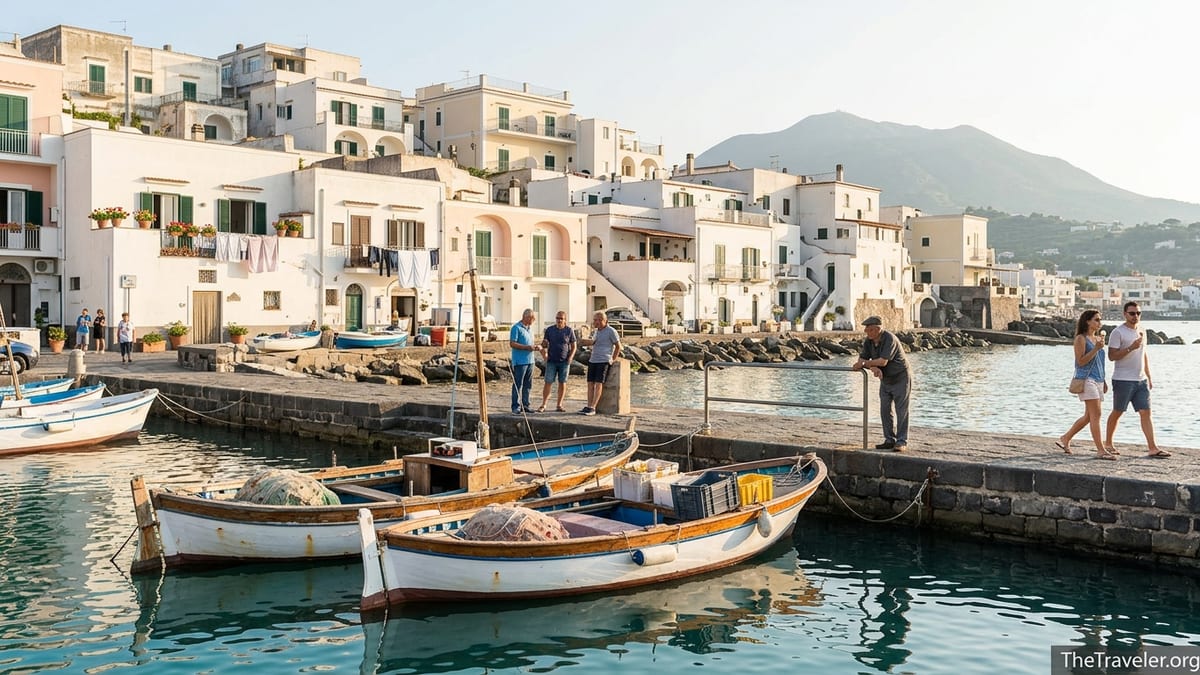
Ischia’s main town is split into Ischia Porto and Ischia Ponte, and walking between the two drives home how much the island still belongs to those who live here. Around the port, you see cafes serving early-morning espresso to workers heading to buses, fishermen unloading crates, and schoolchildren with backpacks weaving through roller bags. There are gelato stands and souvenir shops, but they share space with hardware stores, butchers, and tiny supermarkets where elderly residents argue over the ripest tomatoes. It feels like a small Italian coastal town that just happens to sit on a volcanic island famous for its hot springs.
By the time you reach Ischia Ponte, dominated by the Aragonese Castle perched on its rocky islet, tourism becomes more obvious, but the pace remains relaxed. Families in flip-flops share the narrow promenade with couples dressed for a castle visit, and laundry hangs from balconies above shopfronts selling espresso makers and school notebooks instead of only magnets and beach towels. The mix is what stays with you: this is not a stage set, but a lived-in place where visitors are invited into the backdrop of daily life.
Villages With Lives of Their Own: Forio, Sant’Angelo and Beyond
The island is divided into six municipalities, and each has its own personality that feels shaped more by local needs than by travel trends. Forio, on the western side, is the second-largest town and often recommended for its balance of beaches, restaurants, and transport. Its whitewashed church of Santa Maria del Soccorso overlooks the sea, and at sunset locals gather on the piazza steps as children kick soccer balls nearby. It is one of the best places to sense that this is not just a summer product: year-round residents line up at bakeries, and bars stay lively in shoulder seasons with people who clearly know each other.
Further south, Sant’Angelo in the municipality of Serrara Fontana feels almost like a time capsule. The last stretch of road is closed to traffic, creating a pedestrian-only zone where electric minicars and carts move luggage down to the harbor. This lack of cars is not a marketing gimmick, but a practical arrangement that preserves the natural amphitheater of pastel houses and narrow stone alleys. The tiny central square, shaded by umbrellas, is filled as much with older locals reading the paper as with visitors nursing spritzes. From here, stairs lead down to a small town beach and, further along, paths reach fumaroles and hot sand where people still bury potatoes or fish to cook in the geothermal heat.
Across the island, places like Lacco Ameno, with its iconic Fungo mushroom-shaped rock, and Casamicciola Terme, long known for thermal cures, feel more like small spa communities than “destinations.” Elderly Italians stay for weeks on state-supported health breaks, shuffling in bathrobes between hotels and thermal centers in the mornings, then sitting outside cafes in the afternoons. Their presence anchors the island in an older Italian wellness culture that predates modern weekend getaways and Instagram itineraries.
Thermal Culture: Everyday Ritual, Not Just a Spa Day
Many visitors come to Ischia for its volcanic springs, but what surprised me was how integrated the thermal culture is into daily routines. The island is dotted with both grand thermal parks and humble bathing establishments, and people treat them less as rare indulgences and more as a regular habit. In places like Casamicciola Terme and Barano d’Ischia, you see locals walking to simple bathhouses with towels over their shoulders, chatting about their doctor’s recommendations for particular mineral waters or mud treatments.
Large thermal parks such as Giardini Poseidon in Forio and Negombo in Lacco Ameno illustrate this mix of leisure and tradition. Poseidon’s sprawling terraces of pools, ranging from cool to very hot, sit above Citara beach and attract an international crowd, but you will also spot local couples and extended families who have been coming for years. Negombo, spread around a bay lined with lush Mediterranean and subtropical plants, has its own price list and seasonal schedule, with day tickets typically priced similarly to what you might pay for a full day at a European water park. Yet the atmosphere is quieter: people read books in the shade, soak in terraced pools, and speak in low voices. It feels closer to a shared public garden than a commercial attraction.
Beyond ticketed parks, geothermal features like the hot sands and fumaroles near Maronti beach remain remarkably low key. You might find a simple family-run restaurant where the owners cook fish or eggs in steam vents, or locals who come at off-peak hours for a warm soak where hot springs mingle with seawater. The infrastructure is basic, sometimes just a few changing cabins and a bar, which keeps the experience rooted in its natural setting rather than in polished spa design.
Food That Still Feels Local: From Rabbit Stew to Harbourfront Catch
On an island known for beaches, the most traditional dish is not seafood but rabbit stewed with wine, garlic, and wild herbs from the slopes of Mount Epomeo. Coniglio all’Ischitana appears on menus across the island, from rustic trattorie in the interior villages to seafront restaurants. It is a reminder that, for centuries, Ischia was an agricultural and pastoral community as much as a maritime one. Vineyards still step down the hillsides, and family plots of vegetables are visible from buses that loop around the island.
Seafood, of course, is everywhere, but even harborfront restaurants that cater to visitors often feel more local than polished. In Forio and Ischia Porto, you can sit at a simple table inches from tethered fishing boats and order grilled pezzogna or pezzogna-style catch of the day, spaghetti alle vongole, or fried paranza. Pricing varies, but it is still common to find a generous plate of pasta with clams at a mid-range trattoria for less than what a similar dish might cost in parts of the Amalfi Coast. House wines are frequently from Ischia itself, where white Biancolella and Forastera grapes dominate and are poured in carafes rather than branded bottles.
What lends the food scene its authenticity is how much it still caters to islanders. Morning pastry counters do brisk business with locals ordering espresso and sfogliatelle to go. Small alimentari sell slices of local provolone, salami, and bread to workers on lunch breaks. Many restaurants close at one day per week even in high season, a sign that they are still family-run enterprises rather than part of a tourism machine that stays open simply because there is demand. Eating in Ischia often feels like joining an ongoing conversation rather than being served a pre-packaged experience.
Getting Around: One Ring Road, Slow Buses, Real Life in Between
Ischia’s authenticity is also tied to how you move around it. The island is essentially stitched together by one main ring road that connects the six municipalities, with bus routes running in both clockwise and counterclockwise directions. At busy times, particularly in summer, buses can be crowded and slow, but that very slowness offers a window into everyday life. Schoolchildren, nurses in uniforms, workers carrying toolboxes, and tourists with beach bags all pile into the same vehicles and shout to the driver to stop at informal roadside points opposite small coves or stairways leading to hidden hamlets.
Seeing the island from a public bus rather than from private transfers highlights small details of authenticity: the vegetable stand on a hairpin turn that seems to serve mostly regulars, the shrine tucked into a rock face above a parking lot, or the older couple who greet half the passengers by name. Even the slightly chaotic bus stations in Ischia Porto and Forio, with handwritten notes about route changes taped to glass shelters, feel more like the infrastructure of a functioning community than a polished resort transit system.
Taxis and small private drivers exist, of course, and many visitors rely on them when staying in more secluded areas like Sant’Angelo or inland agriturismi. But even here, there is a personal, local texture: drivers often double as informal guides, sharing stories about landslides that closed certain roads, old hotels that have changed hands, or festivals that light up village squares in August. Getting around is rarely seamless, and yet it is rarely anonymous either.
Moments That Felt Unsurprisingly Real
What ultimately convinced me of Ischia’s authenticity were not any single “must-see” attractions, but small, cumulative moments that did not seem to exist for visitors at all. One morning in Ischia Ponte, a sudden rain shower sent everyone scurrying under awnings. Within minutes, shopkeepers were calling out to each other across the alleyways, sweeping water away from doorways, and joking about the forecast. No one seemed concerned about tourists getting wet; the priority was the rhythm of their own day, which I was briefly allowed to share.
In Forio, I watched a funeral procession leave a church and move toward the cemetery, traffic halting without complaint while pedestrians stepped aside and made the sign of the cross. Later that same evening, the same church square was filled with teenagers and families enjoying gelato and chatting under the streetlights. Life on the island seemed to flow through these shared public spaces in a way that did not change much whether outsiders were present or not.
Even in Sant’Angelo, probably the island’s most photogenic and obviously touristic village, authenticity surfaced in how times were kept. Restaurants closed for the afternoon regardless of how many visitors were strolling under the sun. Older residents sat in plastic chairs in front of doorways, unhurriedly shelling peas or sewing, occasionally glancing at the sea but mostly focused on conversations with neighbors. The village did not appear to bend itself around anyone’s bucket list.
The Takeaway
Ischia surprised me most by how little it seemed to care about surprising me. Where other Mediterranean destinations sometimes feel like they have been sculpted to meet visitors’ expectations, this volcanic island in the Bay of Naples has remained stubbornly itself. It is shaped by its hot springs, its agriculture, its six municipalities with distinct characters, and a year-round community that uses the same ferries, buses, and squares as the visitors who arrive in summer.
Travelers will still find comfortable hotels, thermal parks with well-maintained facilities, and enough restaurants to fill a week of dinners by the sea. But alongside those are local bakeries that close once the bread sells out, bathers arriving daily on state health vouchers, and village rituals that continue regardless of how many cameras are watching. If you come prepared for occasional inconvenience, slower buses, and the feeling of being a guest in someone else’s ordinary life, Ischia rewards you with an experience that feels deeply, refreshingly authentic in a region of Italy where that word is often overused.
FAQ
Q1. How do I get to Ischia from Naples?
From central Naples, hydrofoils and ferries depart several times daily from Molo Beverello and nearby ports, taking about one hour by fast boat or longer on car ferries. Services run year-round, with more frequent departures in summer.
Q2. Which town on Ischia is best for a first-time visitor?
For many first-time visitors, Forio or Ischia Porto work well. Both offer good bus connections, a range of accommodations and restaurants, and easy access to beaches and thermal parks, while still feeling like real Italian towns.
Q3. Is Ischia very touristy compared with Capri or the Amalfi Coast?
Ischia definitely receives visitors, especially in summer, but it feels less polished and more lived-in than Capri or many Amalfi towns. You share streets and buses with residents going about daily life, and many businesses cater to locals year-round.
Q4. Do I need a car to explore Ischia?
A car is not essential, especially if you stay in a well-connected town such as Forio, Ischia Porto, or Ischia Ponte. The public bus network circles the island, and taxis or private drivers can fill gaps, though traffic and parking can be challenging in peak season.
Q5. When is the best time to visit Ischia for a more authentic experience?
Late spring and early autumn often feel most balanced. From May to early June and from September into early October, most services are open but crowds are thinner, and local routines are easier to observe than in the peak of August.
Q6. Are the thermal parks worth visiting if I am not usually a spa person?
Yes, because on Ischia the thermal parks are as much about landscape and local culture as about treatments. A day at Giardini Poseidon or Negombo can feel like time in a seaside botanical garden with warm pools, not just a spa session.
Q7. Is Ischia suitable for budget-conscious travelers?
Compared with many famous Italian coastal destinations, Ischia can be relatively good value. Simple guesthouses, local trattorie, and public beaches exist alongside higher-end options, and careful planning makes it accessible on a moderate budget.
Q8. How many days should I spend on the island?
Three full days allows a taste of Ischia’s main towns and a visit to at least one thermal park. Four to five days or more lets you slow down, explore interior villages, and better appreciate daily island life.
Q9. Is English widely spoken on Ischia?
In hotels, larger restaurants, and tourist-focused services, English is commonly understood. In smaller shops or inland areas, Italian dominates, but basic phrases and a friendly attitude are usually enough to communicate.
Q10. What should I wear when visiting thermal baths and local towns?
At thermal parks and beaches, standard swimwear is appropriate, often with flip-flops and a cover-up. In towns and churches, casual but neat clothing is appreciated; carrying a light layer or scarf makes it easy to adapt to local expectations.