


Most visitors come to Rione Terra in Pozzuoli for the headline sights: the underground Roman streets, the dramatic cliff above the bay and the Duomo built into a temple of Augustus. Yet this compact acropolis rewards the kind of traveler who slows down, looks up at lintels and street corners, and pays attention to the small irregularities in the stone. Hidden in those details is the real story of Pozzuoli: a port city that has risen, sunk and reinvented itself for more than 2,000 years.
Get the latest updates straight to your inbox!
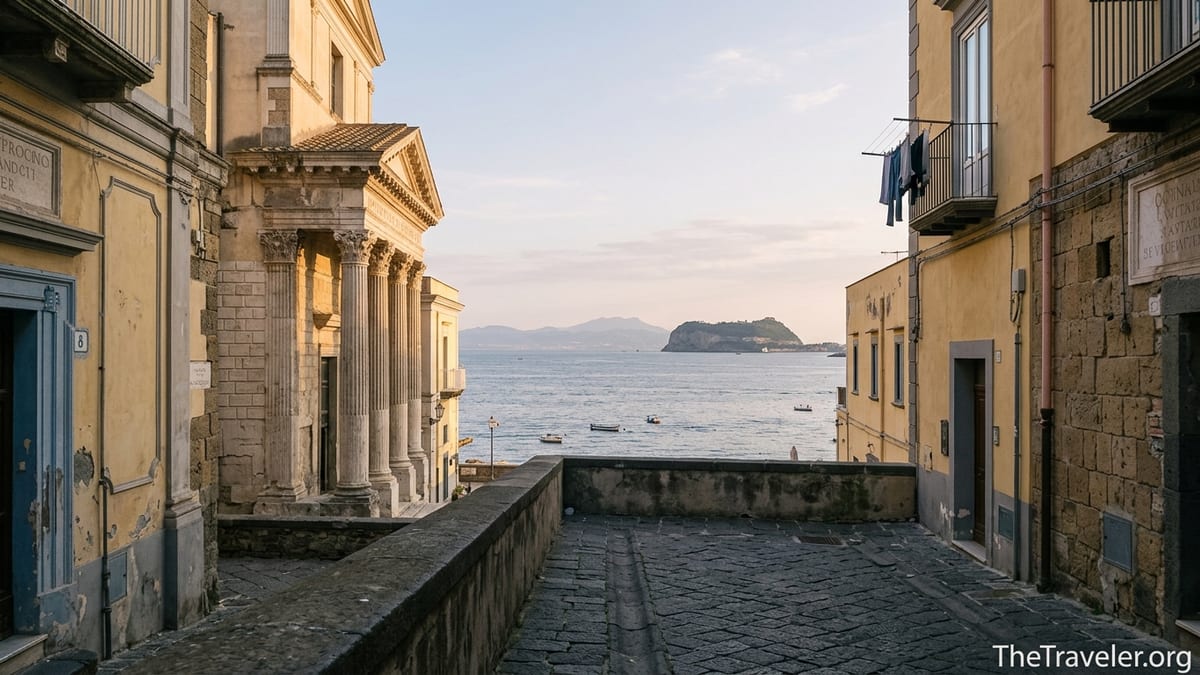
Reading the Rock: How the Cliff Itself Tells the Story
Before you even pass the arch into Rione Terra, pause on the seafront promenade and look at the headland from below. The whole district sits on a spur of yellow tuff, a soft volcanic stone carved by both nature and Roman engineers. Most visitors are drawn straight to the views of the bay, but the base of the cliff is one of the best places to understand that this neighborhood exists because of the Campi Flegrei volcano system, not in spite of it. You can clearly see layers of rock left by historic eruptions, with harder and softer bands forming natural ledges that later became foundations for walls and cisterns.
Walk up the main access stairs toward the arch and pay attention to the cut faces of the tuff on your right-hand side. In certain sections, particularly just below the bastion walls, you can spot tool marks where Roman quarrymen removed blocks for construction. Some cuts are straight and regular, while others follow the natural fractures created by bradyseism, the slow rising and sinking of the ground that still affects Pozzuoli today. Guides often talk about bradyseism using the famous columns of the nearby Temple of Serapis, but here in Rione Terra you can see the same phenomenon inscribed in the bedrock that holds the entire quarter.
Once you are on the upper level, lean on the sea-facing parapet on a clear afternoon. The view runs from Nisida to Baia, but the hidden detail is under your hands. Look for blocks where marine organisms once lived, tiny boreholes and fossil traces that hint that portions of this rock spent periods beneath sea level before being lifted again. For a visitor who has just come from Naples or Pompeii, it is a concrete reminder that this is an inhabited volcanic caldera, not just another picturesque hilltown.
Traces of Shops and Everyday Life in the Underground Streets
The official underground route of Rione Terra is one of the highlights of any visit, yet the most evocative elements are easy to miss if you simply follow the group. When you reach the first paved Roman street, slow down and look at the thresholds of the tabernae, the small shops that once lined the main decumanus. You will see deep grooves in the stone where doors once slid or pivoted, and in a few doorframes faint circular sockets where wooden bars were anchored at night. These small details transform anonymous arches into places where real shopkeepers once opened each morning.
In one stretch of the underground, the guide will usually point out the bakery, or pistrinum, with its big millstones and oven. Take a closer look at the floor just beyond the millstones. The surface here is more polished than in other rooms, worn smooth by countless footsteps and the turning of heavy carts. On the lower parts of the walls, you may notice a faint horizontal change in color where smoke and flour dust left a permanent mark. These layers of use are rarely highlighted on tours, but they are what makes the bakery feel less like a frozen display and more like a workplace paused in mid-shift.
Another overlooked feature of the underground streets is the way light is managed. At several points you will walk past narrow vertical shafts rising to the surface. Most visitors register them as simple skylights, but if you stand under one for a moment you can see how the Romans aligned these openings to bring daylight to key crossing points and work areas while keeping storage rooms in constant cool shadow. On sunny days, the sharp columns of light act like spotlights on thresholds and intersections, revealing wheel ruts in the basalt paving stones and small drains cut to the side that once carried away rainwater and spilled wine or oil.
The Temple Turned Cathedral: Layers Hidden in Plain Sight
At the top of Rione Terra stands Pozzuoli’s Duomo, formally the Cathedral of San Procolo, built around and inside a Roman temple dedicated to Augustus. Many visitors enter, look up at the Baroque nave, and leave with a quick photograph. To appreciate the hidden complexity of this building, start outside on the main façade. Step back toward the small open space in front of the church and look closely at the columns integrated into the structure. The fluting and proportions reveal that these belonged to the original Roman capitolium. Some are original marble drums; others are careful reconstructions where pieces were lost to fire and collapse in the twentieth century.
Inside, walk slowly along the side aisles rather than heading straight down the center. On the left side, embedded in the floor, you can spot rectangular glass panels that reveal earlier foundations below the Baroque tiles. These glass cutouts are easy to stride past in a hurry, but if you stop above one you can see the base of ancient walls and, in some sections, alignment marks left by the architects who oversaw the modern restoration after a devastating fire in the 1960s. Their decision to leave visible “windows” into the earlier phases is one of the smartest contemporary interventions in the building.
Around the presbytery you will notice that some of the temple’s original Corinthian columns stand free, while others disappear into later walls and altarpieces. The capitals that are fully visible show delicate acanthus leaves carved in high relief, while those half-buried in the Baroque structure appear truncated. This contrast is deliberate, underlining the way Christian worship quite literally grew out of the imperial cult. For a traveler used to the enormous ruins of Rome, the scale here feels intimate, and the layering is easier to grasp because you can stand within arm’s reach of capitals that once framed statues of Augustus and later framed painted saints.
Marks of Abandonment and Return: Doors, Numbers and New Plaster
Unlike many Italian old towns that evolved gradually, Rione Terra experienced a sudden evacuation in 1970 because of bradyseismic unrest. The district stood empty for decades while archaeologists and engineers studied and consolidated the rock. As you wander its narrow lanes today, you can still read that interruption in the smallest architectural details. Look at the doorways of the residential buildings that line the main spine of the quarter. Many lintels carry painted or stenciled house numbers that do not quite match modern Italian signage. Some are faded blue or red, others appear twice in different styles. These are traces of the last inhabitants before evacuation and of later survey campaigns that catalogued each property.
On certain façades, particularly near the sea walls, you will notice a sharp border where old, crumbly plaster meets a smoother, paler band. This is not just cosmetic. In many cases the lower part of the wall was rebuilt after ground movement damaged the original masonry. Engineers reinforced the base, then re-plastered only to a certain height, leaving older render above. For the casual visitor it reads as a simple repainting job; for travelers who look closely it is a visible seismograph of the neighborhood’s survival.
Another easily missed detail is the way utilities re-entered the quarter. Near some of the side alleys, at ankle height, you can spot capped conduits and small modern inspection panels, partially disguised in the stone. These mark the cautious reintroduction of water and electricity when parts of Rione Terra reopened to limited access. They are subtle reminders that what looks like a timeless historic district is in fact the product of continuous negotiation between safety, archaeology and everyday life.
Inscriptions, Symbols and Reused Stones
Rione Terra’s fabric is full of spolia, stones repurposed from earlier buildings. A good place to look for them is along the inner lanes behind the Duomo, where postwar houses incorporate carved blocks that clearly started life in Roman walls or medieval churches. You might notice an ashlar with a faint Latin letter half visible near a corner, or a block with a carved groove that no longer lines up with anything around it. These elements were often reused when the district was rebuilt in the seventeenth century, creating a patchwork that rewards a patient eye.
Several door lintels carry carved crosses or simple fish symbols, likely added after the Counter-Reformation to assert Christian identity in a space still architecturally dominated by classical forms. They are often weathered almost flat, especially on the lanes exposed to sea air, so it helps to stand sideways and let the light graze across the stone to pick out the lines. In one small courtyard, a reused cornice fragment acts as a bench; its mouldings are upside down, transforming a formal classical profile into something closer to folk architecture.
Inside the underground path, the habit of reuse appears in more functional ways. Look at the thresholds between certain rooms and you may see blocks that clearly come from a different construction phase: a piece of column drum cut into a doorstep, or an earlier brick arch partially embedded in a later wall. These quiet mismatches tell you that Roman Puteoli was already recycling its own materials long before modern conservation began, a practical response to limited space on this cramped headland.
Sensory Clues: Smells, Sounds and Microclimate
Hidden details in Rione Terra are not only visual. The quarter has its own microclimate and soundscape that shift between the surface streets and the underground tunnels. On a hot summer afternoon, step from the sunlit piazzetta near the Duomo into the start of the underground route. The air temperature drops immediately, but there is also a distinctive change in smell: cool stone, a faint trace of damp lime and, in some sections, the mineral tang associated with volcanic areas. This is not your imagination. The galleries cut deep into tuff maintain relatively stable humidity and temperature, making them ideal ancient storage spaces for food and amphorae of oil and wine.
As you move along the Roman streets, listen for the way outside noise filters down through the ventilation shafts. In some stretches you will hear the echo of footsteps on the modern paving above, or the distant whine of scooters climbing the modern access road. In others, the silence is almost total, broken only by the guide’s voice and the scrape of shoes on stone. These variations give a practical sense of how sound traveled in the ancient city. A shout from a surface courtyard could reach workers below, while the deepest storerooms would have been muffled and secure.
Back on the surface, stand at the sea wall at sunset when the wind is light. You may notice the faint smell of sulfur on some evenings, wafting from the Solfatara area inland. It is subtle, usually masked by sea air and cooking smells from the modern town below, but it can catch you unexpectedly. Combined with the distant low rumble of ferries in the port, it creates a layered sound and scent environment that reinforces how close Rione Terra sits to both water and active geology.
How to Notice More: Practical Tips for Curious Travelers
Rione Terra is compact enough that you can walk every lane in under an hour, but to spot its hidden details it is worth planning your visit carefully. If possible, aim for a morning underground tour time, when groups tend to be slightly smaller and the contrast between bright outside light and the cool tunnels is strongest. Booking procedures can change, so it is wise to check the municipality’s tourism information or ask at the infopoint near the entrance a day or two in advance. Tours are typically included in a modest ticket price for the archaeological path, making this one of the better value experiences in the Bay of Naples compared with larger, more crowded sites.
Once your underground visit is fixed, allow at least an extra hour to roam the upper town at your own pace. After emerging from the tunnels, resist the urge to head straight back down to the port. Instead, circle the Duomo, explore side streets and double back along lanes you already walked. Details such as reused stones, house numbers and religious symbols reveal themselves better when you are not following a guide’s timetable. If you enjoy sketching or photography, this is an ideal place for close-up studies of texture: flaking plaster, pitted tuff blocks and weather-softened bas-reliefs.
Consider pairing your Rione Terra exploration with a visit to the nearby Flavian Amphitheater or the macellum often called the Temple of Serapis. Experiencing multiple sites in a single day helps make sense of how Rione Terra fits into the broader puzzle of Roman Puteoli and the Campi Flegrei. You will start to recognize the same yellow tuff blocks, the same signs of ground movement and the same mix of ancient and modern interventions repeating across the landscape.
The Takeaway
Most travelers arrive in Rione Terra with images of Roman ruins and a spectacular coastline in mind. They find those, of course, in the underground streets and in the sweeping view across the bay. Yet what makes this small district unforgettable is quieter: the way a temple hides inside a cathedral, the unnatural straightness of a quarry cut in volcanic rock, the scratch of an old house number left from a vanished community. These details rarely appear on postcards or tour brochures, but they are what turn a short excursion from Naples into a rich encounter with a place that has never stopped changing.
If you give Rione Terra time, it will reward you with a deeper understanding of how people adapt to restless ground and shifting fortunes. You will leave not just with photographs of arches and sea views, but with the memory of worn thresholds, reused capitals and subtle smells that tie the present city to its ancient counterpart of Puteoli. In a region crowded with famous archaeological sites, that kind of intimacy is a hidden treasure in itself.
FAQ
Q1. How long should I plan to spend in Rione Terra, including the underground tour?
Most visitors should allow around two to three hours: about one hour for the underground guided route, plus at least another hour to explore the upper quarter, walk around the Duomo and linger at viewpoints without rushing.
Q2. Do I need to book the underground tour of Rione Terra in advance?
Booking rules can change, but it is generally advisable to reserve ahead through local tourism channels or to stop at the infopoint in Pozzuoli a day or two beforehand, especially on weekends and holidays when time slots can fill quickly.
Q3. Is Rione Terra suitable for travelers with limited mobility?
The upper streets around the Duomo are relatively level once you reach the top, but the approach involves stairs and uneven paving, and the underground route includes slopes and steps, so access can be challenging for those with mobility issues.
Q4. What should I wear for the underground section of the visit?
Wear comfortable closed shoes with good grip, since the ancient paving can be uneven and occasionally damp, and bring a light layer even in summer because the temperature underground is noticeably cooler than on the surface.
Q5. Can I visit the Duomo of Pozzuoli independently, or only with a guide?
Access arrangements may vary, but in practice visitors are often able to enter the Duomo during opening hours without a full tour, while more in-depth explanations or access to certain areas may be offered only through guided visits.
Q6. Are there places to eat or have a coffee close to Rione Terra?
While options inside the historic quarter are limited, the modern town of Pozzuoli immediately below the headland has numerous bars, cafés and trattorias within a short walk from the main entrance stairs.
Q7. Is photography allowed in the underground passages?
Photography without flash is usually permitted, but rules may differ by tour and by room, so it is best to confirm with your guide at the start and to avoid using tripods in narrow sections.
Q8. When is the best time of day to appreciate the hidden details mentioned in this article?
Morning visits often offer softer light on façades and cooler temperatures underground, while late afternoon on the upper terraces provides beautiful side light that highlights tool marks, relief carvings and the texture of volcanic stone.
Q9. Can children enjoy a visit to Rione Terra, or is it mainly for history enthusiasts?
Older children who enjoy stories about ancient cities and underground spaces often find Rione Terra engaging, especially when guides point out everyday details like ovens and shopfronts, but very young children may tire quickly on the steps and in low-light areas.
Q10. How does Rione Terra compare with larger archaeological sites like Pompeii?
Rione Terra is much smaller and less crowded than Pompeii, with a stronger sense of vertical layering between ancient and modern; it works best as a focused, atmospheric visit rather than an all-day exploration of sprawling ruins.