


More news on this day
Passengers across the UK and Europe are facing a fresh wave of cancellations and long delays as a mix of technical failures in UK air traffic control, stormy late-summer weather, staffing gaps and industrial disputes ripple through one of the world’s busiest aviation networks.
Get the latest news straight to your inbox!
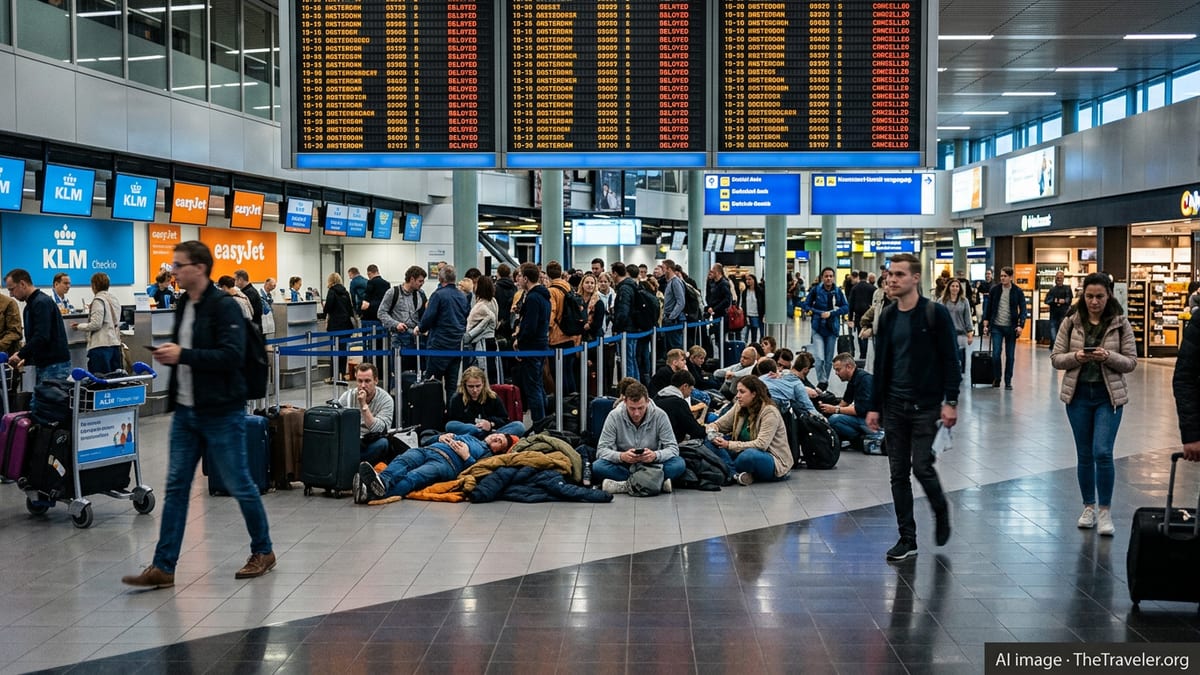
A Technical Meltdown in UK Air Traffic Control
The most visible trigger for the latest disruption has been a serious technical problem affecting the UK’s National Air Traffic Services (NATS) from 8 September 2026, which disrupted departing and arriving flights at major airports including Heathrow, Gatwick and other key hubs. Publicly available information describes an issue in the flight processing system that forced traffic flow restrictions and prompted airlines to cancel or heavily delay services while the fault was traced and resolved.
Reports from flight-tracking platforms and airline travel updates indicate that more than 1,700 flights to, from or within the UK were cancelled over two days, affecting hundreds of thousands of passengers and creating knock-on disruption across continental Europe as aircraft and crews went out of position. Even after the core technical problem was fixed, schedules remained severely out of place, leaving airlines to reset rotations and rebook travellers on already crowded services.
Because the UK sits at the heart of North Atlantic and intra-European air corridors, a failure in its air traffic system quickly cascades beyond national borders. Flights bound for London and other UK cities were held on the ground across Europe while capacity restrictions were in place, causing late-running aircraft and missed connections at hub airports in Ireland, the Netherlands, Germany and Spain.
Eurocontrol, which coordinates European airspace, classifies these kinds of events as network disruptions, requiring flow management measures to maintain safety and reduce congestion. Once implemented, those measures typically continue for hours after a technical issue is resolved, which helps explain why cancellations and missed connections can persist long after the original failure has ended.
Weather and Capacity Pressures in a Busy Late-Summer Season
The air traffic control failure has landed on top of an already stretched summer schedule. Eurocontrol’s most recent network operations reports show that European traffic in mid-2026 has been running at, or above, pre-pandemic levels, with sustained daily peaks through July and August. That recovery has coincided with bouts of severe weather, including thunderstorms and high winds, which routinely lead to capacity reductions at key hubs and trigger waves of late-notice cancellations.
When storms or strong crosswinds hit crowded airspace, controllers reduce the rate at which aircraft can land and depart, and airlines are often required to trim flights to stay within those limits. In practice, this can mean last-minute cancellations on short-haul routes where passengers can be more easily reaccommodated, in order to preserve long-haul operations that are harder to reschedule.
Network data published by Eurocontrol for recent summer months highlight weather and air traffic control capacity constraints as two of the biggest contributors to delays and disruption across Europe. The current spell of late-summer storms in parts of western and central Europe is therefore amplifying the impact of the UK system failure, turning what might have been a short, sharp disruption into several days of uneven operations.
Travel data compiled for major UK airports such as Gatwick already showed elevated levels of cancellations earlier in September, even before the latest NATS issue, underlining how thin the margin for error has become during peak travel periods. When new constraints emerge, airlines have limited slack in their schedules to absorb the shock.
Staffing Shortages and Structural Strain at Control Centres
Alongside technical glitches and bad weather, chronic staffing pressures at air navigation service providers are also feeding into current disruption. Airlines have repeatedly highlighted staff shortages at NATS and other European control centres in recent months, arguing that an inability to cover absences or unexpected peaks has led to avoidable delays and, in some cases, flight cancellations.
Statements from carriers operating large UK and European networks describe days where early-morning traffic has been held or restricted because air traffic control units did not have sufficient controllers available, particularly during busy holiday weekends. Those restrictions ripple through the day as aircraft miss their planned slots, increasing the likelihood that later services will be cancelled entirely.
Industry analyses from Eurocontrol and other European bodies have previously warned that staffing gaps, combined with the long lead times needed to train qualified controllers, could continue to limit capacity even as demand recovers. The current pattern of disruption in the UK and on busy routes over France, Germany, Spain and the Mediterranean suggests that those constraints remain significant in 2026.
For passengers, the effect of these behind-the-scenes pressures is felt in the form of tighter schedules, minimal recovery time between flights and a greater chance that any new problem, whether a storm cell or a system fault, will tip the network into widespread cancellations.
Industrial Action and Local Bottlenecks Across Europe
Industrial disputes are adding an extra layer of uncertainty to travel plans. Over the first half of 2026, several major European airlines and air traffic control providers have faced threatened or actual strikes by pilots, cabin crew and other aviation workers, often linked to pay and working conditions. Briefings from European institutions tracking the sector note that these disputes have periodically grounded flights or forced airlines to cut schedules in advance.
Even when strikes are narrowly averted or limited in scope, airlines tend to adjust their timetables conservatively, cancelling some flights ahead of time to avoid more chaotic last-minute disruptions. Recent examples include industrial action affecting German and Spanish carriers, as well as localized disputes in air traffic management that congest specific regions and force reroutings across the wider network.
At airport level, infrastructure works and border control changes are also creating bottlenecks. Eurocontrol’s public airport updates for summer 2026 highlight longer processing times at some external Schengen borders linked to the roll-out of the EU’s new Entry/Exit System, as well as local runway and taxiway closures for construction. While these issues do not always translate directly into cancellations, they increase ground delays and can push tight rotations over the edge on busy days.
In combination, intermittent strikes, infrastructure constraints and extra checks at border control points reduce operational resilience. When a large system failure like the current NATS incident occurs, these localised pressures magnify the overall impact and make it harder for airlines to rebuild their schedules quickly.
What Travellers Can Expect in the Coming Days
As of 9 September 2026, airlines are gradually restoring flights to and from the UK, but schedules remain fragile. The backlog created by the air traffic control failure means that some aircraft and crews are still out of position, and some carriers are giving priority to long-haul and high-demand routes. Published travel alerts from major airlines serving the UK advise passengers that disruption may continue for several days, with further short-notice cancellations possible while operations stabilise.
Government statistics for earlier summer months show that short-notice cancellations at UK airports rose during periods of intense disruption, even after headline events had passed, as airlines made day-by-day decisions on which services to operate. Similar patterns are likely to appear now, especially if adverse weather or local industrial issues re-emerge elsewhere in Europe.
Consumer guidance from regulators and passenger-rights organisations stresses that travellers whose flights are cancelled at short notice should be offered a choice between a refund and re-routing, and may be entitled to care such as meals and accommodation, depending on the circumstances. However, large-scale disruption often leads to long waits at call centres and service desks, and limited availability on alternative flights, particularly to popular leisure destinations.
Looking ahead, Eurocontrol’s medium-term outlook anticipates high traffic levels across Europe through late summer and into the autumn holiday period. With demand strong, and key parts of the system still constrained by staffing, weather vulnerability and occasional industrial disputes, analysts expect that episodes of concentrated cancellations may remain a feature of European air travel, even as the immediate UK air traffic control crisis is brought under control.
Associated Press coverage of the UK air traffic control issue
UK government data on short-notice cancellations at UK airports