


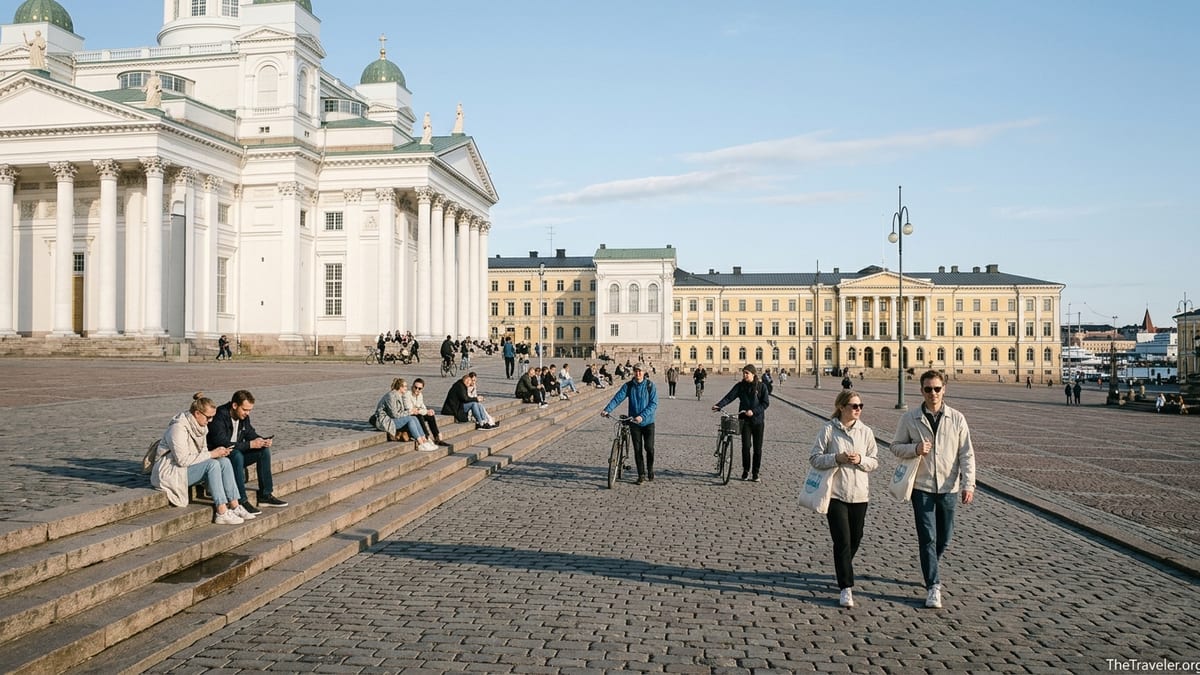
Helsinki Cathedral and Senate Square are the postcard image of Finland’s capital, but locals experience this area very differently from most visitors. Instead of rushing up the steps for a single photo and moving on, Helsinkians weave the square into everyday life: they cut across it on the way to work, meet friends for coffee in its side streets, or stop on the cathedral steps to watch the light over the harbor. With a bit of planning, you can do the same and see this famous ensemble as more than a backdrop.
Get the latest updates straight to your inbox!
Understanding Helsinki Cathedral and Senate Square
Helsinki Cathedral crowns Senate Square, a broad cobblestone plaza framed by neoclassical buildings that house the Government Palace, the main building of the University of Helsinki and the National Library of Finland. Together they form one of the most coherent neoclassical ensembles in Northern Europe, designed largely by architect Carl Ludvig Engel in the 19th century. The cathedral’s white façade and green domes are visible from the harbor and from many tram routes, so you will probably spot it long before you arrive.
Unlike some major European churches, Helsinki Cathedral functions first as a working Lutheran parish and national church, and only second as a tourist sight. Services, weddings, graduations and choir concerts fill its calendar. This means that at certain moments the interior can be closed or partially restricted. Signs at the entrances indicate whether a service is about to begin, and staff will politely ask visitors to keep a respectful silence. It is common to see a mix of tourists with cameras and locals quietly lighting candles or attending a midweek service.
Senate Square itself is a flexible civic stage. On one day it might be almost empty except for a few people drinking takeaway coffee on the steps; on another it hosts a classical concert, an art installation or, in December, rows of wooden stalls for the Helsinki Christmas Market. In winter, plowed ridges of snow frame the statue of Tsar Alexander II in the center of the square; in summer, the cobblestones radiate heat and children race across them chasing pigeons.
Thinking about the area as a lived-in city space rather than a single monument changes how you plan your visit. Instead of simply “seeing the cathedral,” you can time your stop to overlap with a market, a festival event or just the local lunch rush when nearby cafés and university buildings spill people into the streets.
Practicalities: Getting There, Hours and Costs
Senate Square sits right in central Helsinki, an easy 10 to 15 minute walk from the Central Railway Station. Many visitors arrive from the airport by commuter train, then simply follow the flow down Keskuskatu and along Aleksanterinkatu until the cathedral suddenly appears at the end of the street. This is exactly what office workers and students do every day. If you prefer to ride, several tram lines serve the Senaatintori / Aleksanterinkatu stops, including lines such as 2, 4, 5 and 7, which all run through the compact center. Trams in Helsinki are frequent, and you can usually step off within a two to three minute walk of the square.
Helsinki Cathedral does not charge an entry fee for individual visitors, which often surprises travelers used to paid admission in major European churches. There may be suggested donations for maintaining the building, and there can be specific charges if you join an organized guided tour or attend certain concerts, but simply walking in during public opening hours is usually free. Opening times can change seasonally and around religious holidays such as Easter and Christmas, so it is wise to check the current schedule shortly before your trip rather than rely on an old guidebook.
For budgeting purposes, most costs you will encounter are related to transport and nearby cafés or souvenirs, not the cathedral itself. A single tram or metro ticket bought through the local HSL app is typically priced for short city-zone rides and is valid for transfers, which makes it straightforward to include a stop at Senate Square as part of a wider day of sightseeing. If you plan several journeys in one day, a 24-hour city ticket can be more economical than buying individual rides, especially if you are also heading to the harbor, museums or neighborhoods like Kallio or Töölö.
Accessibility is relatively good. The square is cobblestoned, which can be bumpy for wheelchairs or strollers, but the surrounding streets and the cathedral area include ramps and gentler approaches. The famous staircase is steep, so if you have mobility issues, look for the side entrances at street level rather than attempting the full flight of steps.
Timing Your Visit Like a Local
Locals encounter Senate Square at all hours, but if you want to experience it at its most atmospheric without dense crowds, early morning is ideal. On a summer weekday around 8:00 or 9:00, the light slants across the façades, a few delivery vans cross the cobblestones, and office workers cut diagonally from Aleksanterinkatu to the university buildings. This is a good time to climb the steps, sit for a few minutes and watch the city wake up before heading for coffee at one of the nearby cafés once they open.
Midday is the busiest time for tour groups, particularly during cruise season when buses drop passengers near the square. If your schedule forces you to visit then, emulate locals by not lingering in the densest spot at the foot of the steps. Instead, step to the sides of the square or slip into the quieter streets behind the university and National Library, then loop back when groups move on. Lunch hours, roughly 11:00 to 13:30, see many Helsinkians choosing “lounas” deals in nearby restaurants, some of which offer buffet-style Finnish dishes for a fixed price, typically including salad, bread and coffee.
Evenings can be magical, especially in late spring and early summer when the sun sets late and the sky turns pastel behind the cathedral. Local students sometimes gather on the steps with snacks or takeaway pizza, especially on warm May evenings or following university events. In winter, late afternoon and early evening coincide with darkness, which makes the cathedral’s lighting stand out against the sky. Around New Year or during the Lux Helsinki light festival in some years, the cathedral façade can serve as a canvas for light art, drawing residents back to a place they otherwise know by heart.
If you are visiting during December, time your stop to overlap with the Helsinki Christmas Market, which usually fills the square with wooden chalets, food stalls, mulled wine and a carousel. Rather than treating the cathedral as a separate stop, locals often wander through the market, warm their hands on a hot drink, then climb the steps for a quick view over the lights and harbor before heading down to the nearby Market Square by the sea.
Exploring the Cathedral Interior and Finding the Best Views
Helsinki Cathedral’s interior surprises many visitors with its simplicity. Where some European cathedrals overwhelm with baroque detail, this Lutheran space is restrained: high white walls, simple pews, a central pulpit and a few key artworks. Locals are used to this understated aesthetic, and it reflects the way Finnish Lutheran churches emphasize clarity and light over ornament. When you step inside, let your eyes adjust and look up into the dome, where natural light falls through high windows even on overcast days.
When a service is not in progress, you are generally free to walk quietly along the aisles, sit for a moment in a pew, or light a candle. During weekday afternoons, you might share the space with a handful of visitors and one or two locals on their lunch break, taking a few minutes of calm before returning to work. If there is a choir rehearsal, consider sitting discreetly at the back; it is common for Helsinkians to drop in this way when doors are open, treating the music as part of the building’s life rather than a formal performance.
For views, most people instinctively gather high on the central staircase directly in front of the main doors. This is an excellent vantage point over Senate Square, the statue of Alexander II and the yellow and cream façades of the surrounding buildings, with a glimpse of the harbor and islands beyond. To see the square from a less typical angle, locals sometimes move to the upper corners of the steps, near the side colonnades, where you can frame photos that show the curve of Aleksanterinkatu or the university’s façade rather than only the central axis.
If you have time, walk around the exterior of the cathedral at terrace level. Paths behind and around the building offer quieter corners, especially on the side facing the harbor, where you may share the space with only a couple of people taking phone calls or catching some sun on a bench. From here you can look down on the rooftops, pick out the ferries moving in and out of the harbor and spot the red-brick Uspenski Cathedral across the water, giving you ideas for your next stop.
Living the Square: Cafés, Side Streets and Nearby Sights
What truly makes a visit feel local is how you use the space between sights. Instead of arriving by tour bus and leaving immediately after snapping a photo, follow the patterns of Helsinkians who treat Senate Square as part of their daily route. After you climb the steps and look around, wander down to the side of the square closest to the harbor, where small side streets lead toward the Market Square and the waterfront. These streets hold cafés that locals actually use, especially in the mornings and after work.
On the opposite side, narrow lanes thread toward the Helsinki City Museum and older residential blocks. The city museum, which focuses on everyday life in Helsinki and often offers free admission, provides an accessible way to deepen your understanding of the city’s history without leaving the immediate area of the square. Locals might drop in for a short visit with children, then stop for a hot chocolate or coffee nearby, making it a relaxed pairing with a stop at the cathedral.
Food-wise, you do not need to spend a fortune to eat decently near Senate Square. Around the square and along Aleksanterinkatu you will find a mix of classic cafés, slightly more upscale bistros and simple spots where office workers line up for lunchtime “lounas” buffets of salmon soup, meatballs or vegetable stews. Prices for a buffet-style lunch are often in the mid-range for Finland, but they include salad and coffee, which makes them reasonable by local standards. Join the queue, carry your tray to a window seat and watch the flow of people across the cobblestones outside.
From Senate Square, it is an easy continuation to other central sights on foot. Walk a few minutes downhill and you reach the harborfront Market Square, with its open-air stalls in summer and ferries out to Suomenlinna sea fortress. Head along the Esplanadi park to experience one of the city’s favorite promenades, lined with shops and more cafés. Alternatively, turn inland toward the Central Railway Station, passing through pedestrian streets that show Helsinki’s everyday commercial life rather than only its postcard angles.
Seasonal Events and Everyday Rituals
Senate Square’s character changes markedly with the seasons, and locals are keenly aware of these rhythms. In winter, particularly around Christmas and New Year, the square is often decorated with lights and can host the Helsinki Christmas Market, which draws both residents and visitors. Wooden chalets sell crafts, woolens and seasonal treats, while smoke from grills drifts across the cobbles. Helsinkians might stop here after work for a cup of hot glögi, a spiced drink sometimes served with almonds and raisins, standing around tall tables in thick coats before catching a tram home.
Spring and early summer bring student celebrations. Around late April and early May, university students in white caps and colored overalls descend on central Helsinki for Vappu, the beloved May Day festivities. The steps of the cathedral and the lawns of nearby parks fill with picnics, balloons and music. For locals, this is a marker of the new season and longer days. As a visitor, it can be an intense but unforgettable moment to see the square utterly taken over by residents celebrating their own traditions.
Across the rest of the year, Senate Square sometimes serves as a venue for cultural festivals, outdoor concerts and one-off art installations, including large-scale light artworks or acrobatic performances during events like the Night of the Arts or Helsinki Festival. These happenings transform the familiar silhouette of the cathedral into a backdrop for changing experiences. Check the city’s cultural listings for the dates of your stay; you may find that an evening performance or light display is scheduled right on the steps you visited earlier in the day.
Even without major events, small daily rituals give the square its local feel. Office workers and civil servants sit on the steps for a quick sandwich if the weather is good. Photographers test compositions in different seasons, capturing the contrast between bright summer evenings and deep blue winter twilights. Joggers cut across the square as part of their route between the waterfront and inland parks. If you slow down and observe these patterns for a while, you will start to see the square less like a stage set and more like a living room for the city.
Staying Respectful and Safe
Because Helsinki Cathedral is an active place of worship, respectful behavior matters. Locals do not usually speak loudly inside, and many remove hats and keep phones on silent. If you arrive during a service and are not planning to participate, you can either sit quietly at the back or wait outside until it ends. Photography is generally allowed when there is no service taking place, but flashing cameras or intrusive lenses during religious ceremonies are frowned upon. Watching how others behave is a good guide; if most people have sat down quietly and music has started, assume a service or rehearsal is underway.
On the steps and in the square, conditions can change with the weather. In winter, snow and ice can make the staircase slippery, even though the city works hard to clear major routes. Locals instinctively test each step and often rely on the handrails rather than walking straight down the middle when conditions are bad. Shoes with good grip are strongly recommended if you visit in colder months. In summer, on the other hand, the smooth stone can become warm and comfortable enough for people to sit for long periods, but you will still want to be careful after rain, when it may be slick.
The area around Senate Square is generally safe, including in the evening, and it remains partially busy thanks to nearby government buildings, universities and the short walk to the train station. As in any city, keep normal awareness of your belongings, especially when large tour groups or festival crowds gather. Helsinkians tend not to be overly talkative with strangers, but if you look lost and politely ask someone for directions, you will usually receive straightforward help, sometimes with specific tram numbers or walking shortcuts.
Finally, remember that the square’s residential and academic surroundings mean that noise carries. Street musicians and performers sometimes set up at the edges, but there are also people trying to study or rest in nearby buildings. Late at night, locals walking home through the area are usually quiet. Adopting the same calm tone helps preserve the relaxed atmosphere that makes the heart of Helsinki feel welcoming rather than chaotic.
The Takeaway
Visiting Helsinki Cathedral and Senate Square like a local means treating them as part of the city’s everyday fabric rather than as isolated attractions. It involves arriving on foot or by tram, using the square as a crossroads between the station, the harbor and nearby neighborhoods, and being willing to simply sit for a while on the cathedral steps, watching how light and people move across the space.
With a bit of attention to timing, you can experience the area in more than one mood: quiet morning calm, lunchtime bustle, golden evening hour or winter market glow. Pair your visit with a modest lunch where office workers eat, a quick museum stop or a walk to the waterfront, and the postcard image begins to feel like a real place inhabited by real people. That sense of everyday life is ultimately what locals value most about their cathedral and square, and it is what will make your own visit linger in memory.
FAQ
Q1. Do I have to pay to enter Helsinki Cathedral?
Individual visitors are generally not charged an entry fee to Helsinki Cathedral during normal opening hours, though donations and paid guided tours or concerts may be offered.
Q2. What is the easiest way to get to Senate Square from the airport?
Take the commuter train from the airport to Helsinki Central Railway Station, then walk about 10 to 15 minutes along the central streets to Senate Square or take a short tram ride to the Senaatintori stop.
Q3. When is the best time of day to visit Helsinki Cathedral to avoid crowds?
Early morning on weekdays is usually the quietest, before tour buses and cruise passengers arrive, making it easier to enjoy the interior and the steps in relative calm.
Q4. Is Helsinki Cathedral open every day?
The cathedral is typically open daily, but hours vary by season and can change around religious holidays, so checking the latest schedule shortly before your visit is recommended.
Q5. Are there any dress code requirements for visiting the cathedral?
There is no strict formal dress code, but modest, respectful clothing is expected, and visitors usually remove hats inside and keep shoulders and midriffs covered.
Q6. Can I take photos inside Helsinki Cathedral?
Photography is generally permitted when no service is in progress, but you should avoid flash, stay discreet and refrain from taking pictures during religious ceremonies.
Q7. What else can I see nearby after visiting Senate Square?
Within a short walk you can reach the harborfront Market Square, the Helsinki City Museum, Esplanadi park, and ferries to the Suomenlinna sea fortress.
Q8. Is Senate Square safe to visit at night?
Senate Square and its surroundings are usually safe in the evening, with good lighting and regular foot traffic, though you should still use normal city awareness.
Q9. Are there good places to eat near Helsinki Cathedral?
The streets around Senate Square and along Aleksanterinkatu offer cafés, bistros and lunchtime buffets where locals eat, serving Finnish staples like salmon soup and meatballs.
Q10. Does Senate Square host events or markets during the year?
Yes, the square often hosts seasonal events such as the Helsinki Christmas Market, cultural festivals, concerts and art installations that draw both residents and visitors.