


In a continent where even the wildest corners are increasingly packaged and predictable, Lapland still feels inexplicably magical. Stretching across northern Finland, Sweden and Norway, this Arctic region offers something that is getting harder to find in Europe: genuine darkness and silence, real winter, and a living Indigenous culture that shapes daily life. Here, magic is not a marketing slogan but a feeling that creeps up on you in a frozen forest, under a sky that suddenly erupts in green light.
Get the latest updates straight to your inbox!
A Vastness That Still Feels Like True Wilderness
Part of Lapland’s magic comes from the simple fact that it still feels far from everywhere. Fly into Rovaniemi or Ivalo in Finnish Lapland and within 30 minutes you can be driving past nothing but snow-laden spruce, frozen lakes and the occasional reindeer on the roadside. Around Saariselkä, for example, cabin resorts are surrounded by fells and forest where you can ski for hours on groomed trails and rarely see anyone beyond a few locals walking their dogs at dusk.
Even popular resorts manage to feel remote in a way that is unusual in Europe. Kakslauttanen Arctic Resort near Saariselkä sits about 35 kilometers from Ivalo Airport, reached by a simple highway that quickly leaves town lights behind. By the time you arrive, the nearest supermarket feels a world away and mobile signal can drop to a couple of bars. Step away from reception and the only sounds are snow crunching under boots and the rustle of trees in the wind.
This sense of remoteness is reinforced when you move farther north toward Inari, where the road narrows and houses are scattered kilometers apart. Even in peak winter, when tour buses run between the main villages, vast stretches of forest remain completely unlit. On a clear January night it is still possible to stand on the edge of Lake Inari and see no artificial light beyond a faint glow on the horizon from the village itself.
For travelers used to European destinations where every viewpoint has a café and a souvenir stand, Lapland’s understated infrastructure feels refreshing. Waymarked snowshoe trails might begin behind a simple wooden sign. Nordic ski routes often start from a modest car park with only a map board and a public fire shelter, where locals quietly grill sausages over open flames. The wilderness does not announce itself with grand gestures; it just surrounds you.
The Northern Lights as a Nightly Possibility, Not a Gimmick
Few experiences feel as purely magical as watching the aurora borealis dance overhead, and Lapland remains one of the most reliable places in Europe to see it. From roughly late August to late April, long dark nights and relatively low light pollution give you frequent chances, especially in the interior away from the coast. In Rovaniemi, operators run nightly northern lights tours that drive 30 to 60 minutes out of town to escape skyglow, sometimes crossing into Sweden or Norway if conditions are better there.
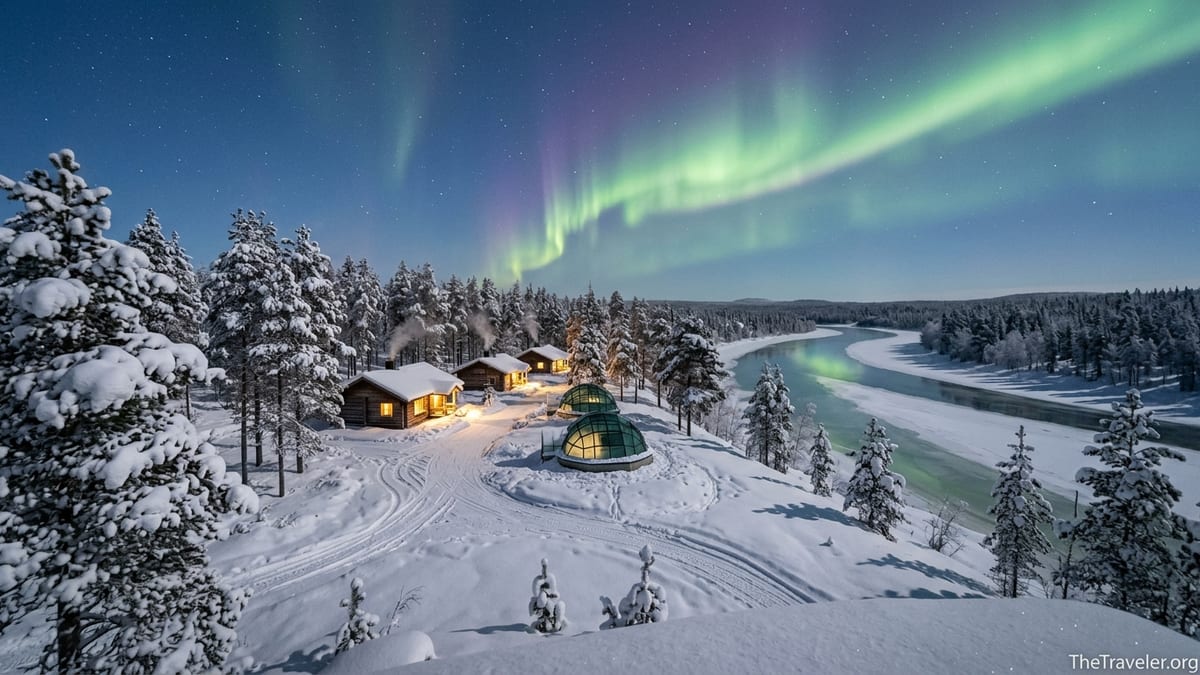
The experience ranges from simple to luxurious, but the magic lies in the same moment: standing under a huge sky when the first pale arc appears, then suddenly strengthens into green ribbons and faint purples that twist and shimmer. At glass igloo resorts such as Kakslauttanen or the Arctic Glass Igloos on Lake Ranuanjärvi, guests often set an “aurora alarm” and watch the show from bed through a heated glass roof, which keeps snow from piling up. Winter half-board rates at these igloo properties often start in the high hundreds of euros per night during peak season, reflecting just how sought-after this experience has become.
More modest northern lights experiences can feel every bit as special. Budget-conscious travelers in Inari or Kilpisjärvi often book a simple cabin or guesthouse for around the cost of a mid-range European city hotel and step outside each clear night to check the sky. Local tour companies might offer a three-hour lights hunt by minibus or snowmobile, sometimes including a campfire stop where coffee is brewed in a soot-blackened pot and cinnamon buns are passed around while everyone stares upward in silence.
What keeps the aurora from feeling like a gimmick here is that for residents, it is simply part of winter life. Locals glance up at the sky when they take out the rubbish or walk the dog. Guides might casually mention that they saw “a good show” on the way home from work the previous night. This everyday familiarity, contrasted with the awe it inspires in first-time visitors, creates a gentle reminder that nature still runs the schedule in Lapland.
Everyday Enchantment: Reindeer, Snow Forests and Real Winter
In Lapland, even daily errands can feel a bit magical. Reindeer, which are semi-domesticated and herded rather than truly wild, wander roadsides and village edges. On a winter morning drive between Rovaniemi and Ranua you can easily find a small herd standing in the middle of the road, unhurried as cars wait for them to drift aside. In Inari, reindeer sometimes stroll through supermarket parking lots, their breath clouding in the air while they nose around for lichen under the ploughed snowbanks.
Organized reindeer experiences are popular, but they often retain a sense of authenticity because they are closely tied to local Sámi herding families. A short reindeer sleigh ride on a commercial farm near Rovaniemi might last 30 minutes and cost roughly what you would pay for an attraction ticket in a European capital, but longer visits farther north can include storytelling, lasso-throwing demonstrations and traditional snacks around a fire in a lavvu tent. The magic comes not from polished theatrics but from the quiet way the animals move through the snow and the matter-of-fact competence of the herders handling them.
The landscape itself amplifies this feeling. In midwinter, daylight can last just a few hours, with the sun barely lifting above the horizon. The result is a continuous blue twilight that settles over snow-buried forests, making tree branches look sculpted and otherworldly. Simple activities such as walking a snowshoe trail around Saariselkä or taking the ski bus up Kaunispää fell for a short sled ride can feel like stepping into the pages of a storybook rather than a modern ski resort.
Real winter brings practical challenges, from icy roads to freezing eyelashes on a windy day at minus 20 degrees Celsius. Yet even this adds to the region’s appeal for travelers seeking contrast from temperate European cities. Locals dress functionally rather than fashionably: insulated overalls, felt-lined boots, balaclavas pulled up to the eyes. Rental shops in Rovaniemi and Levi provide similar gear for visitors, turning people from Dubai, Dublin and Barcelona into an instantly recognizable uniform of Arctic explorers as they shuffle toward husky kennels or snowmobile garages at dusk.
Sámi Culture: A Living Heritage, Not a Costume Show
Lapland’s magic is not only natural but cultural, rooted in the history and present-day life of the Sámi, the Indigenous people of the region. In Finland, Inari serves as a kind of capital for Sámi culture, home to the Sámi Parliament of Finland and the Sámi Museum and Nature Centre Siida on the shore of Lake Inari. Recently renewed and recognized with European museum awards, Siida presents Sámi life through contemporary exhibitions, film and an open-air museum of traditional buildings that show how communities adapted to the harsh environment over centuries.
Visitors who spend time in Inari quickly notice that Sámi culture is not confined to museums or performances. Road signs appear in multiple languages, including Northern Sámi. Reindeer herding co-operatives operate across the landscape, shaping land use and seasonal rhythms. In a small café you may hear Sámi-language radio playing quietly in the background while customers in wool socks and thick sweaters discuss weather patterns that affect spring migration of reindeer.
Many tours marketed across Lapland as “Sámi experiences” actually connect visitors with real families who continue herding traditions alongside modern jobs. In some cases, a guide might pick you up from your hotel in Ivalo or Rovaniemi in a standard minivan, then drive to a modest family property rather than a built-for-tourism complex. There you could sit around a fire in a wooden kota hut, tasting smoked reindeer with flatbread while hearing childhood stories of moving with the herd or attending boarding schools that tried to suppress Indigenous languages.
For travelers, the magic lies in this blend of resilience and openness. It is possible to buy a brightly colored Sámi-style hat in a generic souvenir shop, but it is far more meaningful to learn, in a museum or directly from Sámi hosts, what different patterns and colors can signify and why traditional clothing is worn only in certain contexts. That awareness turns what could be a simple photo opportunity into an encounter with a living culture that continues to evolve.
Storybook Christmas, But Also Quiet Off-Season Moments
Rovaniemi has leaned fully into its reputation as the official hometown of Santa Claus, and in peak December the area around Santa Claus Village on the Arctic Circle can feel like a real-life Christmas film. Families arrive on charter flights for two- or three-night packages that include a visit to Santa’s office, a stop at his Main Post Office, and a handful of winter activities such as short husky rides and tobogganing. Entrance to the village itself is free, so independent travelers can hop on the local bus from Rovaniemi city center and wander between wooden buildings draped in fairy lights without paying ticket fees.
It would be easy to dismiss this as pure commercialism, and indeed the village has its share of tourist-trap elements: paid photo sessions, souvenir shops selling Santa-branded chocolates and keyrings, and queues to meet the man in red that can stretch to an hour on busy weekends. Yet even here, a kind of homemade charm lingers. The buildings are small-scale rather than monumental, the Arctic Circle line is simply painted across the snow, and Santa himself, whatever one thinks of the enterprise, greets each visitor with calm patience that feels almost old-fashioned in its lack of rush.
Beyond the village, the surrounding area offers quieter forms of magic. The Arktikum museum in Rovaniemi tells the story of Arctic research and local history beneath a glass-domed corridor that often collects snow on top, giving visitors the feeling of walking in a tunnel under winter itself. Local ski tracks wind along the frozen Ounasjoki river, where at lunchtime office workers in reflective vests might be seen skiing a quick loop before heading back to their desks.
Outside of the peak Christmas period, many Lapland destinations shift into a slower, more local rhythm that travelers often find even more enchanting. In February or March, when the sun is higher and days are longer, families picnic on frozen lakes, drilling holes for ice fishing and grilling sausages in public fire huts. In April, when spring snow is firm underfoot, it is common to see children napping in prams outdoors while their parents sip coffee on the terrace of a village bakery, wrapped in blankets provided by the café.
Modern Comfort at the Edge of the Map
Part of what makes Lapland feel so special is the way modern comfort coexists with elemental conditions. Many visitors arrive expecting a rugged, back-to-basics experience and are surprised by how refined some accommodations have become. Glass igloo resorts like Kakslauttanen or Ranua’s Arctic Igloos offer underfloor heating, private saunas and multi-course dinners featuring Arctic char and local berries, even when the temperature outside drops frighteningly low. Winter packages that include a couple of nights in an igloo, airport transfers and a handful of activities can easily run into the low thousands of euros, similar to a week in a high-end Mediterranean resort but with a completely different atmosphere.
At the same time, Lapland has not yet turned into an all-inclusive playground in the way some Alpine destinations have. In Levi or Ylläs, you can still rent a simple self-catering apartment, buy groceries from the local supermarket and join evening public swimming sessions at the municipal pool alongside schoolchildren and retirees. Many visitors choose to spend just one night in a luxury igloo for the once-in-a-lifetime photos, then move to a more modest cabin where they can cook pasta and watch the sky from the porch.
The region’s infrastructure underscores this balance between frontier and familiarity. Rovaniemi Airport, recently expanded to cope with growing winter tourism, remains small enough that you can walk from plane to baggage claim in minutes and be on your transfer bus soon afterward. Public buses link Santa attractions, ski resorts and the city center in a simple loop, while long-distance coaches fan out toward smaller villages for those who prefer not to rent a car.
On the ground, small details remind you that you are at the edge of the map. Petrol stations often double as community hubs, selling everything from thermal socks to reindeer meatballs. Café menus feature pulla cardamom buns alongside reindeer stew and salmon soup, and it is normal to leave boots on a rack by the door of certain restaurants or guesthouses, padding around in thick socks as if you were in someone’s home.
Traveling Thoughtfully in a Fragile Arctic
As Lapland’s appeal grows, so does awareness that its magic is fragile. Winters are still cold and snowy, but locals quietly note changes in freeze-thaw patterns and the timing of spring melt. For reindeer herders, more frequent ice crusts on the snow can make it harder for animals to reach the lichen they feed on. For small tour operators who depend on reliable snowmobile trails or frozen rivers, unpredictable weather can mean last-minute route changes or cancellations.
Thoughtful travelers are increasingly seeking out experiences that benefit local communities and minimize environmental impact. In practice this can mean choosing smaller, Sámi-owned companies for reindeer or cultural visits, even if their websites look simpler than large international brands. It can also mean staying longer in one place rather than rushing through multiple resorts in three days, which reduces the number of transfers and gives more opportunity to connect with local rhythms.
Many accommodations have begun to highlight their sustainability efforts, from using renewable electricity to serving local ingredients such as lake fish, mushrooms and berries. Some glass igloo complexes limit the number of units they add each year in order to preserve dark skies and avoid overwhelming village infrastructure. Visitors can contribute by embracing small inconveniences: turning off extra lights to reduce skyglow, renting proper winter clothing instead of buying fast-fashion outfits for a single trip, or choosing slower overland routes for part of the journey when feasible.
Ultimately, the sense that Lapland might not always look and feel exactly as it does today adds a bittersweet edge to its magic. Watching the northern lights shimmer over a silent forest or hearing a Sámi yoik song around a fire, it is hard not to feel both gratitude for the moment and a quiet responsibility to tread lightly.
FAQ
Q1. When is the best time of year to experience Lapland’s magic?
The most classic period is from December to March, when there is deep snow, long nights and good chances to see the northern lights. Late February and March offer a nice balance of daylight, stable cold and winter activities, while early December feels particularly festive around Rovaniemi and Santa-themed attractions.
Q2. Is Lapland only worth visiting in winter?
No. While winter is the most famous season, autumn brings vivid ruska colors and early aurora, and summer offers midnight sun, hiking and canoeing on lakes and fells. Many travelers who first visit in winter return later in another season for quieter hiking, fishing or berry-picking trips.
Q3. How expensive is a trip to Lapland compared with other European destinations?
Lapland is generally more expensive than southern Europe but can be comparable to Nordic capitals. A night in a glass igloo in peak winter can cost several hundred euros, while standard hotel rooms or cabins in villages like Rovaniemi or Levi can be closer to prices in major European cities. Self-catering and using public transport help keep budgets under control.
Q4. Do I need to join a tour, or can I travel independently?
You can absolutely travel independently, especially if you are comfortable driving on winter roads or using long-distance buses. Many visitors base themselves in one or two hubs, such as Rovaniemi, Saariselkä or Inari, and book individual activities like husky safaris or northern lights tours locally. Package trips can be convenient for short family breaks or first-time Arctic visitors.
Q5. How likely am I to see the northern lights?
No operator can guarantee aurora sightings, but spending several nights under dark skies significantly increases your chances. Visiting between roughly September and April, staying at least three or four nights and being willing to stay up late or join a dedicated lights tour will give you a reasonable probability of seeing at least a modest display.
Q6. Is Lapland suitable for young children?
Yes, with some planning. Santa-themed attractions around Rovaniemi are designed for families, and many resorts offer warm overalls and child-sized activities. The main considerations are the cold and short daylight hours in midwinter, so choosing slightly milder months like March and building in time for indoor play and rest makes the experience more enjoyable.
Q7. What kind of clothing do I need for winter in Lapland?
Layering is essential. A typical outfit includes thermal base layers, a warm mid-layer such as fleece or wool, an insulated outer jacket and snow trousers, plus insulated boots, mittens, a hat and a neck gaiter or balaclava. Many activity providers in Lapland supply heavy outer suits and boots, so visitors mainly need good base layers and accessories.
Q8. How can I experience Sámi culture respectfully?
Choose experiences run or guided by Sámi people, such as visits to cultural centers or reindeer herding families that clearly explain their role and traditions. Listen more than you speak, ask permission before taking close-up photos of individuals in traditional dress, and avoid buying imitation Sámi items that misuse cultural patterns or symbols.
Q9. Do I need a car to get around?
A car offers flexibility, especially in smaller villages, but is not essential. Many travelers rely on airport shuttles, local buses and hotel pickups for activities. If you rent a car, make sure it is equipped with proper winter tires and follow local advice on driving in snow and icy conditions.
Q10. Is visiting Lapland environmentally responsible?
Any long-distance trip has an impact, but you can reduce your footprint by staying longer rather than flying for a very short break, supporting local businesses, choosing operators with clear sustainability practices and treating the Arctic environment with care. Small steps, such as avoiding litter, respecting wildlife distances and conserving energy in accommodations, all help protect the magic that makes Lapland special.